


Donald Trump is reportedly considering taking the name of a Black war hero off an aircraft carrier under construction and replacing it with his own, because apparently the presidency, the ballroom, the federal government, the Republican Party and most available merchandise still have not provided enough surfaces upon which to print the man’s name.
Meanwhile, here on the Homefront, the dryer died yesterday afternoon, which feels less like an appliance failure and more like the passing of a minor family elder. That dryer has been passed down through generations. It’s one of those enormous, box-shaped white dryers with two knobs, several dents and a weird squeaky noise that became more noticeable every year. Much of the protective coating that once made it shiny has disappeared, but the dryer remained, faithfully tumbling our clothes through babies, illnesses, renovations and every other mess a family can manufacture.
It was scratched, dented and old enough to remember several presidential administrations, but it was always there for us. I ordered a new one, and this time I ordered it from Lowe’s because I read a comment from a reader about Home Depot supporting Trump, and I would like that reader to know that I took it seriously. However, the new dryer will not arrive until August 31, which means that for the next ten days I will be lugging baskets of wet clothing over to Mom’s house. Luckily for me, Mom may be able to take a day off from her roundup, but she cannot take a day off from her daughter.
In addition to the dryer mayhem, today is dump day. My brother, our resident contractor, will be driving back and forth to the dump while the rest of us make piles for him to load. We filled the trailer yesterday, and I imagine we will fill it approximately five more times before we’re finished.
It is a bittersweet feeling, almost like reverse nesting. In order to make this place more of a home, we must first empty it of a large portion of the memories it has accumulated. I’ll try to save the useful things for someone who might need them, and we’ll preserve the memories that truly matter, but it’s time to make room for new ones.
My oldest is now grounded from scissors, which is a difficult conversation to have with a ten-year-old, especially an ADHD buddy whose brain works so much like mine. I know he probably had every intention of picking those scissors up off the floor. He didn’t consciously decide to create a miniature sword of Damocles for his crawling baby brother. He put them down, his brain moved on and the scissors ceased to exist.
Unfortunately, the floor must remain a safe space for our resident crawler, so I had to do the responsible parent thing and revoke unsupervised scissor privileges. It was emotional, to say the least, but caring for other people often means learning that our intentions don’t erase the consequences of what we leave behind.
My daughter has been doing well over the last couple of days. She is listening to what I have to say and allowing some of it to take hold. Now, don’t misunderstand me, we still begin with a fit because there are procedures to follow and standards to maintain, but reason is eventually being admitted into the building.
She and her baby brother have been watching Cocomelon, singing and dancing along together, and this morning I walked out to discover that she had turned on the television for him, climbed into his crib and begun dancing and clapping beside him. I truly am blessed with wonderful little children.
Then there is Ezra, my dear sweet Ezra, my Mister Boy, my sweet baby pie. He’s amazing. His latest fascination is peekaboo, specifically the version where he hides his own face. He pulls a blanket over his head, attempts with a great deal of vigor to remove it, discovers that he cannot, and cries until he hears my voice. Then he laughs hysterically, apparently delighted that I have once again rescued him from the terrible situation he personally engineered.
He has also taken up clapping, and I am telling you, folks, clapping will be what gets this boy to walk. Most of the time, if he’s standing while holding onto something and needs to use his hands, he simply sits down. Clapping, however, is too important to postpone. He slowly releases whatever is supporting him, remains upright and gives a standing ovation. It’s marvelous.
Then there’s the husband, who spent most of yesterday afternoon helping our resident contractor put new brakes on his truck so he could safely haul the trailer, after spending the morning filling that trailer. He is always there when someone needs him, even when he would unquestionably rather be receiving a deep-tissue massage. We’re all very lucky to have him, although I would appreciate it if nobody repeated that within his hearing. We have an understanding, and I can’t have him becoming too aware of how much I need him.
Things are moving on the Homefront. We have more dirt arriving today, which means my husband will soon be reunited with his best friend, the big orange tractor. The building supplies for our attic renovation will arrive tomorrow, our mini-split will be here soon, and we can finally begin plotting the removal of the natural gas fireplace. Our tomato plants are carrying more tomatoes than I can count, and the cucamelons are happily climbing a trellis lovingly constructed from woodland sticks.
The dryer is broken, but we have family support to help us keep our clothes dry. We have to say goodbye to years of accumulated memories, but we’re building something worth the sacrifice. We had to ground our oldest from scissors, but he’s learning that caring for his younger brother sometimes requires more than good intentions. We have to bring in more dirt, but our whimsical landscape is beginning to emerge from the mess.
We have to sell our souls for school supplies, fight through our frustration to raise happy children and accept that sometimes we might be wrong, but that’s all part of building something, learning something and teaching our children what we value. The administration, on the other hand, appears to have rejected growth in favor of going full-blown toddler.
Mom also took the day off, leaving me alone with Donald Trump, Medicaid, forced labor, economic warfare and more than half a billion dollars in corporate election spending. How dare she. I feel spectacularly unqualified for this, which is at least one qualification the president and I do not share, because I am aware of it.
The future USS Doris Miller was supposed to honor Doris “Dorie” Miller, a Black Navy mess attendant who was serving aboard the USS West Virginia when Pearl Harbor was attacked. Miller helped move his mortally wounded captain to safety, assisted injured sailors and then took control of an anti-aircraft gun he had never been trained to use. He became the first Black American awarded the Navy Cross, although he was denied the Medal of Honor during his lifetime. Miller died at sea in 1943 when the USS Liscome Bay was torpedoed.
The carrier bearing his name was set to become the first aircraft carrier named for a Black American and the first named for an enlisted sailor. It was intended to preserve the memory of a man who fought for a country that restricted where he could serve because of the color of his skin, then died defending that country anyway.
Now, according to reporting from CNN and The Guardian, the Navy is considering removing Miller’s name and replacing it with Trump’s. The decision hasn’t been finalized, and neither the White House nor the Navy has offered a substantive explanation. No American aircraft carrier has ever been named for a sitting president.
Senator Mark Kelly, a retired Navy captain, said the carrier “shouldn’t be renamed at all, let alone for Donald Trump.”
The NAACP was less restrained.
“Doris Miller earned his place in American history through courage, sacrifice, and service,” NAACP President Derrick Johnson said. “Donald Trump only wants to serve himself.”
Here on the Homefront, we’re carrying old belongings out of the house because we need space to build something for our children. Trump appears to be carrying someone else’s memory out of the public square because he needs more space for himself.
That distinction is important and it extends far beyond the name painted on the side of a ship. For nearly three decades, the federal government has interpreted the Americans with Disabilities Act and the Supreme Court’s 1999 Olmstead decision to mean that people with disabilities shouldn’t be forced into institutions when they can safely receive services in their homes and communities. The Trump Justice Department is now backing away from that position.
A legal opinion issued by the department argues that states aren’t necessarily required to provide the services that allow disabled people to remain in their homes. The Olmstead ruling hasn’t been overturned, and the ADA remains law, but the federal government is signaling that it may no longer investigate or challenge states that reduce home and community-based care.
The timing could hardly be worse. States are already preparing for massive reductions in federal Medicaid funding, and many of the services that allow disabled Americans to live independently are delivered through Medicaid. Without federal enforcement, disabled people and their families may be left to challenge service reductions themselves, state by state and lawsuit by lawsuit. The right technically remains, but the institution responsible for helping enforce it is backing away. There’s a particular kind of cruelty in telling someone that they possess a right while systematically removing every practical means of exercising it.
Children’s hospitals are preparing for their own version of that lesson. Hospitals have already spent the last year calculating the damage from roughly $1 trillion in Medicaid reductions contained in Trump’s “One Big Beautiful Bill.” Now the Centers for Medicare and Medicaid Services has proposed additional restrictions on state-directed payments, a major source of funding used to narrow the gap between what Medicaid reimburses and what specialized care actually costs. The Children’s Hospital Association of Texas estimates that the proposed changes could cost children’s hospitals in that state as much as $2.5 billion every year once fully implemented.
More than half of the patients treated by children’s hospitals are covered by Medicaid. Many require the kind of highly specialized care that can’t be delivered at an ordinary clinic or replaced by telling their parents to shop around. The administration can find a reported $20 billion for an aircraft carrier that may bear Trump’s name, but when a hospital needs enough money to care for a medically complex child, everyone suddenly becomes an enthusiastic student of fiscal restraint. This isn’t an absence of government power; it’s a decision about whom that power exists to serve.
The people financing the 2026 midterms are working very hard to influence that decision. According to Reuters, corporations have already spent a record $517 million on House and Senate races during this election cycle, surpassing the $461 million they spent during the entirety of the 2024 cycle. The election is still more than two months away.
Crypto companies, artificial intelligence interests and online gambling businesses account for at least $294 million of that spending. These are industries facing enormous regulatory questions, and rather than waiting for the public to decide how they should be governed, their executives have chosen the far more efficient option of helping decide who will govern them. Public Citizen called the crypto industry’s political apparatus a corporate “Death Star” capable of annihilating individual candidates. Apparently, representative democracy is now available as an in-app purchase.
There are limits to what money can purchase, however, and California voters demonstrated one of them this week. Progressive state senator Aisha Wahab won the special election for the House seat formerly held by Eric Swalwell, defeating Melissa Hernandez despite nearly $6.4 million in spending from groups connected to the American Israel Public Affairs Committee supporting Hernandez or attacking Wahab.
Wahab will become the first Afghan American to serve in Congress. She spent part of her childhood in foster care after losing both of her parents and became the first Afghan American woman elected to public office in the United States before winning this race. The special interests narrowed her lead, flooded the district with negative advertising and made the race far more competitive, but they didn’t win it.
Wahab and Hernandez will face each other again in November for a full term, which means the money will almost certainly return with reinforcements. Still, for one election, voters were offered millions of dollars in instructions and declined to follow them. That’s worth remembering.
Unfortunately, political access appears to have produced better results for Central Romana, a massive sugar producer in the Dominican Republic. Customs and Border Protection banned imports from the company in 2022 after finding evidence that workers were being isolated, underpaid and subjected to abusive living and working conditions. Many of the workers cutting sugarcane are Haitian migrants or people of Haitian descent who face poverty, discrimination and precarious legal status. The Trump administration lifted that ban last year.
A new report from the Corporate Accountability Lab says forced labor persists on Central Romana’s plantations. The company has denied wrongdoing, but Oregon Senator Ron Wyden is demanding records from Customs and Border Protection about why the ban was reversed.
“Circumventing standard trade enforcement processes for politically connected, billionaire-owned corporations undermines the integrity of U.S. trade policy,” Wyden wrote.
The company’s owner, José Fanjul, is a Trump ally who donated to Trump’s 2024 campaign and contributed to his White House ballroom project. Apparently, there is room in the American marketplace for sugar produced under alleged forced-labor conditions, but not enough room on an aircraft carrier for the name of the Black sailor who fought at Pearl Harbor.
Abroad, the administration is preparing another demonstration of its selective enthusiasm for federal power. As the war with Iran approaches the six-month mark, Trump is promising what he calls an “economic D-Day.” Treasury Secretary Scott Bessent says the United States will attempt the greatest coordinated economic isolation campaign in history, targeting Iran and threatening other countries with punishment if they continue trading with it.
“We are going to them and saying, ‘You are either with us or against us,’” Bessent said.
Iran has already endured nearly five decades of American sanctions. The administration has offered few details explaining why another unprecedented escalation will produce the surrender that previous rounds of economic punishment did not.
Officials are presenting economic warfare as an alternative to returning to direct combat, as though collapsing a country’s economy is an antiseptic process conducted entirely on spreadsheets. Economies are made of people. When medicine becomes scarce, food becomes unaffordable or electricity fails, presidents and generals are rarely the first people to suffer.
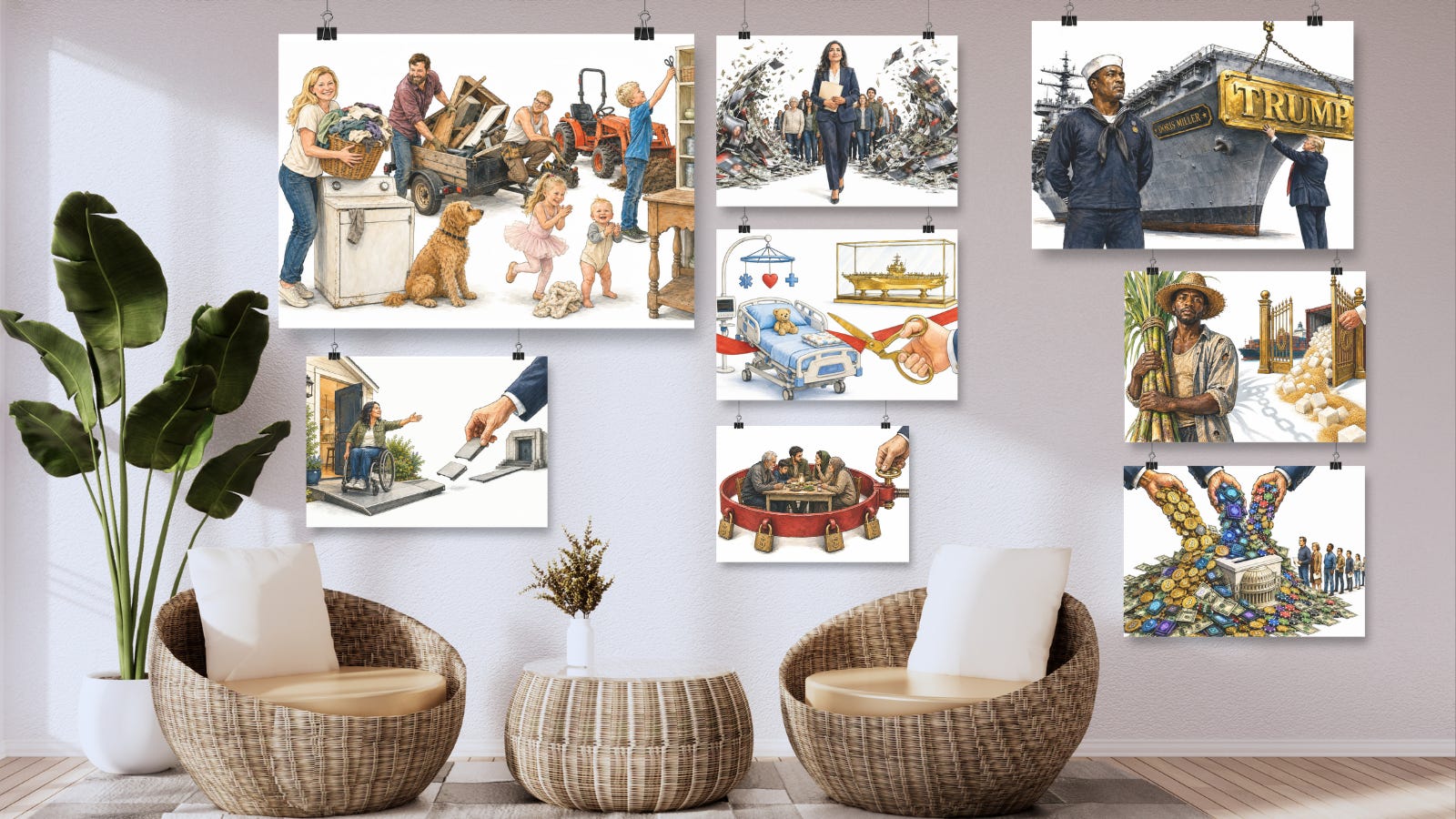
This is the pattern running through today’s news. The administration has power when it wants to threaten foreign governments, override ordinary procedures, protect a politically connected corporation, abandon disabled Americans, squeeze children’s hospitals or erase a war hero’s name. It becomes strangely powerless only when someone vulnerable needs help.
Here on the Homefront, our dryer broke, and the family moved around the problem. Mom has a working dryer, my brother has a truck, my husband can repair the brakes, and everyone contributes what they have so the whole family can keep moving. That is what support is supposed to do. It prevents one broken machine, one illness or one moment of human forgetfulness from becoming a catastrophe. Government is that principle at scale.
We’re emptying our home because we want to make room for the people who live here and the memories they have yet to create. The administration is emptying public institutions to make room for one man’s name, wealthy interests and the exercise of power for its own sake.
We are both building something. The difference is that one of those things is intended to hold people, and the other is being designed to make them smaller.
I remember the exact moment my baby brother decided to walk. Grandma had given 2 cookies to each of the youngest cousins. The 3 girls, all about 6 months older, took one in each hand and walked back to the cartoons on tv. Pete couldn't crawl back with the cookies in hand. He looked back and forth a few times and stubbornly toddled off after them 😀
"The future USS Doris Miller was supposed to honor Doris “Dorie” Miller, a Black Navy mess attendant who was serving aboard the USS West Virginia when Pearl Harbor was attacked. Miller helped move his mortally wounded captain to safety, assisted injured sailors and then took control of an anti-aircraft gun he had never been trained to use."
So obviously a "DEI" move. Why not name that ship after someone who never served anything, never sacrificed anything, and never appreciated those who did...