


The Pentagon has fired the people running Stars and Stripes because they insisted that the military’s newspaper must remain a newspaper, which is apparently an act of insubordination now.
Editor-in-chief Erik Slavin says he was fired for stating that hypothetical censorship of the news provided to American service members would cross a personal red line. Middle East reporter Lara Korte says she was fired after explaining that she works for Stars and Stripes, not the Pentagon. Longtime publisher Max Lederer was removed too, and the most revealing part is that the Pentagon didn’t respond to their concerns about political interference by reassuring them that the newspaper’s editorial independence would be protected. It responded by firing them.
Before we dig any deeper into today’s trash heap, I have survived the emotionally tormenting task of school supply and clothes shopping, which consists largely of staring at two boxes of crayons and wondering whether buying the smaller one will permanently mark your daughter as the unfortunate child whose parents don’t believe in Burnt Sienna. If I get her the smaller box, will every other child have the bigger box? Will they all be sitting around with their sophisticated collection of sixty-four colors while my daughter is expected to create an entire artistic legacy using nothing but red, blue, yellow, and the knowledge that her mother failed her?
Then there are the clothes, because it is absolute robbery that anyone can charge fifty dollars for a pair of pants that will fit a child for approximately three months before being abandoned in a tote marked “too small” alongside six hundred dollars’ worth of other clothing that briefly passed through our lives. My eleven-month-old baby is wearing eighteen-month clothes, which means not only that he is my big boy, but that all of his clothes need to be replaced too, and charging twenty dollars for a onesie that will fit him for about twenty minutes feels like a personal attack.
Whoever is taking home the profits from children’s clothing just bought an island and eight vacation homes, while the rest of us are examining a tiny pair of pants and wondering whether the adjustable waistband will buy us another eleven days.
Home Depot delivered part of our order this morning, then informed me that its system is broken and it can’t deliver the most important pieces until Wednesday, which is well behind schedule and entirely in line with a company whose billionaire co-founder was one of Trump’s most enthusiastic financial supporters. Make promises you can’t keep, ruin someone else’s plans, then explain that the system is simply too broken for anyone to be held responsible. Lowe’s will be my go-to from now on.
On a more positive note, my husband and I got some time alone together last night. To be fair, we spent that time going through totes of stuff from the shop, but it was time together nonetheless, and we genuinely enjoy doing those kinds of things with each other. Romance comes in many forms, and sometimes it looks less like candlelight and more like sitting on the floor together asking whether a mysterious metal object belongs to us or appeared spontaneously in storage.
Our oldest and our daughter, meanwhile, are engaged in a constant war. I am fairly certain she is manipulating him into irritating her so she can get him in trouble and then revel in the sweet glow of victory. It is moderately evil, but I can’t help being impressed by her intelligence. He tries, and I can’t blame him for becoming frustrated because Lord knows I become frustrated too, but as long as he keeps trying, we will keep helping. Somewhere beneath the yelling, the scheming, and the dramatic allegations of crimes against humanity, they’re learning how to live with another person.
Ezra, my sweet baby pie, my mister boy, may be the happiest baby who has ever lived. He smiles, laughs, and seems genuinely delighted simply to be included in the world. Perhaps I should take a lesson from his book sometimes, because the more we allow ourselves to smile, the more we begin to believe we are happy, until eventually happiness becomes easier.
Yesterday he came outside and sat in his pack and play, lovingly referred to by his sister as the “play pack,” and don’t you dare correct her on that point; meanwhile, the kids kicked around a soccer ball and his father and I watered the plants. We recently planted a dawn redwood in the fairy garden, along with hydrangeas and native huckleberries. It takes two hundred feet of hose to reach them, but it is worth every inch to watch those plants begin bringing our garden to life.
We played music while we watered, and Ezra bounced up and down with delight, thrilled to participate in the family even if his participation consisted entirely of dancing in a mesh enclosure while everyone else carried hoses and chased soccer balls. Sometimes I envy his ability to find so much happiness in the world around him. He can laugh at the silliest things, smile for almost nothing, and remind me how much good there really is around us.
When my grandfather died in February of 2024, it felt like losing one of the staples holding our family together. He was grouchy, well-read, snarky, and sarcastic in all the best ways. He lived with Mom toward the end of his life, and during those final weeks she would call me three or four times a night to come help lift him back into bed after he had stubbornly decided that he could walk himself to the bathroom.
I would settle him back into bed and sit with him for a few minutes, and eventually I began to suspect that he might have been doing it on purpose so I would come spend some time with him. Life had become so busy with work and children, and my husband and I were struggling so much financially that stress occupied nearly every available space. We forget to stop and sit with the people we may not have forever because we’re too busy trying to survive the day we’re already in.
When Mom called at seven in the morning to tell me she believed he had passed, I raced over there and found him. As I sat beside him, I felt as though he had given me something in his passing, a sudden and inexplicable gift of clarity. For just a moment, it felt as though I could see the future, and although it made absolutely no sense considering everything my husband and I were facing, I felt certain that, somehow, another child was going to save us.
My husband and I pondered this strange feeling, eventually decided it was crazy, and put it to rest. Then, nearly a year later, we discovered that I was pregnant by accident and against all odds. I was taking birth control, so it shouldn’t have happened, and it took us months to find the right name, but eventually Ezra, meaning “helper,” was the one that stayed.
Then he really did save us. If it weren’t for Ezra, I wouldn’t have come to work with Mom. We wouldn’t have started the GoFundMe that saved our house. I might never have discovered that I have a talent for words, and this entire life we’re building may never have unfolded in the way it has. Every so often I find myself looking toward my Grumpy Grandpa and winking. I am not sure how he knew, but he gave me a very important message.
This long-winded explanation has a purpose, I promise, because it serves as a reminder of why we keep fighting, why we stand up to authoritarian regimes, and why we continue telling the truth no matter the risk. Out in this world are beautiful people carrying gifts we don’t yet realize we need. Sometimes those gifts may initially resemble the exact opposite of what we need, but they bring light into the world and create happiness, health, and safety for people they may never even meet. It can be easy to forget in all the chaos that life isn’t a race toward the finish line, the largest bank account, or the grandest mansion. It’s an experiment rooted in love.
I’m reminded of that every morning when I see Ezra’s sweet smile. He and I have developed a silly little routine, and sometimes when I hear him yelling my name from his crib, I don’t want to get out of bed. Sometimes I think, just five more minutes, but the moment I see his little face peeking over the edge of his crib, I’m thankful that I got to wake up for another day.
There are always two sides to a coin. We can choose to see the side shaded from the light, the one encompassing pain and suffering, because every ordinary human thing contains both, or we can turn it over and see the side that’s illuminated, containing all the love, progress, intellect, peace, and care we’re shown every day.
I can be furious that Home Depot delayed the most important parts of my order, or I can decide that it gives us a few more days to cherish the memories we are making instead of rushing through them. I can be upset that I must spend an arm and a leg on school clothes, or I can appreciate that I have reached a point in my life when buying them doesn’t require choosing between pants and rent. I can be frustrated that my children won’t get along, or I can laugh at the devious little plans forming inside their tiny brains and recognize that all of it is part of human growth.
As I read today’s news, I’m angry that the people in power can look at this world and see nothing more than dollar signs, political leverage, or another campaign donation. I’m angry that they can’t see what I can see inside this ordinary American household, but I will brush off that anger, stand up, and continue fighting for what’s right, and today that begins with telling all of you about the latest trash heap. Mom is still “resting” from the roundup, and by resting I mean working on all the other pieces she has not been able to reach while producing this thing every morning. She deserves the time, so here I am, underqualified but informed nonetheless. Don’t be scared, we can do this together.
Back at Stars and Stripes, those firings matter because the publication has served American military members for generations while retaining a tradition of editorial independence from the department that helps fund it. Journalism can’t serve its readers if its first obligation is obedience to the people it covers.
When describing censorship as unacceptable becomes insubordination, the problem isn’t the journalist’s choice of words. The people serving in the American military deserve truthful information about the institution commanding them, particularly when that institution is sending them into danger. They don’t need a Pentagon newsletter dressed in a journalist’s clothing, nor do they need reporting filtered through political officials who have decided that factual scrutiny is bad for morale.
While the Pentagon was busy deciding that editorial independence is a fireable offense, the United States Postal Service published a ninety-five-page rule under which it could refuse to deliver mailed ballots from states that don’t comply with new federal demands.
The rule is presently blocked by federal courts, but USPS published it so it could be implemented immediately if those injunctions are lifted. It would require states to provide the Postal Service with the names of voters receiving mailed ballots and the barcodes attached to their envelopes. A state that refused to comply could find that its citizens’ ballots were simply not delivered.
Here in Oregon, where voting by mail is the ordinary machinery of democracy rather than some exotic liberal experiment, the stakes could hardly be clearer. The administration is trying to place a federal checkpoint between voters and their ballots, then hand control of that checkpoint to an institution whose purpose is to deliver the mail. The Postal Service doesn’t get to become the bouncer standing outside democracy with a clipboard.
Trump’s fifty percent tariffs on approximately $20 billion in Canadian goods also took effect this morning after negotiations between the two countries collapsed. Canada has promised dollar-for-dollar retaliation beginning September 8, and the products caught in the dispute reportedly range from hockey sticks to tongue depressors, because apparently even opening your mouth at the doctor now requires participating in a trade war.
Tariffs are always presented as punishment inflicted upon another country, but the border doesn’t reach into Ottawa and remove money from Canada’s bank account. American importers pay the tariffs, and those costs have an inconvenient habit of traveling through supply chains until they land in household budgets.
The administration is escalating a conflict with one of our closest allies while Americans are already paying too much for groceries, healthcare, appliances, building materials, and the tiny pants our children will outgrow before the receipt fades. The people directing this policy can speak in abstractions about economic leverage because they won’t be the ones standing in a store trying to determine which necessity must wait until next month. Mom is working on a piece that will go into much more detail, so stay tuned.
Healthcare policy is also being pulled into the administration’s broader experiment in replacing expertise with ideology. The Department of Health and Human Services has opened a public consultation on whether the federal government should change the categories used in vaccine recommendations.
Federal recommendations currently fall into three main groups: routine vaccines recommended for everyone in an age group, vaccines recommended for people with particular risk factors, and vaccines left to individual clinical decision-making between patients and their providers. HHS is now asking whether those categories should be altered and how considerations such as personal autonomy and religious freedom should influence the process.
No recommendations have changed yet, and public comment isn’t inherently suspicious, but public-health experts are concerned that this process is being driven through Robert F. Kennedy Jr.’s HHS rather than originating with the CDC and its established vaccine advisory system. The department is accepting comments until September 20, leaving one month to consider changes that could influence clinical practice, insurance coverage, public-health programs, and whether patients understand a vaccine as the default recommendation or merely one possible option. A vaccine category sounds like administrative language until a parent is sitting in a pediatrician’s office trying to determine whether the government still recommends protecting their child from a preventable disease.
Meanwhile, a new survey of 1,000 physicians commissioned by the Physicians Advocacy Institute found that nearly half of doctors employed by corporate entities feel pressure to prioritize patient volume over the quality of care. Sixty-three percent said employer policies make it difficult to refer patients outside their corporate networks, while 59 percent reported pressure to keep patients inside the health system that employs them.
More than 80 percent of American physicians are now employed by hospitals, insurers, private-equity-backed companies, or other corporate entities, according to research from the same advocacy group. That doesn’t mean every hospital or corporate practice mistreats its patients, but it does mean the person examining you may be trying to exercise medical judgment inside a system measuring productivity, referrals, revenue, and network retention.
Patients are told to advocate for themselves, doctors are told to see more patients in less time, and corporations are permitted to stand between them counting the money. The system isn’t failing because nobody understands what patients need. It’s failing because the people who understand are increasingly denied the power to provide it.
Across Europe, wildfires intensified by hotter, drier conditions are now exposing and sometimes detonating unexploded bombs, shells, and mines left behind by the First and Second World Wars. Fire crews entering areas burned bare by the flames are discovering munitions that have been buried beneath forests and fields for more than eighty years, while extreme heat can cause some of them to explode before anyone reaches them. We’ve heated the planet so profoundly that the ground has begun returning old wars to us.
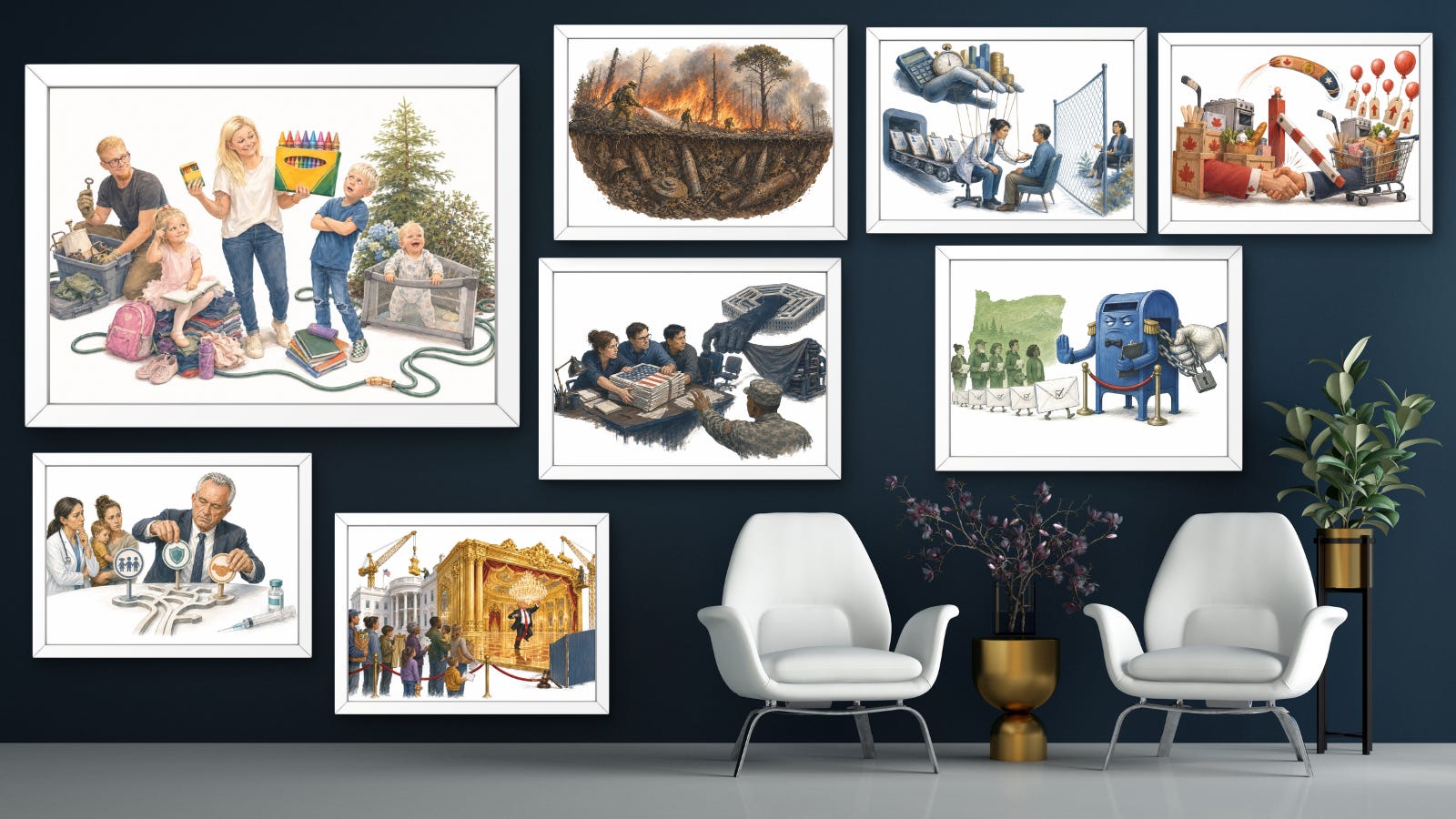
A separate study found that wildfires could burn 39 percent more of Europe by the end of the century even under the most optimistic warming scenario. Under a high-emissions scenario, the area burned could nearly triple. More than 600,000 hectares have already burned across the European Union this year, placing 2026 on track to become its third-worst fire season on record.
Better land and fire management could substantially reduce the damage, but researchers warn that firefighting can’t replace climate mitigation. We can’t continue creating hotter, drier, more combustible conditions and then act surprised when there aren’t enough hoses, aircraft, or human beings to contain what follows.
Of course, while journalists are being fired, ballots are being threatened, doctors are being managed for profit, and the earth is coughing up unexploded artillery, construction may continue on Trump’s $400 million White House ballroom.
Chief Justice John Roberts temporarily paused a lower-court order that would have halted aboveground construction while the legal dispute continues. The project will add roughly 90,000 square feet to the White House grounds, and the administration has argued that stopping construction would create national-security concerns. Apparently, American national security now requires an enormous dance floor.
The recurring story today isn’t simply that Donald Trump is building a ballroom while ordinary people struggle to buy pants for their children. It’s that the people entrusted with public institutions increasingly see those institutions as possessions. The Pentagon’s newspaper belongs to the Pentagon, the Postal Service belongs to the president, doctors belong to corporations, scientific recommendations belong to political appointees, and the White House belongs to whichever temporary occupant can pour concrete quickly enough.
But none of those things belong to them. They belong to the military members who deserve the truth, the voters whose ballots must be delivered, the patients who need care, the parents trying to protect their children, and the generations who will inherit whatever climate we leave behind.
We don’t fight because the world is irredeemably ugly. We fight because it remains beautiful enough to defend. We fight for the grouchy grandfathers who find ways to leave us one final gift, for children whose tiny brains are already learning to negotiate the world, for plants stretching their roots into a new garden, and for babies who bounce to music because being alive and included is still reason enough to feel joy.
Life isn’t a race toward the largest bank account, the grandest mansion, or the biggest ballroom. It’s an experiment rooted in love, and our responsibility is to keep it from being purchased, silenced, or burned.
Thank You for sharing a realistic mix of joyful and frustrating family life and both ridiculous and horrifying national and international concerns - supremely readable as always, even for one with very little time for reading! Makes me want to write… but I must find time to paint.
Dawn Redwood! They used to cover most of the Northern hemisphere. Botanists thought the were extinct. Then a researcher found them growing in a canyon in China. The tribal villagers said, of course it grows here. We worship this sacred tree.
Give it my love.
Ernie