

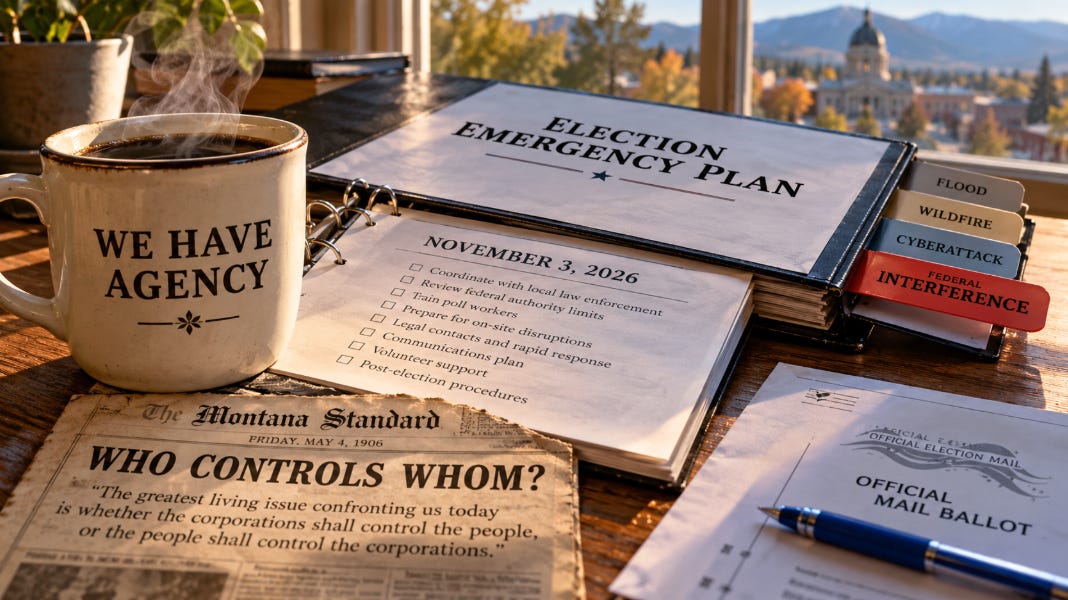
Good morning! Every election office in America keeps a disaster plan. Floods, wildfires, ransomware, a power grid that picks the worst possible Tuesday to fail: officials drill for all of it. This year, according to reporting in the New York Times, the binder has a new chapter. It’s the federal government.
Poll workers are learning what to do if immigration agents show up at a voting site. Law enforcement trainings in Maine now include the text of the federal statute that bars armed federal agents from polling places. In Michigan, clerks are reviewing the limits on Justice Department monitors, who may observe the proceedings but cannot question voters, handle ballots, or interfere with the election. One network that advises election officials offers guidance on what to do when federal agents arrive with a search warrant. Its first step is to stay calm.
“It seems like the federal government is now adversarial to the states,” Maine Secretary of State Shenna Bellows told the Times.
The worry isn’t confined to Democrats. Utah’s Republican lieutenant governor, Deidre Henderson, said her state is planning for federal interference even though she doesn’t necessarily expect it. Minnesota’s secretary of state compared the work to shadowboxing against a blow that may or may not land.
None of this is a prediction. Election officials aren’t forecasting troops at the polls or agents hauling off voting machines. They’re doing what competent public servants do: consulting lawyers, coordinating with local police, training volunteers, and mapping exactly where federal authority ends. Courts have blocked several of the administration’s attempts to reshape election procedures. Others remain unresolved.
Still, it says something about this moment that the people who run our elections now treat their own national government as a hazard to be managed, somewhere between a flood and a hacker.
Some of what they’re bracing for has already happened.
In Alaska, the Justice Department is asking a federal court to block certification of the Senate race if Republican Dan Sullivan narrowly loses. We’ve reported on the dispute over a second candidate with the same surname, whom Alaska’s Supreme Court ruled could remain on the ballot. What’s worth remembering is that Trump acknowledged personally directing the lawsuit: “I’m one that said, ‘Do it.’”
Closer to home, the Justice Department asked Washington on Monday to set aside the mail ballots of more than 400 registrants it believes are noncitizens, and gave the state 24 hours to review the list. It’s the same playbook the department has run in California. There, Los Angeles County officials said the federal list appeared to come from old voter rolls and included many apparent citizens. In Nevada, an investigation of a similar list turned up no noncitizen voters at all. Washington’s secretary of state says he’ll respond only to requests that follow due process.
Then there’s the bounty. On Monday, Trump offered $1 million to anyone who reports voter fraud leading to an arrest and conviction, in past elections or this one. The White House hasn’t said where the money comes from, how to submit a tip, or who decides who gets paid. A week earlier, announcing a separate fraud-tip program, Trump said he’d personally pick the winners. For scale, the Heritage Foundation’s own tracker has logged about 1,600 voter fraud cases over 40 years.
Brazil completes the picture. Without offering evidence, Trump called its election corrupt while insisting he hadn’t taken sides. The Washington Post reports that Bolsonaro then effectively conceded once Trump signaled he wouldn’t help.
Taken together, this shows something simpler than a coordinated scheme: a federal government reaching into the machinery of elections while the president questions any outcome he doesn’t like. Checking eligibility and prosecuting genuine fraud is legitimate work, and states do it every day. But demanding that ballots be sequestered on the strength of lists that have already produced false alarms, or asking a court to prevent certification of a possible election outcome, is something else entirely.
Against that backdrop, Trump spent Monday campaigning in Mississippi, describing a very different America.
In Corinth, Trump spoke for 83 minutes. Most of it was reruns. Two moments stood out. One was a remarkable feat of campaign arithmetic. The other was an unusually candid assessment of diplomacy.
The first was Audi. Two days after announcing plans for the company’s first American factory at his Georgia rally, Trump told the Mississippi crowd that Audi would begin construction next month on a $40 billion plant. On Saturday in Georgia, he’d put the figure at $4.2 billion. Audi itself says around $4 billion. That’s a tenfold raise in 48 hours, and Audi didn’t have to lift a finger.
The calendar fares no better than the arithmetic. Audi says construction is scheduled for 2027, with cars rolling off the line in the early 2030s. The project isn’t even final. It still needs approval from the supervisory board of parent company Volkswagen, which includes German labor representatives who are less than thrilled. Their union chief, the board’s deputy chair, accused Audi’s CEO of violating the company’s political-neutrality rules by appearing at Trump’s campaign event. Management reportedly approved an exception, but German workers are still demanding assurances about their own jobs. The tariffs Trump credits with bringing Audi to America cost the company approximately €1.2 billion last year.
In Trump’s telling, the factory is all but built. In Wolfsburg, it’s an agenda item.
The second moment was darker. Discussing the war with Iran, Trump dismissed the April ceasefire as “just a waste of time as far as I’m concerned.” He said he went along with it because “you like to listen to professionals.” That ceasefire was his own. He announced it in April, extended it indefinitely later that month, and signed a memorandum formalizing it in June.
He said this on the same day Saudi, Pakistani and Turkish officials were in Tehran trying to prevent another escalation, and amid reports that the U.S. and Israel have prepared plans for possible renewed strikes after the midterms. Trump has not authorized those strikes. In the same speech, he promised the war would soon be over and oil prices would come down. Brent crude closed Monday at $115.81 a barrel.
A president who describes his own ceasefire as a waste of time eight days before an election is telling voters something worth hearing. Particularly when the military is preparing for what may come afterward.
The bishops thought they were coming to talk policy. According to Milwaukee Archbishop Jeffrey Grob, the meeting was billed as a private conversation with White House staff about immigration and visas for religious workers. Afterward, the clerics were led into the Oval Office, greeted by the president and directed to stand behind him and pray. They knew photographs were being taken, but hadn’t consented to their public release. They didn’t know they were being filmed. The video went out 12 days before the election.
Several bishops have since publicly objected to the way their participation was presented. Grob made clear he wasn’t repudiating prayer or dialogue, only the political meaning stamped onto it afterward. “The meeting was in no way an endorsement,” he said. Des Moines Bishop William Joensen went further, invoking Jesus’s instruction in Matthew 10:16 to be shrewd as serpents and innocent as doves. He wished he’d been more shrewd, like those who exploited the meeting for partisan purposes. It’s about as sharp as a bishop’s apology gets.
If the bishops had their presence borrowed, Amy Acton had her childhood conscripted.
Vivek Ramaswamy, the Republican running against her for Ohio governor, put $4 million behind an advertisement featuring her estranged mother calling her a liar about her past. Acton hasn’t spoken to her mother since 1978, when her stepfather was charged with raping her at age twelve and her mother lost custody of the children. He fled before trial, and her mother remained married to him. Court records and contemporaneous accounts corroborate significant portions of Acton’s history of abuse, neglect and periods of homelessness, including living in a tent during winter. One Ohio television station’s fact-check rated the advertisement false.
Ramaswamy says the ad is about honesty and Acton’s refusal to debate. Acton says her mother isn’t well, and that the campaign bears responsibility for putting her on camera to attack her own daughter. Trump called the ad “pay dirt.” Vice President Vance said he was disgusted by Republicans “whining” about it. But the whiners included Ohio’s Republican governor, Mike DeWine, who called for the ad to be taken down, while Senator Jon Husted distanced himself from it.
The bishops rejected the suggestion that their prayers constituted an endorsement. Governor DeWine condemned the advertisement, and Acton’s brother, Phil Stearns, publicly defended her account. None could undo what had been broadcast, but none let the political framing go unanswered.
Citizens can, however, do more than object after power has been exercised. They can organize to change the rules governing it.
In 1906, a Montana newspaper put the question plainly.
Speaking out challenges abuses of power and reminds us that participation is not the same as consent. But citizens aren’t limited to objecting after something has happened. They can organize to change the rules governing power itself.
In Montana, that’s precisely what they’re attempting.
Condemnation may impose a reputational cost. It doesn’t necessarily change the rules.
In 1906, a Montana newspaper put the question plainly: “The greatest living issue confronting us today is whether the corporations shall control the people, or the people shall control the corporations.”
Montanans had good reason to ask. The Copper Kings and their timber and mining allies owned newspapers, bribed legislators and controlled a good share of the state’s public life. But in 1906, voters approved a constitutional amendment giving citizens the power to propose and enact laws directly through ballot initiatives. Six years later, the Montana People’s Power League used that authority to pass the Corrupt Practices Act, barring corporations from spending money to influence elections. The people hadn’t simply asked their legislators to confront the Copper Kings. They had acquired a new democratic tool and used it themselves.
Then came Citizens United in 2010, and two years later the Supreme Court struck down Montana’s law. According to figures cited by the Montana Plan’s organizers and reported by Reuters, independent political spending in the state went from $33,000 in 2008 to $162 million in 2024. The latter was an extraordinarily competitive Senate election, and the figures aren’t a direct measure of corporate spending alone. But the transformation in the scale of political money is unmistakable. That isn’t inflation. It’s an entirely different political universe.
This November, Montanans get another say. Initiative 194, the Montana Plan, doesn’t try to overturn Citizens United directly. It proposes a way around it. The Supreme Court recognized a corporation’s constitutional right to make independent political expenditures, but corporations derive their legal powers from the states that charter them: the power to own property, sign contracts, sue and be sued. The Montana Plan would remove political spending from the powers granted to corporations and other legally created entities. Its supporters argue that states can define those powers without violating the First Amendment. Whether the courts will accept that distinction remains an open question.
Business groups challenged the initiative before it reached voters, but the Montana Supreme Court concluded that determining its constitutionality before enactment would be premature. The proposal remains on the ballot. Its backers include former Democratic Senator Jon Tester and former Republican Governor Marc Racicot, which in today’s politics counts as a small miracle.
Hawaii has already taken the legislative route. Its lawmakers passed Act 11 nearly unanimously, restricting political spending powers granted to corporations and other legally created entities. The law is scheduled to take effect in July 2027 unless a court blocks it. The U.S. Chamber of Commerce has sued, with a hearing scheduled for November 19.
The legal fight is real, and pretending otherwise would be a disservice. Critics, including the national ACLU, argue these laws could silence nonprofits and civic groups along with corporations. Some campaign-finance lawyers expect the courts to view the approach as a speech ban dressed up as a change to corporate law. The strategy may not survive constitutional scrutiny. And even if it does, wealthy individuals would remain free to spend enormous sums influencing elections.
But look at what these citizens are doing. They aren’t asking billionaires to behave. They’re going back to the source of corporate power and asking who granted it and on what terms. That’s the heart of community rights and self-government. Once, corporate charters were granted by kings. In a democracy, corporate powers are granted by laws enacted in the name of the people. And those laws are not beyond our authority to reconsider.
Which brings us back to the election officials we started with. Theirs is the work of preserving a democratic process under pressure. The organizers in Montana and Hawaii are working to change what that process allows. Different jobs, same underlying principle: public authority comes from the people, and the people have a voice in defining how it is exercised.
And this movement isn’t confined to Montana and Hawaii. Honest Elections Oregon has filed a similar proposed constitutional amendment for the 2028 ballot, bringing the same challenge to corporate political power into our own state.
Changing the rules is long work. It starts with using the rights we already have. Here in Oregon, today is the last recommended day to mail your ballot. After that, the safest option is an official ballot drop box, open until 8 p.m. on November 3. Mailed ballots can still count if postmarked by Election Day and received within seven days, but there’s no reason to gamble on the postal service when a drop box is available.
Power was never as fixed as the powerful want us to believe. Montanans demonstrated that in 1912. More than a century later, they’ve put the question back on the ballot, and citizens in Hawaii and Oregon are pursuing their own approaches. The outcomes remain uncertain, but the work itself is already underway.
Self-government means considerably more than choosing who gets to govern us.
A personal note before I go: These morning columns have been taking me longer and longer to write, and I owe you an honest explanation. I’ve developed such an aversion to Trump’s voice that even at double speed, my stomach twitches in revulsion. I listen so you don’t have to, but I’ll admit the job is wearing thin.
We have a few more days to get through, and we need to come out the other side with our sanity intact. I confess that’s getting harder each day. Here’s my plan, and you’re welcome to borrow it: do the work, cast the ballot, then step outside for a while. The rally clips will still be there when you get back. Unfortunately.
The last suggestion is a good one, basically CAST.YOUR.VOTE. and…blue is the hue stopping this Coup.
Unending gratitude for keeping the record truth filled, having to listen to him , many of you waded through well.
I’ll not sit back ever, but resting is good. That Democracy requires constant vigilance is the same as safety first , there is always someone trying to pull wool..😉 A hacker, a foreign spy, a shady fast-talking con…knowledge ,education, truth is at our finger tips… verify, check twice, if it sounds too good..acknowledge, it may be another lie.
From the get-go this lesson was lipstick on a pig..many bought it anyway…gave it the power..and it cost ALL of us plenty.
There are times when I have had to overcome the impulse to stop his voice and image from searing into my very soul. Breaking my tv screen would be counterproductive so I fought that impulse. We are all looking forward to the day when he’s gone.