


The federal government has apparently identified the central problem facing the United States: too many people are still keeping notes.
There are journalists writing down what officials say and comparing it with what they do. There are election administrators maintaining voter rolls, testing machines and stubbornly insisting that ballots be handled according to laws written by someone other than Donald Trump. There are civil servants, commissioners and local officials scattered throughout the country performing the dangerous work of preserving records that might later be consulted by the public.
This is proving inconvenient. On Friday night, federal agents arrived at the homes of several New York Times reporters and served them with subpoenas ordering them to testify before a grand jury in Manhattan. The journalists, Julian E. Barnes, Eric Lipton, Tyler Pager and Eric Schmitt, had reported on security concerns involving Trump’s new Air Force One, the lavish aircraft donated by Qatar and retrofitted at a reported cost of $400 million to the American government. That sentence already contains more plot than most governments produce in a year.
A foreign monarchy gave the president a jumbo jet. The American public then spent roughly $400 million preparing the gift for presidential use, which is the traditional etiquette when someone gives you a present requiring antimissile defenses. The aircraft entered service last week and carried Trump to the NATO summit in Turkey, but he left the summit aboard one of the older Air Force One planes before switching back to the new aircraft in England.
The Times, relying on anonymous sources, reported that the Secret Service urged the change because the new plane lacked some of the older aircraft’s advanced security features, including antimissile capabilities. Trump denied that security concerns had anything to do with the switch and said the stop in England was arranged so American service members could admire the new jet. This explanation asks us to believe that the president dispatched two enormous aircraft across Europe because the troops deserved a surprise airplane viewing, which is the sort of logistical extravagance usually associated with a divorced father arriving at a birthday party with a pony.
Asked whether he knew of any credible Iranian threats against Air Force One, Trump replied, “I have a threat all the time. I’m No. 1 on their list.”
So, there was no security concern, except for the constant security concern from the country with which the United States had just resumed exchanging strikes. One might imagine that the proper response to inaccurate reporting would be to present evidence showing that the aircraft was fully equipped, that the Secret Service had raised no objection and that the detour had unfolded precisely as the White House claimed. This would be persuasive, orderly and insufficiently terrifying.
Instead, FBI Director Kash Patel and other Justice Department officials reportedly met at the White House on Friday. Soon afterward, federal agents began appearing at reporters’ homes.
David McCraw, a lawyer for the Times, said the sight of federal agents arriving on journalists’ doorsteps “should shock the conscience of any American” who believes in constitutional press freedom. The Justice Department responded that reporters are not the targets. The targets, it said, are people who leak classified information. This is meant to comfort us.
The reporters are not being targeted. They are merely being ordered into a grand jury proceeding because of information obtained while reporting, after agents visited their homes, in an investigation designed to identify their confidential sources. In the same sense, the mousetrap has no quarrel with the mouse. It is simply conducting a cheese-related inquiry.
Subpoenas directed at journalists have historically been treated as a last resort because forcing reporters to expose their sources doesn’t merely affect one article. It warns every future whistleblower, civil servant and official with a conscience that speaking to the press may bring federal investigators to the reporter’s door and, shortly afterward, to theirs. According to the Associated Press, earlier subpoenas aimed at reporters from The Washington Post and The Wall Street Journal were ultimately withdrawn, but the attempts are becoming more frequent. Attorney General Pam Bondi also rescinded a Biden-era policy that had restricted prosecutors from seizing journalists’ records during leak investigations.
The administration isn’t only interested in who records its conduct. It is also taking a sudden interest in who records the vote. Trump has removed the two Democratic members of the Election Assistance Commission, Benjamin Hovland and Thomas Hicks. The commission’s remaining Republican member, Christy McCormick, was permitted to resign, leaving the bipartisan federal agency without a single sitting commissioner months before the midterm elections.
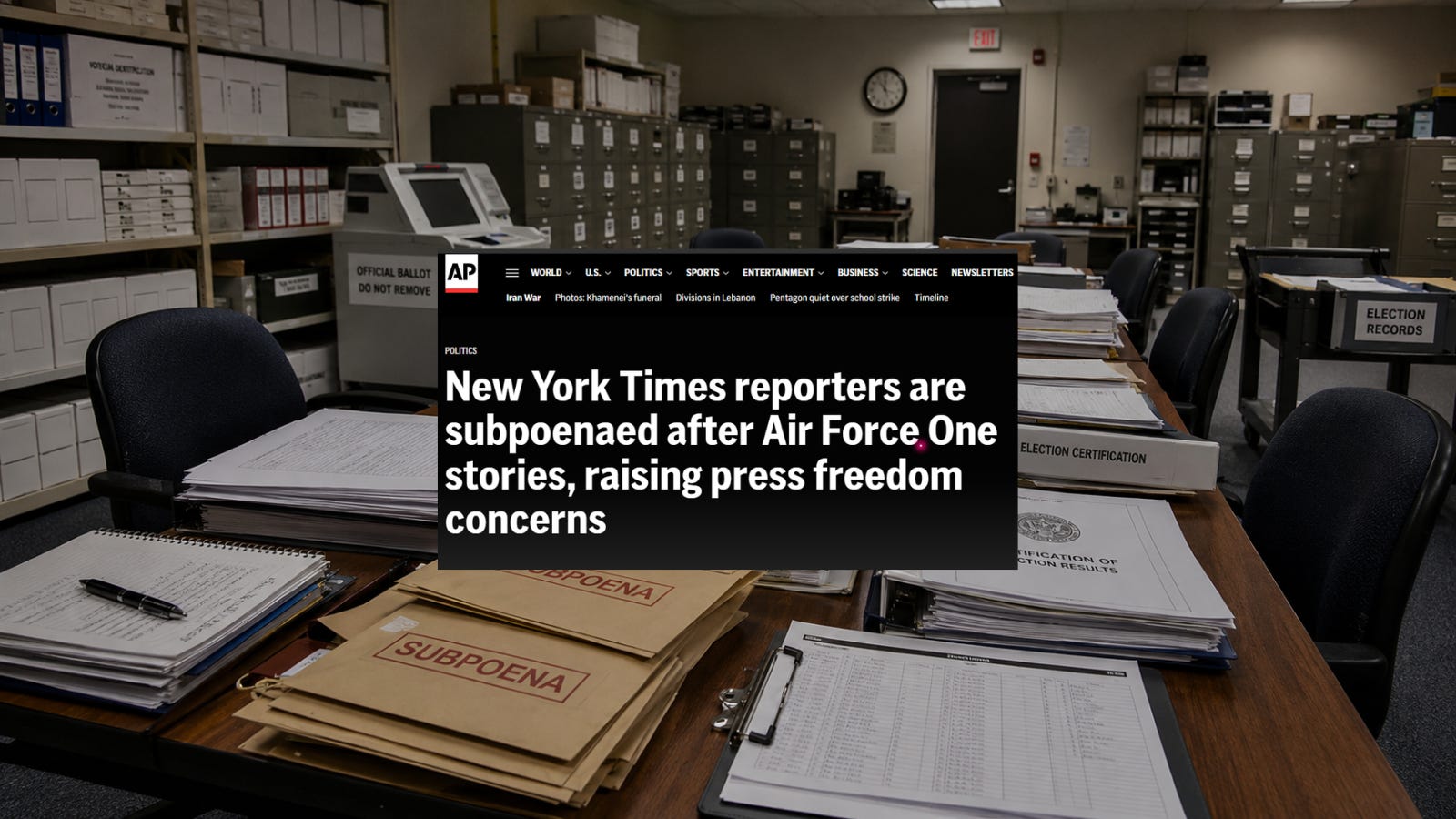
The Election Assistance Commission doesn’t possess armies, tactical vehicles or a cable news program. It performs the less glamorous work upon which functional democracies tend to depend. It distributes election grants, oversees the testing of voting systems and maintains the national voter-registration form. Congress created it through the bipartisan Help America Vote Act in 2002 and designed it to include two Democratic and two Republican commissioners. This arrangement apparently suffered from a serious structural flaw: some members were not doing what the president wanted.
The commission had resisted Trump’s attempt to require documentary proof of citizenship on the federal voter-registration form. A federal judge blocked that portion of Trump’s election order, finding that the president had exceeded his authority because the Constitution gives control over elections to Congress and the states. The White House nevertheless said Trump could remove commissioners who were not “totally aligned” with the task of securing elections.
“Totally aligned” is a remarkable standard for an independent bipartisan commission.
The commission wasn’t created to align itself with the president any more than a smoke detector is installed to support the fire. Its purpose is to function regardless of whether the occupant finds the noise irritating.
To be precise, emptying the commission isn’t expected to allow Trump to wander into local election offices wearing a sash that says Official Ballot Inspector. States administer elections, and election experts say the removals are unlikely to fundamentally alter how the November midterms are conducted. Leaving the posts vacant could, however, prevent the agency from approving new grants and complicate its role in voting-system testing and certification. It also delivers a message familiar to every independent agency under this administration: continued employment may depend less upon lawful service than presidential alignment.
Meanwhile, the Justice Department has sent letters to top election officials in all 50 states and Washington, D.C., warning that they could face criminal liability if they knowingly retain noncitizens on voter rolls or facilitate their voting. Officials were given five days to explain how their states intend to comply with federal law.
Noncitizen voting is already illegal and, according to election experts, exceedingly rare. The administration has nevertheless treated it like an invading army visible only through special presidential binoculars.
The Justice Department is also suing states for access to complete, unredacted voter-registration databases containing information such as birth dates, driver’s-license numbers and partial Social Security numbers. Those efforts have so far failed in court. The administration has additionally pursued regulations that could prevent the Postal Service from transmitting mail ballots for people absent from a federally approved citizenship list, although a judge blocked the major provisions as unconstitutional.
Taken separately, each action arrives with its own official explanation. The reporters aren’t the targets, and the election commissioners were not sufficiently aligned. The letters are merely offers of assistance, and the voter data is needed for security. The president isn’t trying to control elections because presidents don’t control elections. He is simply firing the officials who resisted his election directives, threatening the officials who administer elections and demanding the personal information of the people who participate in them.
Nothing to see here, which may be why the people reporting what they saw received subpoenas. This isn’t censorship in its most familiar costume. There are no uniformed men feeding books into a public bonfire while an orchestra plays something Wagnerian in the background. Modern authoritarian pressure is often more administrative than theatrical. It arrives through personnel emails, federal subpoenas, data requests, regulatory proposals and letters offering assistance in the paragraph immediately before mentioning criminal prosecution.
The purpose isn’t always to erase the record after it has been written. Sometimes it is enough to make everyone afraid to write it.
A journalist wondering whether a source is worth a grand jury fight may become more cautious. A government employee who sees agents appearing at reporters’ homes may decide that silence is safer. An election official facing federal threats may spend more time protecting herself from the Justice Department and less time preparing her county for November. And an independent commissioner may understand that independence is now considered a defect in need of removal.
Democracy depends on a great many people whose names most citizens will never know. Clerks, technicians, local officials, inspectors, and reporters that call people who aren’t supposed to speak and ask them what happened in rooms the public wasn’t allowed to enter. Their work is frequently tedious, procedural and annoying to those in power, which is precisely why it matters.
The people keeping the record are not infallible. Journalists make mistakes, agencies become complacent, election offices require oversight, and every institution capable of checking power must itself be checked. What it mustn’t be is obedient.
A government confident in its conduct doesn’t need every commission “totally aligned” with the president. It doesn’t need agents on reporters’ doorsteps because someone wrote an embarrassing story about the king’s donated airplane. It doesn’t need sensitive voter data from every state while threatening the officials entrusted with protecting it.
It presents the evidence, submits to the process and accepts that public power comes with public scrutiny. This administration appears to prefer a cleaner arrangement, one in which the president makes the call, chooses the officials, defines election security, identifies the acceptable version of events and dispatches the Justice Department when someone produces an unauthorized footnote.
The government has not yet seized the scoreboard. It has merely begun dismissing the referees, questioning the statisticians and knocking on the doors of anyone who wrote down the score. We should probably keep copies.
I talked to Mitch McConnell for 20 minutes and he said that he's totally aligned with democracy, voting rights for all, accurate voter rolls. Because he's on his deathbed. C'mon St. Peter. Let me in, please.
Excellent summary and explanation, Shanley! You may have never imagined yourself as a writer once, but your gift for it is undeniable, especially in the pieces you write where you weave things like invasive vines at home into an analogy for issues we all face. Thank you so much for your contributions!