


The US Constitution appears to have been downgraded from “supreme law of the land” to “optional guidance, vibes-based.” What we’re watching right now isn’t a collection of unfortunate overreaches or isolated scandals. It’s a system stress test—and our civil liberties are failing it in real time.
Start with the press. Federal agents raid the home of a Washington Post reporter who is not accused of a crime, seize her devices, and walk off with the digital lives of thousands of confidential sources. A judge has to step in and say, essentially, do not look at anything you just took, because once you do, the Constitution can’t be un-violated. What the FBI did amounts to intimidation with a warrant-shaped fig leaf. The message to journalists and whistleblowers is unmistakable: your sources, your tools, and even your front door are fair game now. Sleep tight.
Then widen the lens. While DOJ is “cataloging” reporters’ lives, ICE is busy circulating a secret memo arguing it can break into homes without a judge’s warrant, using paperwork signed by itself, because why bother with that whole “neutral magistrate” thing the Fourth Amendment keeps going on about? Administrative warrants, judicial warrants, tomato, tomahto. The executive branch has apparently decided that checks and balances are inefficient, judges are optional, and constitutional law is best handled in internal memos shown only to select supervisors and quietly returned afterward like contraband. Agents who object, resign, or are fired. Training materials are contradicted. The memo is too illegal to distribute widely, which is usually a sign you’re doing great.
Then there’s where all of this leads when no one is watching closely enough: custody. Detention in the black hole. In a tent complex in the Texas desert, run by a private contractor with no experience, no approved security policy, and plenty of government money, a man dies with a coroner ruling his death a homicide. Cause: asphyxiation due to neck and torso compression. “I can’t breathe,” he reportedly said, repeatedly. ICE first calls it medical distress and later amends it to suicide, and even later to a struggle while guards tried to save him. Witnesses say otherwise. So ICE tries to deport the witnesses. Thankfully, a judge intervened barely in time.
This happens when the same government that claims it can enter your home on its own authority also controls who disappears across borders before they can testify. It’s what happens when detention becomes a zone of impunity, shielded by secrecy, privatization, and procedural fog. Thirty-plus deaths in ICE custody last year alone, the deadliest year in two decades, and already multiple deaths in the opening weeks of this one. At some point, “under investigation” stops sounding like due process and starts sounding like a holding pattern for accountability that never arrives.
Put it all together and the pattern is impossible to miss. First, chill the press, then, sideline judges, and normalize force. Finally, manage the fallout by burying evidence, deporting witnesses, and rewriting the narrative until exhaustion sets in. This is not how a healthy democracy behaves. This is how an executive branch tests how much it can get away with, and keeps going when the answer is “more than it should.”
Here’s the part that matters, none of this would be visible without whistleblowers. People inside these agencies who see what’s happening, understand it’s wrong, and risk their jobs, their safety, and their futures to get the truth out anyway. They are the thin line between a fragile democracy and a fully normalized authoritarian one. The Constitution, it turns out, doesn’t enforce itself. It depends on judges who still say no, reporters who keep digging, and insiders who refuse to look away.
Here’s the part the administration really can’t spin away: the public already knows something is wrong. According to the NY Times, voters may be split on deportations in the abstract, half approve, half don’t, but when confronted with the reality of how immigration enforcement is actually being carried out, the answer is decisive. Nearly two-thirds of Americans say ICE has gone too far. Not just Democrats. Independents by a landslide, and nearly one in five Republicans.
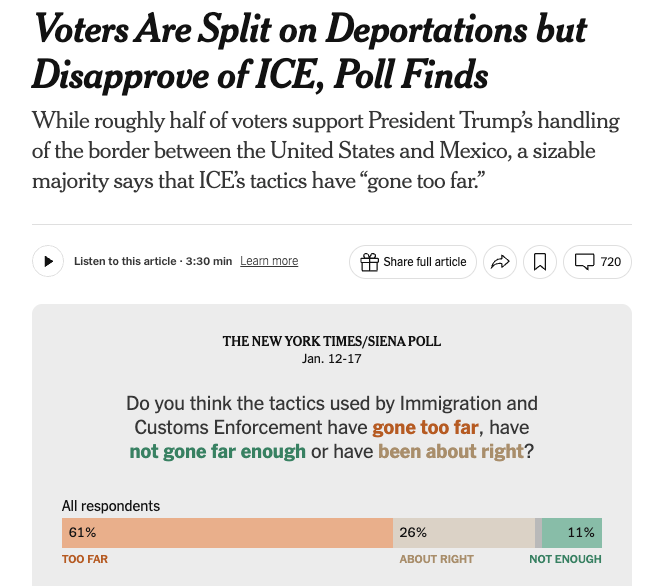
This is what happens when policy crosses the line into spectacle and force becomes the point. People can hold contradictory views, supporting border enforcement while recoiling from masked agents, warrantless raids, citizens dragged from their homes, and bodies piling up in desert detention camps. Americans understand, instinctively, that there is a difference between law enforcement and lawlessness wearing a badge.
What the poll really captures is recognition that something essential has been broken. That when agents can enter homes on self-issued paperwork, when journalists’ doors are kicked in for doing their jobs, when witnesses to deaths in custody are nearly deported before they can speak, the problem is rightly seen as unbridled power.
Even voters who want “strong enforcement” are saying the same thing: there is a way to do this, and this isn’t it. This is why whistleblowers matter so much at this moment. Polls don’t shift in a vacuum. They move because people see videos they can’t unsee, read reporting that cuts through official lies, and hear testimony that was never supposed to make it out. The administration is betting that fear, fatigue, and procedural fog will outpace public attention. So far, fingers crossed, it’s losing that bet.
The other day, a friend and I were walking past some storefronts and noticed that one claimed to be a barber college. My friend noted that it takes 1,800 hours of training to become “certified as a barber” in Ohio. That got me thinking about the level of training ICE agents receive.
According to the Department of Homeland Security, ICE applicants are required to take an 8-week in-person course at ICE’s academy in Georgia. Training includes courses in immigration law and handling a gun, as well as physical fitness tests.
Assuming a 40-hour week, that equates to 320 hours of training — far less than it takes to become any city police officer — or even a barber. Let that sink in a bit…
Now this is crazy this equates to an ICE agent getting 82% less training than a barber. Don’t know too many barbers that need to be physically fit, or know how to handle a gun properly or the ins and outs of federal laws welding those scissors or hair shears.
Given the Department’s rush to add 10,000 new ICE agents and the Felon’s regime disregard for any regulations and standards, this by far is nuts. Where’s any of these “well trained” agents to fulfill any of the rhetoric that comes out of Kristi Noem’s mouth, JD Vance or that small man Bovino. How often are we hearing “well trained” ICE agents, in any of these press conferences or speeches, honestly a zoo monkey is better well trained.
Considering this is way beyond minimal to say the least. It’s really not a stretch that they use 5-year olds as “bait” or shoot innocent people.. is it?
Despite the rhetoric, ICE’s presence in our communities is not making any of us safer — just the opposite is happening as these heavily armed and poorly trained officers are sent out to terrorize communities. Terrorize children, families and are doing so many illegalities it’s just non-stop and we all should be saying “Enough” to these actions.
Let your representatives know that Congress needs to pass legislation mandating that ICE agents — especially since these monkeys may be armed — they need, as a minimum, the same level of training required for actual police officers, including de-escalation of tensions and respect for the people they encounter and maybe have them take a test on the Constitution. That ought to weed out at least 99%..
The Fourth Amendment has been tested many times and its core has been solid. Most of the amendment is unshakeable, like a judge must sign a warrant based on an oath/\affirmation of a police officer who has probable cause to need a warrant and a warrant must name the place to be searched and the person or thing to be seized. Over the years, exceptions to the need for a warrant have been decided and clarified through court cases.
I learned this acronym for warrantless searches from a former FBI SA turned college professor who learned from his FBI training. I believe most/all of these are still standing. Every cop knows these and they know that they cannot create any of these circumstances and then use that as a reason for a search. Most warrantless searches are done through consent. There are reasons for that.
SPACESHIP
S: Search incident to lawful arrest aka the Chimel Rule (Chimel v. California 1969)
P: Plain View aka The plain view doctrine (Hicks v. Arizona 1987)
A: Automobile exception (Carroll v. U.S. 1925)
C: Consent
E: Emergency or Exigency (risk of escape, destruction of evidence, safety)
S: Stop and Frisk* (Terry v. Ohio 1968)
H: Hot pursuit - probable cause (Warden v. Hayden 1967)
I: Inventory - for automobiles in police impound (California v. Acevedo 1991)
S(P)ecial circumstances: No expectation of right to privacy - airports, borders, jails, schools, federal buildings, probationers, garbage
* In 2013, Floyd v State of New York ruled NYPD's Stop and Frisk unconstitutional