


Donald Trump’s threats against Iran have become so extreme that even some of America’s closest allies are drawing lines. British reporting makes clear the UK has not given Washington a blank check: Downing Street has held to a “defensive only” policy for use of British bases, while lawmakers across the political spectrum are pressing Keir Starmer to go further if Trump attempts strikes on civilian infrastructure. It means Trump is not operating in a world where every ally will automatically indulge his worst impulses. Even governments that have stood beside the United States for decades are now trying to avoid legal and moral complicity in a wider catastrophe.
The foreign press is also being far blunter than much of the American media. France 24 did not dance around Trump’s falsehoods with the usual euphemisms. They called his claim about having urged the killing of Osama bin Laden in his 2000 book “an outright lie,” and they also directly challenged his boast that he had “ended eight wars,” noting that this claim has been “repeatedly debunked by fact checkers around the world over and over.” They described several of his other statements as “false” and ultimately “completely false.” They did not treat Trump’s fabrications about the war, his own achievements, or even the contents of his own book as colorful exaggerations or harmless “misstatements,” but as deliberate lies that could be checked against the public record in minutes. That difference in tone matters. It strips away the mythology of the strongman and leaves behind what so much of the world is now seeing plainly: a reckless president making threats of mass destruction while lying about both the facts on the ground and his own history.
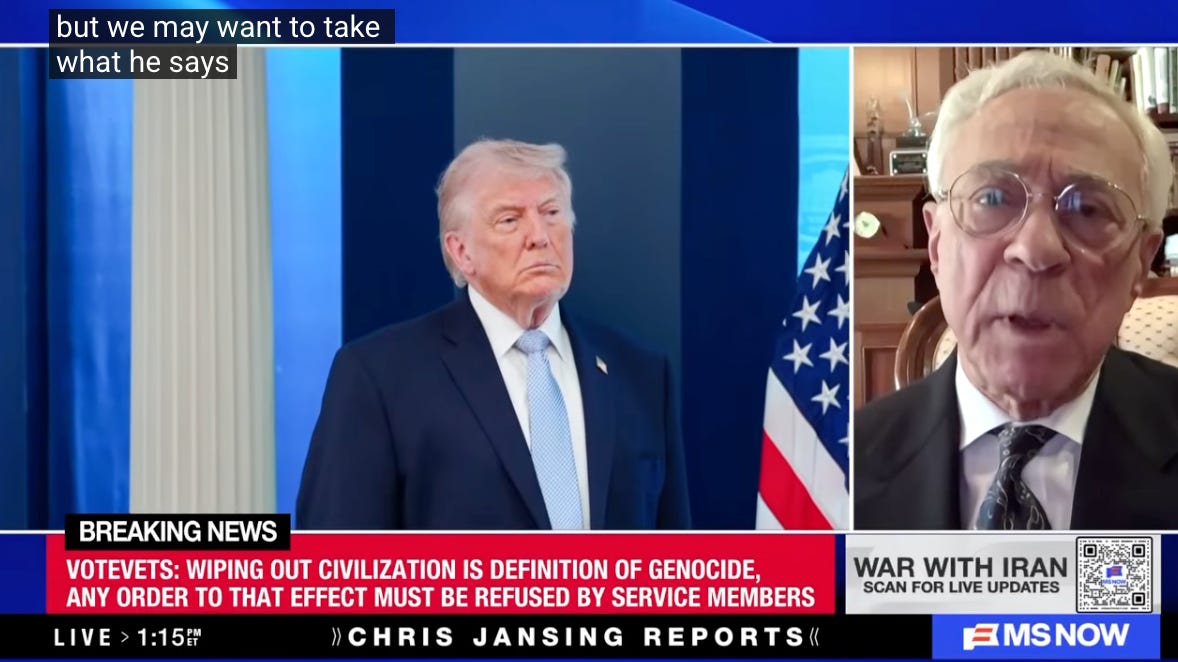
At the same time, there are signs that Trump may not simply snap his fingers and turn his darkest rhetoric into action. More and more of the discussion has shifted from whether his threats sound criminal to what U.S. personnel must do if he gives an unlawful order. Retired senior commanders have said publicly that officers should have the moral courage “to stand up against” orders to destroy civilian targets with no direct military relevance, with former Lt. Gen. Ben Hodges warning that “destroying civilian targets that do not have direct military relevance is not something that you can do.” Other military analysts have stressed that the greatest responsibility lies at the top of the chain of command, where illegal or immoral orders are supposed to be stopped before they ever reach the rank and file. As Colonel Jack Jacobs put it, service members must do what they are told “unless you’re given an order that’s immoral or illegal,” while “the buck is going to stop with the people at the top of the military food chain.” But the rank and file are not automatically shielded either: a private, an airman, or a seaman cannot assume that “just following orders” will protect them if an order is plainly unlawful. Legal experts interviewed by major outlets have echoed the same point: attacks on power plants, bridges, and other civilian-dependent infrastructure without clear military necessity could amount to war crimes, placing commanders in particular jeopardy but potentially exposing anyone involved in carrying out such orders to criminal liability as well.
None of that is a guarantee of restraint. Trump has already shown contempt for law, truth, and human life and he has done so openly, snapping at a reporter that he does not care about war crimes. But there are still forces pushing back against the most apocalyptic version of this war: allies refusing unconditional cooperation, foreign media refusing to launder his lies into euphemism, and military and legal voices reminding the world that “just following orders” is not a defense for war crimes. In a moment this dangerous, those constraints may be among the few things standing between Trump’s ugliest fantasies and an even greater disaster.
But for Trump’s costly, impulsive war on Iran, the Strait of Hormuz would be open. Everyone but the morons and liars around Trump knew attacking Iran would lead to closure of the Strait as an essential act of Iranian defense.
Now Trump threatens genocide in Iran (as explicitly defined by U.S. laws) unless Iran rescues him from the consequences of his actions.
That’s where we are. His goal now is to return to the status quo he destroyed. This afternoon’s demand that Iran open the Strait immediately is coupled with Trump’s pledge to defer annihilation of Iran (with a nuke?) for another two weeks.
Meanwhile, Vance is telling Europe to buy oil from Russia. Russian support for Iran has deep historical roots and continues. Impeachment and conviction of Trump removes the entire regime. It’s the only sane option.
Today was enuf of a tipping point that we finally had some influential people and elected reps in Senate and Congress saying it's time to implement the 25th Amendment (remove trump from presidency due to disability). What's interesting and beneficial for voters to know is which politicians actually did that. I heard mid afternoon that Hakeem Jefferies and Chuck Schumer did NOT call for 25th Amendment. Mike Johnson did not call for Congress to reconvene in this global emergency. I heard it mentioned that one would have thot every elected Dem should have been on the steps of White House demanding loudly that trump be removed or impeached. To me this would have been the silver lining to todays big black looming cloud ... the opportunity to use this flashpoint while it's hot to get that nut case out of the oval office.