


Good morning. Before we get lost in the fog machine of Trump’s latest foreign-policy theatrics, let’s start with what the administration would very much like you to forget.
The Epstein files are still sealed. Not “under review” in any meaningful sense months after the Department of Justice received a comprehensive trove of material and quietly ran it through a redaction assembly line. The public still hasn’t seen what’s in them, who’s in them, or why protecting powerful men remains a higher priority than accountability for a sprawling abuse network and justice for the survivors. At the same time, millions of Americans have quietly lost enhanced Affordable Care Act subsidies, watching premiums spike and coverage options shrink while Congress shrugs and tells them to shop harder. And buried in a New Year’s Eve data dump, Republicans released video testimony from former Special Counsel Jack Smith that accidentally did the opposite of what they intended: it showed, calmly and methodically, that Donald Trump would have been convicted beyond a reasonable doubt for serious crimes if the clock hadn’t been run out.
That deposition was a literal failed ambush. MAGA Republicans tried to box a career federal prosecutor into a perjury or ethics trap by forcing a closed-door deposition, refusing to make it public, denying him clear guidance on what he was allowed to say, and then declining to send a DOJ lawyer to object in real time. Smith and his counsel dismantled the setup on the record, exposing the absurdity of subpoenaing someone to speak and then threatening them for answering. He didn’t grandstand or posture; he simply explained that you don’t bring a case unless you believe, based on evidence, that a conviction is likely. That quiet professionalism is exactly why Republicans tried to bury the footage overnight.
So that’s the baseline this morning: sealed evidence, vanished healthcare support, and a president who escaped conviction not because he was innocent, but because power and timing intervened.
Cue the spectacle. Over the weekend, oil prices dipped as markets tried to process Trump’s declaration that the United States is now, apparently, “in charge” of Venezuela. Brent crude slid, and West Texas Intermediate followed. Investors are less persuaded by imperial press gaggles than by timelines, infrastructure, and reality. Venezuela may sit atop enormous oil reserves, but it currently produces a fraction of global supply after years of sanctions, decay, and underinvestment. Trump promises U.S. oil companies will swoop in, spend billions, rebuild everything, and make everyone rich any day now. Markets, being humorless creatures, hear “someday, maybe, if a lot of things go right” and price accordingly.
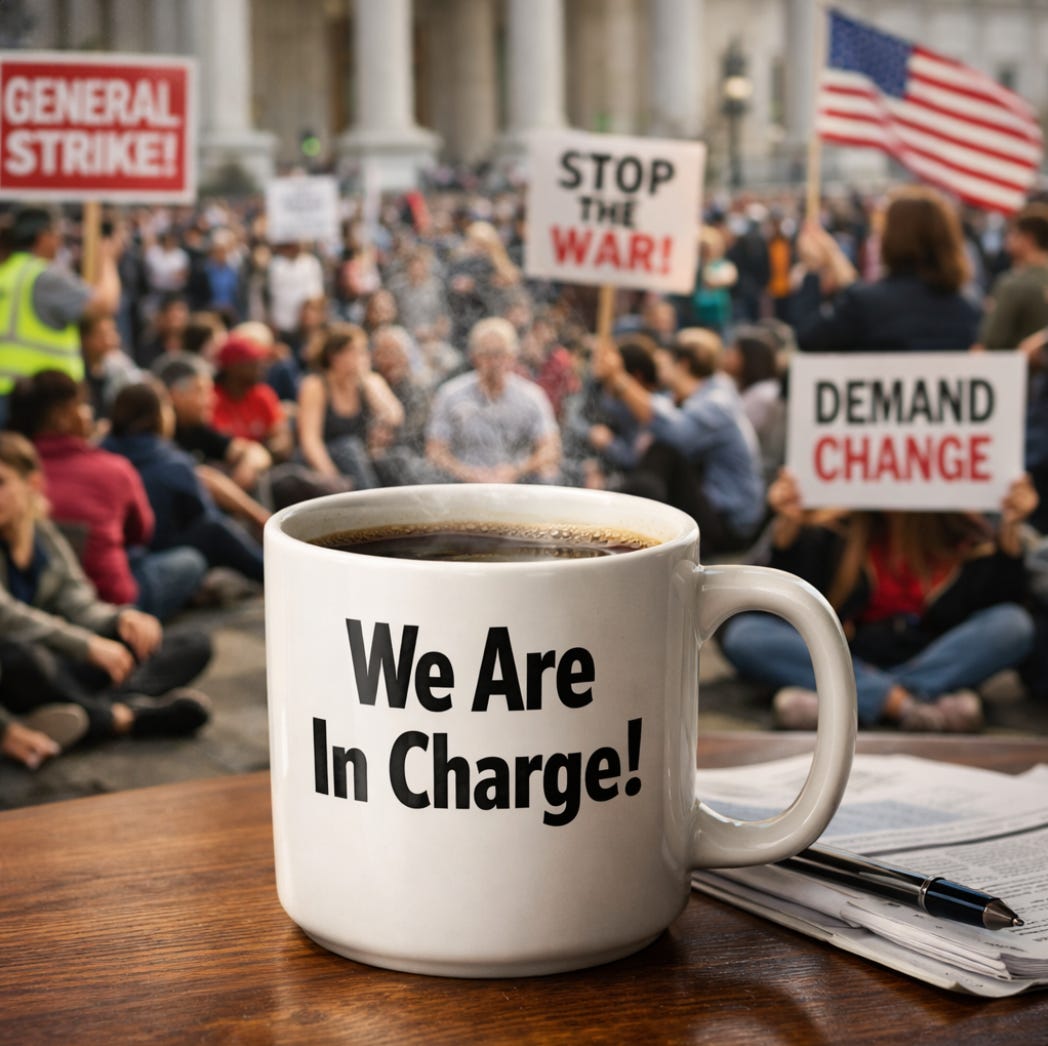
Trump, meanwhile, could not be clearer about the posture. Asked during a press gaggle who’s in charge of Venezuela, he demurred and then blurted it out: “That means we’re in charge.” He admitted he hasn’t even spoken with the newly installed leadership, but justified U.S. control by declaring Venezuela a “dead country,” echoing the same language he once used to describe the United States under Biden. Elections, he said, can come later, after the oil is fixed, the infrastructure is rebuilt, and the country is made suitably profitable. He threatened a second strike if Venezuela’s new authorities don’t “behave,” declared the U.S. needs “total access” to oil and other assets, and wrapped the whole thing in the Monroe Doctrine, because nothing says 21st-century diplomacy like dusting off 19th-century imperial logic.
Trump’s sudden love affair with the Monroe Doctrine is especially adorable when you remember it only applies to other people’s geography. In Venezuela, it’s “our hemisphere,” “our backyard,” “our rules”, the 1823 cosplay edition. But the moment the conversation shifts to Greenland, the doctrine magically evaporates like a puddle in a Vegas parking lot. Greenland isn’t in the Western Hemisphere? Sure it is, if you squint hard enough and you’re holding a Sharpie. It’s under Denmark’s sovereignty and Greenland’s self-government, which in Trump-world makes it “up for grabs” as long as he can mumble the words “national security” and keep a billionaire on speed dial. The doctrine isn’t principle, it’s a prop.
Take Greenland. In the same gaggle, Trump couldn’t resist wandering there too, insisting flatly that the United States “needs Greenland from the standpoint of national security,” warning that it’s supposedly “covered with Russian and Chinese ships all over the place,” and ridiculing Denmark by claiming it recently boosted security by adding “one more dog sled.” Then, almost immediately, he tried to shut the conversation down: “I don’t want to talk about Greenland now… we’ll worry about Greenland in about two months.” Which, of course, is always how you know he very much wants to talk about it, and we should all very much worry.
The quotes matter because they expose the posture. Trump isn’t talking about alliance, defense cooperation, or international law. He’s talking about necessity, ownership, and inevitability. Greenland, in his telling, is something the U.S. “needs,” something Denmark “is not going to be able to do,” and something the European Union supposedly agrees America should have, a claim offered without evidence, because evidence isn’t the point.
Here’s where it stops being comedy and starts being strategy. Ronald Lauder, billionaire heir, Trump confidant, and the man who originally planted the “buy Greenland” idea back in Trump’s first term, is no longer just whispering in Trump’s ear. Through a deliberately opaque, Delaware-registered consortium, Lauder has been buying stakes in Greenlandic companies tied directly to the island’s political elite. One of those investments links Lauder to business partners with close family ties to Greenland’s foreign minister, the very official responsible for negotiating Greenland’s response to U.S. pressure.
The company at the center of this is tiny, economically insignificant on paper, and couldn’t attract outside investors for years. The value isn’t bottled water or balance sheets, it’s access and leverage. It’s pressure points in a country of just 57,000 people, where business relationships and political power inevitably overlap.
This is how modern empire works. Trump supplies the public threats, tariffs, force, “national security,” the insistence that “we need it.” His allies build the private scaffolding underneath, investments, partnerships, quiet influence that never makes the podium. A two-track strategy: intimidation from above, infiltration from below.
Venezuela gets framed as hemispheric “cleanup” under the Monroe Doctrine. Greenland gets framed as Arctic security. Same logic, different brochure, and the doctrine only applies right up until it interferes with something Trump wants to take.
Through all of this, Trump insists it’s about drugs: narco-states, poison flooding the U.S. Which makes it worth pausing to remember that just weeks ago, Trump pardoned a convicted narcotrafficker, the former Honduran president Juan Orlando Hernández, sentenced to decades in U.S. prison for facilitating massive cocaine trafficking. The message is consistent if you stop taking the rhetoric seriously. Drugs are a justification, not a principle. Loyalty is the real principle. Friends get clemency, and enemies get crusades.
The cost of this worldview isn’t abstract here at home. It has names. In 2025, thirty-one people died in ICE custody, the deadliest year for immigration detention in more than two decades. This came as the Trump administration ramped up enforcement to record levels, detaining nearly 70,000 people by mid-December. Roughly three-quarters had no criminal convictions. People died of strokes, seizures, respiratory failure, tuberculosis, suicide. Some died in detention centers, some in field offices, others in hospitals — still shackled, still under ICE control. Again and again, families describe the same pattern: medical complaints dismissed, care delayed, crises recognized only when it was too late.
DHS insists conditions are fine and points to a “low” death rate without releasing the data behind the claim. But dividing human lives by a large enough denominator doesn’t make this normal, just bureaucratically convenient. This is what America looks like under the Trump regime: mass detention, degraded care, and death treated as an acceptable byproduct of enforcement.
This moment doesn’t call for polite weekend protests that power politely ignores. It doesn’t call for strongly worded statements, symbolic resolutions, or waiting patiently for institutions that have already demonstrated they will not self-correct. It calls for pressure, sustained, lawful, unavoidable pressure, applied where power actually feels it.
Congress must be flooded with demands, not requests. Demands for the full release of the Epstein files. Demands for real investigations into the suppression of evidence. Demands for public, independent assessments of Donald Trump’s cognitive and physical fitness to hold office, not whispered concern, not anonymous leaks, but formal oversight with sworn testimony and medical transparency. If the president is fit to command armies, detain tens of thousands of people, and threaten foreign nations, then Congress has an obligation to prove it.
And Congress must reclaim what it has surrendered. The power of the purse, and the power to authorize, or refuse war. No more emergency justifications that magically never expire, and no more allowing one man’s impulses to become foreign policy by default.
But here’s the truth we have to face: none of that happens unless it becomes inconvenient not to act. Think peaceful, lawful, yet disruptive. That means showing up during business hours, not just on weekends. It means targeting the machinery of normalcy, commerce, offices, institutions that rely on everything continuing as usual. It means coordinated strikes, sit-ins, slowdowns, boycotts, and mass civic action that makes clear the cost of ignoring accountability is higher than the cost of delivering it.
No giving them the excuse they crave, which means no violence, but also no compliance theater. No pretending democracy survives on decorum alone while power runs unchecked.
History doesn’t move because leaders suddenly develop consciences. It moves because ordinary people make it impossible for injustice to operate quietly. This administration has crossed moral, ethical and constitutional lines. Now we decide if we are willing to use the tools still available to force accountability while we still have them.
This is not about left or right. It’s about whether the Constitution is real, whether law still binds the powerful, and whether “peace on earth” means anything when it’s built on silence, secrecy, and submission.
The fog machine will keep running. The only thing that stops this is pressure, organized, relentless, lawful pressure, until Congress remembers who it works for and starts acting like it.
That’s the call.
I know if I were a Greenlander I would be looking at the two countries: Denmark: old, settled, democratic, sane and the U.S.: no longer young, brash, bloated and lets face it, our world face is UGLY. Our streets are filled with gun violence, our kids are losing, our twenty-somethings are Nazi-curious and our government looks like a big fat smelly orange turd. I'm going with the Danes. (I used to love America but I cannot right now. It is gross to me, when 70m+ people voted for an obvious felon, rapist, failed businessman, racist piggy, bloated grotesque decrepit lying old man and continue to support him beyond reason. )
We, as ordinary citizens, can and must act to stop Trump by drastically reducing all discretionary spending. If we all acted together, the drop in consumer spending would push the economy into a recession and further erode Trump’s declining power. The effects of homegrown economic sanctions would be rapid, possibly enough to deter further imperialistic adventures.