


Holy hell, this CNBC interview is like watching a guy juggle chainsaws, legal threats, central banking, war propaganda, airline mergers, AI vendor beef, and his own reflection in a gold-plated mirror, and somehow still believe he’s the calm one in the room. The big picture is that Trump used the interview less to inform and more to perform: every question became a launch ramp for the same core message, I alone am powerful, everyone else is stupid, weak, disloyal, or late, and also please admire my instincts because they are better than generals, economists, judges, contractors, central bankers, CEOs, and history itself.
On Iran, he was openly boasting that the U.S. had effectively imposed regime change whether or not he wanted to say the quiet part out loud. At one point he said, “It is regime change, no matter what you want to call it… I’ve done it indirectly, maybe, but I’ve done it” and then immediately framed that as proof he was negotiating from strength. He kept insisting Iran had “no choice” but to come to the table because, in his telling, the U.S. had already destroyed everything that mattered: “We’ve taken out their navy, we’ve taken out their air force, we’ve taken out their leaders.” From there, he cast the whole thing as a masterstroke of coercive leverage, blockade successful, military dominance total, negotiations inevitable, and made clear that if talks did not move fast enough, bombing was still very much on the menu, saying, “I expect to be bombing because I think that’s a better attitude to go in with.” That is the through-line: diplomacy, in his mind, is just bombing with a microphone attached.
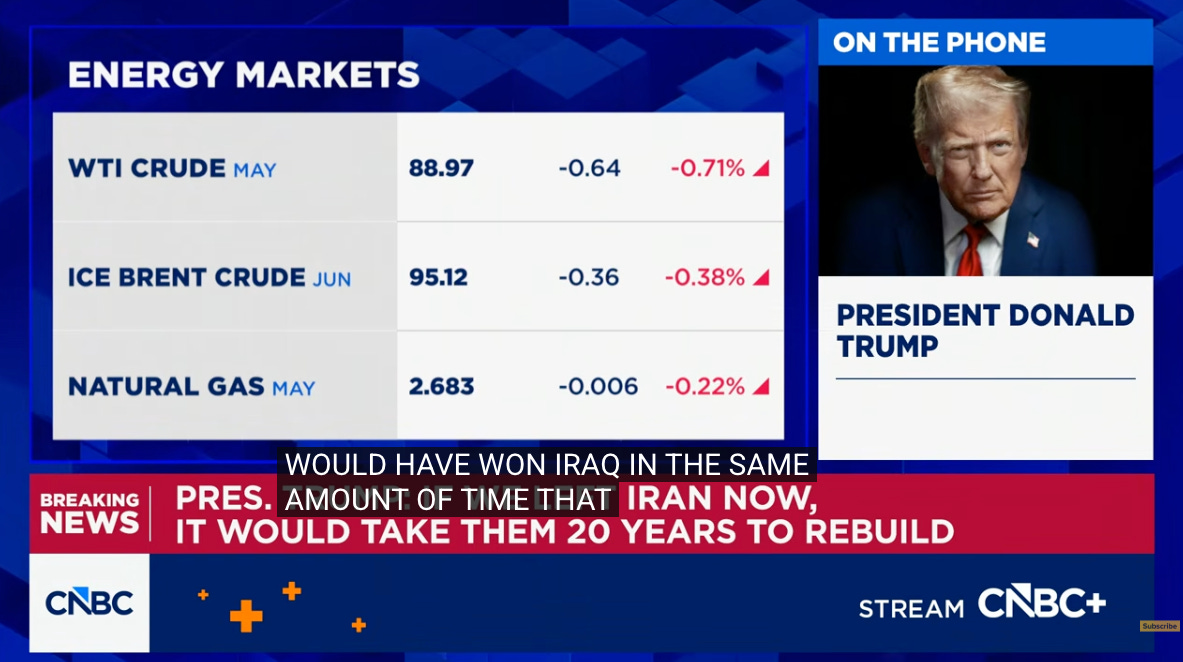
He was not subtle about it. When asked whether he might extend a ceasefire if negotiations showed progress, he basically said no: “I don’t want to do that. We don’t have that much time,” before making clear that Iran needed to move immediately. Most people hear “negotiation” and think backchannel, incentives, de-escalation. Trump hears “negotiation” and thinks enter the room carrying a flamethrower, then act offended that everyone else seems nervous.
He also kept circling back to the idea that the war is already essentially won, and in the most Trumpian way possible it could never just be a military advantage or a favorable position. No, it had to be total and absolute. He declared, “We’ve totally won the war,” insisted the nuclear site was “obliterated,” and boasted that “if we left right now, it would take them 20 years to rebuild.” He then used the market as if it were some kind of personal validation machine, pointing to the fact that “the market’s up” and that oil was not as high as he expected as proof that his judgment had been vindicated.
That is really the con in miniature. If catastrophe does not arrive instantly in the exact form critics warned about, he treats that not as a temporary reprieve or a complicated reality, but as proof that he was right about everything all along. The logic is absurd but familiar: the war has not yet produced the worst-case outcome on his timetable, therefore he is a genius, the site was “obliterated,” the war is “won,” and everyone raising moral, strategic, or factual objections must be either weak, stupid, or lying.
Then came the Fed section, which was like watching a real estate developer crash through macroeconomics with a leaf blower. He does want Kevin Warsh, he does want lower rates, and he is still obsessing over Jay Powell as “too late,” but the most revealing part is how fast an actual policy question turned into a contractor tantrum. Asked whether he might back off the DOJ probe so Warsh’s confirmation path would be smoother, he immediately veered into a renovation rant, complaining that the Fed building should never have cost what it does, that “a job that should have cost $25 million” is somehow costing billions, and boasting, “I would have fixed that building… for $25 million,” and “I built under budget, ahead of schedule.” He then spiraled into a full HGTV of grievance: “They ripped down the most beautiful ceilings,” “they put up six inch sheetrock walls,” and “they said, sir, we have no insulation. It’s not in the budget.” It’s peak Trump: a question about monetary governance answered like an episode of This Old Authoritarian.
From there he slid into one of his favorite fairy tales, that business swagger is a substitute for institutional competence. Complex central bank governance, legal process, procurement rules, judicial review, and Fed independence all got flattened into the same basic performance: I know buildings, therefore I know everything. He literally uses his hotel as evidence of his superior judgment, saying, “I built the hotel… for 201 million,” then comparing that to the Fed project as though that somehow settles the question of what should happen to the Fed chair. That is always the trick with him: replace institutions with vibes, replace evidence with braggadocio, and replace accountability with some version of trust me, I’ve seen drywall before.
The Anthropic section was especially revealing because it sounded like he was free-associating his way through a government tech procurement decision. He described Anthropic as “a group of very smart people,” but then immediately pivoted to grievance, claiming “they started telling our military how to operate, and we didn’t want that,” before adding that “they tend to be on the left, radical left.” That is already doing a lot of work: not a clear policy standard, not a procurement rationale, just a mash-up of ideology, attitude, and personal irritation. He then noted that “they came to the White House a few days ago, and we had some very good talks with them,” and concluded, almost like a monarch deciding whether a courtier had groveled sufficiently, “I think they’re shaping up.”
And then came the giveaway. Asked whether Anthropic might still be allowed inside the Defense Department, he answered, “In the meantime, we replaced Anthropic with somebody else… Sam Altman, the very, very smart group.” Think of a king describing which court alchemists currently amuse him. The actual substance seems to be: Anthropic may be in trouble because of vibes, politics, and perceived disobedience, while OpenAI is in favor because access, flattery, and being the preferred smart people of the moment. It is less industrial strategy than feudal patronage with GPUs.
Then he pivoted to inflation and interest rates and produced the usual stew of grievance, intuition, and self-canonization. He insisted inflation came down because “I had won the election and it started falling after I won the election. And I started getting prices down… right after November 5th,” as though macroeconomics is just another branch of personal branding. He also drifted into one of his favorite nostalgic myths, claiming, “We should have the lowest interest rate in the world,” and “when I was a young guy growing up, we always had the lowest interest rate worldwide.”
From there he blended tariffs, foreign freeloading, and monetary policy into one giant slurry of nationalist resentment, railing that supposedly “elite” countries are only elite because “we allow them to walk away with $30 billion, $40 billion a year,” and boasting, “I sort of put a clamp on that with the tariffs and charges that we charge them.” That is always the dark comedy of listening to him on economics: he treats the global financial system like a casino where the house should always win, and the house is him personally.
His tariff comments were one of the nastier parts of the interview because he more or less said the quiet part out loud. When asked whether companies might be avoiding refund claims because they were worried about offending him, he replied: “If they don’t do that, I’ll remember them.” Hardly subtle, that’s not even dog-whistle corruption, just regular whistle corruption, blasted through a stadium speaker. The message is basically: nice corporation you’ve got there, shame if someone remembered you incorrectly.
He also spent a lot of time raging at the Supreme Court in the way only Trump can: as though every judicial opinion is just a personal betrayal by stage actors who forgot their lines. He complained they should have “saved the country” with one sentence on tariffs, predicted they might rule against him again on birthright citizenship, and generally treated the Court not as a coequal branch but as an insufficiently loyal subcontractor. That is a recurring pattern all through the interview: every institution exists to validate him, and when it doesn’t, it becomes stupid, weak, corrupt, disloyal, or all four by lunchtime.
Then, because the interview apparently had to hit every square on the authoritarian bingo card, he wandered into culture-war nonsense about NIL, meaning the rules allowing college athletes to profit from their name, image, and likeness, and treated it as yet another example of judges and elites ruining a system he imagines only he understands. He complained that “they destroyed college sports” and ranted that “now it’s all football,” with players staying in school because “they can make more money than they would if they went into baseball, Major League Baseball or the NFL.” He even griped, “we have a seven year freshman,” as though the real national emergency is not authoritarianism or war but the horror of unpaid laborers finally getting a cut.
The specifics barely matter, but the pattern does. Every topic gets sucked into the same gravity well: the country was broken, judges are clueless, elites are fools, and only Trump, builder of hotels, critic of drywall, savior of civilization, can restore order.
The airline merger segment was one of the few moments where he sounded almost conventionally skeptical of consolidation. When asked about United potentially buying American, he said flatly, “I don’t like it. No, I don’t mind mergers… but with American, it’s doing fine. And United is doing very well… I don’t like having them merge.” He contrasted that with Spirit, saying, “I’d love somebody to buy Spirit,” because the airline is struggling and its jobs are at risk. He also made the broader point that too much consolidation in aerospace and defense leaves the country with “a very small number” of companies and “you get one bid and it makes them lazy.”
But even there, he could not resist turning a potentially normal antitrust answer into a superhero monologue about himself, missile systems, and industrial command. Within seconds he was boasting about Patriots and Tomahawks, insisting “we have the best stuff in the world by far,” and then bragging that he had forced contractors to stop enriching shareholders and start building capacity: “Raytheon took billions of dollars… for stock buybacks instead of buying plants. So I made it illegal for them to do that.” So even when he briefly lands on a position that sounds halfway intelligible, he still has to wrap it in a cape, salute his own magnificence, and set off fireworks around himself.
By the last stretch, the whole thing had become pure imperial uncle-at-the-banquet energy. Asked whether the UAE might need help, he said, “It is [under consideration], but it’s been a good country. It’s been a good ally of ours,” and then added, “if I could help them, I would.” On Saudi Arabia, he was just as fawning, calling its leader “another great guy,” while folding the whole region into his personal mythology of loyal clients and grateful partners. Israel, meanwhile, became the plucky junior sidekick in the Trump cinematic universe: “We’re the big brother. They’re the small brother. But the small brother has been very helpful to us… they’ve displayed great courage.”
Then came the contempt. NATO, he sneered, was not really helping and “they’re a paper tiger,” while Europe, in his view, had better “straighten themselves out between energy and immigration” or “they’re not going to have a Europe anymore.” And because no Trump monologue is complete without a drive-by humiliation of Biden paired with self-mythologizing, he mocked his predecessor by saying “he couldn’t walk up a flight of stairs” before pivoting to himself: “That’s why when I get out of those planes, I walk nice and slowly. I’m not looking to set any speed records.” At that point he was not really answering questions so much as narrating his own fan fiction in real time, part warlord, part real-estate king, part staircase influencer.
The interview is not really about Iran, or the Fed, or Anthropic, or tariffs, or airlines. It’s theater. Trump uses every subject as a stage prop to reinforce the same image of himself, warrior, builder, fixer, boss, genius, victim, emperor, and truth-teller rolled into one overstuffed suit. The actual content is a slurry of threats, bragging, policy distortion, loyalty signaling, institutional contempt, and casual corruption, all delivered with that familiar tone of a man who thinks saying a thing confidently is the same as making it true. It’s less an interview than a 37-minute hostage situation for reality.
It sounded as if a cable-news green room, a dictator mood board, a contractor Yelp review, and a Truth Social rant got trapped in a blender and emerged somehow even more orange.
What makes all of this so terrifying is the sheer instability of it. In one interview Trump bragged that he had no interest in extending the Iran ceasefire, hinting that more bombing was the “better attitude” for negotiations, and boasting that he had essentially imposed regime change by force. Then, minutes later, he reverses himself and extends the ceasefire anyway, claiming Iran is “seriously fractured” and Pakistan asked him to hold off, even as the U.S. sends more troops and another carrier strike group into the region. Strategic improv: he treats war like a ratings stunt, diplomacy like a protection racket, and global brinkmanship like one more stage for his ego. Nobody in Congress gets to pretend the warning signs are subtle. The danger is not just his lies or his delusions of grandeur, but that one unstable, impulsive man keeps lurching between threats, reversals, and military escalation while the people who should act still behave as if this is normal. This is not normal, this is an emergency.
Mary, I found myself shaking my head so much during this piece, that I now feel like a veritable bobble head.
This drivel diatribe of his often makes zero sense.
My sincere hope is that once we’ve extricated ourselves from this horrific nightmare, and gained control of all three branches of the federal government, that we can remind the mindless, spineless, and impotent GOP of their disgusting and despicable decision making for the next FIFTY YEARS.
“…one unstable, impulsive man keeps lurching between threats, reversals, and military escalation while the people who should act still behave as if this is normal. This is not normal, this is an emergency.”
What makes it more terrifying: there are no adults inside the tent while Trump circus barks outside it. Trump operatives are as delusional and stupid, and/or malevolent, as he is, to the one. Add the Crusader (Hegseth) plus Second Coming (Huckabee, Evangelical) agendas, and war crimes, including nuclear strikes, can’t be dismissed.
Our institutions and leaders outside the circle of insanity are utterly failing us.