


I’d like to begin this Sunday’s reminder with a word of gratitude.
Thank you for the support and kindness you have shown my family during this season of doubt. Some of the most life-changing and radical things have happened to us over the last few days, and to be honest, I am still sitting here typing this in disbelief.
Because of some deeply generous souls, we were able to make an offer to our landlady, and we will hear sometime this afternoon whether she accepts it. We also found a path to an MRI for our son, which is something we have been trying so hard to secure.
But most importantly, we found a little peace, regardless of the outcome. Not because everything is solved, and not because the fear has disappeared. As Nelson Mandela once wrote, “The brave man is not he who does not feel afraid, but he who conquers that fear.” This week, it was your kindness that helped us conquer ours. Because of you, we know more clearly than we have ever known that we are not alone, and that our journey is far from over.
I have been trying to find the words for what that feels like, to be standing on one side of a terrifying unknown and suddenly realize that people have been quietly building a way across. Not by fixing everything, or making the hard thing disappear, but by making the gap feel less impossible.
And maybe that is why, when I came across the story of a young Sumatran orangutan in Indonesia finally trusting a rope bridge built over a road that had split his forest in two, I felt it somewhere deeper than usual. Because apparently this week I am a woman who can be emotionally undone by both human generosity and cautious primates, which feels fair, honestly. We all have our spiritual gifts.
There is something so moving about the fact that even now, even with so many people treating the living world like an inconvenience to be paved over, fenced off, monetized, litigated, or explained away by a man in a fleece vest with a quarterly growth chart, there are still human beings in Indonesia building rope bridges for orangutans.
Not metaphorical bridges, though honestly, if you give me an orangutan and a suspended rope walkway, I am going to find my way to a metaphor eventually. Actual bridges, suspended in the forest canopy, stretched above a public road in North Sumatra, built because a widened road had cut through the trees between the Siranggas Wildlife Reserve and the Sikulaping Protection Forest.
For people, the road matters. It connects remote communities to schools, health care, government offices, and the ordinary necessary errands of being alive. This is not one of those easy stories where humanity can be neatly sorted into villains and saints, as satisfying as that would be for those of us currently running on caffeine, spite, and whatever hope we can pry loose from the couch cushions. The road is useful, but it also severed the canopy.
For an orangutan, this is not a small thing. Sumatran orangutans spend most of their lives in the trees, moving through the forest with those long, thoughtful arms, living in a world where the branches are not decoration but infrastructure. When the canopy breaks, the forest breaks with it. What looks to us like a strip of pavement can become, to them, a wall.
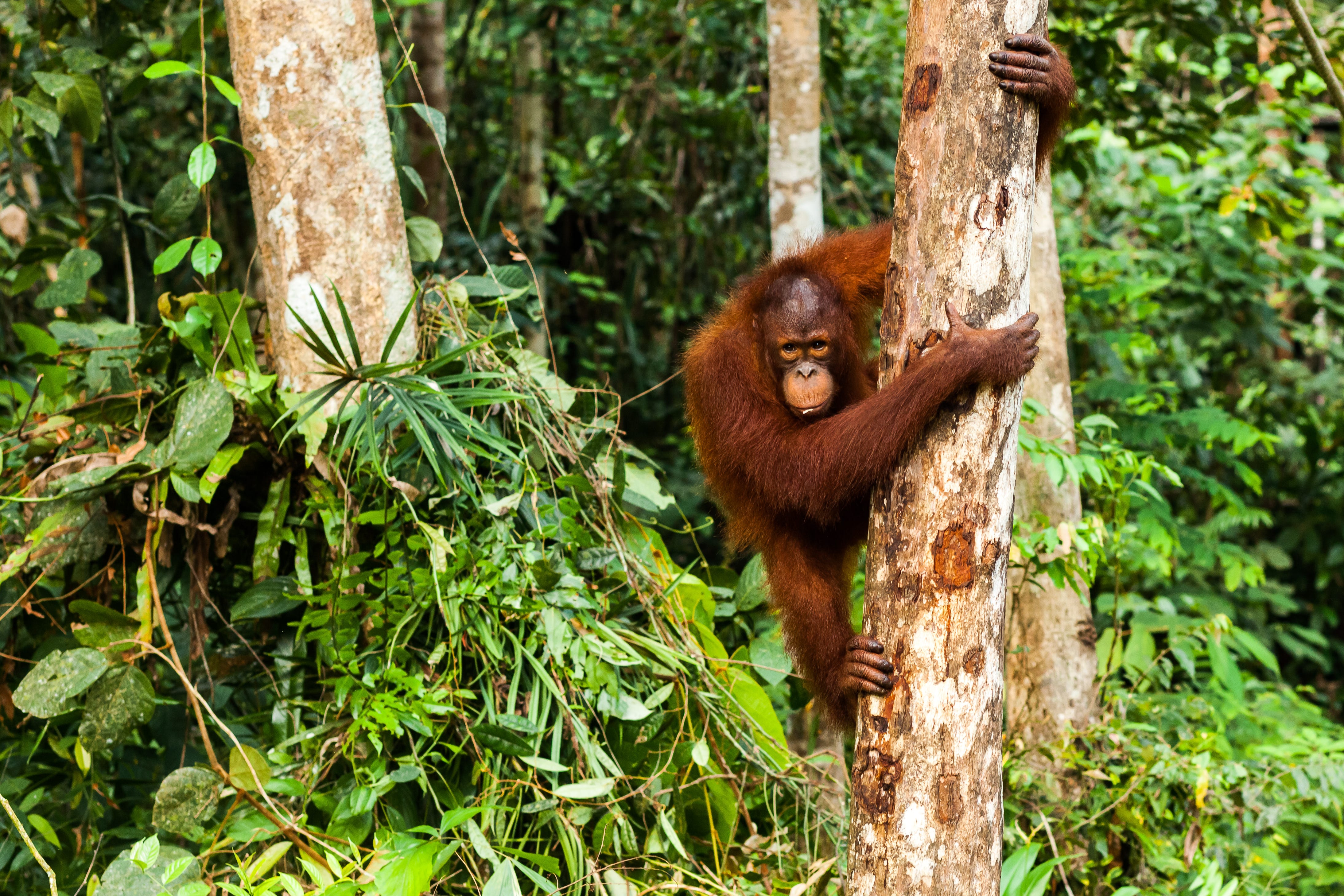
So, conservationists did something tender and practical, which is my favorite combination of human behavior and frankly should be its own personality type. The Indonesian conservation group TaHuKah, working with the Sumatran Orangutan Society and government agencies, installed five rope canopy bridges over the road. They surveyed nests and forest cover and animal movement. They placed camera traps. They made the bridges strong enough for one of the largest tree-dwelling mammals in the world, which is a phrase I would like someone to put on my tombstone someday, if only because it sounds like a respectful way to describe a tired mother carrying groceries. And then they waited, which is the part that gets me.
They didn’t build the bridge and immediately receive a triumphant parade of grateful orangutans, because orangutans, unlike certain billionaires, apparently have a healthy sense of caution before stepping onto something new just because a human said it was innovative. Smaller animals used the crossings first, squirrels, macaques, langurs, and gibbons. The orangutans watched, they came close, they tested, and they thought about it. One can only imagine the internal monologue, which I assume was something like, “interesting, yes, very cute little rope situation you have made here, but I was not born yesterday.”
For two years, the bridge was there before an orangutan trusted it enough to cross, and then one did. A young Sumatran orangutan was captured on camera at the edge of the forest. He gripped the rope carefully and stepped out over the open air. Halfway across, he paused and looked down at the road below, which is exactly what I would do if I found myself suspended above a public road on a rope bridge, though my expression would contain less quiet majesty and more immediate regret. Then he kept going, he crossed from one side of the broken forest to the other.
That is it, that is the whole miracle. Not the kind with thunder and trumpets, but the kind with a camera trap in the trees and a cautious animal deciding that maybe this strange thing built by humans could hold him.
I keep thinking about that. The bridge had to be built long before it was trusted, and the work had to be done without any guarantee that it would matter. People had to climb into the trees and secure ropes and study movement patterns and check footage and keep believing in a future that might never arrive on schedule. They had to accept that repair is not always dramatic, sometimes it looks like making a safe passage and then waiting, with as much patience as you can bear, for life to find it.
This week, I have been thinking a lot about bridges, because people have been building them for us too. Not always with rope and knots and field equipment, though honestly at this point I would not put it past some of you to show up with climbing gear and a spreadsheet. But in the ways people do when they decide not to look away, a message, a donation, a share, a kind word at exactly the moment it was needed, or a hand extended across the terrifying gap between “we are not okay” and “we are still here.”
Now we must be honest, the orangutan bridge doesn’t restore what has been broken. The road is still there, the habitat still fragmented, Sumatran orangutans are still critically endangered, and the world is still full of people who seem determined to confuse extraction with progress. One crossing doesn’t solve all of that. One young orangutan testing a rope bridge doesn’t mean the species is safe or the forest is whole or that humanity has suddenly become the thoughtful little woodland neighbor it occasionally imagines itself to be. But it means something, it means somebody noticed the break and refused to look away.
It means somebody understood that a wound in the world doesn’t always ask us for a speech. Sometimes it asks us for a ladder, a rope, a meal, a ride, a phone call, a check, a casserole, a GoFundMe, a bag of groceries, or a safe place to land. Sometimes it asks us to build something we may not live long enough to see fully used. Sometimes it asks us to keep showing up after the first day, and the first month, and the first year, when the cameras show squirrels and gibbons and absolutely zero orangutans, thank you very much, because trust has its own timetable.
That may be the most honest kind of hope I know right now. Not hope as certainty, or as a cheerful little mug with an inspirational quote on it, though I respect the mug community and its tireless work, but rather, hope as infrastructure. As the thing we build across the gap because something living might need it later. As the stubborn, practical belief that if the world has been broken in a specific place, then perhaps we can mend it in a specific place too.
The orangutan didn’t know the names of the people who built that bridge. He didn’t know about the meetings, the surveys, the partnerships, the funding, the waiting, the camera footage reviewed by tired eyes. He only knew that where there had been danger, there was now a way across.
Maybe that is enough. Maybe that is what all our little acts of mercy are doing, even when they feel too small to matter. Maybe every meal delivered, every dollar given, every kind message sent into the dark, every person who says, “I see you, and I am not leaving,” is one more rope across the open air.
And maybe someday, after enough waiting, after enough watching, after enough careful testing of whether this thing can really hold, someone makes it across because we built it before they were ready to trust it.
That is my Sunday reminder that there is still hope for humanity after all. Because somewhere in North Sumatra, people built a bridge for an orangutan who took two years to believe in it.
And then he crossed.
A beautiful piece of writing, Shanley - straight from your heart. Thank you for brightening my world this afternoon.
Thank you SO MUCH, Shanley! Beautiful. And so many of us feel like you are "family" now, also. Bridges! 🥰