


Good morning! Fourteen days before the midterms, Air Force One buzzed a crowd at the Pitt-Greenville Airport in eastern North Carolina, and the president stepped out with an offer.
The Trump Dividend, first unveiled at last month’s GOP convention in Dallas, is still $5,000 for every adult citizen. Tuesday night it came with fine print. Married couples get $10,000. The money must be spent or invested in the United States. “You cannot go to China, darling,” he warned an imaginary wife with wandering ideas. “Let’s go to China and buy some things in China. You can’t do that.” France, oddly, remained an acceptable vacation destination. “You can have some fun.”
Trump offered proof that his latest dividend was possible: the $1,776 “Warrior Dividend” paid to military personnel last December. His generals, he explained, had proposed $1,775. But Trump, “being a super genius,” recognized that adding one dollar would make $1,776. He asked whether the military could scrape together another dollar. The general said yes. The Pentagon’s arithmetic crisis was resolved.
What he neglected to mention was that the payments came from $2.9 billion Congress had already appropriated for military housing, not some newly discovered reservoir of tariff revenue. The proposed $5,000 dividend, which would exceed $1.2 trillion, has no comparable appropriation. Trump has solved the dollar. The rest is apparently somebody else’s homework.
Tariffs came up. So did the phrase “it’s called recycled.” Also left unexplained: how the Treasury plans to stop a dividend dollar from paying off the Visa bill for a Beijing vacation. Money is fungible and, unlike voters, doesn’t take instructions.
Trump promises the money only if Republicans hold both the House and the Senate. “If we lose, you get nothing. You’re going to get nothing.”
The evening had already delivered the usual road show: a Willie Horton remake starring Roy Cooper, an extended appreciation of Ohio Senator Jon Husted’s posterior, and the news that “tariff” had been demoted to Trump’s fifth favorite word, somewhere behind God and family.
Then, roughly seventy miles from Camp Lejeune, he turned to the Marines, civilian workers and families still pursuing compensation for exposure to the base’s contaminated drinking water. Trump announced that his administration had delivered $1 billion in settlements. He made them an offer, too.
“If we win the House and the Senate, I am directing the Department of Justice to settle all remaining legitimate claims as soon as possible.”
He then spelled out the terms himself.
“So if we don’t win, there’s no money. If we do win, you’re getting it.”
Camp Lejeune isn’t an abstraction in eastern North Carolina. For thirty-four years, people at the base drank, cooked with and bathed their children in water contaminated with industrial solvents and benzene. Some became sick while they still lived there. Others wouldn’t learn what the water had done to them until decades later. Jerry Ensminger, a retired Marine master sergeant, lost his nine-year-old daughter Janey to leukemia in 1985 and has spent decades fighting to expose what happened.
In 2022, Congress finally opened a legal path to compensation. The Camp Lejeune Justice Act allowed eligible victims and their families to pursue claims that had long been blocked. It was not a reward, and it was not a favor. It was an acknowledgment of a debt that had gone unpaid for decades.
In fairness, Trump’s Justice Department has accelerated settlement approvals and payments. But the “$1 billion delivered” figure he cited in Greenville deserves scrutiny. The department’s latest published accounting, dated September 18, shows more than $1.1 billion in settlement offers, but just over $879 million actually paid. The Congressional Budget Office has estimated that total compensation could reach $21 billion. Lawyers representing victims say their clients are dying while they wait.
These are people pursuing compensation under an existing federal law, not applying for a new campaign benefit. Their legal claims will remain valid regardless of which party controls Congress. But Trump had just made his promise to expedite the remaining settlements conditional on Republican victories. Expedited attention from the president now comes with an election-night contingency.
Three days earlier, roughly four hundred miles west, Defense Secretary Pete Hegseth went to the University of Tennessee to thank ROTC cadets for volunteering to defend their country and managed to provoke an international incident by insulting the soldiers who had already done exactly that.
He recalled walking into coalition headquarters in Kabul and seeing the flags of some fifty nations. A beautiful sight, he said, except that maybe five countries actually contributed, and toward the end only one or two were involved in combat operations. He dusted off an old joke he’d already used before Congress: ISAF, the International Security Assistance Force, really stood for “I Saw Americans Fighting.”
Britain lost 457 service members in Afghanistan. Poland lost 43 soldiers and a civilian paramedic, prompting Foreign Minister Radosław Sikorski to suggest Hegseth explain his assessment to their families. A spokesperson for British Prime Minister Andy Burnham said Hegseth was simply wrong. Across the coalition, more than 1,100 troops from allied and partner nations died alongside approximately 2,465 Americans. That’s a lot of funerals for countries supposedly there for decoration.
British Army veteran Ash Alexander-Cooper, who served eight tours in Afghanistan and was seriously wounded, offered a rather different account. He remembered carrying wounded and dead British, New Zealand, Afghan and other personnel. On the battlefield, nobody was particularly concerned with the nationality of the person bleeding beside them. They were brothers and sisters in arms.
Hegseth’s own Afghanistan deployment wasn’t a combat mission, something he has acknowledged himself. He served in 2011 and 2012 as a senior counterinsurgency instructor in Kabul, training American and allied units. That’s honorable work. So was everyone else’s.
The distinction matters because NATO formally ended its combat mission in December 2014. Its successor, Resolute Support, focused on training, advising and assisting Afghan forces, and Americans served in it alongside their allies. NATO ended ISAF in December 2014. Its successor, Resolute Support, was formally a noncombat mission focused on training, advising and assisting Afghan forces. Americans served alongside their allies in that mission, too.
He also blamed European governments for weakening their militaries while opening their borders and financing their welfare states, folding an immigration grievance into his critique of the same allies he’d just belittled. Trump made a similar accusation in January, suggesting allied troops had stayed safely away from the front lines. It’s starting to sound less like a slip and more like a position.
The reason America’s allies first answered the call is worth remembering. Following the September 11 attacks, NATO invoked Article 5, its collective-defense clause, for the first and only time in the alliance’s history. America had been attacked. Its allies answered. NATO subsequently took command of the international security mission in Afghanistan, where soldiers from dozens of nations served, fought, suffered and died alongside Americans.
Those allies kept faith with America when it needed them. In Knoxville, the secretary of defense offered them a punchline.
Three days later, Hegseth had another explanation for the limits of American military support. This one involved a billionaire and a service agreement.
Asked Tuesday whether the Pentagon had restricted Ukraine’s access to Starshield, the military-grade version of Elon Musk’s Starlink satellite network, Hegseth insisted it hadn’t. “We haven’t pulled anything back,” he said. SpaceX, however, had the option to make decisions about its terms of service.
When Ukrainian soldiers lose the communications they need to defend their country, the matter belongs somewhere between the Pentagon and customer support.
That same evening in Greenville, Trump was celebrating Musk for precisely the opposite reason.
Recalling Hurricane Helene, which devastated western North Carolina in September 2024, Trump described communities isolated by catastrophic flooding, without electricity, roads or reliable communications. He said he called Musk, who rushed Starlink equipment into the disaster zone. “Elon saved a lot of lives,” Trump told the crowd.
The satellite connections genuinely helped stranded communities communicate with rescuers. Trump also claimed Governor Roy Cooper had done nothing and that recovery only began when he took office four months later, an account that would surprise the National Guard, FEMA and thousands of emergency workers who had been on the ground since September.
But the president understood something important about the technology. When people are isolated and their lives are in danger, access to reliable communications matters enormously.
Ukraine had just received a demonstration of the reverse.
On the night of October 13–14, Ukrainian military units discovered that Starshield terminals mounted on moving equipment were losing connectivity at speeds above approximately 100 miles per hour. Some operators reported disruptions at considerably lower speeds. There had been no warning.
The restrictions disrupted offensive drones, but they also compromised Ukraine’s ability to intercept incoming Russian weapons. Ukrainian engineers had developed drones capable of chasing down newer, jet-powered Shahed attack drones traveling at more than 250 miles per hour. A communications system that stops working at 100 miles per hour presents an obvious difficulty for a weapon intended to catch something traveling more than twice that fast.
Serhii Beskrestnov, a Ukrainian defense technology adviser, told the Associated Press that the military had developed an effective countermeasure, only to discover that a sudden restriction had undermined it. Ukraine managed to restore some disrupted connections, but the speed cap remained.
There was another important distinction. Beskrestnov said the affected Starshield service operates inside Ukraine, not on Russian territory, and isn’t used to guide Ukrainian drones attacking Russian oil refineries. Whatever the political dispute over those refinery strikes, the restrictions were interfering with Ukraine’s defenses against attacks on its own territory.
Then came Tuesday night’s reporting.
The Wall Street Journal, citing American officials and people familiar with the decision, reported that Musk personally ordered the slowdown. CBS News independently confirmed that a decision by Musk led to the restrictions, reporting that he had spoken with administration officials beforehand to clarify Trump’s thinking.
Whether Trump knew about or authorized the specific decision remains disputed. The Journal reported that Musk and Trump discussed the matter after the restrictions became public, while one source said they had also discussed it beforehand. Reuters had previously reported, citing American and Western officials, that an instruction to slow the service had originated inside the White House.
The public explanations haven’t exactly cleared things up.
Musk initially insisted that Starshield was controlled by the American government and that decisions about speed restrictions rested with the military and ultimately the president. Trump denied ordering the slowdown and said he didn’t think Musk was responsible.
On Wednesday, Secretary of State Marco Rubio offered yet another explanation from India. He said he wasn’t aware that the administration knew about the decision beforehand, adding, “But that’s irrelevant.” Access and speed restrictions, he explained, were governed by a private commercial contract.
So Musk said the government controlled the restrictions. The government said the company controlled them. The president said he didn’t know who was responsible. And Ukraine, whose soldiers were struggling to intercept Russian weapons, was still trying to find out who could restore the service.
The reporting has identified Musk’s role and exposed a serious gap between the technology’s operational importance and the competing accounts of who controls it.
Trump and Musk had publicly expressed their anger at Ukraine for attacking Russian oil refineries. To understand why, follow the diesel.
On October 10, Trump explained what he had told Zelensky: Ukraine could do whatever it wanted to Russia, “but don’t hit the refineries because that’s a world problem.” Zelensky did it anyway. “He goes and hits the diesel fuel,” Trump said. “He better damn well stop.”
Musk answered the White House video with a verdict of his own: “Zelensky has gone too far.” Four days later, Ukraine’s drones began dropping their connections.
The grievance has a price tag. Diesel now averages $6.32 a gallon, just off its record of $6.53 in late September. Regular gasoline is $4.26, up from $3.05 a year ago. For a party trying to hold both chambers of Congress two weeks from now, those numbers are on every receipt.
Ukraine’s refinery strikes don’t account for most of them. Most analysts point to the war Trump started with Iran, which choked off traffic through the Strait of Hormuz, where roughly a fifth of the world’s oil used to pass. On September 9, Trump predicted oil prices would tumble “right after the election,” suggesting Iran was dragging out the war to influence the midterms. In Greenville on Tuesday, he said that “they” dreamed of keeping the war going past the election, and called the cost “a very small price to pay.”
At Camp Lejeune, families pursuing compensation under federal law heard their president make faster settlements conditional on an election. In Knoxville, the sacrifices of soldiers who answered America’s call became a punchline. And in Ukraine, critical military communications were restricted by a billionaire while Washington and SpaceX offered conflicting accounts of who controlled the decision.
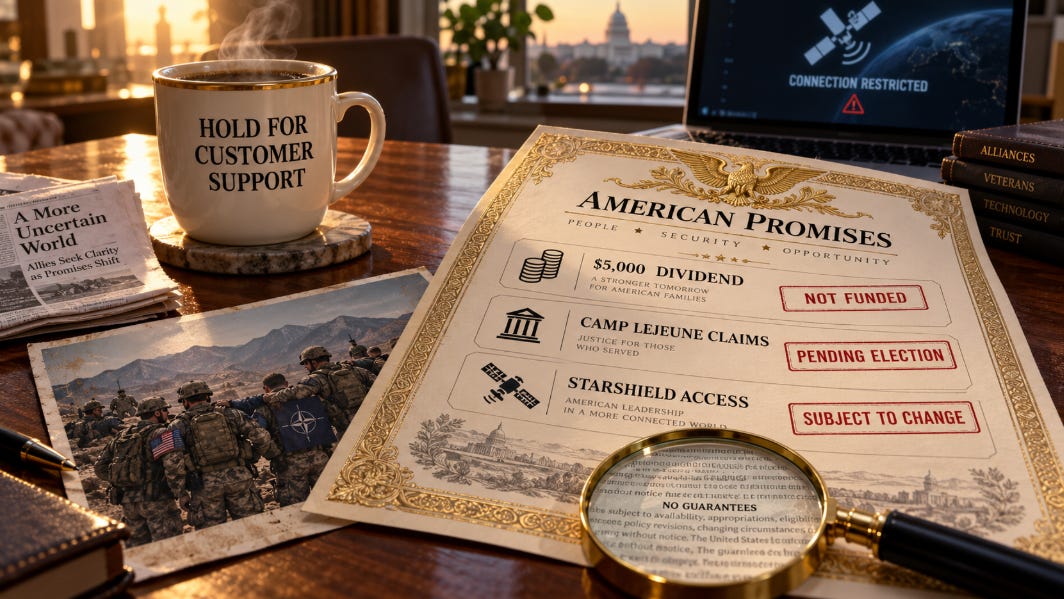
Terms and conditions apply.
Trump is a gangster through and through. He is a one-man Tammany Hall. He’s channeling Boss Tweed. His shtick is old and tired. The vast majority of Americans know that his offers of cash are bogus.
The squabbling about who decided to throttle the speed of the Starshield technology doesn't matter. It was cut at a time when Ukraine was under intense attack, rendering defensive action almost impossible. Did Putin know in advance? Both Trump & Musk are compromised when it comes to Putin, so who is to say? This is, however, one more deadly example of why nobody can trust the US any more. I hope Canada is taking notes as we review our commitment to the F-35, which could easily become our Starshield if the US retains the source code and all software updates. Any dependence on the US looks pretty risky, and the facts that Trump got elected a second time and then the entire GOP rolled over and played dead means the risk outlives the Trump regime.