


Before we get to the eagles, a small household dispatch from the land of eye drops, antibiotics, and questionable bubblegum flavoring.
The kids are mostly recovered from pink eye, though we are still having to administer eye drops with the tenderness and moral exhaustion of people trying to convince small unwilling witnesses that medicine is not, in fact, an act of betrayal. The antibiotics, we were promised, taste like bubblegum. The children remain unconvinced.
Meanwhile, my husband and I are covered in blisters, scratches, splinters, and the general evidence of a household project that has become less “home improvement” and more “light frontier survival,” but the house is looking beautiful. Baby Ezra is officially a moving baby now, which means his newest joy in life is spilling the dog water so he can splash in it like a tiny chaos otter.
So, we are tired, scratched up, disinfected within an inch of our lives, and trying very hard to remember that most beautiful things require some mess, some tending, and a lot more patience than anyone originally budgeted for.
Which may be why this story about a group of fourth graders in Danville, California hit me so hard. Even now, with the world doing its level best to make cynics of us all, a group of elementary school children looked up from their desks, learned that two bald eagles might lose part of the wild home they depend on, and decided the correct response was not despair, but action.
And because children are often closer to the original language of hope than the rest of us, their action looked like lemonade stands and bake sales, handwritten letters and handmade posters, bald eagle origami folded carefully by small fingers, cars washed, leaves picked up, sidewalks walked with signs in hand, and a classroom full of children asking every day how much more had been raised to save a place they had come to love.
Which, honestly, is about as close to scripture as humanity gets some days.
The eagles are Jackie and Shadow, the now-famous bald eagle pair who have made their nest in Big Bear Valley and, through the strange little miracle of a livestream, have also made a nest in the hearts of people far beyond the pine trees and cold blue water of Southern California.
People have watched them build, wait, tend, return, repair, grieve, and begin again. They have watched the weather move around them, the wind shake the branches, and still, there they were, doing the ancient work of staying.
At John Baldwin Elementary School, science teacher Sara Stinson had been using Jackie and Shadow’s livestream as part of a life-cycle lesson, which is one of those educational choices that feels almost too lovely for this tired century. Instead of learning about nature as if it were something distant, flattened into worksheets and vocabulary words, the students got to meet it in real time.
They watched the eagles set up their nest, lay eggs, hatch chicks, and raise them. They watched these birds not as an abstract species in a textbook, but as neighbors, as parents, as wild beings with routines and needs and a home.
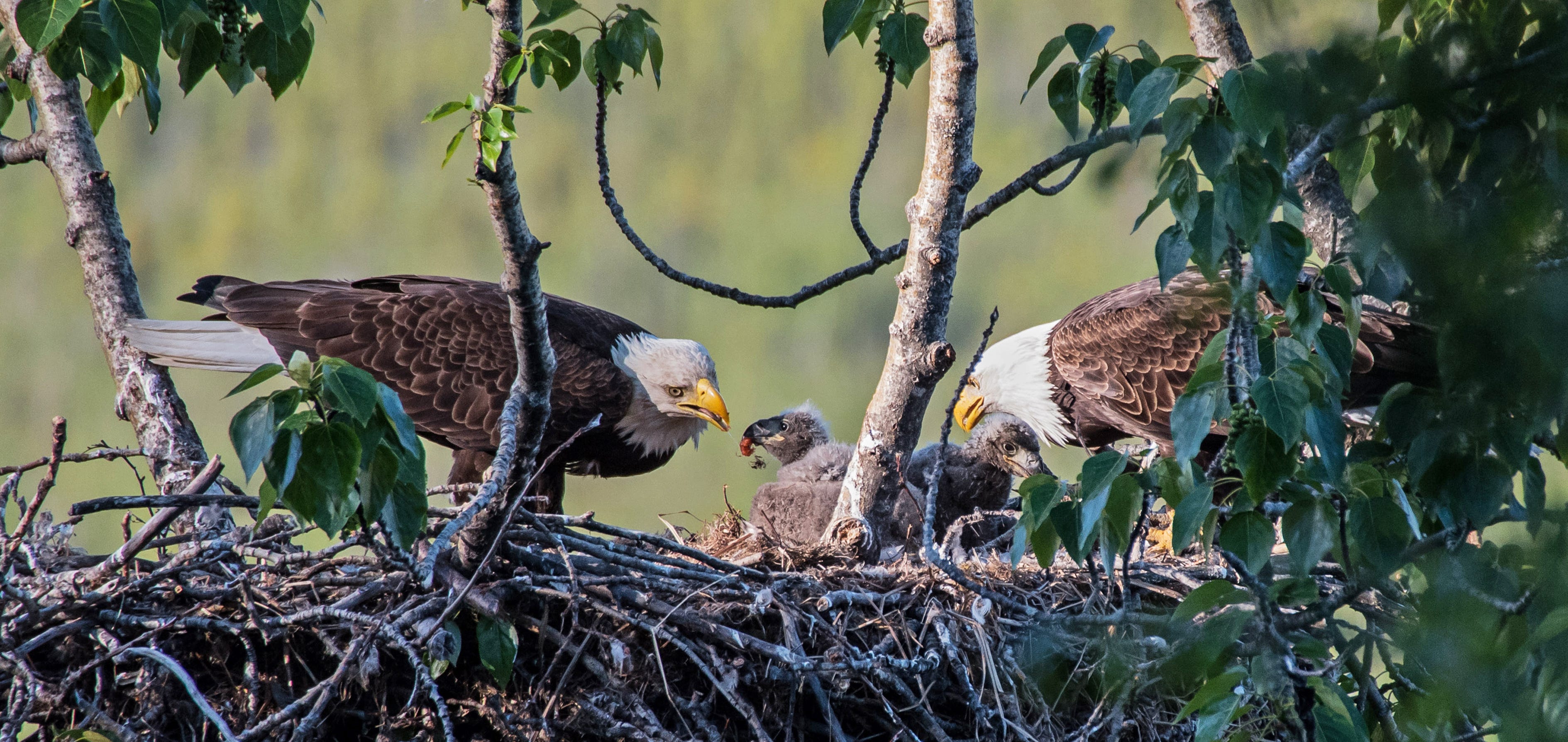
And that is where love begins, so much of the time. Not in theory, but in attention. Not in the grand speech about saving the planet, but in the quiet moment when a child sees a bird return to a branch and begins to understand that the world is full of lives that are not ours, but are still somehow entrusted to us.
Then the children learned about Moon Camp, a stretch of shoreline in Big Bear Valley that conservationists say is part of Jackie and Shadow’s foraging area, less than a mile from their nest. They learned that the land could be developed into luxury homes and marina slips unless the San Bernardino Mountains Land Trust can raise $10 million by July 31 to buy and protect it. They learned that the nest tree itself was not the whole story.
That is the part I keep coming back to, because it feels like something children understand better than adults do. A nest is not only a tree, a home is not only a roof, and a life is not only the small space where a body happens to sleep.
The eagles need the lake, the fish, the quiet places, the trees, the shoreline, the invisible agreements between hunger and habitat, between parent and chick, between wing and wind. They need a world around them that still functions as a world. They need what every living thing needs, which is not extravagance, but enough.
And when the children understood that enough might be taken, they did not retreat into the sort of sophisticated hopelessness adults are always pretending is wisdom.
They did not shrug and say that money always wins, or that development is inevitable, or that someone should really do something about that someday after the next meeting and the next report and the next round of people explaining why nothing can be done.
Instead, they folded birds from paper. They wrote persuasive letters to family members, community leaders, lawmakers, influencers, and celebrities. They made flyers and walked through downtown Danville with posters in their hands. They held bake sales and lemonade stands. They washed cars, picked up leaves, and turned a classroom lesson into a school-wide act of devotion.
They began, in other words, exactly where human beings have always begun when their hearts are still intact: with whatever they had in their hands and a stubborn refusal to confuse smallness with powerlessness. I have been thinking a lot lately about that particular kind of moral clarity, the kind children have before the world teaches them how to apologize for caring.
There is a purity to it that can feel almost embarrassing to adults, not because it is childish, but because it exposes how much we have surrendered under the costume of being realistic. Children haven’t yet learned all the respectable ways to look away. They haven’t yet been trained to make peace with beautiful things being destroyed because someone found a way to profit from the wreckage.
They see the eagle, the nest, the place where the eagle hunts; and they understand, immediately and without a committee, that these things belong together. So, they try to help. That’s all, and that’s everything.
There is an innocence in this story, but I don’t think innocence is the same thing as naivete. We get that wrong all the time. We treat innocence as though it means not understanding the darkness, when maybe innocence is the part of us that can see the darkness clearly and still refuses to worship it. Maybe innocence is not ignorance at all, but the original intelligence of the soul, the one that knows before we are taught otherwise that love is supposed to become action.
A child watching Jackie and Shadow doesn’t need a political theory of conservation to know that a wild creature should not have to lose its home for someone else’s view. A child doesn’t need a lecture on ecological interdependence to know that if you take away the place where a parent finds food, you have not left the nest untouched. A child doesn’t need to be told that grief belongs to humans alone, because they have seen animals wait, return, call, protect, lose, and begin again.
This is what I mean when I say there is still hope for humanity. Not because we are always good, or even because we are usually good, but because somewhere in a classroom there are children who watched two eagles long enough to love them, then loved them deeply enough to act.
And look, I know a lemonade stand is not a magic wand. I know the world is not saved by poster board alone, although I do think poster board deserves more credit than it gets, particularly when wielded by children with righteous eyebrows and a concerning amount of glitter glue.
But the point isn’t that children can fix everything by themselves. The point is that they remembered the first rule of being human, which is that when something living is in danger, you don’t begin by calculating whether your contribution is large enough to matter. You begin by refusing to abandon it.
You begin by saying: I have two hands, I have a voice, I have a Saturday afternoon, I have a front yard and a pitcher of lemonade, and I am going to place my small brave self between the thing I love and the machinery that would make it disappear.
That is not childish, that is sacred.
And maybe it is also instructive, because so much of adulthood seems to be a long education in helplessness. We are taught to understand systems so well that we forget we are part of them. We learn the names of all the barriers, all the funding gaps, all the legal obstacles, all the reasons a thing may be lost, and sometimes by the end of all that understanding, we have mistaken our own paralysis for intelligence.
Children have a way of cutting through that fog. They remind us that the world is not made only by the powerful, even though the powerful would very much like us to believe that. The world is also made by teachers who turn a livestream into a doorway. It is made by students who write letters in careful pencil. It is made by parents who help tape signs to folding tables. It is made by neighbors who stop for lemonade, not because they are thirsty, but because a child has asked them to believe that an eagle’s hunting ground matters.
Maybe that is why this story feels so tender to me. These children weren’t trying to save an idea. They were trying to save a place, the eagles’ hunting ground, their shoreline, their familiar horizon, and the world around the nest that makes the nest possible.
There is something deeply human in that, and also something deeply wise. Because nothing living exists alone. The eagle belongs to the shoreline, the nest belongs to the forest, and the future belongs, at least in part, to the people willing to protect what they may never personally own.
The children remembered that. They matter because they show us the original shape of hope before the world dents it. They cared without embarrassment. They acted without certainty. They gave what they had, even though what they had was small.
And if that isn’t hope for humanity, I don’t know what is. Happy Memorial Day to you all, I hope your Sunday is as hopeful as mine.
A wonderful story that I'm so glad you shared. I don't watch those eagles all the time but I do click in occasionally. I truly hope that what these children are doing, along with others. can save that beautiful stretch of land and the eagles nesting site!
I have been watching Jackie and Shadow's livestream for three years now, and the eagle family which this season includes chicks Sandy and Luna (SO adorable) never fails to lift my spirits. If you haven't shared this wonderful post on the FOBBY (Friends of Big Bear Valley) website or Facebook page, it would be a welcome addition. The amount needed to purchase the Moon Camp property is ten million dollars. As of today they just passed the 3 million dollar mark. Thousands of folks all over the world watch as Jackie and Shadow raise their families, and I feel certain that your post with its heartfelt story/message would be yet another impetus for people everywhere to donate to this wonderful cause.
Yay for the children and their teacher in Danville! Heros, everyone of them.....and thank you Shanley for helping to spread the word. Your writing, as always, shows such empathy and sensitivity.