


Good morning! Donald Trump appears to have spent the night discovering that reality does not, in fact, become obedient just because he announces it loudly on a plane. Yesterday, heading to and from Phoenix, he was already performing his usual magic trick: declare a breakthrough before one exists, insist that “good news” has arrived, hint that Iran has basically folded, and threaten more bombing in the same breath just to keep the brand consistent. In his travel gaggles, he claimed talks were going well, suggested Iran would hand over nuclear material, and said the bombing could resume if no agreement was reached.
Saturday morning arrived and, rude as ever, refused to cooperate. Iran’s military says it has reimposed “strict control” over the Strait of Hormuz because the United States is still maintaining its blockade of Iranian ports. The New York Times live coverage describes the situation not as some triumphant resolution but as a confused, contradictory standoff, with Trump publicly acting as if the war is winding down even though no new face-to-face talks had been announced by this morning. The Financial Times reports that Iranian officials flatly rejected Trump’s version of events, with Tehran saying the strait would not fully reopen while the blockade continues. France 24’s reporting adds the key point here: this is not some random mood swing. Iran is using the strait as leverage, which means Trump’s big Friday “look at me, I solved it” performance was a live audition for the role of man surprised that other countries can also read maps.
Because history enjoys a sense of irony, the world’s most important oil chokepoint is once again a live wire precisely because Trump keeps trying to treat geopolitics like a real-estate closing where you can just wave around imaginary paperwork and bully everyone into nodding along. AP reported that Iranian gunboats fired on a tanker as Tehran reimposed restrictions, a not-so-subtle reminder that “deal’s basically done” and “ships are getting shot at” are not usually adjacent items in successful peace-process PowerPoints. Even the more optimistic reporting makes clear that, reopened or not, the economic damage is already real: energy markets are rattled, actual shipping remains hesitant, and the recovery from war-related disruption will take far longer than one of Trump’s little airborne monologues.
Back in the fantasy world where Pete Hegseth mistakes Fox News bravado for military readiness, the reality for deployed troops looks a lot less like dominance and a lot more like institutional incompetence. Families have been pouring money into care packages stuffed with snacks, socks, toothpaste, deodorant, and basic hygiene supplies because food and morale aboard deployed ships reportedly look grim, while military mail to the region remains “in effect until further notice.” One service member warned supplies were “going to get really low,” with “morale… at an all-time low,” which is not exactly the image Hegseth is trying to sell when he’s out there performing his usual strongman routine. For all the macho propaganda about American power, this story makes the operation sound less like a fearsome war machine and more like a superpower that can’t keep its own people fed, supplied, or reassured.
Just to prove Trump can blow up relations here in North America every bit as badly as he’s destabilizing the Middle East, Howard Lutnick went out and said the quiet part out loud about Canada. Asked about Ottawa’s strategy, Lutnick sneered, “Good for them. That is like the worst strategy I’ve ever heard. They suck.” From there, the message only got uglier: America is the “$30 trillion economy,” Canada has a “problem with us,” and the White House clearly believes that if Mark Carney dares look elsewhere, he is being insolent rather than prudent.
That is Trumpism in a nutshell. The administration’s view is no longer partnership but subservience: you sell to us, you depend on us, you do what you’re told, and if you look for leverage elsewhere you get mocked and threatened. As Ben Smith put it in a CBC interview, the “underlying point” from Washington’s perspective is that Canada “doesn’t have many cards and ought to do what they want.” Later in the segment, he summed up the White House view even more bluntly: “you have to do business with the United States no matter what.”
Whether the target is Iran, Europe, or Canada, every relationship gets recast as a protection racket run by men who confuse intimidation with strength. Then they act shocked when the rest of the world starts looking for the exits. During a recent CBC broadcast, the whole discussion makes clear that any Canadian effort to hedge toward China is treated not as the predictable response of an ally being bullied, but as a “thumb in the eye” to the Trump administration. It is the schoolyard bully who steals your lunch and then gets offended that you stop sitting with him.
Europe, for its part, seems to be getting the message too. Trump has spent years treating economic warfare as a one-way instrument, something America could deploy against Iran, Cuba, Venezuela, China, or whoever else annoyed him that week, all under the assumption that the United States could weaponize interdependence without ever becoming vulnerable to it. But the same logic is now circling back. European investors and policymakers are increasingly talking about diversification away from U.S. assets and greater strategic autonomy, not because they woke up one morning in a fit of anti-American melodrama, but because the United States keeps behaving like a deranged business partner who thinks “alliance” is just another word for “hostage situation.” Europe still holds enormous amounts of U.S. assets, and nobody is staging some operatic overnight liquidation, but the point is not the speed; it is the direction. Reports from Bloomberg and the FT have highlighted both the roughly $10 trillion scale of European holdings and growing conversations about reducing dependence, including Amundi’s stated plan to cut exposure to U.S. dollar assets and steer more attention toward Europe and emerging markets. Empires always imagine the money will love them forever until the money starts quietly looking around for the door.
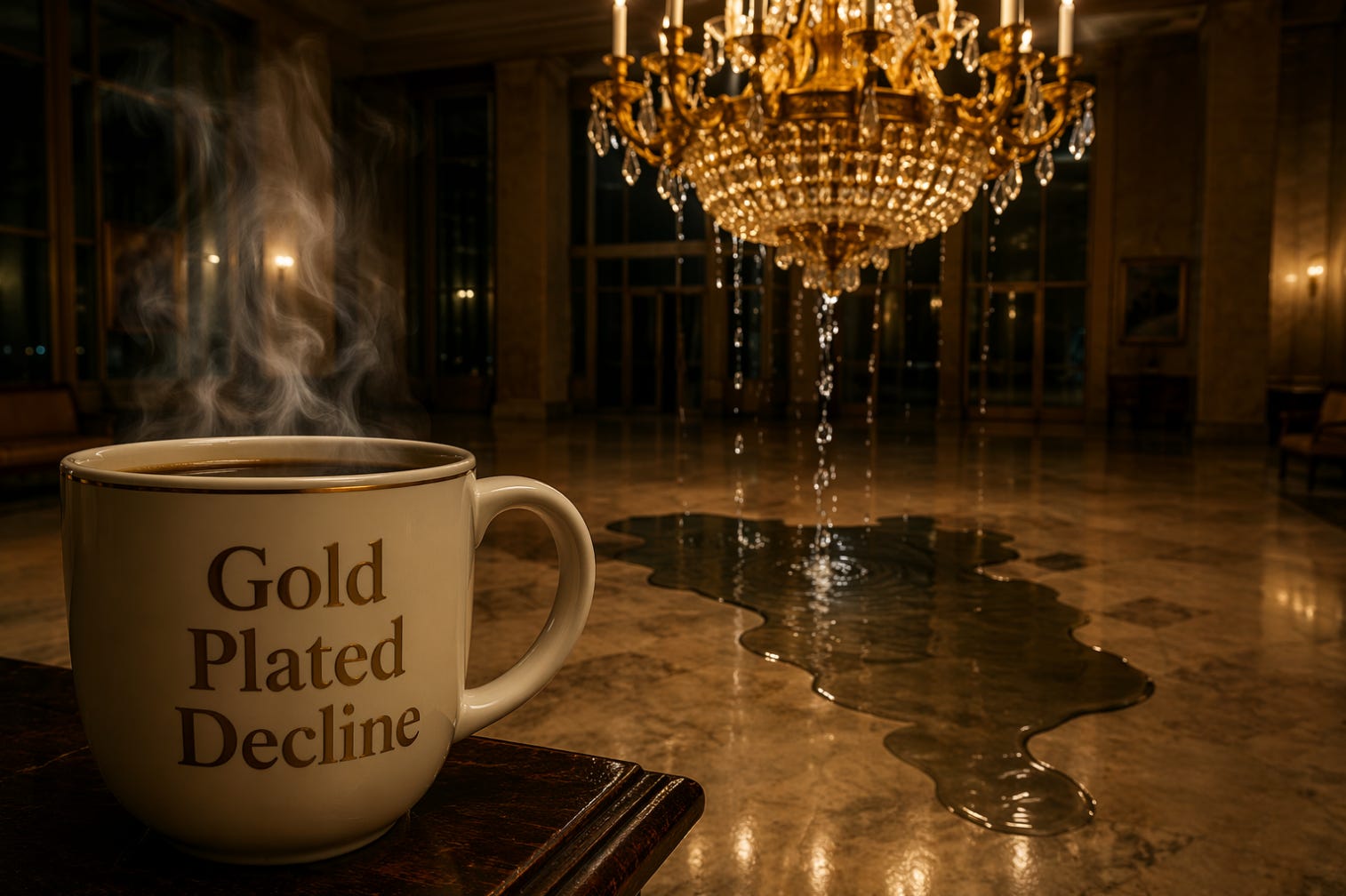
No Trump roundup is complete without at least one scene of cultural vandalism dressed up as patriotism, so we also got a vivid portrait of what has happened at the Kennedy Center. Instead of a facelift, it was a hostile takeover in formal wear. In The Atlantic, Josef Palermo writes that what he saw inside was “far worse than the public knows,” and the picture he paints is of an institution hollowed out by cronyism, donor grift, political branding, and breathtaking incompetence, with artistic credibility bleeding out while management fixated on monetizing proximity to Donald Trump. PBS, summarizing Palermo’s account and the larger upheaval, says the center will “shut down this July for two years,” after a “wave of layoffs” and a deeply politicized rebranding. Earlier reporting on the Les Misérables fundraiser documented ticket packages as high as $2 million for seats near the president. So yes, what better way to “save” a national arts institution than to turn it into a gilt-edged influence bazaar while the building itself visibly decays. Nothing says stewardship like slapping gold on the chandelier while the roof leaks.
This is the real throughline of the era: a governing philosophy built on dominance, humiliation, extortion, and gold-plated incompetence. Every problem is treated like a shakedown, every alliance a protection racket, every institution becomes a donor opportunity. When reality pushes back, these people stare into the mess they created and announce, with magnificent confidence, that everything is going very well.
In closing, I want to thank everyone for the kind wishes. Marz is doing his best to keep me grounded, quite literally, on the hiking paths, and he seems to understand that I’ve been a little distracted. I’m hoping my uncle will let my dad know just how much I miss him.
Putting words together that convey what’s true and real In the psychotic environment of Trumpworld is an extraordinary gift. Thank you, Mary and family. You help keep us sane and grounded.
"Mission Accomplished."