

I started researching this piece with what felt like a simple question.
If poverty is bad for people, and if poor people have less money to spend in grocery stores, repair shops, childcare centers, restaurants, local businesses, and all the other places where ordinary money moves through ordinary life, then shouldn’t poverty also be bad for the economy? And if poverty is bad for the economy, shouldn’t it eventually be bad for the wealthy too?
A country where millions of people are broke is not a thriving country. A town where workers can’t afford rent isn’t a healthy town. A family living one emergency away from collapse is not free in any meaningful sense, even if every founding document, bank advertisement, campaign speech, and corporate slogan in the country insists otherwise.
So why does America, the richest country on earth, continue to tolerate so much poverty, precarity, and debt? The answer, I think, is not that poverty is good for the economy as a whole, because it simply is not. Poverty is wasteful, destabilizing, cruel, expensive, and corrosive. It weakens families, hollows out communities, limits education, worsens health, suppresses small businesses, and turns ordinary life into a long negotiation with fear.
But poverty can be very profitable for specific people and specific institutions. That distinction matters. What is bad for the country can still be good for the landlord, what is bad for the worker can still be good for the employer, and what is bad for the family can still be good for the lender. Poverty can still be good for the corporation that has learned how to extract from desperation rather than contribute to stability.
Joseph Stiglitz, the Nobel Prize-winning economist, has put the matter plainly: “Inequality is a choice.” Not a weather pattern, not a natural law, not some unavoidable expression of human nature moving through the invisible hand. A choice. A structure. A series of decisions made in tax codes, labor laws, zoning rules, antitrust enforcement, trade policy, welfare policy, and all the little places where power writes itself into the daily lives of ordinary people.
This is the contradiction at the center of American life. We are told the economy is built on freedom and choice, but so much of it depends on people having too few real choices to refuse a bad deal. The system doesn’t need everyone to collapse, collapse is bad for business. A person with no income, no housing, no bank account, no phone, no transportation, and no ability to pay is not very useful to creditors, landlords, employers, retailers, insurers, subscription platforms, or the little companies that have figured out how to put a fee on every inconvenience.
What the system really needs is something more durable and more profitable: people who are working, paying, borrowing, renting, consuming, and hoping, but never quite getting stable enough to stop being useful. Almost secure, solvent, caught up, and almost free. This is the economy of almost.
In 2024, the official poverty rate in the United States was 10.6 percent, which meant 35.9 million people were living in poverty by the government’s official measure. The Supplemental Poverty Measure, which includes taxes, transfers, work expenses, medical expenses, and regional housing costs, was higher, at 12.9 percent. That number matters because the official poverty line often misses the actual machinery of American hardship, which is not only about income, but about what gets taken from that income before a person can breathe.
The Federal Reserve found in 2024 that 37 percent of adults could not cover a $400 emergency expense entirely with cash, savings, or a credit card they would pay off at the next statement. Thirty percent said they could not cover three months of expenses by any means if they lost their main source of income. This isn’t total collapse, and that is precisely the point. This is something more useful to the machine, it’s managed insecurity.
It is not always a conspiracy. In many ways, it is worse than a conspiracy, because it doesn’t require a secret meeting or a single villain. It simply needs incentives, if insecurity is profitable, institutions will find ways to preserve it. If desperation lowers wages, someone will benefit from desperate workers. If housing scarcity raises rents, someone will benefit from tenants who can’t leave. If medical fear keeps people tied to bad jobs, someone will benefit from that fear and if debt turns survival into a revenue stream, someone will design products that keep people paying.
What I am describing is the difference between wealth creation and wealth extraction. Wealth creation happens when a society becomes broadly healthier, smarter, safer, more productive, and more capable. People earn more, spend more, save more, start businesses, buy homes, raise children, and participate in public life with some sense that tomorrow might be better than today.
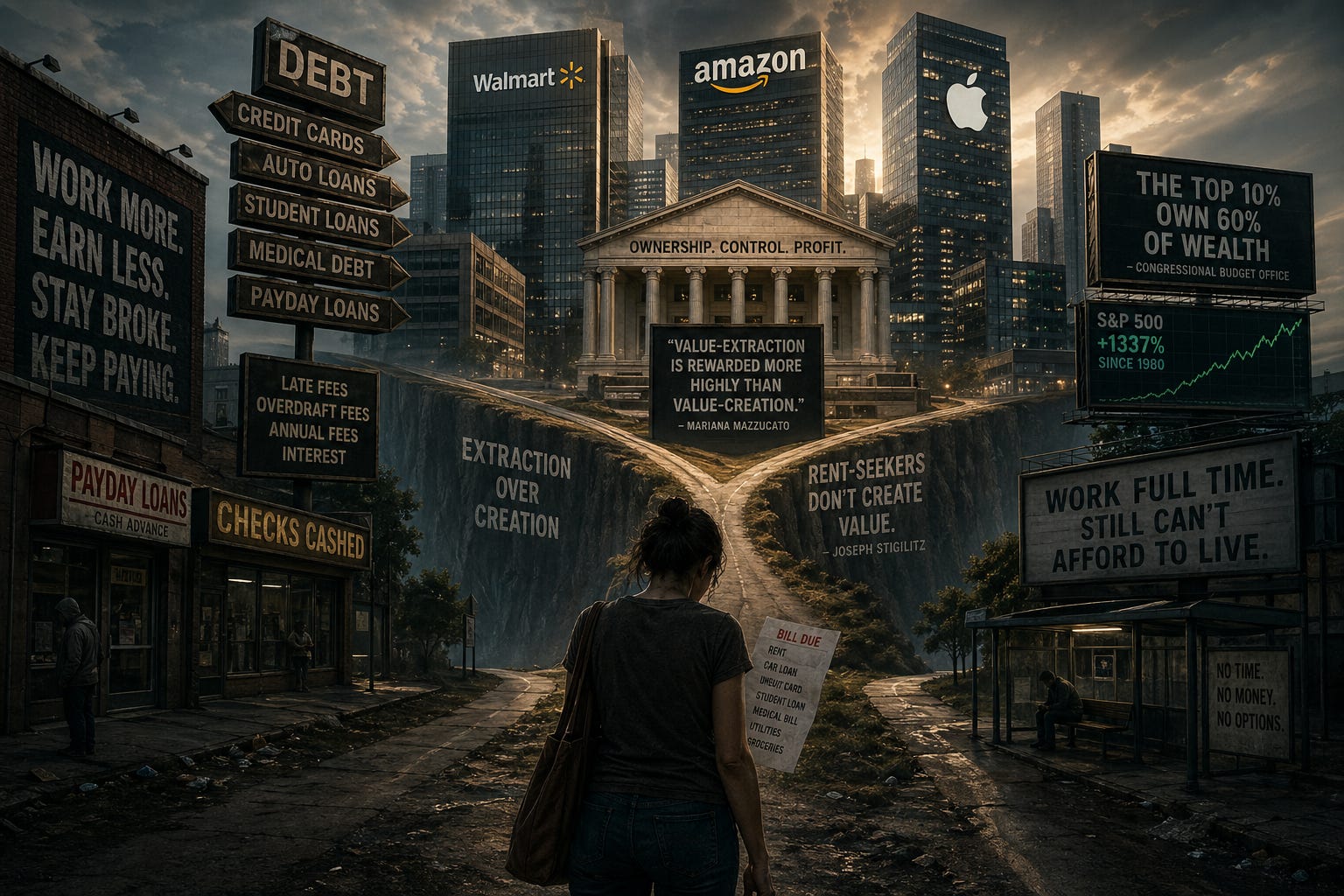
Wealth extraction is different. Extraction happens when wealth flows upward not because society is flourishing, but because someone has gained control over something people can’t live without. Housing, credit, transportation, medicine, food, communication, education, and work itself.
Mariana Mazzucato, whose work has focused on the difference between making value and taking it, describes the disease clearly: “value-extraction is rewarded more highly than value-creation.” That is the American wound in one sentence, we have built a country that praises production, but often rewards capture. We call it innovation when a company builds a tollbooth in front of something people already needed. We call it efficiency when the cost is pushed onto workers, families, public programs, and the bodies of the poor.
In a healthy economy, prosperity spreads; in an extractive economy, pressure rises at the bottom and value flows upward. Even the macroeconomic argument is not especially radical. Researchers at the International Monetary Fund found that “lower net inequality seems to drive faster and more durable growth,” which is another way of saying that an economy is stronger when more people can participate in it rather than simply survive beneath it.
This is what makes the persistence of American poverty so revealing. It is not that poverty makes the country richer, it’s that poverty makes certain people richer before the damage reaches them, or because the damage can be pushed onto someone else.
Credit cards are one of the cleanest examples, because they reveal the two Americas living inside the same product. For people with money, credit cards can be convenient, even rewarding. They offer points, miles, fraud protection, cashback, and a little buffer between purchase and payment. For people without money, those same cards can become a trap with soft velvet edges: minimum payments, high interest, late fees, promotional rates, balance transfers, and the quiet humiliation of watching a balance grow even while you are paying it.
The Consumer Financial Protection Bureau says 208 million American consumers have credit cards. In 2024, credit card balances exceeded $1.2 trillion, the average balance per cardholder rose to about $5,300, and the average APR reached 25.2 percent for general-purpose cards and 31.3 percent for private-label cards, the highest levels in the CFPB’s data since at least 2015.
The same report found that consumers were assessed $160 billion in credit card interest charges in 2024, up from $105 billion in 2022, plus $31.3 billion in fees. About 15 percent of general-purpose cardholders and 20 percent of private-label cardholders made only the minimum payment, which is the polite financial language for a person remaining alive inside the system but unable to get out of it.
This is the business model in miniature. The most profitable borrower is not always the person who defaults completely. The most profitable borrower is often the person who can make the minimum payment but not the full payment, who can catch up but not get free, who can stay current enough to remain in the system while paying for the privilege of being trapped inside it.
The CFPB found in a report on credit card late fees that “revenue from late fees has consistently far exceeded pre-charge-off collection costs.” That sentence is dry, bureaucratic, and devastating. It means that the penalty is not simply a penalty, and the failure is not merely being administered, the stumble is being monetized.
Car loans work in a similar way, but with a distinctly American cruelty, because in much of this country a car is not a luxury. It is how people get to work, school, childcare, doctor’s appointments, and all the daily places of ordinary survival. When public transportation is weak or nonexistent, a car loan becomes more than a consumer product. It becomes an entrance fee to American life. That gives lenders and dealers enormous power.
At the end of 2025, Americans owed about $1.67 trillion in auto debt, while credit card debt stood at $1.28 trillion, student debt at $1.66 trillion, mortgage debt at $13.17 trillion, and total household debt at $18.8 trillion. The country is not only working, it’s financing the right to keep working.
A bad car loan can be made to look affordable by stretching the term, lowering the monthly payment, rolling old debt into new debt, and hiding the true cost beneath the one number a desperate buyer is most likely to focus on: can I make this payment next month? If the answer is barely yes, the deal can move forward.
The CFPB has warned about negative equity in auto lending, where the trade-in value of a vehicle is less than the outstanding loan balance and the unpaid balance gets rolled into the next loan. The Bureau’s language is almost too honest: including negative equity in financing “can place consumers further underwater.” That is finance speaking in the language of drowning.
And if the borrower falls behind, the consequences do not end with losing the car. Repossession can mean losing transportation, then losing work, then damaging credit, then still owing money after the vehicle is gone. The person loses the thing they needed in order to earn the money they needed in order to pay for the thing. That is not just a financial trap; it’s a closed loop of dependence and harm.
Housing may be the deepest version of this problem, because housing is where wages go before a family can do almost anything else. Before savings, before dental care, before new shoes, before school supplies, before the repair that keeps the car running, before a small business gets a customer, before the future gets even a chance, the rent is due.
For owners, housing can build wealth. For renters, housing too often transfers wealth. The Harvard Joint Center for Housing Studies reported that for the third consecutive year, the number of cost-burdened renters reached a record high in 2023, with 22.6 million renter households, or 50 percent of renters, spending at least 30 percent of their income on housing and utilities. More than 12.1 million were severely burdened, meaning they spent more than half their income on housing and utilities.
According to the National Low Income Housing Coalition’s summary of that Harvard report, renters making under $30,000 a year had, on average, only $250 left each month after housing costs to cover everything else. Everything else is food, medicine, transportation, laundry, school clothes, the electric bill, the phone bill, the prescription, the birthday present, the broken tooth, the oil change, and the small mercy of taking your child somewhere that is not home. A nation can call that a market, but the human being living inside it experiences it as pressure.
The same logic appears in low-wage work. An employer that pays poorly may hurt the broader economy by leaving workers with less money to spend, less ability to save, and less stability at home. But the savings from those low wages go directly to the employer, while the damage spreads outward into the public, into families, schools, emergency rooms, food assistance programs, and the bodies of people who are told to be grateful for jobs that do not quite sustain them. The gain is private, while the cost remains social. That is one of the central tricks of extraction.
The Government Accountability Office reported that millions of American adults who earn low wages rely on Medicaid and SNAP to meet basic needs, and that about 70 percent of adult wage earners in both programs worked full-time hours. The work existed; the paycheck simply did not reach the cost of survival.
This is where companies like Walmart become more complicated than a simple morality tale. Walmart helps millions of people survive high prices by offering cheap goods. For families under pressure, that matters. A lower grocery bill is not an abstraction when you are counting the days until payday.
But Walmart also thrives in the kind of economy that makes Walmart necessary. It benefits from a country where wages are low, household budgets are tight, local retail has been weakened, and millions of people need the cheapest possible option because every other part of their lives has become too expensive.
Walmart reported fiscal year 2025 revenue of $681 billion and employs approximately 2.1 million associates worldwide. It’s not just a store; it’s a force in the economic weather. Walmart is both a relief valve and a symptom. It doesn’t simply exploit poverty, it becomes indispensable in a society that produces poverty.
Amazon represents a different kind of power. It is not merely a store, but a marketplace, delivery network, advertising platform, cloud infrastructure company, subscription service, logistics empire, and search engine for buying things. Its power comes from becoming the road itself. Consumers depend on it for speed and convenience, sellers depend on it for access to customers, workers depend on it for jobs, and advertisers depend on it for visibility. Entire businesses can live or die inside rules they did not write and cannot meaningfully negotiate. Lina Khan described Amazon as “essential infrastructure for a host of other businesses.” That is the tollbooth model, first become the road, then charge everyone for driving on it.
In 2024, Amazon reported $638 billion in net sales. Its third-party seller services brought in $156 billion, advertising services brought in $56 billion, subscription services brought in $44 billion, and AWS brought in $108 billion. Those categories matter because they show that Amazon is not only making money by selling products, it’s making money by controlling the infrastructure other people must use to sell, advertise, ship, compute, subscribe, and be seen.
The Federal Trade Commission and state attorneys general sued Amazon in 2023, alleging that it used interlocking anticompetitive tactics to maintain monopoly power, stop rivals and sellers from lowering prices, overcharge sellers, degrade quality, stifle innovation, and prevent fair competition. Amazon denies wrongdoing, and the case remains a legal fight, but the allegation itself describes the architecture of the tollbooth with unusual clarity.
Apple shows another version of the same pattern, though it operates less through poverty and more through enclosure. Apple makes products people love, and that is part of what makes its power so effective. The phone is beautiful. The ecosystem is smooth. The services connect. The devices recognize each other. Gradually, the user is not just buying a product, but entering a controlled environment.
The developer needs the App Store. The user needs the cloud. The family uses the messages. The photos live there. The subscriptions renew there. The repair, the charger, the storage, the payment system, the upgrade path, all of it begins to feel less like a choice and more like a necessity.
Apple reported $109.2 billion in Services net sales in fiscal 2025, up 14 percent from 2024. Its Services gross margin was 75.4 percent, which helps explain why the locked garden is so valuable. The more life moves into the ecosystem, the more the gate itself becomes a profit center.
This is not the same as a payday loan or a predatory car note, but it belongs to the same broader architecture. Poor people are squeezed through desperation. Middle-class people are squeezed through dependency. Affluent people are squeezed through convenience, lock-in, and the high cost of leaving.
Extraction begins where the ability to refuse ends. That may be the sentence that explains more of American life than almost anything else.
Workers can’t refuse bad wages if losing the job means losing health insurance, renters can’t refuse rent hikes if every apartment nearby costs the same or more, and borrowers can’t refuse high interest if the alternative is missing rent, missing work, or going without care.
Small sellers can’t refuse Amazon if that’s where the customers are, app developers can’t refuse Apple if that’s where the users are, and consumers can’t refuse monopolies when the market has been organized around dependence.
We are often told these are choices, technically, perhaps they are. But a choice made under threat is not the same as a choice made in freedom.
This is why the language of freedom in America can feel so strange against the reality of American life. A person can be legally free and economically cornered, they can have options and still have no good option, they can be employed and still be poor, insured and still avoid the doctor, housed and still terrified of rent, educated and still buried in debt, connected and still surveilled, or consuming and still falling behind. This is managed insecurity.
It is not the old image of poverty alone, although that poverty is still very real. It is also the condition of people who look, from a distance, like they are doing fine. They have jobs, cars, phones, apartments, streaming services, maybe even degrees. They are inside the economy, not outside of it, which is precisely why they can be harvested by it.
Every month, the money comes in and the claims arrive to meet it: rent, car payment, insurance, credit card, student loan, phone bill, internet bill, utility bill, medical bill, subscription, fee, interest, minimum payment, late charge, processing charge, convenience charge, which may be one of the more insulting phrases capitalism has ever produced. By the time the worker gets to decide what to do with their money, much of the deciding has already been done.
And this is where shareholders enter the story, because the economy is not merely a place where goods and services are exchanged, it’s a system of claims. Workers live mostly on wages, while the wealthy live increasingly on ownership: stocks, real estate, interest, dividends, rents, fees, platforms, patents, and appreciating assets.
When a company says it is creating value for shareholders, it can sound almost democratic, because many Americans technically own stock through retirement accounts. But meaningful ownership is deeply concentrated.
The Congressional Budget Office found that in 2022, families in the top 10 percent of the wealth distribution held $119.6 trillion in wealth, while the bottom half held $12.8 trillion. The top 10 percent’s share of total wealth rose from 56 percent in 1989 to 60 percent in 2022, while the bottom half’s share remained about 6 percent.
CEO pay tells the same story from another angle. The Economic Policy Institute estimates that from 1978 to 2024, top CEO compensation rose 1,094 percent, while typical worker compensation rose 26 percent. In 2024, CEOs at major U.S. firms were paid 281 times as much as a typical worker. That is why the economy can grow while so many lives feel smaller.
Growth alone does not tell us who is being enriched. A rising stock market doesn’t mean a rising household, a profitable company doesn’t mean a stable worker, and a booming housing market doesn’t mean people are housed. We have confused the wealth of owners with the health of the country.
Stiglitz has a name for one form of this kind of wealth: rent-seeking. “Rent-seekers don’t create value,” he has said. They position themselves where value must pass, then take their cut. They don’t always invent the road, grow the food, heal the patient, teach the child, build the house, or do the work. Sometimes they simply own the gate.
America has learned this lesson before, or at least it has had the chance to learn it. The age of monopolies showed what happens when private power becomes too concentrated. A company can become so dominant that it no longer merely participates in the market; it begins to govern the market. It sets the terms, narrows the choices, disciplines competitors, pressures workers, and reshapes public life around its own needs.
The lesson of monopoly is not that business is bad; the lesson is that unchecked power eventually stops serving the market and starts ruling it. And yet, again and again, America seems to forget. We allow private systems to grow until they become unavoidable, then we act surprised when they behave like powers rather than participants. We watch industries consolidate, wages stagnate, rents rise, debt deepen, public goods weaken, and private tollbooths appear where shared infrastructure should have been. Then we ask why people are angry.
People are angry because they can feel the trap even when they don’t have the language for it. They know something is wrong when working full-time doesn’t guarantee stability, when a medical bill can undo years of effort, when rent rises faster than pay, when debt becomes normal, when every company wants a subscription, when every mistake has a fee attached, and when every basic need seems to come with someone standing between the person and the thing they need.
People know, somewhere deep in the body, when they are being farmed. That is the emotional truth beneath the economic one. The cruelty of this system is not only that people suffer, it’s that their suffering is useful, their late fees are revenue, their overdrafts are revenue. Their unpaid balances, their rent, their inability to buy a home, their need for a car, it’s all revenue. Their fear of losing health insurance is leverage, their exhaustion is political silence, and their desperation is someone else’s margin.
A society can survive some inequality; it can’t remain healthy when insecurity becomes a business model. The question, then, is not whether America can afford to reduce poverty. Of course it can, this country has extraordinary wealth, extraordinary talent, extraordinary productive capacity, and extraordinary imagination when imagination is demanded of it. The question is whether America is willing to stop treating instability as a source of profit.
Because the opposite of poverty is not luxury, the opposite of poverty is power.
The power to say no, to leave a bad job, to move, to wait, to see a doctor before the crisis and to participate in public life without being too tired to think.
A society where people can’t afford to say no is not truly free, no matter how many choices it claims to offer. It may have markets, apps, one-click checkout, same-day delivery, payment plans, credit scores, rewards points, loyalty programs, and personalized recommendations. It may have all the symbols of abundance, all the glowing screens and frictionless conveniences and cheerful corporate language promising ease. But beneath that surface is a quieter reality.
Millions of people are not choosing from abundance; they are choosing under pressure. And pressure, in America, has become one of the most profitable products of all.
Agreed. Now that I am 90 years old I can see that parenthood is one of the traps from which my personal shortcomings and those of my parents made me ripe for economic indenture. Thank heavens school loans were not yet marketed. If I had had school loans I would likely still be in debt.
I hope Substack works for you. I know your children will thank you for having parented them.
Hal
This is an incredible analysis. It clearly shows example after example of the disturbing truths of life in America for the very few "haves" and the vast majority of "have-nots".