


There are some stories that arrive already absurd, wearing a little hat and carrying their own punchline, and then there are stories that begin innocently enough with the president announcing that he’s found a way to make hamburger cheaper.
At first glance, this one sounds almost wholesome. Americans are paying too much for beef. The cattle herd is at a roughly 75-year low, grocery prices remain painful, and ground beef has joined the growing list of ordinary household staples that now require a brief consultation with your checking account before entering the cart. President Trump, who has spent much of his presidency assuring us that tariffs are the greatest economic invention since currency, announced last week that he intends to temporarily remove one of them.
Specifically, the administration wants to waive the normal out-of-quota tariff on as much as 300,000 metric tons of imported ground-beef product over 90 days. Trump says someone, somewhere, has committed to selling this beef at 25 percent below current market prices.
Who? You may ask. Excellent question. Where is it coming from? You may wonder. Another excellent question. Who agreed to the discount? Apparently we’ve entered a phase of economic policy in which details are considered an optional decorative flourish. Agriculture Secretary Brooke Rollins said this week that she didn’t know which countries would supply the beef, which is comforting in roughly the same way it would be comforting to board an airplane and learn that the pilot is still being selected but everyone remains very optimistic about landing.
Still, let us be charitable. Perhaps the paperwork is coming, the suppliers are being finalized, and perhaps there is a perfectly ordinary explanation for why the United States government announced that hundreds of millions of pounds of cheaper foreign beef are on the way before anyone appears willing to tell the American public whose cows we are discussing. There probably is, probably.
The reason Washington is doing this is straightforward enough. The United States doesn’t currently have enough cattle. Years of drought, high feed costs, herd liquidation and difficult economics have pushed cattle numbers down to levels we haven’t seen in generations. American ranchers finally have something approaching pricing power because there simply aren’t enough cattle available to satisfy demand.
That has been good for cattle prices. It has been considerably less good for companies that buy cattle. Tyson Foods recently announced that it’s closing major beef-processing facilities in Illinois and Utah, eliminating thousands of jobs, because there aren’t enough cattle moving through the system to keep all those plants economically viable.
This is where our simple hamburger story develops its first small facial twitch. The administration says America needs to rebuild its cattle herd. It also says the beef-processing industry has become dangerously concentrated. The Justice Department is investigating an industry in which four companies control roughly 85 percent of processing capacity. Two of those giants have Brazilian ownership. And now the administration’s immediate solution to expensive American beef is to make a giant quantity of foreign beef cheaper for processors to import.
Again, this doesn’t necessarily mean anything nefarious. It merely means our national beef policy has reached the stage where we are simultaneously trying to save American cattlemen, investigate their biggest customers and give those customers cheaper imported cattle products. It’s a policy approach best described as aggressively moisturizing the rug while someone is still sweeping things underneath it.
This is also where Brazil enters the room. Brazil is the world’s largest beef exporter, and it already sends enormous quantities of lean processing beef to the United States. This isn’t steakhouse ribeye. Much of it is lean beef and trim that gets blended with fattier American beef to produce the hamburger found in grocery stores, restaurants and fast-food chains.
Brazil’s low-tariff access to the American market is limited, however, and once the applicable quota fills, additional shipments are normally hit with a 26.4 percent tariff. Which means that if you wanted to dramatically improve the economics of Brazilian beef entering the United States, one exceptionally effective way to do that would be to remove 26.4 percent of the tariff. A Brazilian wax, if you will. I’m sorry. We had to get here eventually. And before anyone objects, I would simply note that Washington itself has presented us with a policy involving Brazil in which a substantial percentage is being suddenly stripped away for reasons that are not yet entirely clear. I’m merely reporting the grooming procedure.
The situation becomes even more interesting because Brazil’s beef industry is about to encounter trouble in Europe. Beginning September 3, Brazil is scheduled to lose eligibility to export certain animal products, including beef, into the European Union because European regulators say Brazil hasn’t provided sufficient guarantees that its antimicrobial-use controls comply with EU standards.
There is an important distinction here because social media has already poured gasoline over it. Europe has not announced that Brazilian beef is toxic. It has not announced that inspectors found warehouses full of radioactive hamburger. It has not declared that consuming a Brazilian meatball will cause your internal organs to apply for asylum. The dispute involves Brazil’s ability to demonstrate compliance with European rules governing antimicrobial use and monitoring.
That is still significant, because losing access to a major export market creates a powerful incentive to find other markets. And fortunately for Brazil, several days before the European door closes, the United States announced that it would like several hundred thousand metric tons of foreign beef at a discount. Again, coincidence is a thing, coincidence happens every day. I personally once bought shampoo on the same afternoon my husband mentioned that his hair felt dry, and nobody convened a congressional investigation. But coincidences become more entertaining when additional coincidences begin arriving in formation.
One of America’s largest beef processors is JBS USA, owned by Brazilian meat giant JBS. JBS’s owners have had direct access to Trump. Joesley Batista, one of the brothers who control JBS, personally met with Trump during the earlier fight over tariffs on Brazilian goods and reportedly argued that those tariffs were making beef more expensive for American consumers. Pilgrim’s Pride, which is controlled by JBS, contributed $5 million to Trump’s inaugural committee.
Five million dollars is a considerable amount of money. It’s enough money that, were someone to hand it to me, I would probably remember their name. The administration is now preparing to reduce the cost of importing beef. It hasn’t identified the companies that will benefit. It hasn’t identified the countries that will supply it. And because the universe occasionally has a sense of humor so heavy-handed that even I would edit it down, Brazilian beef connected to JBS was arriving at the Port of Houston around the same time Trump made the announcement.
There’s no evidence those shipments were part of the new program, no evidence JBS had advance knowledge, and no evidence that someone whispered, “Get the beef on the boat, Donald is about to wax the tariff.”
I would like that sentence entered permanently into the historical record. Still, at some point a journalist is allowed to look around the room. We have Brazilian beef. We have Brazilian meatpacking giants. We have a Brazilian meatpacking billionaire who has personally discussed beef tariffs with the president. We have a Brazilian-controlled company donating $5 million to Trump’s inauguration. We have Europe preparing to close its market to Brazilian beef products, Washington preparing to open ours wider, hundreds of millions of pounds of beef supposedly heading our way at a 25 percent discount, and nobody in the administration will say who made the deal.
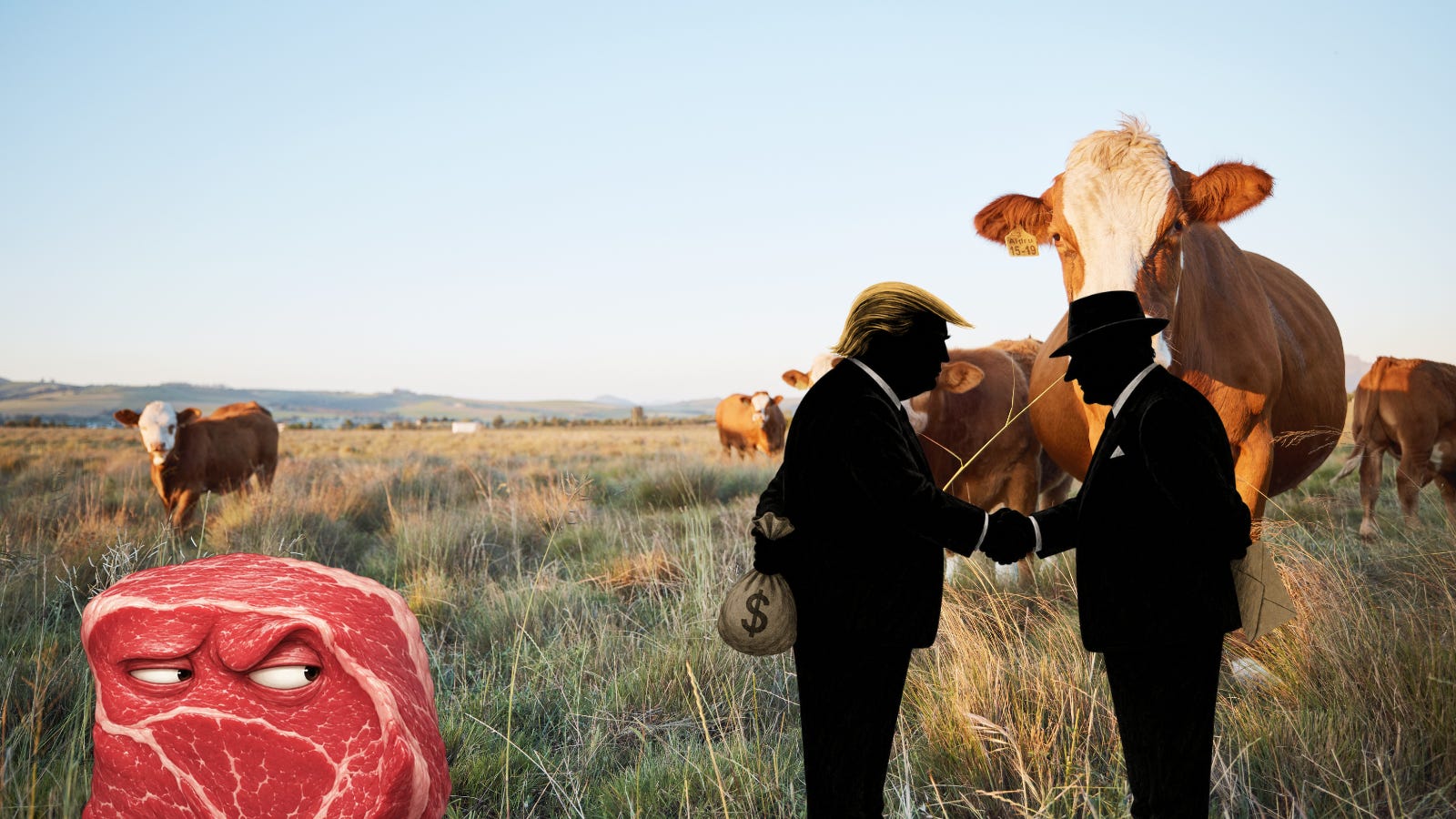
This is normally the point in an investigation where someone wheels out a corkboard. I resisted, for several hours. Then I remembered that Trump has also spent months arguing that the giant meat processors are part of the reason Americans pay too much for beef. So, the government is investigating the processors because they may have too much market power while simultaneously making imported beef cheaper for those same processors to buy. I have now placed Brazil on the corkboard. There is yarn, we are no longer pretending otherwise. The good news for consumers, according to Trump, is that all of this will result in cheaper hamburger.
The less exciting news is that agricultural economists who have actually modeled the policy think the effect at the grocery store will probably be tiny. Purdue economists estimate that even under generous assumptions, the average retail price of ground beef is unlikely to fall by anything close to 25 percent. It may not even fall 1 percent. This is because the tariff reduction happens near the beginning of the supply chain, while your hamburger has to travel through importers, processors, distributors and retailers before reaching the little Styrofoam tray under fluorescent lighting at Safeway.
Every one of those businesses will encounter the savings before you do. Some may pass them along, some may not. Capitalism is full of mystery. So we appear to be contemplating a policy under which American ranchers face additional foreign competition, giant processors get access to cheaper inputs, foreign exporters gain a new market, and American families may eventually receive enough savings on a pound of ground beef to finance approximately three quarters of a gumball. At which point we will presumably hold a press conference. There will be flags, someone will wear a hard hat. Trump will announce that hamburger has been saved. Perhaps he will stand behind a table covered in raw beef, as presidents traditionally do when stabilizing commodity markets. And somewhere in Brazil, an executive will quietly slide another frozen block of lean trim toward a cargo ship.
I want to emphasize that we do not currently have evidence of a secret Brazilian beef conspiracy. We have something far more annoying. A collection of entirely public facts arranged in such an absurd configuration that conspiracy has become aesthetically unnecessary. The administration says it’s protecting American ranchers while increasing foreign beef imports. It says tariffs protect American industry while waiving tariffs on beef. It says giant processors have too much power while adopting a policy those processors may benefit from. It says consumers will get beef 25 percent cheaper while economists say the actual grocery-store savings will probably be nowhere near that. It says there’s a deal but won’t tell us who made it.
And hovering over the whole thing is Brazil, whose beef industry is about to lose access to part of Europe and whose largest meat company happens to have both an enormous American footprint and a history of unusually friendly access to the president.
Maybe everything is completely innocent. Maybe, somewhere inside the federal government, there is a beautifully organized binder explaining all of this and Brooke Rollins simply hasn’t received her copy. Maybe the supplier will turn out to be Uruguay. Maybe 300,000 metric tons of discounted mystery hamburger will descend upon America and our grocery bills will collapse with such force that economists everywhere will apologize. Anything is possible. But until Washington tells us whose beef it’s buying, who promised the discount, which companies will receive the tariff benefit and how any of this is supposed to rebuild the American cattle herd, I think a certain amount of suspicion is appropriate.
Not dangerous suspicion, not internet basement suspicion, just the normal sort of suspicion one develops when a government announces 661 million pounds of unidentified foreign meat and then acts surprised that people would like to know where it’s coming from. For now, all we can say with certainty is that America has a beef problem, Washington has found Brazil nearby with a large beef industry, and someone has apparently decided that the solution is to remove 26.4 percent from the equation.
They’re calling it inflation relief, I’m calling it the Brazilian wax. And judging by the reaction from American cattlemen, somebody forgot to ask whether they wanted one.
I had been betting on Argentina, but your presentation makes a lot of sense. Given Trump's loose grasp of percentages, the "25%" savings could simply be his perception of what happens when the tariff is waived.
The questionable inspection protocols currently in place due to lack of staff at the FDA make eating this beef an exercise in adventure. I'll pay a bit more for my locally sourced and only occasionally eaten beef and follow the advice I saw somewhere to "eat more chick'n".
Omg, not coincidental at all, and not suspicious for creepy collusion at all. I wonder how much of that beef is from a cow. This ahole is soo on the take, he never does anything without a cash payout. Thank you, Shanley, for making this mystery meat palatable with sharp humor. Way to go.