

Good morning! They voted for Trump, but they live in a state that did not. In the new disaster-relief system, the second fact appears to cancel out the first. That is the lesson now drifting through the smoke over Oregon.
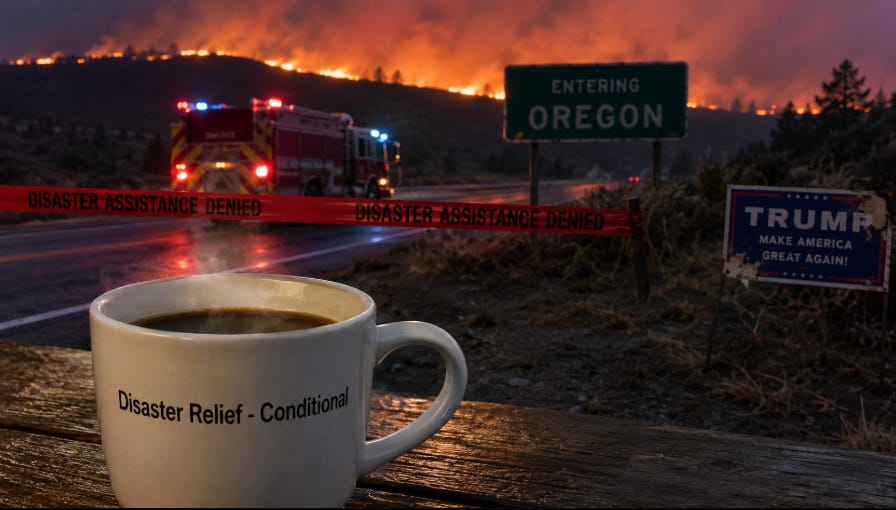
The Rowe Creek Complex has burned across hundreds of thousands of acres in Central and Eastern Oregon. The East Evans Creek Fire has burned nearly 16,000 acres in Jackson County. At the time Oregon requested federal firefighting assistance, both fires had residents under Level 3 “Go Now” evacuation orders. Rowe Creek was then the largest fire in the United States.
FEMA denied both requests.
This was not a case of Oregon asking Washington to reimburse a county for an overcooked backyard barbecue. East Evans Creek had more than 230 homes under immediate evacuation orders and threatened roads, bridges, radio and cellular towers, utilities, businesses, irrigation systems and agricultural operations. Rowe Creek had more than 400 people under Level 3 evacuation and threatened electrical cooperatives, public-safety communications, and transmission lines. Oregon officials say both fires exceeded the household threshold FEMA historically used when approving Fire Management Assistance Grants, including the higher informal benchmark the agency has apparently adopted in recent years.
FEMA approved assistance for three other Oregon fires, the Lower Dry Creek, Akawa Butte and Grasshopper fires, but rejected East Evans Creek and Rowe Creek. The agency reportedly said the two rejected fires did not meet the criteria for a major-disaster declaration.
A small problem with that explanation is the 300,000-acre wall of fire standing behind it. A Fire Management Assistance Grant is not supposed to be reserved for the smoking ruins left after a fire completes its transformation into a major disaster. It exists to help states fight fires that threaten to become major disasters. FEMA’s program covers up to 75 percent of eligible firefighting costs and is designed to get assistance moving quickly while homes, infrastructure and communities can still be saved.
The new policy is that Oregon must first permit the fire to achieve its full destructive potential. Only after the homes burn, the power lines fall and the evacuation route disappears beneath a column of smoke may the state return to Washington and demonstrate that the earlier request was not merely the product of an overactive imagination.
Senators Ron Wyden and Jeff Merkley described the denials as a significant departure from FEMA’s historical criteria and its own guidance. They asked the agency which eligibility standards changed between 2025 and 2026, who changed them, and what information FEMA used to conclude that these fires did not qualify. The sorts of questions one asks when an emergency agency appears to have moved the goalposts while people are running toward the end zone carrying pets, medications and whatever else they could fit in the car.
The outrage is bipartisan. Democratic state Representative Emerson Levy and Republican Representative Vicki Breese-Iverson issued a joint statement demanding equal treatment for the affected communities. Breese-Iverson, who represents Prineville and has lived in rural Oregon throughout her life, said local communities had done everything right, and FEMA still shut the door.
Her participation matters because the geography of these fires makes a mockery of any assumption that this is simply federal money being withheld from Democratic voters.
East Evans Creek is in Jackson County, which Donald Trump carried with 51.64 percent of the vote. The Rowe Creek Complex spans territory in Wheeler, Crook, Jefferson and Wasco counties. Trump won Wheeler County with 71.20 percent, Crook County with 73.71 percent and Jefferson County with 63.44 percent. He also carried Wasco County, though much more narrowly, with 51.06 percent.
There are places in Oregon where finding a Harris voter requires no special effort. Wheeler and Crook counties are not among them.
Trump won these precincts by margins large enough to qualify as a local weather system. If federal disaster assistance were being allocated according to county-level loyalty, FEMA would be descending over Prineville beneath a banner reading THANK YOU FOR YOUR SUPPORT.
Counties rarely submit these applications directly to the White House. The State of Oregon does. The request arrives bearing the identity of Oregon, with a Democratic governor, two Democratic senators and a statewide electorate that chose Kamala Harris.
The administration does not need to see Wheeler County. It can see Oregon.
Collective punishment administered through federalism works this way. County lines and precinct returns cease to matter. Republican ranchers, conservative retirees and Trump-supporting business owners receive no exemption simply because they live inside a state the president considers hostile. The entire state is painted blue, and everyone within its borders is treated as part of the enemy encampment.
The residents of Crook County may have supported Trump by more than 50 points. The residents of Wheeler County may have given Harris barely one vote in four. They all still live in Oregon.
Their votes were useful when Trump needed an Oregon total to add to the national popular vote. Their needs become less visible when they arrive attached to paperwork from Governor Tina Kotek.
The national record gives us little reason to dismiss this as paranoia.
An Associated Press analysis of FEMA data found that Trump has approved approximately 80 percent of disaster requests from Republican governors during his second term, compared with about 60 percent from Democratic governors. When the states are sorted according to their 2024 presidential vote, Trump has approved more than three-quarters of the requests from states that supported him and fewer than half from states that did not. AP found that no president since the modern disaster-declaration system was established in 1989 had produced such a wide partisan disparity.
The administration says there is no politicization involved. This is just one of those remarkable coincidences in which a process produces sharply partisan outcomes while remaining pristinely unaware of politics, rather like a roulette wheel that lands on red whenever the casino owner’s brother places a bet.
Earlier this month, Trump denied disaster requests from New York, New Jersey, Massachusetts and Rhode Island following February’s severe snowstorm. All four are Democratic-led states.
New reporting makes those denials considerably harder to explain as close judgment calls. Regional FEMA and NOAA offices had already determined that all four states met the government’s thresholds for assistance. Professional reviewers had finished their work, documented the damage, and concluded that the applications qualified. Trump rejected them anyway.
This was a president discarding the findings of his own agencies after they concluded that the states deserved help. FEMA said yes. NOAA said yes. Trump looked at four Democratic-led states and said no. The administration maintains that politics played no role.
The Oregon grants are technically different from presidential major-disaster declarations. FEMA, rather than Trump personally, made the FMAG decisions, and the legal standards are not identical. This prevents us from stating as proven fact that Trump ordered these two denials because Oregon voted for Harris.
It does not require us to place the entire matter inside a locked filing cabinet marked UNKNOWABLE MYSTERY.
Oregon has already seen how the administration views federal funding and blue states. In a court filing concerning more than $7.5 billion in canceled clean-energy grants nationwide, government lawyers acknowledged that Oregon and other targeted states were selected “based solely” on their political identity, specifically, whether the administration categorized them as blue. The filing also said officials did not look beyond the primary grant recipients to consider where the projects’ jobs, investment and other benefits would actually land. The Energy Department now disputes that characterization, but the language in the court record is not subtle.
The administration has already demonstrated that it can look at a federally funded project in a Trump-voting rural county, noticing that the county sits inside a Harris-voting state and deciding that the state’s political identity is the only identity that matters.
We have seen the consequences here in Oregon. Coos County voted for Trump with 58.34 percent of the vote. That did not give Coos County an exemption when the administration canceled clean-energy grants assigned to Oregon. It did not create a little red-county escape hatch in the side of the blue-state penalty box.
Now the same question hangs over disaster assistance.
I live in Coos County. In May, Governor Kotek placed Coos, Klamath and Wheeler counties under drought emergency declarations. At the time, all of Coos County was experiencing moderate drought, with precipitation over the preceding year running between 70 and 90 percent of normal. State officials warned that conditions were unlikely to improve in the near term and that the dryness would increase wildfire risk.
On July 20, the Coos Forest Protective Association raised the fire-danger level on the lands it protects to High/Yellow. Debris burning is prohibited. Fire season has been in effect since June 1.
Coos County is not experiencing a Rowe Creek-scale fire today. May it remain that way.
But Wheeler County was placed under drought emergency status in the same state order as Coos. At the time, more than 97 percent of Wheeler County was already in severe drought, parts had reached extreme drought and the John Day Basin’s snow-water equivalent stood at 2 percent of normal. The state warned that extreme dryness would increase the danger of wildfire. Then the wildfire came.
The sequence could hardly be clearer. The drought was documented. The risk was identified. The fire arrived. People were ordered to leave. Infrastructure was threatened. Hundreds of thousands of acres burned. FEMA decided the situation was not disastrous enough.
Everyone in Oregon should be concerned, including the people who believe political punishment is acceptable when aimed at Portland. Fire has an irritating habit of ignoring the culture-war map. It does not stop outside a Trump voter’s property to salute the yard sign. It does not spare the Republican-owned ranch while making a purposeful turn toward a Democratic household. Smoke does not request a voter-registration file before entering a child’s lungs.
Once a president begins treating states as partisan units deserving reward or punishment, the people inside those states become incidental. Some are intended targets. The rest are acceptable losses.
Trump voters in blue states appear to be collateral damage in the larger project of punishing blue America. They may have supported him by landslide margins, but once their community’s needs arrive in Washington on a Democratic governor’s letterhead, the loyalty that mattered so much on Election Day becomes administratively invisible.
Perhaps some of them assumed Trump’s threats against blue states referred only to urban liberals, Democratic officials, university professors and whichever Portland resident had most recently failed to display sufficient enthusiasm for an internal-combustion engine. Perhaps they imagined the federal government could punish the people they dislike while carefully protecting the roads, hospitals, electrical systems, farms, firefighting districts and emergency services on which everyone depends. A state-level loyalty test does not come with county-level exemptions.
States are not cable-news panels divided into convenient ideological segments. They are an interconnected political and economic unit. When the federal government withholds assistance from Oregon, the consequences do not remain politely contained within Multnomah County. They travel across power grids, insurance markets, transportation systems, hospital networks, local budgets and firefighting districts.
The federal government was created in part because disasters routinely exceed the capacity of individual communities and states. Americans everywhere contribute to the same national treasury. When a hurricane hits Louisiana, Oregon taxpayers help. When a tornado hits Oklahoma, New York taxpayers help. When a blizzard buries Rhode Island or a wildfire threatens rural Oregon, the national government is supposed to respond according to the scale of the emergency, not the president’s assessment of the governor’s political leanings.
That compact requires a president capable of understanding federal money as public money rather than personal property. Trump has always preferred patronage to governance. Everything becomes a transaction with himself at the center: praise earns access, obedience earns protection, disloyalty earns retaliation. Disaster relief is merely the latest public institution to encounter the velvet rope.
We do not have to look far for evidence of how heavily revenge weighs in Trump’s decision-making. On Thursday, he threatened to sacrifice the confirmation of Todd Blanche, his former personal lawyer and current acting attorney general, rather than make concessions demanded by two Republican senators who have fallen out of his favor.
John Cornyn and Thom Tillis want the administration to formally kill the $1.8 billion “Anti-Weaponization Fund” embedded in Trump’s extraordinary settlement with the IRS and narrow the agreement’s protections against future audits of Trump, his family and his businesses. Trump could accept those changes, secure his chosen attorney general and move on.
Instead, he has suggested withdrawing Blanche’s nomination and submitting it again after Cornyn and Tillis leave the Senate in January.
Trump is governing by grudge calendar. Why settle an institutional dispute today when you can place the Department of Justice in confirmation limbo for six months and wait for your enemies to vacate the building?
None of this is proof that Trump ordered FEMA to deny Oregon’s firefighting grants. It tells us that revenge is not too petty, costly, or self-defeating to serve as an explanation for his conduct. He will spend political capital, institutional stability, and even the ambitions of loyal subordinates to preserve his right to punish.
Congress gave presidents broad discretion over disaster declarations because it assumed they would use judgment in good faith. The statutes were designed to help the executive respond to complicated emergencies, not sort the country into jurisdictions deserving rescue and jurisdictions requiring correction.
Trump treats discretion differently. To him, it is the legal space between what he wants to do and anyone’s ability to stop him. The same president willing to hold his attorney general’s confirmation hostage to a personal feud is now entrusted to decide, beyond judicial review, whether a disfavored state deserves help after a blizzard, flood, or wildfire.
As Charles Blow put it, Trump has governed not as president of the United States, but as “president of MAGA America,” and even membership in MAGA America appears revocable when you live on the wrong side of a state line.
The courts may offer little relief. Presidents possess broad authority over major-disaster declarations, and judges have historically been reluctant to second-guess federal funding decisions. Oregon’s FMAG denials may be more vulnerable if FEMA ignored its own regulations or relied on undisclosed standards, but “difficult to overturn” is not the same as fair, legitimate or faithful to the purpose of the law.
Trump’s recurring discovery is that any norm can become a weapon once he will do what his predecessors considered beneath the office.
Oregon now has 30 days to appeal. Firefighters and state officials are left trying to determine which standards FEMA is actually using, while rural communities wonder whether the federal government will still be there when local resources run out.
It leaves the rest of us with an uncomfortable new calculation whenever we see smoke rising beyond the tree line.
Does the fire meet the federal standard?
Did the state vote correctly?
Which of those questions now matters more?
The people of Wheeler, Crook, Jefferson, Jackson and Wasco counties should not have to ask. Neither should those of us living under drought emergency conditions here in Coos County. Disaster aid is not a campaign reward. Firefighting assistance is not a presidential favor. Federal taxes are not tribute paid to a ruler who later decides which provinces have shown sufficient loyalty.
They voted for Trump, but they live in a state that did not. In the disaster-relief system taking shape beneath him, the second fact appears to cancel out the first.
Do you think this will change any of the votes of the OR MAGAs? Will they reconsider if supporting an unreasonable leader that hurt them personally was a good idea?
For that matter will the level of personal dealing, reward or punishment change any blue votes?
I'm guessing "nope".
Federal funds are not the administration’s personal funds to be parsed out via personal or political grudges,decisions or desires. Emergency assistance programs should be funded in an emergency (a conflagration, especially ones burning down homes and displacing residents, in any state should qualify as an emergency) per agreed upon non political regulations regarding the usage of these funds.