


Donald Trump arrived in Marietta, Georgia, on Wednesday for what the White House presented as an official event promoting Trump Accounts, the new tax-advantaged investment accounts for children created by his signature tax-and-spending law.
He had barely reached the lectern before floating one of those jokes that doubles as a trial balloon: he was there to announce his candidacy.
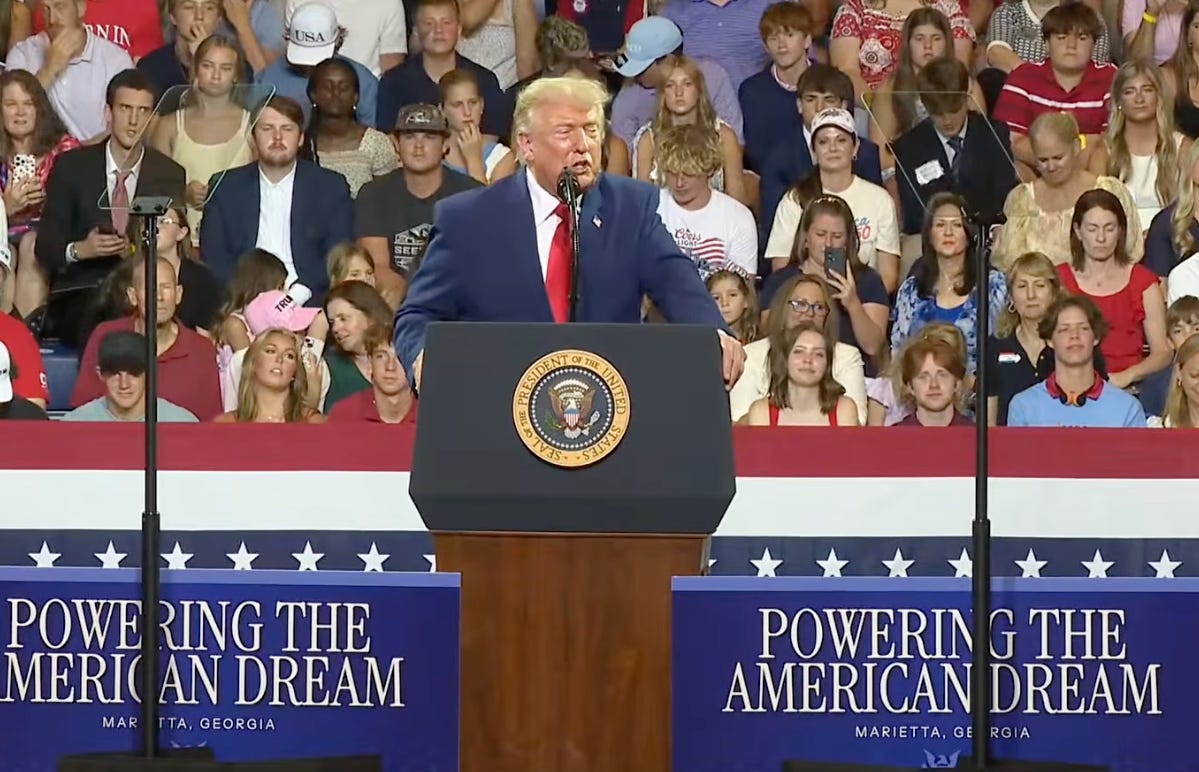
“I’m only kidding,” he assured the crowd, although the next hour and fourteen minutes would make it seem less like a joke than an unusually candid description of the proceedings.
Trump praised the Republican candidates gathered around him, recalled his “big, beautiful victory” in Georgia and warned that they had to win their coming races “by a lot” because “otherwise we’re going communist.” Then came the customary traveling assortment of migrants, murderers, transgender people, Venezuela, Iran, Afghanistan, the stock market, eggs, pharmaceuticals, front-row groupies and the unique suffering involved in being Donald Trump.
The advertised subject of the event did not appear until roughly twenty-five minutes into his remarks. “Perhaps most consequential of all,” Trump finally announced, was a provision in his tax-and-spending law “called the Trump Accounts,” which he declared was already “hot as a pistol.”
Once he reached the policy allegedly responsible for the trip, Trump described how “every newborn child gets $1,000 deposited in their Trump Account at birth,” praised wealthy donors and summoned carefully selected Georgia families to the stage to testify to the splendor of investing in capitalism before mastering solid food.
The brief official-policy interlude then ended, and the campaign rally resumed.
Trump brought gubernatorial candidate Rick Jackson to the microphone to announce a proposal to add another $1,000 in state money. He endorsed candidates for attorney general, lieutenant governor, secretary of state and Congress. He instructed the crowd to elect Mike Collins to the Senate, repeatedly insulted Collins’s opponent as “Pee-Wee Herman” and assured the audience that his prescription-drug policies “alone should win us the midterms,” unless Democrats cheated again.
By the closing stretch, Trump was demanding voter identification, documentary proof of citizenship, the near-elimination of mail ballots, and the destruction of the Senate filibuster so Republicans could enact his election agenda without Democratic votes. The event ended where it had begun: not with a discussion of children’s savings accounts, but with an appeal to preserve Republican power.
The Trump Accounts were the official designation under which the campaign rally traveled.
None of this, by itself, violated the Hatch Act. The federal law restricting partisan political activity defines an “employee” as someone serving in the executive branch “other than the President and the Vice President.” Nearly everyone else involved in producing an official White House event must navigate rules governing political activity. The two people at the top are expressly excluded. Trump can endorse candidates, attack their opponents and tell voters that a Democratic victory will bring communism, squalor and death while standing behind an official presidential lectern. The Hatch Act simply does not reach him.
That said, not every dollar spent around him automatically becomes a legitimate public expense. Longstanding Justice Department guidance says appropriated funds may pay only for travel reasonably related to an official purpose. Political travel must be financed politically, and costs are supposed to be apportioned when a trip combines official and campaign activity. Federal election rules also require reimbursement for campaign travel aboard government aircraft.
“Supposed to” is doing considerable work there. A president must remain protected and reachable whether he is negotiating a treaty, visiting a disaster zone or spending an hour calling Democratic candidates communists. Secret Service protection does not clock out when the speech turns partisan. The White House Communications Agency continues providing secure communications during political and even personal travel. Campaign reimbursement formulas may not reproduce the full expense of moving the presidency from Washington to a high school gymnasium in Georgia; salaries and many support costs must still be paid.
Further, somebody must decide where the official portion ends and the political portion begins. No mean feat when the event has been deliberately designed so that no such boundary can be seen without laboratory equipment.
Was Trump speaking officially while praising the law he signed? Presumably. Was Rick Jackson acting politically when he used the presidential stage to announce a plank in his campaign for governor? Obviously. What about Trump praising Jackson, attacking Democrats, endorsing four other candidates and discussing what should win Republicans the midterms? Somewhere, an accountant is invited to divide the presidential motorcade by the minute while pretending the entire performance was not constructed to make such division absurd.
The Georgia appearance was therefore not merely a clever way to have taxpayers help finance a campaign rally. The content made it considerably worse.
Trump used the institutional authority of an official presidential event to deliver a stream of claims that were not simply partisan judgments or convention-hall exaggerations. Many were specific, measurable and provably untrue.
He claimed that his administration had secured $19.2 trillion in new investment in about fifteen months. The White House arrives at its ever-growing totals by combining corporate announcements, multiyear spending plans, foreign-government pledges and projects that sometimes began before Trump returned to office. By contrast, the Bureau of Economic Analysis measured $232.2 billion in actual new foreign direct-investment expenditures during 2025, or $284.5 billion when future planned expenditures associated with those investments were included. Those categories are not identical, which is precisely the problem: Trump presents announced commitments and aspirational spending over several years as though $19.2 trillion has already marched into the country carrying tool belts.
He announced that the United States and Venezuela together control “about 62 percent of the world’s oil market.” According to the Energy Information Administration, the United States produced about 23.6 million barrels per day of petroleum and other liquids in 2025, while Venezuela produced about 1 million. Global production was approximately 106 million barrels per day. Together, the two countries accounted for roughly 23 percent, not 62 percent, unless Trump has discovered another Venezuela beneath the first one and forgotten to tell the geologists.
The word “partnership” is also doing more work than the facts support. Venezuela is a sovereign nation, not a subsidiary of the United States government, however much Trump’s rhetoric treats it as one. Under the arrangement his administration struck in January, the United States sells Venezuelan oil and deposits the proceeds into accounts it controls, with a corresponding executive order shielding those funds from legal claims and restricting how they can be paid out. Whatever else that structure is, it is not two countries splitting a market as equals, it is one government marketing another country’s oil and deciding, unilaterally, what “benefit” looks like and when it arrives.
He said inflation was collapsing, although consumer prices remained 3.5 percent higher than a year earlier, with energy prices up 15.7 percent and gasoline up 26.7 percent. He also claimed that “affordability” was a word invented by Democrats, thereby extending his claimed powers from economic management into retroactive control of the English language.
These were not incidental slips; they were the presentation. The official event supplied flags, cabinet officers, federal staging, presidential transportation and the authority of the office. Falsehoods supplied the campaign message, while the presidential seal laundered credibility.
At an ordinary campaign rally, a boast about controlling 62 percent of the world oil market arrives wearing a red hat and asking to be cheered. At an official White House event, the same boast is introduced by government officials, carried on government channels and archived as a presidential statement. The institutional clothing has not made the claim more accurate.
Georgia was the retail version of that operation. Trump’s July 16 primetime address from the White House demonstrated the wholesale model.
That evening, Trump gathered his Cabinet in the East Room, stood between American flags and announced the release of newly declassified intelligence concerning foreign interference and vulnerabilities in the American electoral system. The setting communicated gravity before he had offered evidence. The president addressed the nation, surrounded by senior officers of the government, invoking the intelligence community and promising documentary proof.
What followed was process laundering.
Trump claimed that China had carried out the largest compromise of election data in history by illicitly acquiring files on 220 million American voters. The released material showed that a Chinese actor had downloaded voter-registration information available through commercial websites. Much of that information can be purchased legally, or obtained free, in numerous states. The document said the data could theoretically be used in an influence operation. It did not establish that voter-registration systems had been breached, records had been changed, ballots had been altered or a single vote had moved from one candidate to another. The actor’s motivation was listed as unknown.
Trump nevertheless presented the acquisition of publicly available voter information as evidence of an election-security nightmare and accused members of the “deep state” of suppressing the truth. But intelligence officials had assessed the matter during Trump’s first administration. The declassified 2021 National Intelligence Council report concluded with high confidence that China had considered but did not deploy influence operations intended to change the election’s outcome. Even the dissenting view, which believed China had tried to undermine Trump politically, said there was no information suggesting China had interfered with election processes.
The documents did not prove what Trump said they proved. They provided fragments of genuine intelligence, technical concerns, hypothetical capabilities and internal disagreement. Trump stacked those fragments into the silhouette of a stolen election and invited viewers to mistake the outline for evidence.
The White House then completed the operation by publishing a page titled “Setting the Record Straight,” which declared that the documents revealed massive foreign compromise and deliberate official suppression. The government supplied the preferred interpretation, attacked anyone who read them differently as “Radical Left Democrats” or “Fake News allies,” and used the authority of the White House website to place campaign polemic beside declassified intelligence as though both carried the same evidentiary weight.
This is how process laundering works. Declassification suggests transparency. Intelligence assessments suggest professional analysis. A primetime presidential address suggests national importance. An official government archive suggests settled fact. Each element is real; only the conclusion assembled from them is not.
Some television networks declined to carry the address live for precisely that reason. ABC and NBC remained with regular programming while monitoring the speech. CNN covered it as a news event but did not surrender its main channel to an uninterrupted feed, making the full address available with analysis on its digital platforms. CBS aired a special report. MS NOW carried part of the speech before breaking away for analysis. Fox continued live. There was no blackout. There was an editorial decision not to provide twenty-four minutes of unmediated presidential propaganda merely because the White House had dimmed the lights and placed flags at symmetrical distances from the podium.
Refusal to amplify becomes proof, in Trump’s world, that the claim is being suppressed. The documents are devastating, the story goes, which is why the media will not show them to you. The speech must contain forbidden truth, because some networks declined to broadcast it without interruption. Any missing evidence demonstrates the extraordinary thoroughness with which the evidence has been hidden.
Four days later, that argument reached the regular meeting of the Coos County Board of Commissioners here on the southern Oregon coast.
Commissioner Rod Taylor began by acknowledging that the matter was not county business. He then used the county’s commissioner comment period to speak about it anyway.
Taylor told the room that Trump’s address had been “blacked out by the lamestream media,” naming ABC, CBS, NBC and CNN and falsely declaring that none of them had covered it. He said the newly declassified documents “demonstrate exactly” how the 2020 election was corrupted and how that corruption had continued to “percolate through our republic.” He urged residents to visit the White House website and read the material for themselves.
Taylor tells the public to read the newly declassified documents, but his description of them strongly suggests that he has either not read them carefully or cannot distinguish what they actually establish from what Trump claims they establish.
The records do not show that thirteen municipalities coordinated a mysterious halt in counting. They do not explain Biden’s vote total by revealing a previously concealed fraud. They do not prove that foreign actors changed ballots, manipulated tabulation or altered the outcome. Yet all of those familiar suspicions reappeared in Taylor’s remarks, now authenticated only by the fact that the president had spoken about them while releasing documents.
Taylor repeatedly insisted that he and others were merely asking questions, though he had already supplied the answers. The election “was corrupted.” The corruption had spread. The declassification “shows how it happens.” “The truth is coming.”
It is a verdict wearing a question mark as a fake mustache.
This was not Taylor’s first experience with technical-looking election claims that collapsed under expert examination. He previously used his county platform to elevate Douglas Frank, whose purported statistical proof of nationwide election manipulation was publicly dismantled during a county work session by Stanford political scientist Justin Grimmer. Grimmer was careful not to assume Taylor could personally evaluate advanced statistical claims and even credited him with listening politely. Days later, Taylor returned to the same stolen-election conclusion without meaningfully incorporating the rebuttal.
That history is useful, but Taylor and Frank are not the story. Taylor matters because he is replaceable. His appearance at a county meeting four days after the primetime address was the receipt: proof that a transaction conducted in Marietta and the East Room had been cashed out a continent away by someone who never needed to understand what he was cashing.
The same process can unfold wherever a local official, party activist, radio host, pastor, social-media personality or politically committed neighbor treats presidential presentation as a substitute for independent verification. No one needs to understand the intelligence assessment or identify the document that proves the claim. No one needs to explain the difference between publicly available voter data, attempted influence, and actual interference with ballots.
The president said it, and the White House released it. Ergo, the media tried to hide it. By the time the allegation reaches a county meeting, those three propositions have become self-contained proof.
Trump supplies the conclusion. The machinery of government supplies the apparent authentication. Partisan media and political allies supply repetition. Local officials supply civic legitimacy.
With each transmission, the claim moves farther from its original source while acquiring another institutional costume. A campaign grievance becomes a presidential address. A presidential address becomes a White House document release. A White House document release becomes evidence of media suppression. Media suppression becomes a county commissioner’s warning entered into the public record during an official government meeting.
Repetition performs the work that evidence cannot.
This is the structural failure exposed by the presidential exemption from the Hatch Act. The exemption was workable only while presidents recognized a boundary the statute did not force them to observe. It allowed the chief executive to remain a political figure without pretending every presidential utterance could be separated neatly into official and partisan compartments. It depended on some measure of restraint.
Once that norm disappears, the exemption ceases to function merely as flexibility for a busy executive. It becomes a mechanism through which campaign messaging can be fused with official authority, public resources and the distribution systems of the federal government. Enforcement may reach an aide who sends the wrong email or a cabinet official who uses a title at a partisan event. It does not reach the person at the center of the production, because Congress expressly wrote him out of the cast.
Appropriations rules can theoretically divide the travel bill. Lawyers can classify appearances. Accountants can calculate reimbursable aircraft expenses. A campaign committee can write a check representing its assigned portion of the flight.
None of those procedures captures the most valuable public resource being used.
The incalculable value of the presidential seal as a propaganda-distribution system.
That is Trump’s actual innovation. Not merely the power to tell a lie, but the power to make the lie arrive wearing the government’s credentials.
The fact that trump lies with impunity, and that there are so many who believe him and repeat what he says is what makes him so scary. All any of them have to do is read the documents to see that they do not say what he claims they said. Yet, obviously none of his followers read anything and quite frankly no one really calls them on it. I am beyond frustrated.
"... not every dollar spent around [Trump] automatically becomes a legitimate public expense."
Say it's not so, Mary! 😉
Earlier I read a discussion about "What can we ['we' as in 'we the rational people'] do between now and the midterms to try to ensure a blue wave?"
The answer was write to elected officials (check); march in protests (check); volunteer wherever needed (check); donate when you can (check); support local Democratic candidates (check); and most of all, VOTE.
Yet none of it seems to have much impact, even when the numbers are good... So disheartening.