


Good morning! Welcome to another edition of Everything Is Fine, Except the President Is Posting AI-Self Portraits Through a War, Oil Markets Are on Fire, the Fed Is Cornered, China Is Loading the Economic Cannons, Taiwan Is Preparing for Survival, and Apparently Someone Near the Pentagon Thought Defense Stocks Looked Tasty Right Before the Bombs Fell.
You know. Monday.
Let’s begin with the Iran war, where Donald Trump has once again demonstrated that the Situation Room is apparently just whatever room he happens to be in when he opens Truth Social. Iran sent its latest response to a U.S. peace proposal through Pakistani mediators, as the United States and Iran were reportedly discussing a short-term arrangement that could extend the cease-fire for another thirty days and reopen the Strait of Hormuz. That strait, you may recall, is not just a picturesque ribbon of water on a map. It is the gateway for roughly a fifth of the world’s oil supply, which makes it a fairly inconvenient place for the world’s most emotionally dysregulated man to conduct foreign policy via tantrum.
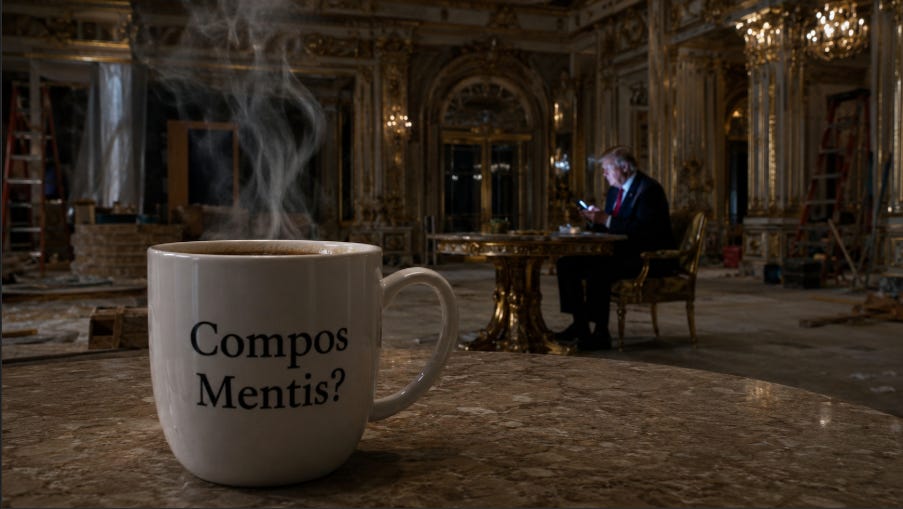
Trump’s response to Iran’s counterproposal was not a speech, not a strategy, not a carefully calibrated diplomatic statement. It was: “I don’t like it — TOTALLY UNACCEPTABLE!” followed by “Thank you for your attention to this matter,” because the president is now rejecting wartime peace proposals with the tone of a county zoning board denying a permit for a shed.
One would think that after rejecting an offer in the middle of a war, the President of the United States might call in his national security team, convene his foreign policy advisers, review escalation scenarios, coordinate with allies, calm markets, and explain what comes next. That would be the normal-president option. Instead, Trump vented online, rambled about Obama, cash, Iranian “thugs,” and how “they will be laughing no longer” — a 2 a.m. grievance collage with warheads in the margins. Nothing says steady hand in a nuclear crisis like rage-posting yourself into a corner while the cease-fire frays.
This is where the story gets more dangerous than merely ridiculous. Iran does not appear to be negotiating like a country that believes it lost. It appears to be negotiating like a country that believes it survived the U.S.-Israeli attempt to break it, kept its regime intact, retained leverage over Hormuz, and now gets to name a price for turning the global oil valve back on.
According to New York Times reporting, Iran’s demands included U.S. war reparations, recognition of Iranian sovereignty over the Strait of Hormuz, and an end to American sanctions. Those are not surrender terms. Those are “you hit us, failed to topple us, and now we still control the choke point” terms.
The Financial Times version of the standoff sharpened the same point. Iran’s response reportedly focused on sanctions relief, an end to the war “on all fronts,” an end to the U.S. blockade on Iranian ports, a thirty-day suspension of oil sanctions, the release of frozen assets, and “Iran’s management” of the Strait of Hormuz. Nuclear concessions were not the headline. Tehran’s message was essentially: first stop the war, stop strangling our economy, accept that we have leverage over the shipping lane, and then maybe we can talk about the nuclear file after a confidence-building period.
That is exactly the opposite of what Trump and Netanyahu want. The Trump administration has reportedly demanded a long moratorium on Iranian enrichment, the transfer of Iran’s near-weapons-grade uranium stockpile out of the country, and the dismantling of Natanz, Fordow, and Isfahan. Iran may be open to some negotiations over enrichment and the uranium stockpile, but a twenty-year ban with no clear sunset clause is not something Tehran is rushing to cosign for Donald Trump’s Mission Accomplished moment.
Benjamin Netanyahu continues doing what Benjamin Netanyahu does: making sure every off-ramp has a spike strip across it. Netanyahu told 60 Minutes that the war is “not over” because Iran still has highly enriched uranium, and when asked how that material should be removed, he said: “You go in and you take it out.”
To recap: Iran is saying stop the war first. Trump is saying hand over the “nuclear dust.” Netanyahu is saying go in and take it. The oil market is saying please, for the love of Brent crude, somebody put an adult in the room. Unfortunately, the adult in the room appears to have been replaced by a man posting AI ballroom images at 11 p.m.
Israel is not helping on the Lebanon front either. The Guardian reported more deadly Israeli attacks in Lebanon despite a cease-fire, including strikes that Lebanese state media said killed two people and injured five others in the southern town of Abba. Israel and Hezbollah continue accusing each other of violations, but the broader picture is that the so-called cease-fire is beginning to look less like a cease-fire and more like a suggestion box with explosions attached.
The Strait of Hormuz is now the central pressure point. Iran has warned that it will retaliate against any new U.S. strikes and will not permit more foreign warships into the strait. The United Kingdom and France are attempting to organize a multinational defense ministers’ meeting involving forty countries to discuss restoring trade flows through the waterway. The UK has already dispatched HMS Dragon to the region so it is ready to act the moment conditions allow, which is a very specific kind of optimism given current conditions. France’s Emmanuel Macron, having read the room, subsequently clarified that France had “never envisaged” a military deployment, which is a very French way of saying we announced something and then immediately announced we didn’t. Iran, for its part, warned both countries not to get dragged into what it calls U.S. and Israeli aggression, and suggested that any intervention in the strait would only deepen the crisis. The Europeans are thus caught between wanting to look useful and not wanting to get shot at, which is a diplomatic position with a long and distinguished history on the continent.
Iranian foreign ministry spokesman Esmail Baghaei used a press briefing to frame Iran’s position as defensive, sovereign, and entirely the fault of everyone else. Strip away the propaganda lacquer and the message is still important: Iran says it will negotiate when there is room for diplomacy, but if forced to fight, it will fight. Baghaei also warned that any foreign intervention in the Strait of Hormuz or Persian Gulf would bring “further complications.”
Markets are already reacting. Brent crude promptly jumped to around $105 a barrel, because oil markets, unlike the President, read the room immediately. The New York Times noted that stock futures dipped alongside the oil surge as investors absorbed the fact that peace talks were not producing peace, which tends to be the kind of thing that moves markets when a major oil artery is still effectively strangled.
This is the part where foreign policy becomes domestic policy, because Trump’s war is no longer some abstract cable-news graphic with missiles arcing across a map. It is showing up at gas pumps, in grocery bills, in mortgage rates, in supply chains, and in the Federal Reserve’s calculations.
The Financial Times has a brutal breakdown of the war’s toll on the U.S. economy. The Pentagon’s direct estimate is $25 billion, but economists say that is just the tip of the iceberg. Trump’s Iran war is ripping through the economy through higher fuel prices, rising borrowing costs, supply-chain disruptions, and the next wave of food inflation.
Gas prices are up more than half to about $4.55 a gallon. Diesel is up similarly, to around $5.66. American consumers have already paid an estimated $35 billion extra in petrol and diesel costs since the war began, which works out to about $268 per household — roughly the cost of a week’s groceries. So yes, Trump’s foreign policy is now quite literally eating into the grocery budget.
And because diesel is the bloodstream of the American industrial and food system, the pain does not stop at the pump. Economists expect a lag of roughly six months before higher diesel costs fully show up in grocery prices, with perishables like fruits, vegetables, meat, and seafood likely to lead the way. Fertilizer prices are already up more than 30 percent since the war began, which could hit harvests and push food costs higher still.
This is what happens when a president who promised cheap groceries turns the global energy system into a hostage negotiation.
Then there is the Fed trap. Before the war, investors expected the Federal Reserve to cut interest rates twice this year. Now, with fuel prices pushing inflation back up to around 3.5 percent, that relief appears to be off the table. Justin Wolfers estimates that the Fed’s inability to cut rates by half a percentage point could cost the economy about $200 billion in lost output. Mortgage rates have also risen from 5.98 percent before the war to 6.37 percent.
So when Trump screams for lower rates, the answer from reality is: perhaps you should not have set the oil market on fire.
Pimco and Franklin Templeton are warning the same thing from the bond-market side. Pimco’s Dan Ivascyn told the Financial Times that rate cuts could be “counter-productive” in the current inflation environment and that tightening should not be completely ruled out for the United States if inflation pressures persist. Franklin Templeton’s Jenny Johnson warned that inflation will be harder to control and that it will be difficult for the Fed to cut.
This will absolutely frost Trump’s cookies if it happens. He wants the Fed to bail him out with cheap money, but his own war is making rate cuts harder. He wants lower mortgage rates, but oil shocks and inflation pressure are pushing the Fed in the other direction. He wants a victory lap, but he may get higher gas, higher groceries, higher borrowing costs, and Jerome Powell staring at the data like, “Thank you for your attention to this matter.”
Meanwhile, someone adjacent to the Pentagon apparently had other priorities.
According to Financial Times reporting, a broker for Defense Secretary Pete Hegseth contacted BlackRock about a multimillion-dollar investment in major defense companies shortly before the U.S. strikes on Iran. The investment reportedly did not go through, but the timing alone is a flashing red light.
Americans get higher gas, higher diesel, higher mortgage rates, higher grocery prices, and a giant supplemental Pentagon bill. Defense contractors get new orders, and people adjacent to the defense secretary were reportedly sniffing around major defense investments before the bombs fell. Maybe everything was innocent. Maybe it was just a coincidence, and maybe I am the Queen of Denmark and my crown is in the dishwasher. At minimum, this deserves scrutiny, because chaos may be catastrophic for the country, but it can be extremely convenient for the right portfolio.
Which brings us back to Trump’s mental state, because this is no longer a question of style, tone, or whether he is “being Trump.” That phrase has become one of the most dangerous euphemisms in American politics. “Being Trump” now means making war threats online, rejecting peace offers without explanation, wobbling between “combat is over” and “we’ll blow them up,” and processing nuclear diplomacy through the same emotional machinery he uses to complain about poll numbers.
Former Trump White House lawyer Ty Cobb is now saying the quiet part out loud. Cobb said it is not surprising the country is in this much trouble given that the Cabinet will not invoke the 25th Amendment for a man he described as “clearly insane.” He specifically tied that assessment to the Iran war and Trump’s nightly social media screeds, saying the war highlights Trump’s “insanity and depravity.”
That is not coming from some random liberal with a resistance mug and a blood pressure cuff. That is Trump’s former White House lawyer.
The transcript also cites Iran expert Karim Sadjadpour making a point that cuts to the heart of the strategic failure: the defining deliberation of this war may not be between the United States and Iran, but between Trump and himself. Trump has vacillated between walking away and threatening to bomb Iran into oblivion, while Iran’s regime has remained consistent: resistance, chaos, survival. That consistency is not weakness or rigidity — it is the strategic advantage of a party that knows exactly what it wants, facing a party that changes its mind between interviews.
That is the problem. Trump thinks every crisis is a negotiation in which he can posture, bluff, threaten, insult, flatter himself, and then declare victory. But Iran’s regime is not a Florida contractor waiting to be stiffed on an invoice. It is an entrenched theocratic state that has always been willing to let the country burn rather than compromise its own survival.
Now Trump is taking that same impulse-driven operating system to Beijing. The New York Times reports that China is “locked and loaded” for a prolonged economic confrontation with the United States. Beijing has been building a legal arsenal to retaliate against U.S. sanctions, punish companies that comply with Western efforts to pull supply chains out of China, and force businesses into an impossible choice: break Chinese law or break American law.
China has blocked Meta’s acquisition of a promising Chinese-founded AI start-up, codified rules aimed at punishing foreign businesses that comply with Western pullback efforts, and begun using legal mechanisms to counter U.S. sanctions. Beijing is signaling that it no longer fears escalation; it is preparing for it.
This is not a meeting where Trump can just wander in, compliment Xi’s strength, demand a headline, and come home pretending he solved trade. China has spent years studying U.S. vulnerabilities, building countermeasures, and preparing to turn global supply chains into an instrument of punishment. That requires a president with discipline, preparation, and strategic clarity.
Instead, America is sending a man who just responded to an Iranian peace proposal with “I don’t like it” and then posted through the night like a raccoon trapped in a golf cart.
Then there is Taiwan. Taiwan’s legislature just approved a $25 billion special defense budget for urgent deterrence measures, including American defensive systems, counter-drone technology, and medium-range munitions. But the Trump administration has reportedly been sitting for months on a $14 billion U.S. arms package, with officials saying the White House wanted to hold it so Trump could have a “successful” meeting with Xi. Think moral rot dressed up as summit choreography.
Taiwan is preparing for the possibility of war. China is intensifying pressure around the island. Senators from both parties are warning Trump not to treat support for Taiwan as a bargaining chip. And Trump is reportedly delaying weapons because he wants the vibes to be nice when he meets Xi.
Meanwhile, Taiwanese civilians are spending their weekends learning to handle weapons. They are not waiting for the diplomatic calendar to sort itself out. They are not holding their breath for a successful summit. They appear to have made their own assessment of how much the vibes matter, and they are preparing accordingly, because when the most powerful country in the world is run by someone posting AI self-portraits at 11 p.m., sometimes you decide to stop outsourcing your survival.
Let’s pull the camera back. Iran is negotiating like it survived the war. Netanyahu is pushing to keep the war open until Iran’s uranium is physically removed. Hormuz remains the global choke point. Oil is back around crisis levels. Gas and diesel are hammering American households. Food inflation may be next. The Fed cannot cut rates because Trump’s war is feeding inflation. Defense-stock ethics questions are hovering over the Pentagon. China is preparing for economic war. Taiwan is preparing for actual war. And the president of the United States is posting like the comments section became commander in chief.
Trump’s instability is now the connective tissue between foreign policy, domestic inflation, corruption risk, alliance fracture, and global insecurity. The war drives oil prices. Oil prices drive inflation. Inflation traps the Fed. Higher rates hurt households. Supply-chain shocks hit food. Defense spending rises. Contractors benefit. Ethics alarms flash. China watches. Taiwan waits. Netanyahu pushes. Iran digs in. And Trump posts.
The throughline today is not simply Iran, oil, China, Taiwan, or Trump’s latest social media unraveling. It is what happens when foreign policy becomes impulse, war becomes branding, allies become bargaining chips, and people close to power appear to understand one thing very clearly: chaos may be catastrophic for the country, but it can be very good for the right portfolio.
And somewhere in all of this, Americans are supposed to feel reassured that the man who cannot manage his own late-night posting habits is managing a nuclear standoff, a global oil shock, a superpower summit, and the fate of Taiwan.
Thank you for your attention to this matter.
If I'm not mistaken, didn't Iran offer to hand over its enriched uranium at the pre-war talks with Kushner and Wickoff right before we started bombing?
Thank you, Mary. I don't trust trump to manage his way out of anything, even a paper bag. Like Ty Cobb said, he is clearly insane. When will someone, anyone act on that?