


Good morning! The deadline to strike a deal with Iran has passed with Hormuz still largely closed, sanctions and the American naval blockade back in place, nuclear talks essentially nowhere, and the president demanding Iran raise a “white flag of surrender.”
Trump is in no particular rush to solve it. “I have no time schedule. I’m not in a hurry,” he told Fox News Monday, a position that sits awkwardly beside the surrender demand.
The New York Times reports the White House has known for some time the deadline would be missed, and that the war has effectively become an economic contest of endurance. Washington is betting sanctions and blockade pressure will eventually force Tehran to concede. Tehran is betting its control over Hormuz lets it outlast American gas prices and depleted inventories. It’s two men holding their hands over a stove, waiting for the other to scream.
The irony: this is the same isolate-and-pressure strategy Trump spent years arguing had failed. The June memorandum was supposed to offer an exit from that cycle. Instead, its vague language over Hormuz shipping rights restarted it: the agreement got rushed out without resolving who controls the strait, Iran attacked ships in what it considered unauthorized channels, the U.S. retaliated, and by Monday everyone agreed the deal was already dead.
There is a familiar institutional lesson here, one we explored in Tendon, Not Fat: safeguards that look like friction are often the connective tissue that keeps complex systems working under stress. The June Iran deal needed to happen, so unresolved language over the most important piece of water in the conflict became something to finesse until later.
Later has arrived.
The administration’s stated objective remains that Iran must never get a nuclear weapon; Trump restated it Monday on Truth Social. But there’s been little evidence of sustained nuclear negotiations since June. The actual bargaining is now overwhelmingly about the strait, sanctions, frozen funds, and the blockade. including regime change and degrading Iran’s missile capability. Six months later, the operational center of gravity is whether tankers can cross 21 miles of water without getting shot at.
Trump’s proposed solution: make it American. He said Friday he’d soon declare the Strait of Hormuz U.S. territory, a claim with roughly the same relationship to international law that declaring the English Channel part of Florida would have to cartography. The strait sits between Iran and Oman, whose territorial waters overlap at its narrowest point, and international law preserves transit rights through it. A president cannot acquire foreign territory by calling dibs.
The unserious legal claim sits atop something real: enormous coercive military power. The rhetorical move converts that power into a sovereignty claim; we control who moves, therefore it’s ours. Iran makes the mirror claim. Neither is legally sound; neither side needs formal sovereignty to impose staggering costs on everyone else.
The market is adapting accordingly. Saudi Aramco is reportedly using ship-to-ship transfers near Fujairah to supply Asian refiners while avoiding Hormuz, and diverting crude toward Yanbu on the Red Sea, though Houthi activity around Bab al-Mandeb complicates that route too. When governments can’t solve a problem, the energy system engineers around them.
Which brings us to Oman, against whom the president has now threatened war twice.
“If Oman gets in the way, we’ll bomb the shit out of them,” Trump told Fox News Monday.
Muscat’s offense is that it’s trying to negotiate. Oman has spent decades occupying a uniquely valuable position between Washington and Tehran: military and economic ties to the U.S., channels into Iran, and enough independence from both to carry messages neither will deliver directly. During this war, it’s been working with Tehran on an interim Hormuz arrangement; Iranian officials said Monday those talks were “continuing in earnest.” The FT reports diplomats hoped that agreement could bridge back to the June framework, with Washington prepared to lift the blockade if Tehran reopened the strait on acceptable terms. That’s a difficult mediation assignment even before one party threatens to bomb the mediator.
Trump first threatened Oman in May. Monday’s threat isn’t an improvisation anymore; it’s becoming a method. An ally or intermediary is useful insofar as it immediately produces the desired outcome, and its independence becomes evidence that it’s in the way.
Oman’s independence is arguably the reason the channel exists. Threatening it while depending on it is a tidy illustration of consuming the instrument while trying to use it.
Trump also claimed Monday that Washington opened a direct backchannel to the IRGC. The IRGC promptly denied it. We have no independent basis to say which account is correct; it’s simply notable that on the day the formal agreement expired, the two governments couldn’t agree publicly on whether they were even talking.
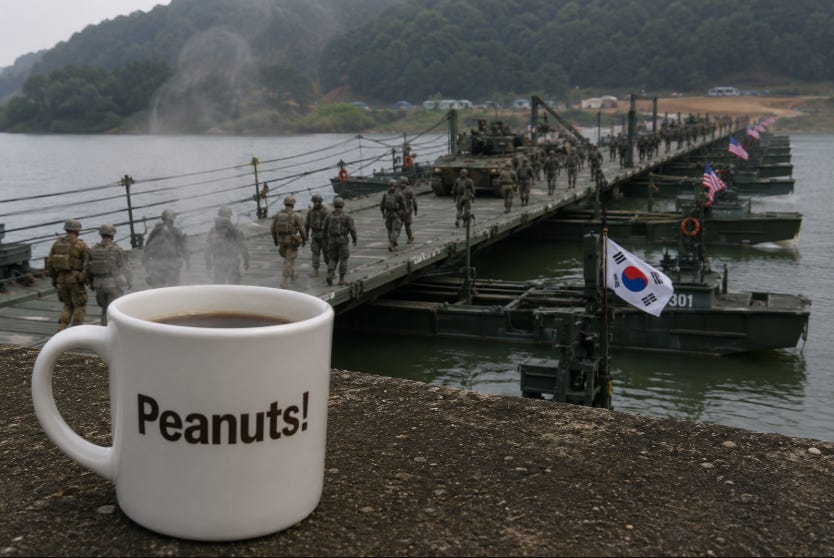
Trump dismissed concerns about American munitions use as “peanuts.”
The war is exporting its costs well outside the Middle East, and nowhere more clearly than South Korea. Sunday, Trump ordered Secretary Pete Hegseth to “substantially reduce” the annual Ulchi Freedom Shield exercises, citing their cost, the “inappropriate and hostile” signal they supposedly send North Korea, and Kim Jong Un’s good behavior “as long as Donald J. Trump has been President.”
In the same post, Trump volunteered another grievance. “While somewhat unrelated (?)”, he wrote, he had recently asked South Korea to join the United States in the “Denuclearization of the Islamic Republic of Iran,” and Seoul said “No thanks!”
Trump doesn’t explicitly say South Korea’s refusal caused the drawdown. But he chose to insert an admittedly unrelated dispute over Iran into the announcement of a Korean security decision anyway. It is reflexive foreign policy in almost diagrammatic form.
The Guardian adds the detail that makes it worse: this year’s exercises were specifically redesigned because North Korean capabilities are changing. More than 14,000 North Korean troops have reportedly fought alongside Russia in Ukraine, gaining firsthand experience with drones, GPS disruption, cyber operations, and contemporary battlefield tactics. American officers in Korea said explicitly that this year’s training accounted for those lessons coming home.
Trump’s reflex is to reduce the training.
North Korea, for its part, test-fired missiles ahead of the exercise and called it a “rehearsal for an aggressive war.”
This is what “unthreatening and respectful” looks like now.
After the 2018 Singapore summit, Trump surprised his own advisers by suspending major joint exercises. Eight years later, personal rapport with Kim is again being treated as sufficient grounds to alter alliance readiness.
The deeper problem isn’t simply that personal diplomacy is fragile. Institutional deterrence is leadership-agnostic by construction. Treaty commitments, standing exercises and alliance architecture exist precisely so security relationships don’t reset every time either country changes leaders. Trump inverts that logic. He makes continuity contingent on a subjective and essentially unfalsifiable variable: whether Kim personally likes the occupant of the Oval Office.
That creates a second-order problem. If Kim decides one American president is preferable to another, he has an incentive to reward the president he likes with restraint and punish a successor he dislikes with confrontation. The reason could be ideology, policy, personality, red hair or hazel eyes. Once personal preference becomes the standard, there is no standard.
Kim hasn’t been given a vote in an American election. He’s been given a mechanism for making the perceived cost of changing presidents higher.
The whole purpose of institutional deterrence is to deny an adversary that kind of leverage. Kim shouldn’t have to like the president, and the president shouldn’t have to like Kim, for everyone to know what the commitments are.
This is happening while the physical backing of the alliance thins too. The USS George Washington is leaving the Pacific for the Middle East, and the FT reports Iran-related operations have forced delivery delays on weapons including Tomahawks bound for Japan.
The U.S. is spending down both kinds of alliance capital simultaneously: the matériel that makes a commitment credible, and the trust that makes an ally believe it’ll arrive.
These stories stop looking like separate controversies and start looking like an operating system.
Consider Gaza. Jared Kushner met Hamas leader Khalil al-Hayya in Egypt Sunday, then went to Jerusalem to press Netanyahu on a peace plan Netanyahu had already rejected. There’s nothing scandalous about talking to Hamas if you’re negotiating Gaza. The more revealing question is why Kushner is, again, the one doing it.
What happens when diplomatic capability migrates from institutions into individuals? Career diplomats, regional desks and the machinery of the State Department can look slow, redundant and frustrating beside someone with direct access to the president and a personal network of foreign contacts. That is exactly why they are easy to treat as fat.
But the cumbersome machinery is what preserves expertise, negotiating history and relationships when administrations change. Kushner can take his phone book with him. A functioning diplomatic service is supposed to make sure the United States doesn’t have to start rebuilding those relationships every four years.
You don’t have to abolish the Foreign Service to weaken it. You just make it optional whenever someone closer to the president can route around it. The immediate result looks efficient: fewer layers, faster access, trusted people in the room. The long-term cost is that state capacity becomes personal property. Another tendon mistaken for fat.
Iran, fascinatingly, is building its own version of the same trap, just selecting for a different trait.
Ayatollah Mojtaba Khamenei has remade Iran’s security leadership around veteran hard-liners with longstanding personal ties to him, not inexperienced people, but revolutionary and Iran-Iraq-war-generation figures with few illusions about conflict. What’s being selected out is moderation.
Mohsen Rezaei, now atop the Supreme National Security Council, argued during the Iran-Iraq war that Iran should keep fighting rather than accept a ceasefire, essentially the same argument hard-liners are making today about Hormuz leverage. Hossein Taeb, tapped to run the Basij and expand its “public intelligence network,” was controversial enough that Mojtaba’s father removed him as intelligence chief in 2022; he returns as Iran braces for possible unrest from war-driven economic pain.
Trump’s loyalist model trades institutional competence for access. Mojtaba’s trades moderation for resolve. Both are constructing decision-making environments that make it harder for anyone near the top to say: actually, we might be the ones losing this.
One more episode worth flagging, because it shows what happens when institutions stop distinguishing between what they know and what they want to be true.
An anonymous Indian X account fabricated a quote from IRGC commander Ahmad Vahidi declaring Iran would never abandon nuclear-weapons ambitions. There’s no evidence he said it, and no evidence Iran has declared itself nuclear-armed.
It traveled from Indian social media to Israeli accounts, to pro-Netanyahu Channel 14, to Yair Netanyahu, and within hours into a speech by Netanyahu himself, then to U.N. Ambassador Mike Waltz, Senator Rick Scott, and Fox News.
Nobody has established who created it, and there’s no evidence the Israeli government did. What’s damning enough on its own is how little resistance it met once it reached institutions that wanted it true.
Call it narrative laundering, or “everyone copied the homework from the kid who made it up.”
Last item, probably worth a deep dive later: the Office of the Comptroller of the Currency, the Treasury Department bureau that regulates national banks, has given preliminary approval for a national trust bank tied to the Trump/Witkoff family crypto venture. Career staff handled the application, but the OCC’s own decision acknowledges conflict concerns involving the families and foreign investors while saying some broader questions fall outside the charter review.
It’s a tidy example of how a conflict can become nobody’s jurisdiction when it’s divided into small enough pieces.
The larger picture this Monday is remarkably consistent.
America still has carriers. State still has diplomats. Oman is still answering the phone.
Institutional degradation rarely arrives with someone taking the sign off the building. It happens when the connective tissue becomes optional.
Exercises look redundant until an adversary comes home from Ukraine with new skills. Career diplomats look slow until the envoy who replaced them takes his relationships and leaves. A neutral mediator looks irritating until you learn its neutrality was the reason anyone listened to it.
This war is turning into a stress test of how many of those mechanisms can be weakened at once before the consequences stop being counterfactual.
Monday’s answer isn’t especially comforting.
Brava, Mary! You have again analyzed the circumstances exactly right, as messy as they are. What a nightmare, from which the ahole won’t let us wake up. I love your metaphor of cutting tendons, mistaken for fat. He’s been doing that to our govt since day effing one. Thank you for sharing your brilliance with us.
I think the issue around Kim is less about likes and more about interests. For Trump, it's ego - he takes flattery from people like Kim and Putin and thinks it shows what a great, powerful, and likeable guy he is. But for people like Kim and Putin, their national interest is a weaker US and their route to that end is to keep stroking Trump's ego. Right now, they're winning.