


Good morning, and welcome to one of those rare political mornings when reality, for once, does not merely knock politely at the door but kicks it in wearing steel-toed boots and carrying a Supreme Court opinion.
Months of Donald Trump treating tariffs like a divine right of kings, his favorite word, his favorite weapon, his favorite magic spell for turning economic complexity into campaign merch, the Supreme Court has delivered the simplest possible response: no.
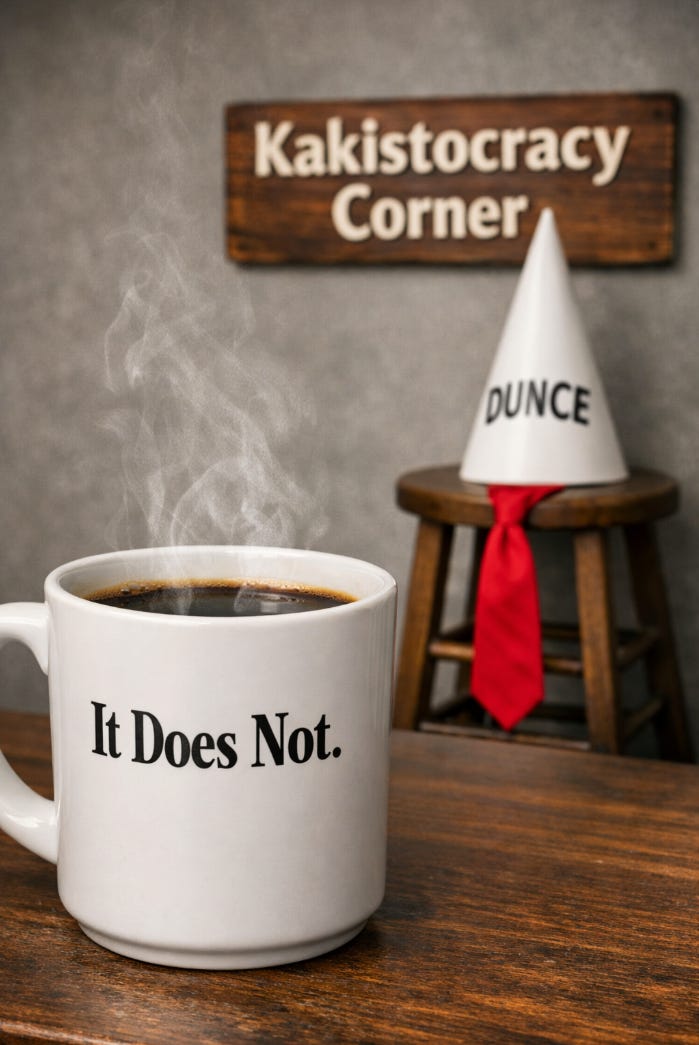
“Our task today,” the justices wrote, “is to decide only whether the power to ‘regulate… importation,’ as granted to the President in IEEPA, embraces the power to impose tariffs. It does not.”
Three words that function, in context, as a legal guillotine. Trump’s sweeping global tariff regime, the economic centerpiece of his second term, the thing he has been screaming about at factories like a man pitching a miracle tonic from the back of a wagon, has been ruled illegal. Emergency powers, the Court reminded him, do not include the authority to tax the world by presidential decree. If you want tariffs of this magnitude, you go through Congress. You know, that quaint old building where laws are supposed to come from.
The timing could not be more perfect if it were scripted by a satirist. Just yesterday, Trump was in Georgia doing his greatest hits tour: tariffs resurrected steel, tariffs fixed affordability, tariffs brought cranes into existence, tariffs are the greatest thing that has ever happened to America, and also Democrats “cheated like dogs,” mail-in ballots are “crooked as hell,” voter fraud is lurking in the bushes, and Canada has apparently been running a decades-long con job against the United States, because sure, why not.
The speech was a familiar Trump stew: industrial nostalgia, conspiratorial grievance, offhand authoritarian impulses, and the constant insistence that whatever he personally likes must therefore be national security policy. Tariffs were not just trade policy, they were patriotism itself, stamped “Made in the USA” and delivered with the subtlety of a foghorn.
But the economic data was already undermining the sermon in real time. Commerce Department numbers showed the trade deficit hitting record territory. Forbes was out here politely asking what on earth Trump meant when he claimed the deficit had shrunk by 78 percent, because the actual deficit widened sharply in December. Justin Wolfers, doing the thankless work of Economics 101, reminded everyone that the trade deficit is not a morality play but an accounting identity, Americans buying goods abroad is not the same thing as America being “ripped off.” A country is not a company and deficit is not a national humiliation. It is, at most, a statistic being used as a prop in a political performance.
Then came today’s ruling, which is not just a policy setback but a structural rebuke. This was the Court saying: you do not get to declare “trade deficits” an emergency and then build a parallel tax system on the fly.
Remember: Customs and Border Protection collected more than $250 billion in customs duties in 2025, and roughly half of that came from these IEEPA tariffs, according to trade attorney Tim Brightbill. That’s massive. That’s hundreds of billions flowing through a legal mechanism the Supreme Court has now rejected. Refund lawsuits are already stacked like cordwood. The “tariffs pay for everything” fantasy now comes with a rather large question: who gets their money back?
The Tax Foundation estimated American households paid roughly $1,100 each in 2025 from the trade war’s costs. Which is a fun little twist on the Trump pitch that foreigners were going to foot the bill. Turns out, once again, the “foreigners” were mostly just… American consumers standing at the checkout line holding the receipt.
So the tariff miracle collapses on multiple levels at once: illegal, ineffective, and expensive. A trifecta of kakistocratic governance, the worst people doing the worst job, loudly insisting it’s genius.
Speaking of institutions being repurposed into personal branding exercises, the Department of Justice has now hung a massive banner of Trump’s face outside its headquarters reading “MAKE AMERICA SAFE AGAIN.” Nothing says independent rule of law quite like decorating your justice ministry the way you’d decorate a campaign rally. In healthy democracies, justice departments are deliberately insulated from the personality of whoever occupies the Oval Office. In systems built around strongmen, however, the leader’s image becomes inseparable from the state, the building is no longer the people’s; it is his. That visual language is not accidental. It signals loyalty flowing upward, not accountability flowing outward. William Kristol put it bluntly: we no longer have a Department of Justice, we have a Department of Trump.
Democracies do not typically wallpaper their prosecutorial institutions with the leader’s slogan and likeness. The message is clear: the department belongs upward, not outward.
Hovering over all of this is the other crisis brewing: war. The New York Times reports that as Trump weighs another major assault on Iran, he has made almost no coherent case for why, or why now. George W. Bush at least traveled the country making arguments, flawed, selective, disastrous, but arguments nonetheless. Trump, by contrast, is massing carrier groups and threatening strikes in a haze of vague objectives: nuclear sites, protesters, missiles, terrorism, stability, deals, bad things will happen. No congressional authorization or articulated end-state. Just menace and improvisation.
Allies, notably, are not lining up. Reports suggest Britain is reluctant to provide basing support for strikes from Diego Garcia. The coalition scaffolding that makes American military action possible is missing. Trump is discovering that alienating allies for sport has consequences when you actually need logistics, intelligence, and legitimacy.
It’s all of a piece: spectacle first, institutions second, consequences later.
But today, at least on tariffs, the system pushed back.
“Our task today… It does not.”
A rare moment when the law, for once, spoke in complete sentences and closed the door. Personally, I am positively giddy! There will be much more to come on the fallout of this decision.
Drink your coffee. It’s going to be a day.
So nice to have some good morning news! Now how about the billions being given to the peace board or the IRS lawsuit? Oh and citizens’ constitutional rights and justice for their murders? And the people wrongfully in detention? I know…take the win, keep fighting for the rest…I truly am happy and grateful that SCOTUS found the guts to do their job.
Giddy is not good enough an emotion. Granted, there are ways around this and he'll find them like a dog who was told not to roll in something and then quickly finds another dead mouse to plunge into. The big question... who or how is the money going to go back to the "overcharged" companies/consumers. Are the corporations just going to get the money back, enriching themselves but not the consumer? Or, do prices comedown because of the windfall. Methinks NOTHING will happen as Trump will just try to run out the clock. Which clock? No one knows but he'll try. Meanwhile, we continue to pay for this crap.