


Good Sunday morning! The United States is now engaged in major combat operations in Iran, and as of this morning, Tehran has confirmed what until hours ago was only declared in a Truth Social post: Ayatollah Ali Khamenei is dead.
After nearly four decades as Iran’s supreme leader, the embodiment of the Islamic Revolution, the final authority over its military, judiciary, foreign policy, and nuclear ambitions, he was killed in a joint U.S.–Israeli strike. This is literal regime decapitation.
The move was announced in language that felt less like cautious statecraft and more like a franchise reboot of regime change. The stated goal: eliminate imminent threats and prevent nuclear weapons. With the subtext: this ends when Tehran changes hands.
“We obliterated” Iran’s nuclear program last June, we are told. Obliterated, flattened, vaporized. And yet here we are again, with bombs falling because the obliteration apparently required a sequel. Hollywood understands that when you promise the audience the villain has been destroyed, you shouldn’t bring him back unless you’re prepared to explain the plot hole. This time the “villain” did not return for Act Two. He was removed from the script entirely.
The speech announcing the strike was muscular, theatrical, absolute. Destroy their missiles. Annihilate their navy. Total immunity for those who defect. Certain death for those who don’t.
And then, the line that will echo longest:
“When we are finished, take over your government. It will be yours to take. This will be probably your only chance for generations.”
It is one thing to weaken an adversary. It is another to publicly invite the overthrow of a sovereign government while bombs are still falling. When a U.S. president tells the people of another nation that “the hour of your freedom is at hand” and encourages them to seize control of their state, the line between military action and political transformation becomes very thin.
Congress, meanwhile, was notified, but not consulted. The Gang of Eight received their briefing, the bombs received their coordinates, and the Constitution received a polite nod in passing.
Now comes the ritual of the War Powers Act, the legislative equivalent of shaking a fist at a departing aircraft carrier. Senators will vote, speeches will be made. A resolution may even pass both chambers. Followed, of course, by a presidential veto.
Overriding a presidential veto requires a two-thirds majority in both the House and the Senate. Not a simple majority, two-thirds. In a polarized Congress, that is Everest.
Absent that supermajority, the resolution becomes symbolic, a formal objection entered into the record while the aircraft remain airborne.
Is that complicity? Or is it paralysis? The distinction matters less than the outcome. Once again, Congress debates war after war begins.
At the same time, DHS is elevating alerts. The FBI is on high counterterrorism readiness. Embassies are on edge. The President himself acknowledged the risk, saying, “The lives of courageous American heroes may be lost and we may have casualties. That often happens in war.”
That often happens in war. It is a sobering line, especially coming from a commander-in-chief who avoided military service during Vietnam through five draft deferments. History has a long memory, even when politics prefers amnesia.
And hovering over all of it is a quiet political contradiction: the president who ran on no new wars is now openly encouraging regime change. The base that was promised America First must reconcile that promise with a policy that sounds remarkably like America in charge.
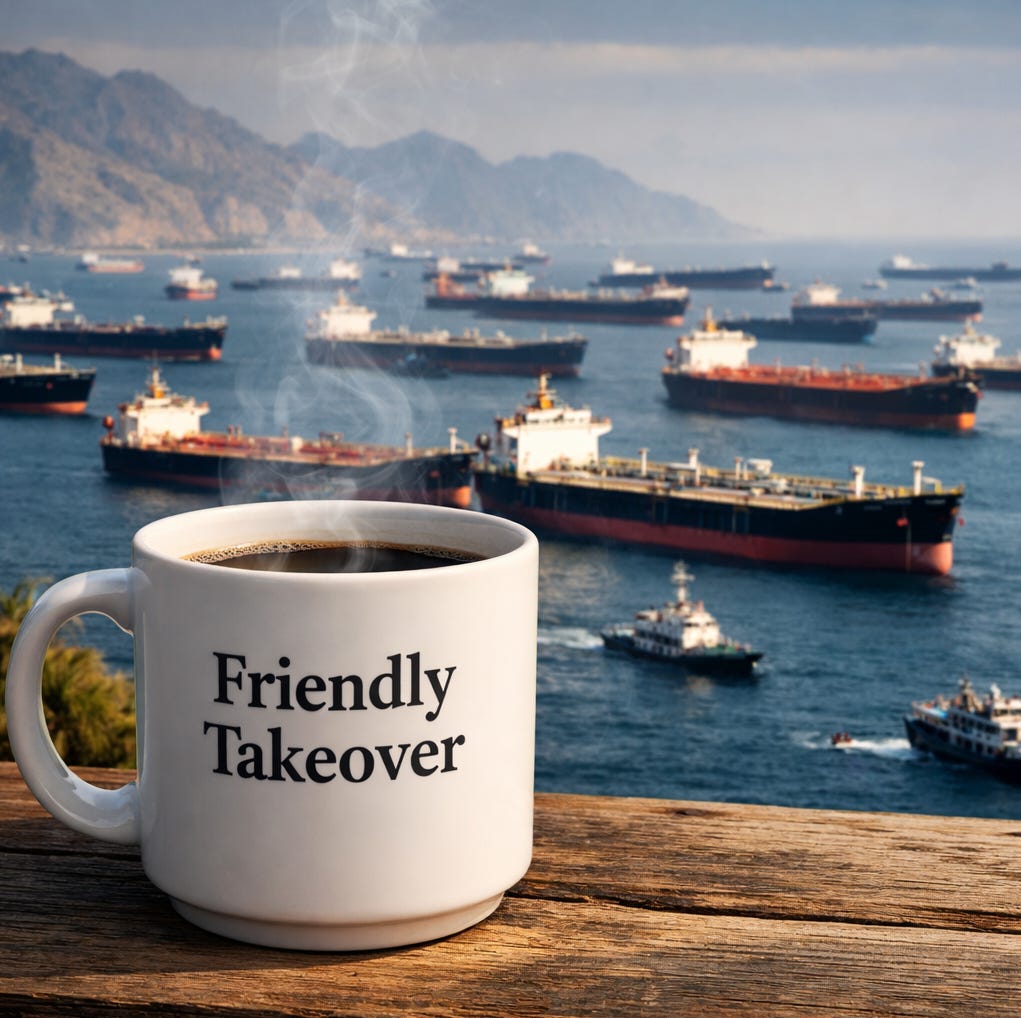
If regime change is having a moment in the Persian Gulf, it appears to be trending closer to home as well. As casually as one might discuss acquiring a golf resort, the White House floated the idea of a “friendly takeover” of Cuba.
You know, like when a private equity firm rescues a struggling rural community hospital and calls it a “strategic partnership.”
The justification offered was disarmingly blunt: Cuba has “no money, no anything right now.” Which, coming from the nation tightening the economic vise, lands with all the subtlety of a repo man offering financial advice while hooking up your car.
The backdrop is not small. Venezuela’s oil support has been cut. The U.S. has tightened sanctions. The Cuban economy, long fragile, is in visible distress. Into that moment drops the word “takeover.” Not assistance, but takeover.
That word is not diplomatic vocabulary. It is corporate vocabulary. It implies a distressed asset. Mismanagement equals opportunity. It suggests that sovereignty is just another shareholder vote waiting to happen.
History has a wicked memory where Cuba is concerned. The island remembers an era when American financial dominance was so pervasive it helped fuel the revolution of 1959. Havana hears echoes. Miami hears opportunity. The hemisphere hears Monroe Doctrine 2.0 with a Silicon Valley UX refresh.
U.S. Marines are not likely to roll down the Malecón waving “Under New Management” banners tomorrow. A literal annexation would detonate hemispheric backlash. But rhetoric signals leverage. It signals that Washington believes economic strangulation creates acquisition options. It signals that nations can be restructured like distressed retail chains.
Back in the empire’s financial headquarters, the company that was going to dethrone Big Tech and build a parallel digital civilization has managed to lose $712 million in a single year while generating roughly the annual revenue of a moderately successful suburban smoothie franchise.
Sales increased by sixty thousand dollars, a figure that in corporate terms translates to “did someone find coins in the couch?”
Truth Social remains the crown jewel, a digital town square that revolves around one extremely enthusiastic user. Outside of presidential posting hours, the engagement levels resemble a folding table at a sparsely attended county fair. But growth is apparently overrated. The new plan is to spin it off into its own publicly traded entity. Because if there’s one thing Wall Street loves, it’s taking a small thing and slicing it into two even smaller things and calling it innovation.
Then there’s the bitcoin treasury strategy. $1.2 billion poured into crypto, now nursing hundreds of millions in unrealized losses. The treasure chest, it turns out, is full of IOUs and vibes. But why stop at volatile digital currency when you can pivot to nuclear fusion? Yes, the same firm struggling to scale a social media platform is now positioning itself as a $6 billion fusion energy powerhouse for AI data centers. It’s less a business plan and more a cinematic universe with quarterly earnings calls.
The stock that once rode campaign adrenaline into triple digits now hovers near launch price, like a meme that forgot why it went viral. The founder received his shares for free, meaning he profits as long as the ticker still blinks. Retail investors? Well. Thoughts and prayers.
And then there’s the part that always arrives after the speeches, after the flags, after the righteous fury. The bill.
Energy analyst Matt Randolph laid it out bluntly this weekend: the Strait of Hormuz is not just a line on a map. It’s the most critical oil choke point on Earth. Roughly 20% of the world’s oil moves through that narrow stretch of water. Iran doesn’t need to “win” there. It doesn’t need to sink every tanker. It doesn’t even need a formal blockade. It just needs to make the waters feel dangerous enough.
Insurance rates spike, and tankers hesitate. Markets panic, and suddenly we’re not arguing about regime legitimacy, we’re arguing about $80 oil and $3.50 gas. That’s the most likely scenario. Painful, but survivable.
That’s the optimistic door. If traffic through Hormuz is significantly disrupted, not stopped, just disrupted, oil doesn’t creep upward, it leaps. We’ve heard the wild predictions before: $150 oil, $200 oil. Usually, they’re cable-news fantasy. This is the one scenario where they stop being fantasy.
If that happens, nations scramble. Strategic petroleum reserves get tapped. Emergency coordination begins, except, and here’s where geopolitics returns, not everyone has equal incentive to stabilize global prices. China, which has been stockpiling oil for years, could choose to sit on its reserves rather than flood markets.
War in 2026 is not just missiles and speeches. It’s supply chains and shipping lanes and commodity markets. Think inflation, interest rates, and grocery bills. Will the phrase “America First” survive first contact with $5 gas?
Iran does not have to defeat the United States to inflict economic turbulence. It simply has to drag the fight sideways into the water. We are, as Randolph put it, teetering on an edge.
Somewhere between Tehran, Havana, Congress, and Wall Street, Americans will discover that foreign policy eventually arrives at the pump.
Here we are heading into the midterms. Abroad, we promise to obliterate nuclear programs and invite revolutions. Closer to home, we float friendly takeovers and corporate restructurings of sovereign nations. On Wall Street, we chase fusion reactors and crypto windfalls while hemorrhaging nine-figure losses.
Congress debates after the fact, while the executive escalates in real time. The language of diplomacy sounds like a mergers-and-acquisitions memo.
History shows that when executive power stretches too far, the response rarely comes from the marble columns. It comes from the electorate. Democracy does not need spectacle to reassert itself; it needs people.
As a reminder, it only takes a handful of Republicans in the House and Senate to bring this fiasco to an end.
This fiasco is a horrible canker in a year of fiascos, one after another. Yet, Twump et al call it winning. That old expression of, "Don't pee on my leg and tell me it's raining," has become something more crass.
Let's madlib it: Don't _______ on my _______ and tell me it's ________ .
I'm going with shit, mouth, ice cream.
Well, here is the rub. Trump went to war on his own, and flipped his middle finger to us and the world. Nothing new. What should be the headlines today: Congress impeaches Trump. What is in the news, the GOP endorses an unnecessary and illegitimate war on Iran. The Dems want a war powers resolution. Wow. The game is on and the home team has yet to arrive. We are a Country ruled by whim and diktat. Yes, there will be increased prices. No, the Iranian regime will remain not change.