


Good morning! Lindsey Graham died suddenly Saturday night, just days after his seventy-first birthday and shortly after returning from Ukraine. His office described the cause only as a “brief and sudden illness.” By Sunday morning, Washington had begun doing what Washington inevitably does when a senator dies: offering condolences, lowering flags and quietly counting votes.
Death is personal, grief is real, and Graham leaves behind family, friends and colleagues who are entitled to mourn him without immediately being handed a Senate whip sheet. But Lindsey Graham was not merely a private citizen. He was one of one hundred people entrusted with extraordinary public power, and his death occurred at a moment when the control of that power may determine whether the United States remains recognizably democratic.
Before Graham’s death, Republicans held a 53–47 Senate majority. His absence temporarily reduces that advantage and leaves Majority Leader John Thune with less room for defections until South Carolina’s Republican governor, Henry McMaster, appoints an interim successor. Graham had also been seeking reelection in November, meaning South Carolina will now have a hastily reorganized contest for a seat Republicans had assumed was safely theirs. The state remains deeply conservative, so Democrats should probably refrain from measuring the curtains. Still, nothing brightens a summer like an emergency Republican primary conducted among ambitious people convinced that Donald Trump’s endorsement is both a sacrament and a weapon.
Graham himself understood the value of proximity to power better than most.
He entered the Trump era warning that the Republican Party would be destroyed, and would deserve to be destroyed, if it nominated Trump. He called Trump a race-baiting bigot, a jackass and the most flawed nominee in Republican history. These were not subtle observations requiring years of archival research to decipher.
Then Trump won. Graham subsequently became one of his most dependable defenders, golf companions and foreign-policy advisers. He briefly rediscovered his vertebrae after January 6, declaring himself finished with Trump, but the condition proved temporary. By the time Trump returned to power, Graham had again become a loyal apostle, apparently persuaded that history’s most important question was not whether he had been right about Trump, but whether Trump might invite him to play another eighteen holes.
The transformation made Graham one of the defining figures of the Republican surrender. He recognized the danger early, described it accurately and then spent the remaining years of his career helping the danger consolidate power.
His death is therefore more than a change in Senate arithmetic. It removes an experienced legislator, a foreign-policy hawk and one of the remaining intermediaries between Trump’s personality cult and the older Republican national-security establishment. Graham supported Ukraine, NATO and an interventionist American role abroad even as much of MAGA migrated toward isolationism, Putin apologetics and the conviction that every international alliance is a protection racket Donald Trump has not yet adequately monetized.
The immediate importance of that vacant Senate seat can be seen in another story unfolding just months before the midterm elections.
Trump has pushed out every remaining member of the federal Election Assistance Commission, the bipartisan agency Congress created to establish voting-system standards, certify equipment, distribute election-security funds and assist state and local election officials.
Benjamin Hovland and Thomas Hicks, the commission’s two Democrats, were fired. Christy McCormick, its remaining Republican, was permitted to resign. A fourth commissioner, also a Republican, had already left in April. The commission now has no commissioners at all. Career staff can continue performing routine functions, but the bipartisan leadership Congress intended has been removed and the agency cannot make major new policy decisions in the ordinary way.
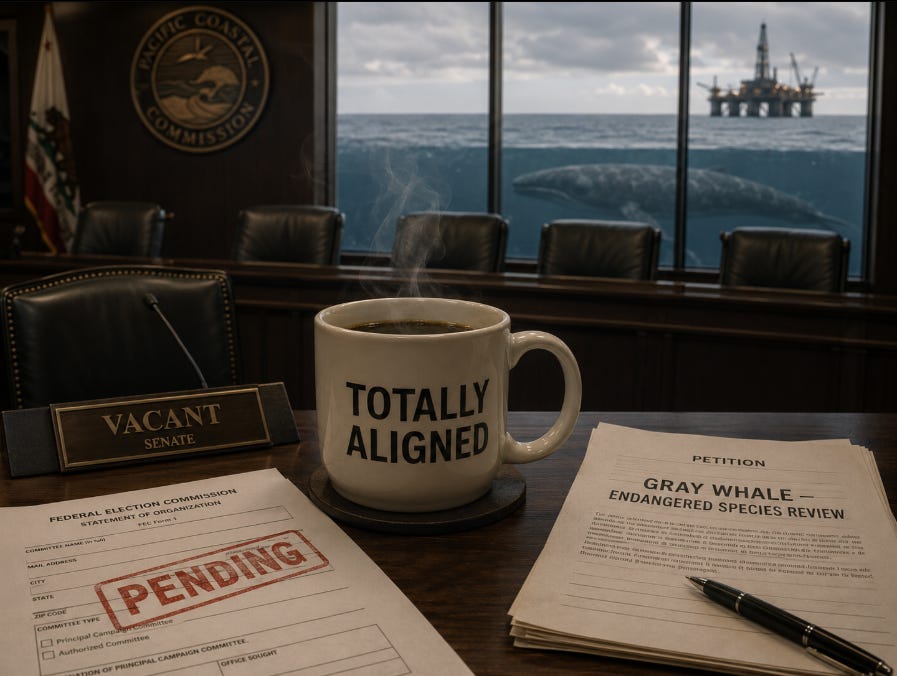
The White House offered an explanation that was somehow both chilling and refreshingly honest. The president, a spokesperson said, has the right to remove people who may not be “totally aligned” with the important work of securing elections.
Totally aligned. Not competent, impartial, or faithful to the law. Not trusted by both parties or experienced in administering elections.
Aligned with Donald Trump.
That single phrase captures the governing philosophy of the second Trump administration. Every institution is presumed illegitimate until it has been converted into an extension of the president. Independence is insubordination. Neutrality is sabotage. Bipartisanship means Republicans and Democrats may both be present, provided everyone understands who owns the building.
The commission had not yet complied with Trump’s demand to add documentary proof of citizenship to the national voter-registration form. Most states currently require applicants to attest under penalty of perjury that they are citizens. Trump wants additional documentation, despite the predictable effect of disenfranchising eligible voters who lack ready access to passports, birth certificates or other qualifying records.
When an independent commission does not move quickly enough, there are several options available in a democracy. The president can make an argument. Congress can pass a law. Courts can review it. The public can debate it.
Trump chose the option traditionally preferred by strongmen and middle managers with Napoleon complexes: remove everyone who has not said yes.
This is where Graham’s death and the Election Assistance Commission purge become the same story. Trump can nominate replacements, but the Senate confirms them. Senate arithmetic determines whether nominees are subjected to meaningful scrutiny or ushered through like resort guests whose names are already on the gold-plated list.
A senator dies in Washington. An election commission is emptied. A governor prepares an appointment. A president prepares a list of loyalists. These are not disconnected events. They are moving parts in the same machine.
Historian Ruth Ben-Ghiat offers a useful way to understand that machine. Democracies, she explains, do not usually die because citizens argue, protest, endure scandals or hold bitterly contested elections. Healthy democracies can survive all of those things. The more revealing warning signs are electoral manipulation, weaponized government, intimidation of the press, normalization of extremism and a crisis surrounding the transfer of power.
The United States now exhibits every one of them.
Electoral manipulation does not require operatives stuffing paper ballots into a box after midnight. It can mean changing registration requirements, disenfranchising targeted populations, manipulating district lines, intimidating voters or weakening public faith that elections can produce legitimate outcomes.
The end goal is not always to eliminate elections. Modern authoritarians often prefer to keep them. Elections provide ceremony, legitimacy and wonderfully photogenic footage of the leader waving from a balcony. The objective is to make certain that the contest becomes less competitive, the opposition less capable and defeat increasingly difficult.
An empty Election Assistance Commission is not sufficient to accomplish that. Elections are administered primarily by state and local officials, and thousands of career employees, judges, poll workers, secretaries of state and civic groups remain in place. The republic has not been canceled because three people received emails from the White House.
But authoritarians do not begin by announcing that November’s results have already been selected. They begin by weakening the people and institutions capable of resisting when the demand comes.
Ben-Ghiat’s second warning sign is weaponized government. Impartial public servants are removed. Loyalists are installed. Prosecutors, regulators, tax authorities, law-enforcement agencies and independent commissions are gradually repurposed until the government no longer serves the public under a common body of law. It serves the leader, who increasingly decides who deserves protection and who deserves punishment.
We have watched that process unfold across the federal government. The Justice Department pursues Trump’s enemies while abandoning or reversing cases involving his allies. Prospective officials are tested not merely for qualifications but for their willingness to endorse the mythology surrounding the 2020 election. Inspectors general, prosecutors and career experts have learned that fidelity to evidence is no defense against a president who considers reality a hostile faction.
Courts remain a crucial source of resistance, as Ben-Ghiat emphasizes. Judges have blocked unlawful orders, rejected unsupported claims and forced the administration to explain itself in something other than capital letters. But courts are also under enormous pressure from an executive branch that increasingly treats judicial rulings as suggestions from people who have not yet appreciated the majesty of executive landscaping equipment.
The press faces the same authoritarian pressure.
Trump has sued news organizations, pursued journalists, denounced unfavorable reporting as treasonous and used the power of government to create a chilling effect around investigation and dissent. The point is not necessarily to close every newspaper or imprison every reporter. A modern autocrat can accomplish a great deal by making independent journalism ruinously expensive, legally dangerous and professionally exhausting.
Billionaires can purchase news organizations. Owners can intervene in editorial decisions. Reporters can be subpoenaed, investigated or subjected to invasive searches. Editors can learn that an accurate story may provoke years of litigation, regulatory retaliation or the loss of corporate approval for the next acquisition.
Eventually, intimidation develops an administrative convenience: censorship begins happening before the government has to request it.
But Ben-Ghiat also notes that today’s information environment makes complete capture more difficult. Independent journalists, creators, newsletters, podcasts and small digital publications can continue reaching audiences without first requesting permission from a network president, a billionaire proprietor or an executive worried about the company’s next merger.
That does not make independent media invulnerable. It makes it indispensable.
Then there is the normalization of extremism. Political violence is excused when committed by supporters of the ruler. Vigilantes and paramilitary forces are praised as patriots. Dehumanizing language prepares the public to tolerate treatment that would once have been considered un-American.
Immigrants become invaders, contaminants or vermin. LGBTQ people become threats to children and civilization. Protesters become terrorists. Journalists become enemies. Political opponents become traitors deserving imprisonment or death.
Once a targeted group has been pushed outside the moral community, almost anything done to it can be presented as self-defense.
Trump’s pardons of the January 6 defendants fit this pattern precisely. Men and women who assaulted police officers, hunted lawmakers and attempted to stop the constitutional transfer of power were not merely released. They were rehabilitated as heroes.
The pardon conveys a message larger than mercy: violence on behalf of the leader will not necessarily be punished if the leader regains the power to erase the punishment.
January 6 itself was the transfer-of-power crisis Ben-Ghiat identifies as the final warning sign. Trump lost an election, refused to accept the result, pressured officials, promoted fabricated claims, attempted to corrupt the certification process and finally incited a mob against Congress.
The coup failed. The accountability failed too.
Trump was permitted to run again, returned to office and transformed the attack into a founding myth of his restored presidency. That sequence is extraordinarily rare. Countries that survive attempted coups generally understand that the person who attempted the coup should not be handed the keys again to see whether improved staffing might produce a more satisfactory result.
Ben-Ghiat nevertheless concludes that American democracy is damaged, not dead. Courts still resist. Civil society still organizes. Election officials still perform their duties. Independent media still investigate. Communities subjected to militarized enforcement have developed networks of mutual protection and civic action.
Her optimism is not comforting in the passive sense. She is not telling Americans to relax because the founders installed a hidden democracy-preservation mechanism somewhere behind the portrait of James Madison.
Democracy survives when people defend it.
Which brings us, not by mood but by mechanism, to the dead whales.
Pacific gray whales are undergoing what environmental advocates describe as a catastrophic mortality event. Scientists and advocates estimate that thousands may have died during 2025 and 2026, though the exact number is difficult to determine because most carcasses sink or remain undiscovered offshore. The animals washing onto beaches are often emaciated. The primary explanation is starvation, driven by a warming Arctic and the collapse of the food web gray whales have depended on for generations.
In August 2025, a marine biologist petitioned the National Oceanic and Atmospheric Administration to restore the gray whale’s protection under the Endangered Species Act. Federal law contemplates an initial finding within ninety days when practicable. Nearly a year later, NOAA has neither advanced the listing nor rejected it. It has simply failed to act while the Trump administration expands oil development in the waters the whales depend on to survive.
This produces the same result as Trump’s assault on the Election Assistance Commission, through a different mechanism and in a slower key. An institution exists whose job is to impose a limit: the EAC on how election rules are administered, NOAA on which species federal law protects. The administration does not need to abolish the institution or defeat it in an open argument. It only needs to ensure that the institution never acts. An empty commission cannot pass a rule. An unanswered petition cannot list a species. Either way, the thing that would have been constrained, a citizenship-documentation requirement, an oil lease, proceeds exactly as if the check had already been defeated, because in practice, it has been. Silence is a policy. Delay is a decision. The absence of a ruling is itself the ruling, and it always favors whoever already holds the leverage of “not yet.”
Gray whales recovered once because a government imposed limits on human appetite and enforced them. They are dying now because a government has learned that it no longer needs to lift those limits, it only needs to stop enforcing the mechanism that would renew them.
Politics is not a sport conducted for the entertainment of people who enjoy maps with red and blue states. It is how a society decides which institutions remain independent, which voices may be heard, which citizens may vote and which living systems are permitted to survive.
The Senate confirms the people who run environmental agencies and election agencies. Congress funds conservation, climate science and election security. Courts decide whether presidents can discard statutory protections through executive decree. Elections determine whether those offices are occupied by people who believe government has obligations to the future or by people who regard the future as an unleased extraction opportunity.
A whale starving in the Pacific is not separate from a president purging an election commission in Washington. Both are consequences of a political system deciding whether power will be restrained by duties to something beyond itself.
Democracy asks those in power to accept limits for the sake of people they may dislike and elections they may lose.
Sustainability asks the living to accept limits for the sake of people not yet born and species incapable of making campaign contributions.
Authoritarianism and extractive capitalism reject the same proposition. Both insist that whoever possesses power now should be free to take whatever can be taken now. The ballot, the agency, the newsroom, the public land, the ocean and the atmosphere become resources to be controlled rather than inheritances to be preserved.
Lindsey Graham once understood that Trump represented a profound danger. Then he decided proximity was safer than resistance. His journey became the Republican Party’s journey: recognition, submission and finally enthusiastic service.
His sudden death leaves a Senate seat empty. Trump’s purge leaves an election commission empty. Climate failure leaves an ocean increasingly empty of whales.
Those vacancies are not the same in scale or character. But they all ask the same question.
What will fill the space?
A caretaker or a loyalist? An independent commission or another presidential instrument? A recovering population of gray whales or a migration route marked by carcasses? A multiracial democracy capable of reform or an electoral shell maintained to flatter a ruler?
Ben-Ghiat believes American democracy will survive and ultimately emerge stronger. The gray whale’s first recovery reminds us that decline can be reversed when society acts with purpose.
Both forms of hope depend on the same thing.
Protection must be more than a sentiment expressed after the loss. It must be a political choice made before there is nothing left to save. Call it hope if you need a word for it. I’d rather call it work.
Trump has already said he spoke with Graham just hours before he died.
According to Trump, Graham's last words before hanging up had to do with his desire to see the Save America Act passed.
Uh huh.
Well, I spoke to Mitch McConnell for about 20 minutes yesterday, and he said he'd had a change of heart. McConnell said he's now 100% against the SAA.
Thank you for such a complete overview of where we stand and really what we must do which is to push back every way we can as individuals in and in groups. The one thing I wish is that the courts would impose sanctions or punishment for failure to follow court orders .