


Good morning! “We’re going to beat the fucking shit out of them.”
“We’re going to let them keep talking.”
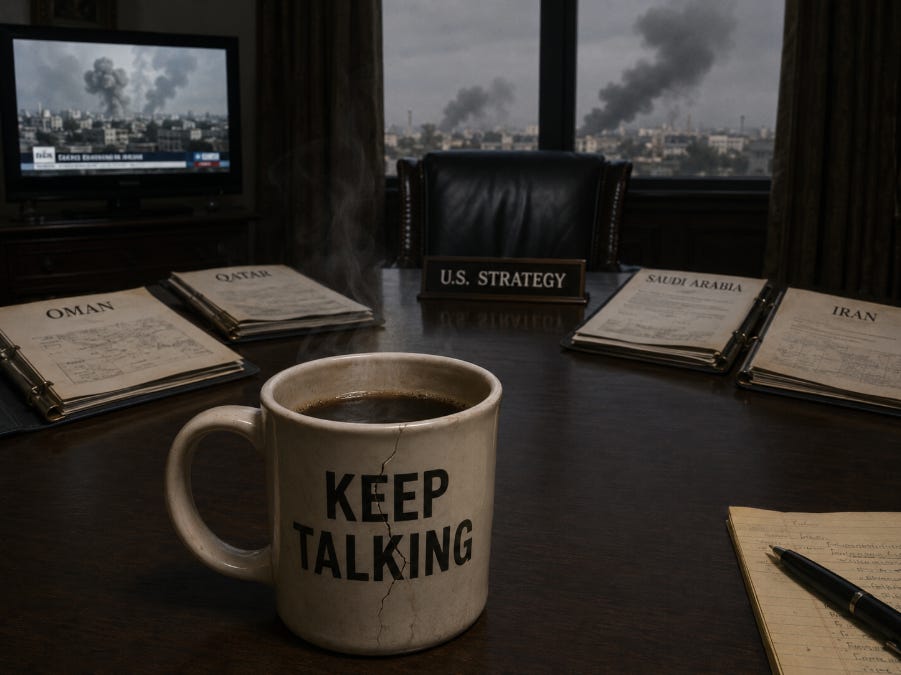
Both sentences came from Donald Trump during an appearance on Fox & Friends Tuesday morning. The first was his promise about Iran. The second was his description of the diplomacy that would apparently continue while the promised beating was administered.
The Financial Times reported that oil prices climbed sharply following Trump’s remarks, extending earlier gains and approaching $90 a barrel.
The president had managed to summarize his Middle East policy in two consecutive thoughts: pulverization first, conversation throughout. By Wednesday morning, the missiles had returned.
This is the Trump administration’s Middle East policy in miniature: negotiations conducted under the table while the president pounds on top of it, public threats bearing little discernible relationship to private strategy, and every declaration of progress followed by an event demonstrating that nobody involved appears to agree on what progress means.
Trump said on Monday that Iran had asked “very nicely” for the United States to stop bombing and wanted to meet. Iran said it had done no such thing. Trump said the two countries were talking. Iran said there were no negotiations with Washington. Trump said there was a “good chance” of a breakthrough. Iranian officials said they had not agreed to a ceasefire and were in no hurry to begin direct talks.
Then came Wednesday. American and Saudi warplanes struck Iranian-aligned forces across seven Iraqi provinces. At least 20 members of Iraq’s Popular Mobilisation Forces were reported killed and more than 30 wounded. Iran launched ballistic missiles toward American forces in Jordan. The Revolutionary Guards claimed to have stopped three tankers traveling through what Tehran called an illegal route. The Houthis continued threatening Saudi shipping through the Red Sea. Brent crude surged back toward $90.
Trump had supplied the obscenity the previous morning. By Wednesday, the widening disaster was supplying the context.
“We’re going to beat the fucking shit out of them,” he had said, followed by the reassurance that the people whose shit he intended to beat would be allowed to continue talking.
There are two layers to nearly everything Trump does. The first is the performance layer, where dominance must be asserted, humiliation delivered and every event converted into proof that the president has frightened somebody important. The second is the operational layer, where governments, militaries and diplomats must somehow manage the consequences after the cameras leave.
The performance layer was on full display at Fox. Trump was not explaining the purpose of another military strike, identifying a desired political outcome, or describing the conditions under which the war might end. He was performing toughness for an audience trained to recognize profanity as strategy and volume as strength.
The operational layer was visible in the oil market, where traders interpreted the performance as another sign that no one could reliably predict whether the world’s most important energy corridor would be open, closed, mined, tolled or under bombardment by lunchtime.
The same division appeared during Trump’s meeting with Benjamin Netanyahu on Tuesday.
Netanyahu spent nearly 90 minutes behind closed doors with Trump. The meeting was closed to reporters. Netanyahu later described it as “excellent.” The White House called it “positive and productive.” No meaningful details were offered about what either man had requested, promised or decided.
That has become the standard format for Trump’s most consequential meetings: keep reporters away from the discussion, release footage of the handshake, distribute a handful of flattering adjectives and invite the country to mistake stage management for statecraft.
The absence of detail was especially conspicuous because Netanyahu did not arrive in Washington for a ceremonial visit. As one of the central figures who persuaded Trump to enter the war against Iran, the Israeli prime minister remains committed to continuing it. An election at home raises the stakes further: Netanyahu needs his relationship with the American president to stand as evidence of his indispensability, particularly as criticism of both the war and Israel’s conduct grows.
Trump has pressures of his own. The war is unpopular. Gasoline prices are rising. Republicans facing voters in November are growing anxious. Speaker Mike Johnson has already said, “We got to wrap it up.” Senior American officials have reportedly warned that critical munitions are being depleted.
Netanyahu emerged from the Oval Office calling everything excellent. By the following morning, Saudi Arabia had entered the war directly, Iraq was condemning an attack on its own security forces, missiles were flying toward Jordan and Trump was promising another beating.
The meeting may indeed have been excellent. The Middle East was having a rather different morning.
Volodymyr Zelenskyy also met with Trump on Tuesday, producing an almost too-perfect illustration of the collision between Trump’s wars.
Zelenskyy came to Washington representing a country still seeking American air-defense weapons against Russia. Netanyahu arrived associated with demands for a military campaign consuming many of the same categories of weapons. Trump insists the United States is not running short, although he has also said he would “like to have more” and complained that too much ammunition was given to Ukraine.
Zelenskyy reportedly brought intelligence that Russia had supplied Iran with satellite imagery of American bases in the Middle East. Ukraine, meanwhile, had struck an Iranian commercial vessel in the Caspian Sea, killing a civilian sailor. Iranian officials considered retaliating against a Ukrainian port before diplomacy temporarily cooled that confrontation.
The president’s first visitor was therefore fighting Russia, the country reportedly helping Iran locate American military targets. His second visitor helped sell him the war against Iran. Between them sat the man blaming the first war for the ammunition problems complicating the second.
A lesser mind might perceive an interconnected strategic problem. Trump sees a scheduling conflict.
All this initially seemed to support a simple hypothesis: the governments of the Middle East had concluded that Trump did not know what he was doing and had begun working things out among themselves.
The reality is more complicated and, in some ways, more revealing. There are at least two separate strategic tracks underway.
The first belongs to the Gulf states, which are building diplomatic and military structures that do not depend entirely on Washington behaving coherently.
Oman has been conducting direct shuttle diplomacy with Iran over the Strait of Hormuz. Qatar and Pakistan have served as intermediaries between Tehran and Washington. Saudi Arabia, Qatar, Kuwait and Bahrain have coordinated through repeated ministerial calls. GCC armed forces are conducting joint “Bahrain Shield” exercises intended to strengthen regional planning and collective defense.
These countries are not expelling the United States from the regional order. Saudi Arabia has now conducted joint airstrikes with American forces. They are, however, reducing the portion of their survival that depends upon Washington discovering and maintaining a consistent policy.
Gulf governments do not necessarily trust Iran. Wednesday’s attacks demonstrate that quite clearly. They condemn Iranian-aligned attacks, support Saudi Arabia’s right to defend itself, and are preparing for collective military action. At the same time, they continue coordinating diplomatic efforts aimed at de-escalation and securing navigation through the Strait of Hormuz and Bab al-Mandab. They are building both the conference table and the bunker.
Saudi Arabia offers the clearest example. Riyadh spent months attempting to stay out of the US-Israel war against Iran. It participated in regional diplomacy, tried to protect its oil infrastructure, and insisted it did not want to become a direct combatant.
Then Iranian-aligned groups repeatedly attacked Saudi energy facilities and shipping. The Houthis announced a blockade of Saudi vessels in the Red Sea. Drone attacks arrived from the direction of Iraq. Saudi Arabia responded by joining the United States in bombing sites across Iraq.
Saudi officials said they were not seeking escalation while carrying out airstrikes in seven provinces, which is the modern diplomatic equivalent of announcing that one has no desire for dessert while climbing into the bakery window.
The attacks created an immediate rupture with Baghdad. Iraq’s Popular Mobilisation Forces are not simply foreign gunmen who wandered into the country on Iran’s behalf. The PMF is an umbrella organization that includes Iranian-backed militias, but it was also incorporated into Iraq’s state security structure after helping fight the Islamic State. Some component groups continue to operate with substantial independence, creating precisely the sort of legal and political ambiguity that wars like this thrive upon.
Washington and Riyadh call them Iranian proxies. Baghdad regards them, at least institutionally, as part of the Iraqi state.
Iraq’s president condemned the strikes as an assault on national sovereignty. The prime minister postponed a planned visit to Saudi Arabia. Militias threatened retaliation against American and Saudi interests. One morning of airstrikes managed to damage a diplomatic relationship that might otherwise have helped contain the very militias being targeted.
The regional governments may be constructing an alternative system around Trump. They are also being dragged into his war faster than they can complete it.
Iran represents the second strategic track, and Tehran is not acting as part of some unified Middle Eastern consensus. It is playing its own hand against Trump’s domestic political clock.
Iranian officials appear to believe time is on their side. Gregory Brew of the Eurasia Group told The New York Times that Tehran’s calculation is that it can absorb pain and pressure more successfully than Trump can, eventually forcing him to accept a deal closer to Iranian demands without securing meaningful concessions in return.
Iran does not need to defeat the United States in a conventional military contest. It needs to make the conflict expensive enough, long enough, and politically miserable enough that Trump becomes desperate to frame a compromise as victory.
Higher oil prices help. Republican fears about the November midterms add pressure. Public uncertainty about the purpose of the war further erodes support, while dwindling stocks of specialized American munitions narrow Trump’s military options.
The New York Times reported that internal American deliberations have focused on shrinking inventories of air-defense weapons. Trump abandoned threatened attacks on Iranian power plants, bridges and the underground facility known as Pickaxe Mountain after senior officials warned about shortages of interceptors and other critical munitions.
Trump denied that the United States was running low, then said he would like to have more and blamed Ukraine. There is no ammunition shortage. There is merely an insufficient abundance caused by someone else.
Iran may be facing constraints of its own. Analysts cited by the Times estimate that Tehran produced hundreds of solid-fuel ballistic missiles before the current war, but no one outside its command structure knows how many remain accessible. Iranian officials have hinted that missile stocks may also be depleted or dispersed in ways that complicate their use.
Both sides are therefore negotiating around inventories neither side wishes to acknowledge.
Iran says America paused because it failed. Trump says Iran asked him very nicely to stop. American officials worry about interceptors. Iranian officials worry about missile supplies. Each government describes the other as exhausted while presenting its own pause as an act of generosity.
The battlefield has become a contest between several clocks: Iran’s economic clock, Iran’s missile clock, America’s munitions clock, Trump’s gasoline-price clock, and the Republican electoral clock ticking toward November. The danger is that each side believes the other clock will expire first.
Iran has also overplayed its position on the Strait of Hormuz. Oman proposed a regional mechanism for managing traffic, including separate routes through Iranian, international, and Omani waters. Early reports suggested Tehran was showing flexibility. By Wednesday, Iran had rejected the proposal.
Tehran demanded full authority over its half of the strait and partial control over the route along Oman’s coast. Iranian officials warned that the strait would remain closed unless Oman accepted the counterproposal.
Iran may believe control of Hormuz is the leverage that will force Trump to concede. Demanding authority over another country’s shipping route is not regional cooperation. It is an attempt to convert military disruption into permanent control over an international waterway. Gulf governments may have stopped waiting for Trump, but that does not mean they are prepared to surrender the keys to Tehran.
Then there is the most revealing fact of Wednesday’s escalation: the public record still cannot establish who struck first.
Iran says its missile attack on American forces in Jordan was retaliation for American aggression. The United States and Saudi Arabia say their strikes inside Iraq were retaliation for more than 30 drone attacks against American personnel and Saudi energy infrastructure. The Iraqi militias deny launching those drones. Some suggest the attacks came from the Houthis. CENTCOM’s public statements have not resolved whether the US-Saudi bombing preceded Iran’s missile launch or followed it. Every side is retaliating. Nobody can establish where the retaliation began.
This is Schrödinger’s War: each attack is simultaneously a response to the previous strike and the provocation for the next one, depending on which government opens the box.
Battlefield confusion is hardly new. What matters is the contrast between the uncertainty of the operational record and the certainty of Trump’s rhetoric. Before Washington could explain the sequence, Trump had already selected the punishment.
“They’re going to get a beating.”
The qualification never came. Facts were still being assembled, the Iraqi groups accused of attacking Saudi Arabia denied responsibility, and Baghdad had already opened an investigation. None of that troubled Trump’s certainty, or prompted any acknowledgment that bombing forces affiliated with the Iraqi state might widen the conflict further.
Just the beating, followed by the talks, presumably followed by another beating if the people being beaten fail to negotiate with sufficient gratitude.
Tuesday was devoted to announcing progress that did not exist. Trump said Iran wanted talks. Iran said it did not. Oman presented a regional plan. Iran rejected it. Netanyahu emerged from a closed meeting pronouncing everything excellent.
By Wednesday morning, Saudi Arabia had entered the war, Iraq had condemned an attack on its own forces, Iran had fired missiles toward Jordan, the Houthis were squeezing Saudi shipping through the Red Sea and oil had climbed back toward $90.
A war is being narrated by a president who promises pulverization and confirms negotiations in consecutive breaths. It is being fought partly by armed groups whose relationship to the states sheltering them is deliberately ambiguous. It pauses and resumes around munitions inventories no government will admit are shrinking.
American and Iranian officials both describe themselves as retaliating, while the public chronology cannot establish which supposed response came first. Nearly everyone seems to want an exit, and no one controls all the people carrying matches.
The frame is not that the region has concluded Trump does not know what he is doing; it has just stopped waiting to find out.
The good news is that some Democrats in Washington are beginning to plan the same way.
Scott MacFarlane reports that some congressional Democrats are already drafting for a Washington they expect to outlast Trump by writing laws aimed at whoever governs next. The proposals include tighter safeguards around presidential pardons, 18-year terms for Supreme Court justices, and restrictions preventing presidents from suing agencies within their own administrations and then benefiting from settlements negotiated by officials who answer to them.
None of it will likely pass while Trump remains in office. The point right now is to build the legislative architecture and the public support for it in advance.
Any presidential power restrained only by custom, shame or an expectation of good faith is not meaningfully restrained at all. That is the same lesson Oman, Qatar, Saudi Arabia and the Gulf states have been absorbing for months, in a different vocabulary: an order that depends on one man’s coherence is not an order, it’s a bet. A bet that even removing Trump will not settle. A post-Trump government will still have to turn shattered norms into enforceable law, and lock away the tools he abused before the next aspiring autocrat finds them lying around.
Trump has spent years providing the country with an exhaustive inventory of everything a lawless president can do when everyone else mistakes tradition for a lock.
The least we can do is keep the list.
I hear echoes of what little Donald might have experienced as the child of Fred Trump: systemic abuse via a mix of tyranny with promises to relent if Donald bent to his ruthless will. Or maybe not.
Whether nature or nurture brought us here, the world is now captive to a sadistic parent figure seeking total dominance, with bombs and nukes.
How we humans continue to allow such pathological figures to rule our lives and futures seems a major design flaw in our species.
The beatings will continue until morale improves