


Good morning! You can’t make a tanker sail through Hormuz with a Truth Social post. Or restock Group III synthetic base oil by staging a signing at the United Nations. And you can’t make $4.48 disappear from the gas pump by pointing a camera somewhere else.
Nevertheless, these countermeasures are being launched as midterm voting begins.
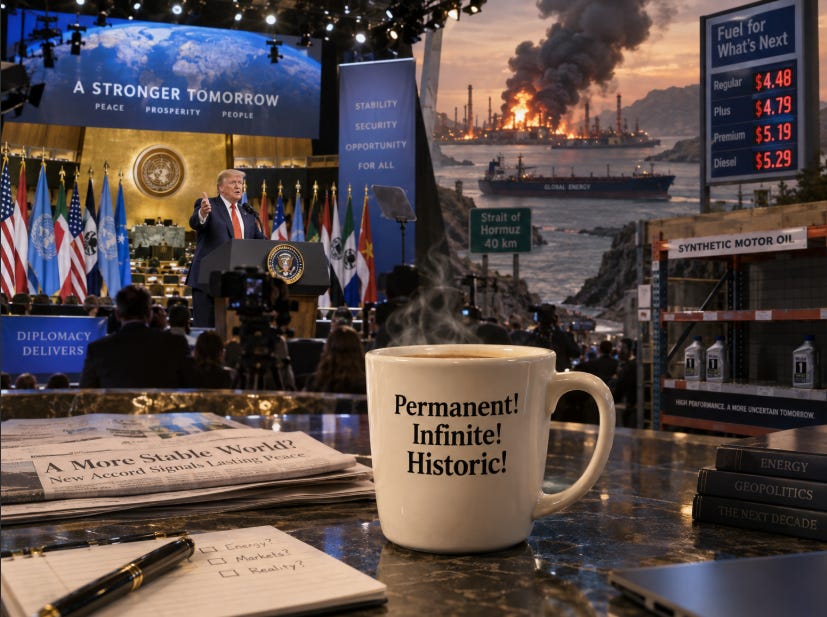
It is Sunday, September 20, and we appear to have reached the phase of the midterm campaign in which foreign policy increasingly comes with production design, and the White House has a Greenland deal to sell.
President Donald Trump announced Friday that the United States has obtained what he calls “permanent control over security, and all other needs” in Greenland. Secretary of State Marco Rubio called the emerging agreement “historic” and said it “permanently and completely” addresses American national-security concerns. Former administration official Katie Miller, wife of Stephen Miller, dispensed with the diplomatic nuance altogether, posting an image of Greenland covered by the American flag beneath the words “ITS HAPPENING.”
Trump has gone even further, describing what he calls an “Infinite Life” agreement: a deal with no end, forever and ever, amen.
Assuming everything proceeds as planned, they will sign the agreement next week on the sidelines of the United Nations General Assembly in New York.
Back in June, there was Versailles. The United States and Iran had reached what was actually an interim memorandum intended to begin a longer negotiating process. But there was Donald Trump, seated amid the gilding and chandeliers of the Palace of Versailles, unexpectedly signing the thing in a room that had spent several centuries accumulating historical gravitas so politicians could eventually borrow it by the hour.
The setting said peace treaty.
The document said keep negotiating.
The cameras got Versailles.
Reality got the fine print.
Now the chandeliers have been replaced by rows of national flags and the United Nations seal, but the production technique is awfully familiar: choose a venue so freighted with diplomatic legitimacy that some of its importance rubs off on whatever piece of paper happens to be on the table.
Versailles supplied borrowed history.
The UN supplies borrowed legitimacy.
And neither tells us what is actually in the agreement.
Denmark, Greenland and the United States have spent months negotiating an updated Arctic-security framework. The deal reportedly excludes non-NATO countries from establishing military bases in Greenland, restricts potentially threatening investments, provides for an expanded American military presence and is intended to remain in force even if Greenland eventually becomes independent.
That last provision is probably the strongest argument that Trump’s defenders can make that this is more than reheated leftovers from 1951.
The United States already possessed remarkably broad military rights in Greenland under the Defense of Greenland Agreement signed 75 years ago. American forces once operated numerous installations there, and the United States still runs Pituffik Space Base for missile warning, missile defense and space surveillance. The old agreement was hardly some month-to-month sublease awaiting a Trumpian master negotiator to secure a better landlord. State Department historical records say it remained in effect for the duration of the North Atlantic Pact, an alliance conceived as being of indefinite duration.
But if Greenland someday chooses independence from Denmark, the new agreement reportedly follows Greenland into independence rather than leaving the security relationship dependent upon Copenhagen.
Meaningful, yes, but “meaningful” appears to lack sufficient tensile strength for the current White House. Therefore, meaningful morphs into permanent control. Expanded military rights become “Infinite Life.” A prohibition on hostile foreign bases becomes something approaching American dominion.
And an agreement that Denmark says explicitly recognizes its sovereignty and territorial integrity and Greenlanders’ right to self-determination becomes a Stars-and-Stripes graphic declaring ITS HAPPENING. Denmark says the deal still requires parliamentary action before it can take effect.
A perfectly respectable security agreement lies trapped somewhere inside all that chest-thumping, waving a tiny flag and asking someone to let it out.
The Washington Post reports, citing people familiar with the negotiations, that the agreement was deliberately structured so Trump could declare victory while Denmark and Greenland preserved their sovereignty red lines. Those people also said the agreement does not give Washington the veto over Greenlandic decisions that Trump’s rhetoric might suggest.
A Danish parliamentarian with knowledge of the negotiations made the same basic point from the other direction on France 24. Asked whether the agreement substantially expanded the military rights Washington had possessed since the 1950s, Lars-Christian Brask initially answered, “Short answer is no,” before explaining that modern missile-defense technology requires an updated arrangement and that a larger American presence is expected.
Later, describing the negotiations themselves, Brask said the questions of possession, ownership and control had essentially been set aside so negotiators could focus on what the whole Greenland saga was actually about: security in Greenland and the Arctic.
Trump spent more than a year insisting sovereignty was the problem, yet negotiators appear to have solved the security problem without changing the sovereignty.
There is still no logical answer to why an allied security problem that Denmark and Greenland were already prepared to negotiate had to pass through months of threats to take the territory, NATO contingency planning and Greenlanders wondering whether soldiers from an allied country might someday arrive to occupy them before everybody eventually returned to negotiating Arctic security.
AP notes that Denmark had repeatedly made clear it was willing to expand the American military presence and strengthen U.S. commercial interests even while refusing to discuss sovereignty. For some reason, we took the scenic route.
AP further observes that the announcement gives Trump a foreign-policy achievement to tout ahead of the November midterms, while the six-month Iran conflict has complicated the domestic political environment.
Because political theater works considerably better when nobody wanders behind the curtain and asks who is actually writing the agreements, we should take a look backstage.
The Kyiv Independent did exactly that this week, publishing a deeply reported examination of Steve Witkoff’s role in the Russia-Ukraine negotiations. The White House angrily disputes the article, calling its characterization “fake news nonsense” and defending Witkoff as an envoy working intensively with both Kyiv and Moscow. That rebuttal belongs in the record, along with the allegations.
According to Ukrainian officials and people familiar with the talks, frustration with Witkoff has spread to both sides of the negotiating table. Ukrainian officials have questioned his understanding of the war and its territorial history. People familiar with Kremlin thinking told the outlet that Russian officials have also wondered whether their positions were always being accurately conveyed to Trump.
And then there is the piece of paper. During an April meeting, according to the Kyiv Independent, Vladimir Putin wrote “3+2” while discussing five Ukrainian territories. Witkoff returned to Washington with the paper. The reporting says he subsequently understood Putin to be proposing one territorial exchange; people familiar with Moscow’s actual position say he had misunderstood it.
European and Ukrainian officials reportedly realized almost immediately that something had been lost in translation.
There is a reason professional diplomacy comes equipped with enough translators, stenographers, regional specialists, and note-takers to staff a respectable wedding. “What exactly did Putin mean by 3+2?” is the sort of question one would ideally answer before rearranging the internationally recognized borders of Europe.
Another episode is even more remarkable. Before the Alaska summit, Witkoff reportedly met Putin without an American stenographer and relied upon the Kremlin’s translator rather than a U.S. government interpreter. The Kyiv Independent says he subsequently conveyed a Russian territorial position that did not match what Moscow was actually prepared to offer.
The White House disputes the characterization, but even the dispute illustrates something important. Foreign relations are not merely deals in the real-estate sense, where two principals shake hands and lawyers spend the next week figuring out what they meant.
One Ukrainian official gave the Kyiv Independent perhaps the most concise summary of the frustration: Washington kept telling Kyiv that it had to end the war.
“As if we don’t fucking want to end it.”
And this is where the gap between the announcement and the underlying reality stops being amusing.
Last Monday, Trump said Russia and Ukraine had agreed not to attack each other’s energy facilities. That certainly sounded encouraging, but Zelenskyy said Kyiv was willing to suspend attacks on Russian infrastructure if Moscow made a firm reciprocal commitment and Washington could help guarantee it. Ukraine was still waiting for something concrete. Russia, meanwhile, said its broader military operations would continue.
Six days later, the Moscow oil refinery was on fire.
Ukraine launched what Russian authorities called the largest drone attack ever directed at Moscow. Russia claimed more than 1,100 Ukrainian drones were intercepted across the country, Crimea and the Black Sea, including hundreds headed toward Moscow. Two people were killed in the wider Moscow region and others were wounded. Ukraine said it used an array of domestically produced systems, including Flamingo and Pelican missiles, against oil and logistics infrastructure that helps finance Russia’s war.
Russian officials immediately accused Kyiv of timing the attack to disrupt the final day of parliamentary elections, though DW found no evidence Ukraine had targeted election infrastructure, and the election itself proceeded with meaningful anti-war opposition excluded and voting conducted in occupied Ukrainian territory Moscow claims to have annexed.
The refinery, however, was quite definitely burning.
Ukraine’s campaign against Russian energy infrastructure is increasingly consequential in its own right. DW reports that Russian refineries were hit on average roughly once every three days during the first eight months of this year, and that June refinery throughput fell to 3.8 million barrels per day, its lowest level in more than two decades and roughly 30 percent below the previous year.
Fuel shortages have spread into ordinary Russian life. DW reports long lines, drivers using apps to locate stations that still have gasoline, and accounts of questionable fuel mixtures appearing where supplies are scarce.
Ukraine decided that if Russia intends to make war an everyday fact of Ukrainian life, some portion of that reality can travel in the opposite direction.
And Ukraine can increasingly do it with weapons built in Ukraine, which presents Washington with a new complication: a Ukrainian Flamingo does not require permission from Washington to fly. Neither does a Pelican.
The war is becoming harder to control precisely as the rhetoric from Washington keeps suggesting that pieces of it have been brought under control.
The Middle East is even less cooperative. The Versailles ceasefire tableau now belongs to another political geological era, approximately three months ago.
Iran is warning that renewed large-scale American strikes could bring retaliation against U.S. bases and potentially against regional governments that facilitate those attacks.
The Houthis have opened another front against Saudi Arabia. Saudi authorities say they intercepted a ballistic missile aimed at Riyadh, the first such attack on the capital during this latest escalation, while Houthi attacks or attempted attacks have also been reported against other Saudi locations and infrastructure.
Saudi Arabia is reportedly running low enough on missile interceptors that it has sought additional air-defense help from France, Britain, Pakistan and Egypt. The ink is barely dry on a new mutual-defense pact with Turkey and Pakistan, and someone’s already reaching for the warranty card; Ankara says it’s ready to help, though nobody seems eager to leap into another shooting war.
Italy, meanwhile, has contributed one of those sentences historians cherish because it usually precedes several chapters explaining why the sentence became necessary.
“We are not at war.”
Italian Foreign Minister Antonio Tajani said that while urging Europe to reinforce its naval mission protecting Red Sea shipping after an Italian military aircraft was reportedly damaged in Saudi Arabia.
Not at war.
Just reinforcing the naval mission in the increasingly dangerous war zone while military hardware gets damaged.
Completely different department.
When a war treated as one problem encounters a region containing a dozen others, this is what happens.The Houthis have their own interests. The West Bank has its own dynamics. Lebanon is another theater. Iran, Saudi Arabia, Israel, Turkey and Pakistan each have separate calculations. The danger is that those theaters are becoming connected by retaliation, alliance commitments, shipping routes, and energy infrastructure.
Where all this geopolitical grandeur finally makes its way is into your checking account. Today’s AAA national average for regular gasoline is $4.476 a gallon. One year ago, it was about $3.20. AAA attributes the latest climb principally to high crude prices and continued volatility around the Strait of Hormuz.
Now the war has followed Americans from the gas station into the oil-change bay.
The Financial Times reports that the price of Group III base oil used in many modern synthetic motor oils has nearly quadrupled since February to a record $12.45 a gallon. Costco has raised prices and is rationing some synthetic motor oil to one purchase per customer. Walmart has reported low inventory on several brands. Independent garages are struggling to obtain supplies. Valvoline has raised oil-change prices as its lubricant costs climbed.
The supply chain is another little tour of globalization we were apparently all expected to learn only after somebody blew part of it up.
An Iranian strike damaged Shell’s giant gas-to-liquids facility in Qatar, an important source of the highly refined base oils modern engines require. Hormuz disruptions then interfered with tanker flows feeding other major producers.
And because full-synthetic motor oil has strict formulation and certification requirements, you cannot simply wander into the warehouse, pour whatever is nearby into a bottle marked 0W-20 and hope nobody’s Chevrolet notices.
The internal combustion engine has joined the geopolitical conversation.
Battery-electric owners may now enjoy the exotic luxury of learning about the Group III base-oil crisis from newspapers rather than from the person holding their car keys at Jiffy Lube. There is no engine oil to change.
For everyone else, another Middle Eastern supply-chain disruption has quietly entered the household budget.
Higher diesel costs move through trucking and distribution and eventually into the price of almost everything that has to travel. Not every expensive tomato is Iran’s fault, but energy is threaded through the economy.
War has transmission mechanisms. So do incompetence and uncertainty.
And there is only so much counterprogramming available when people can see the number on the pump.
Which brings us back to our friend in the imaginary White House press room, yelling: RELEASE COUNTERMEASURES! Greenland deal! Historic! Permanent! Infinite! Look at the flags, do not look at Costco rationing motor oil, or Riyadh, or the Moscow refinery.
Next week’s UN photographs won’t tell us whether the Greenland deal is historic; the agreement will. The same test applies elsewhere. Refineries and power grids will tell us whether an energy truce exists, while Hormuz, Bab el-Mandeb, Riyadh and the tankers will tell us whether the Middle East is stabilizing. At home, the evidence arrives on gas-station signs, oil-change invoices and grocery receipts.
Reality leaves paperwork.
The administration can choose Versailles or the United Nations, arrange the backdrop and supply the adjectives. It cannot order a tanker through Hormuz, stock a Costco shelf by press release, negotiate with a burning refinery or make $4.48 disappear by moving the camera.
*Somebody* didn't proof Katie Miller's headline of "Its Happening" instead of "It's." Such a basic grammar mistake. If they make an error at this basic level, one wonders what *other* errors/oversights are being made at political, geopolitical, economic, etc. levels.
I keep thinking of the last minute, major changes the US inserted into the recent tariff agreement with Canada and hope the Danes and Greenlanders read as thoroughly as the Canadians. And are as vocal about any unexpected wording.
This administration practices the art of distraction like no other, it's right up there with insulting people for them. The recent lie about people okay with gas prices to ensure that Iran has not EVER got a nuclear weapon makes me laugh and scream at the same time.
A. No one can guarantee that any nation will never have a nuclear weapon unless one is used to annihilate that nation first. And that ensures WWIII.
B. When did this regime last listen to the general public and give us any serious consideration? They are so out of touch that they sit in front of the Sunday news hosts and don't even seem to realize the utter ridiculousness of what they are saying or that they are lying. I find that very insulting.