

Good morning. According to Donald Trump, the United States “owns” the Strait of Hormuz. It is a generous definition of ownership, given that commercial traffic through it has collapsed to something resembling a country road after midnight.
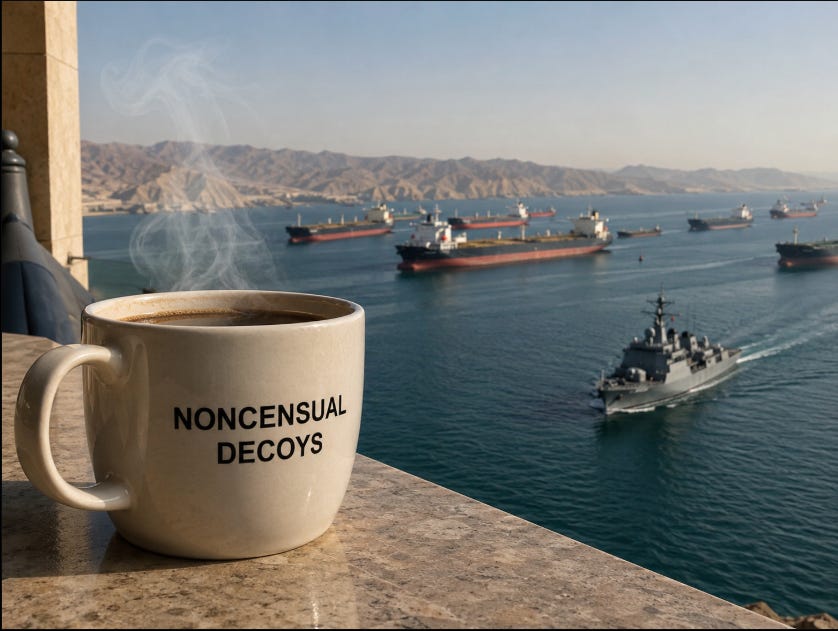
Trump said yesterday that the United States has “total control” of Hormuz, adding that if Iran challenges that control, “they get blown away.” Iran, inconveniently, continues to behave as though it did not receive the memo. Tehran says the strait will remain closed until Washington accepts its conditions, while shipping data cited by Al Jazeera showed only eight vessels passing through on Tuesday. Before the war, roughly 130 to 140 ships crossed each day.
So perhaps “owns” is doing more work than usual.
The more useful description of the Iran war this morning is that the military superpower still has vastly greater destructive capacity, but Iran has proved substantially more adaptable and durable than the administration expected.
The New York Times reports that Iran has steadily altered its tactics as the war has continued, using combinations of drones and missiles, maneuvering weapons and attacks from multiple directions to complicate U.S. air defenses. During five days of attacks on American bases in Jordan last month, Iran repeatedly forced U.S. forces to expend Patriot interceptors until one missile broke through on July 17, killing three American soldiers and wounding more than 100 people.
The arithmetic behind that contest is unpleasant. The Pentagon has reportedly fired more than 1,500 Patriot interceptors during the war and has fewer than 1,700 remaining, while the United States produced only about 600 during all of 2025. On one especially intense day, American forces reportedly fired around 50 Patriots, each costing roughly $4 million.
Iran appears to have learned from Russia’s war against Ukraine. The Times reports that Iranian forces studied Russia’s practice of mixing ballistic and cruise missiles with drones to overwhelm or distract Ukrainian defenses, then adapted versions of those tactics against the United States. Iran has also recovered missile-launch infrastructure that American and Israeli officials believed had been devastated early in the war. Defense Secretary Pete Hegseth declared on April 8 that Iran’s missile program was “functionally destroyed” and “almost completely ineffective.” Iran subsequently dug out damaged underground sites, resumed firing and helped bring shipping through Hormuz nearly to a halt.
One lesson of the last several years may be that declaring an enemy’s military capability destroyed works considerably better if the enemy agrees.
Ukraine has presented Russia with a related problem. It has repeatedly compensated for inferior conventional mass by finding cheaper, harder-to-defend ways of imposing costs on Russian infrastructure, logistics, and energy revenue. Now the two wars are colliding in an unexpected place: the price of oil.
The Financial Times reports that Vice President JD Vance asked Volodymyr Zelenskyy on July 31 to halt Ukrainian attacks on tankers using the Caspian Pipeline Consortium terminal at the Russian port of Novorossiysk. Washington had become alarmed that Ukraine’s campaign was disrupting Kazakh oil exports, destabilizing global markets and affecting American companies.
Chevron owns half of Kazakhstan’s giant Tengiz oilfield. ExxonMobil owns another quarter. Both have interests in the CPC system carrying Kazakh crude through Russia to the Black Sea.
Ukraine reportedly agreed not to attack CPC infrastructure or non-Russian vessels unless those ships were sanctioned by Kyiv or carrying Russian cargo, and attacks on tankers near the terminal stopped afterward. A U.S. official confirmed to the FT that Washington had warned Ukraine against targeting non-Russian vessels and CPC infrastructure.
There is also an awkward piece of leverage in the background. A person familiar with Ukraine’s position told the FT that Kyiv agreed to the request while seeking U.S. approval to manufacture Patriot interceptor missiles and hoping to acquire several hundred before winter. Zelenskyy reportedly told Vance during the same July 31 call that Patriots and air defense were Ukraine’s highest priority.
Nobody has produced evidence of an explicit bargain, as in, stop hitting these tankers and we’ll give you Patriots, and it would be irresponsible to pretend otherwise. But alliances do not require handwritten quid pro quos to contain leverage. Ukraine needs American air-defense support to protect its cities from Russian missiles. Washington wanted Ukraine to stop doing something that was hurting oil flows and American commercial interests. Ukraine stopped.
The administration’s behavior toward Iran itself makes this interesting. Earlier in the conflict, when disruption in Hormuz sent oil prices soaring, Washington temporarily relaxed its own sanctions regime to allow Iranian crude already at sea to reach the market. The administration later broadened that relief during the ceasefire process before reversing course when the arrangement deteriorated. Put another way, the United States has now demonstrated willingness to soften economic pressure on an adversary when oil markets become sufficiently stressed and to constrain an ally’s military campaign when that campaign creates similar pressure.
The recurring principle looks less like “maximum pressure” than a market-stability veto: when strategic objectives collide with oil prices, inflation or major American balance sheets, strategy bends. That may be economically rational, but it reveals the real hierarchy of priorities. War aims are what governments say they want; the costs they refuse to bear show how badly they want them.
This morning we have a very direct measurement of those costs.
U.S. inflation eased slightly in July, according to the latest consumer price data, with headline CPI falling to 3.4 percent from 3.5 percent in June and core inflation declining from 2.6 percent to 2.5 percent. That sounds reassuring until you look at the path that produced it.
Gasoline prices rose above $4.50 a gallon in May as the Iran war disrupted energy markets, helping push overall inflation to a three-year high of 4.2 percent. Prices subsequently fell below $3.80 during the relative lull in June and early July, contributing to this morning’s better inflation reading. Then the war heated up again. Gasoline climbed back above $4 late in July, meaning August’s numbers may begin reflecting the renewed disruption.
The Federal Reserve is therefore being handed one of those delightful policy combinations central bankers treasure: inflation that is cooling but still elevated, energy prices driven by a war with no obvious endpoint, tariffs adding their own pressure and financial markets wondering whether Fed Chair Kevin Warsh will eventually have to raise rates after holding steady at his first two meetings.
The International Energy Agency is not offering much comfort. It has lowered its oil-supply outlook again and now expects global supply to fall by 4.3 million barrels a day this year, about 4 percent, citing the continuing failure to restore normal traffic through Hormuz and Bab al-Mandeb. That is a larger reduction than the IEA forecast only a month ago. The U.S. Energy Information Administration has meanwhile raised its average 2026 Brent forecast to $86.81 a barrel.
This is how Iran’s adaptability becomes an American domestic-policy problem. Tehran does not have to defeat the U.S. military. It can impose costs through shipping disruption, interceptor depletion, attacks across a wider geography and the persistent possibility of damage to Gulf energy infrastructure. Those costs travel from battlefield to tanker to pump to CPI, and from there into Fed policy and American politics.
Iran has found a transmission mechanism between asymmetric warfare and the U.S. cost of living.
That helps explain why the diplomatic machinery is working so frantically this morning. Pakistan says it is trying to bring Washington and Tehran back to the negotiating table before the 60-day memorandum-of-understanding window expires Sunday. Pakistani Interior Minister Mohsin Naqvi has been in Tehran, while Oman and Qatar are also involved in efforts surrounding Hormuz.
The underlying agreement is itself a small monument to constructive ambiguity. The June 17 MoU established a ceasefire and a 60-day period for negotiations, but the two sides remain divided over what its language actually means. Iran interprets the Hormuz provision as recognizing Iranian authority to manage passage through the strait; Washington rejects that interpretation. Other provisions involve sanctions waivers for Iranian oil and making frozen Iranian assets available.
So the diplomatic clock is approaching zero just as the financial cost of failure becomes harder to ignore.
The conflict continues spreading around the edges: renewed Houthi strikes near Bab al-Mandeb, drone attacks in Iraq’s Erbil province, and a Lebanese army complaint that Israeli strikes are blocking its ceasefire deployment, none of it contained, all of it adjacent to the main event.
There is another story this morning about how power is exercised when the people making the decisions are insulated from the risk.
We learned earlier this week that Trump was secretly removed from Air Force One in Ankara last month after officials concluded there was a credible Iranian threat against the plane, spirited away to a smaller military aircraft while the 747 continued on to Britain. Peter Baker’s follow-up in The New York Times supplies the part of the story that deserves more attention: Air Force One did not fly empty. It carried Secretary of State Marco Rubio, Treasury Secretary Scott Bessent, Stephen Miller, Steven Cheung, other staff, military personnel and journalists, many apparently not told that the threat level around the plane they were sitting in had just changed. They were simply instructed to keep their window shades closed while Trump traveled separately, then was quietly returned to the 747 so he could emerge in Britain as though he’d been aboard all along.
The aircraft and its passengers didn’t just facilitate the misdirection. They became it.
There’s a legitimate case that the Secret Service can’t broadcast a live protective operation to a planeload of people mid-execution, and former security officials make that case forcefully. But that argument covers keeping secret which plane the president is on. It doesn’t obviously cover leaving everyone else on the original aircraft without telling them the threat picture had changed. Officials and reporters who’ve flown into Iraq or Afghanistan knew where they were going. The people on Air Force One in Ankara didn’t know what they were flying into, because it had just changed underneath them.
The comparison to history is not flattering. When Bill Clinton switched planes in Pakistan in 2000, aides floated using the press plane as an unwitting decoy; Clinton’s team objected, devised a different plan, informed at least one pool reporter in advance, and disclosed the operation once Clinton was safe.
The Trump White House disclosed nothing until reporters uncovered the operation themselves.
Trump said yesterday that the decision was “up to the Secret Service” and argued that the smaller plane he used may actually have faced more danger. The Times notes the obvious logical difficulty: if officials believed the alternate aircraft presented greater risk, it is not immediately clear why removing the president from Air Force One enhanced his security in the first place. The White House has also not explained whether additional protective measures were provided to the aircraft carrying the decoys.
Of course, a president deserves extraordinary protection. But who decided that everyone else could absorb a threat serious enough that the president himself could not, and what obligation did the government have to tell those people once secrecy was no longer operationally necessary?
More detailed reporting is coming on a broader accountability theme: the administration is simultaneously testing how far executive privilege can shield communications with outside advisers, how far presidential authority can reach into election administration, and how effectively federal funding can be used to force state policy changes. Courts are already pushing back on some of those efforts, while others are likely to become the next round of litigation over executive power and oversight.
That same question, who advises, who benefits and who gets scrutinized, also hangs over Pete Hegseth’s newly reconstituted Defense Policy Board.
The Guardian reports that board members Marc Andreessen and Blake Masters have financial or governance connections to companies linked to 1789 Capital, the venture fund where Donald Trump Jr. is a partner. Andreessen Horowitz has co-invested alongside 1789 in defense companies including Anduril, Hadrian and SpaceX, while Masters has held board roles connected to 1789-backed investment vehicles.
The Defense Policy Board advises the Pentagon on strategy and defense technology. Companies within this broader investment ecosystem have received substantial federal contracts and financing.
None of that, by itself, proves wrongdoing. People with deep experience in defense technology will inevitably have industry relationships, and connections are not kickbacks. But the reason conflict-of-interest scrutiny exists is precisely because government should not require the public to determine whether an adviser’s policy judgment and financial ecosystem just happen to be moving in the same direction.
The broader accountability theme today is therefore not especially subtle. The president’s security apparatus can secretly transfer a known risk to staff and journalists without telling them. The Justice Department is testing how far it can extend privilege over the president’s conversations. Federal funding is being wielded to accomplish, indirectly, policy outcomes Washington cannot simply order states to adopt. And when another attempted expansion of executive authority ran into the judiciary this week, a federal judge was unimpressed.
Back in the war that is supposed to demonstrate overwhelming American power, Iran remains dug in, Hormuz remains largely shut, Patriot stocks are being consumed, oil supplies are tightening, gasoline remains expensive, and Pakistan is trying to arrange negotiations before Sunday.
Power is often advertised in absolutes: maximum pressure, total control, overwhelming force, executive authority.
Reality sends invoices. Iran and Ukraine have both proved adept at discovering where those invoices become uncomfortable. Courts are testing where presidential authority runs out. Journalists are asking who was expected to assume a mortal risk without being informed. And financial markets increasingly demonstrate that they possess something remarkably similar to a veto over the strategic purity of American foreign policy.
Washington can choose its objectives. The balance sheet clearly gets a vote.
"Air Force One did not fly empty. It carried Secretary of State Marco Rubio, Treasury Secretary Scott Bessent, Stephen Miller, Steven Cheung, other staff, military personnel and journalists.." Wondering if certain people now realize tRump considers them 'expendible'. tRump 'loyalty' only goes one way.
Obama sent experts to negotiate with Iran. Felon 47 sent real estate bros with vibes and hair gel. Shocking how that went sideways.