


Good morning! Washington has entered the familiar phase of a political health crisis in which nobody will say what is happening, everybody insists everything is fine, and a strangely coordinated group of allies begins offering proof of life in nearly identical increments of approximately 20 minutes.
Mitch McConnell, 84, has not been seen in public since he was admitted to a Washington-area hospital on June 14. His office says he is continuing to improve, remains engaged with Senate business and appreciates the outpouring of support. It has not said what put him in the hospital, why he has remained there for nearly a month or when the people of Kentucky might expect to see the senator they elected.
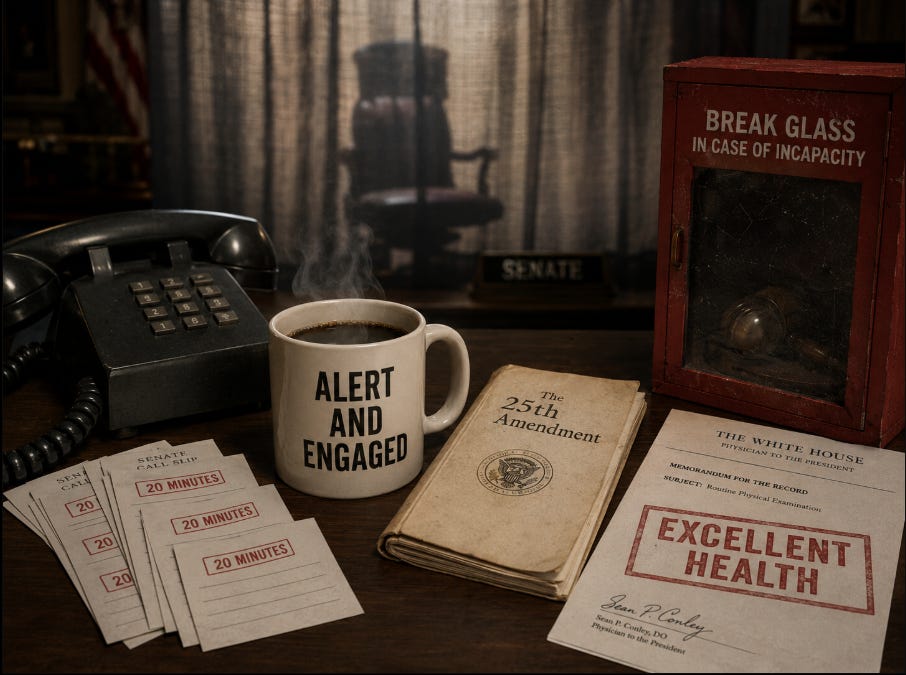
Emergency dispatch audio reportedly referred to an unconscious person at McConnell’s home and CPR in progress. Video released by CNN showed someone being taken toward an ambulance on a stretcher, although the person’s face could not be seen. McConnell’s office has neither confirmed nor directly rebutted those reports, leaving Washington to perform its favorite trick: creating an information vacuum and then scolding everyone for noticing the suction.
Into that vacuum came the telephone calls. Senate Majority Leader John Thune said he spoke with McConnell on July 6. Senate Majority Whip John Barrasso spoke with him the following day, according to aides, in a call his spokesperson said lasted 20 minutes and included a discussion of national defense spending. Scott Jennings, a commentator and longtime McConnell adviser, then announced that he had spoken with McConnell for just shy of 20 minutes about Iran, Ukraine, Maine and Senate history.
The claims may be entirely true. McConnell may be alert, lucid, fully briefed and spending his hospital stay holding substantive conversations about defense appropriations and the finer points of Senate history. But none of these accounts amounts to independent verification. They are descriptions of private conversations provided by allies, aides and former advisers whose political interests are tied to maintaining the impression that McConnell remains fully capable of doing his job.
The uniformity of the assurances made them less convincing rather than more. Each followed the same basic template: McConnell was engaged, knowledgeable, and able to sustain a detailed conversation for nearly 20 minutes. The duration was precise enough to sound evidentiary but repeated often enough to sound as though it had been distributed on laminated cards.
On CNN, Jennings was challenged to get McConnell on the telephone. He did not. Social media users began announcing their own imaginary 20-minute conversations with the senator. Thomas Massie joked that McConnell had called to endorse ending the Iran war, cutting off aid to Israel and abolishing warrantless surveillance, which was an efficient way of telling everyone that the conversation had not occurred. The Daily Show joined in, because satire tends to arrive whenever official messaging becomes too mechanically absurd for ordinary prose.
Governor Andy Beshear has now written an open letter asking McConnell to reassure the people of Kentucky about his health and ability to serve. That is not an unreasonable demand. McConnell is not merely an elderly private citizen recovering from an illness. He is a United States senator, the chair of the Senate Rules Committee and the head of a defense appropriations panel where Republicans hold only a one-seat advantage. The Senate returns Monday for a session dominated by military spending, national security and government funding. Senators cannot vote by proxy, even when their offices insist they are extremely engaged from an undisclosed hospital room.
The public is not entitled to every detail of McConnell’s medical chart. It is entitled to know whether its elected representative can perform the constitutional duties of the office.
That distinction has become increasingly inconvenient in a capital run by a gerontocracy that has learned to manage the optics of capacity more efficiently than the fact of it. Staff issue statements. Allies report private conversations. Surrogates testify to a leader’s vigor. The office continues operating through unelected aides while the elected official remains out of view. Anyone who asks who is actually making the decisions is accused of invading medical privacy.
We saw versions of this with Dianne Feinstein. We later learned more about how Joe Biden’s staff managed concerns surrounding his age and decline. Now McConnell has disappeared behind a hospital curtain while Washington offers a chorus of nearly identical testimonials from people asking the public to trust them.
This doesn’t prove McConnell is incapacitated. It does prove that the public has very few reliable ways to discover incapacity when everyone surrounding a powerful official has an incentive to conceal it.
That concern extends well beyond the Senate, and in Donald Trump’s case, the questions are no longer limited to observations about his public behavior.
On April 10, Representative Jamie Raskin wrote to White House physician Capt. Sean Barbabella demanding a comprehensive cognitive and neurological evaluation of the president, public release of the results and a detailed account of any medications that might affect Trump’s cognition. Raskin explicitly placed the request in the context of the 25th Amendment after Trump spent Easter weekend publishing threats and grandiose declarations about Iran. The letter cited reactions from an ideologically eclectic collection of Trump allies and former supporters, including Marjorie Taylor Greene, who said the president had “gone insane.”
Those reactions were political opinions, not medical findings, and should be treated accordingly. Tucker Carlson, Candace Owens, Alex Jones and Marjorie Taylor Greene are not a roaming neurological review board, however entertaining the waiting room might be.
But Raskin’s inquiry did not end with commentary about Trump’s Truth Social feed. After the White House failed to answer his April letter, Raskin wrote Barbabella again on June 18. This time, he pointed to a series of concrete and unexplained medical facts. Trump had reportedly been evaluated by 22 specialists during his May physical, nearly twice the number involved the previous year. He had visited Walter Reed three times in 13 months, including a roughly three-hour visit on May 26 that the White House described as a routine annual examination, even though Trump had already undergone another annual physical within the preceding year.
Raskin also asked why Trump had undergone another CT scan only six months after an earlier scan, why the president was taking what the congressman characterized as an unusually high daily aspirin dose, and whether his persistent hand bruising and leg swelling were connected to a broader medical condition. He demanded the complete examination results, laboratory and imaging reports, medication list, consultation reports and identities and specialties of the 22 doctors involved. He also asked Barbabella to appear before the House Judiciary Committee and answer questions under oath.
The White House response was not a medical explanation. It was an insult directed at Raskin and another declaration that Trump possessed unmatched energy and remained in excellent health. Alas, “very rude congressman” is now a recognized differential diagnosis.
Senator Chris Coons has separately called for Trump’s medical records to be released and reviewed independently, framing the matter as a question of fitness for duty rather than partisan curiosity. Thirty-six physicians and mental-health professionals have also placed their concerns into the Congressional Record. They acknowledged that they had not personally examined Trump and were not issuing a formal clinical diagnosis. That caveat matters. No responsible argument should convert public observation into medical certainty.
The public record now contains far more than a few Democrats speculating about Trump’s eccentric speeches. There are unanswered congressional inquiries about repeated hospital visits, an unusually large group of specialists, multiple scans, visible physical symptoms and undisclosed medications. None proves that Trump is incapacitated. Together, they establish that legitimate questions exist and that the administration has chosen opacity over evidence.
The McConnell episode reveals why that choice matters.
If a president’s health deteriorated, the public might expect the 25th Amendment to operate as an emergency brake. But the involuntary-incapacity provision must initially be activated by the vice-president and a majority of the Cabinet, or by another body Congress has created. Raskin has proposed establishing such an independent presidential-capacity commission, but the legislation faces obvious resistance in a Republican-controlled Congress.
Absent that independent body, the people responsible for acknowledging presidential incapacity would largely be the same people whose offices, influence, and political futures depend upon preserving the administration.
The safeguard exists. It does not pull its own fire alarm.
No elaborate conspiracy would be necessary. The White House physician could issue a brief memorandum declaring the president to be in excellent health. Cabinet members could describe vigorous private conversations. Political allies could report that he remained alert, engaged and intensely focused on policy. Staff could manage his schedule, filter access and perform increasing amounts of executive work around him. The public could be instructed not to speculate while being denied the information necessary to evaluate the official assurances.
Perhaps several loyalists would independently remember speaking with him for precisely 20 minutes.
America has constitutional procedures for presidential incapacity. It has no automatic protection against everyone near an incapacitated president deciding that acknowledging it would be personally, politically, or financially inconvenient.
McConnell spent decades demonstrating that institutional norms bend toward whoever is willing to break them first. He turned the debt ceiling into a hostage, manipulated the rules governing the Court and followed a floor speech blaming Trump for January 6 with a vote to acquit him. Now his own office asks the country to operate under the rules he perfected: trust the insiders, accept the carefully constructed language and do not demand evidence that might disturb the balance of power.
Perhaps every assurance is accurate. Sympathy for an ill man is entirely compatible with skepticism toward the institution protecting him. Illness does not erase McConnell’s humanity, but neither should it erase his public record or suspend the obligations of representative government.
At some point, representative government requires the representative.
The machinery of government is still functioning. It is simply becoming harder to determine whom it serves.
It’s been suggested the Governor should appoint a replacement Senator as is apparently allowed by the state constitution, to force proof of McConnell’s life and competence. In this day and age, that no one has offered evidence of his actual condition seems beyond bizarre.
It certainly appears as if the gang that can't shoot straight can't shoot straight...