


Good morning! While Iran burned, Donald Trump danced beneath a shower of gold confetti. Spain had just won the World Cup, but the president had once again located the true purpose of an international sporting event: providing Donald Trump with a brightly lit place to stand. He joined FIFA president Gianni Infantino for the trophy presentation, remained conspicuously present during Spain’s celebration and absorbed the boos rolling down from the stands with the serene composure of a man who has spent decades mistaking attention for affection.
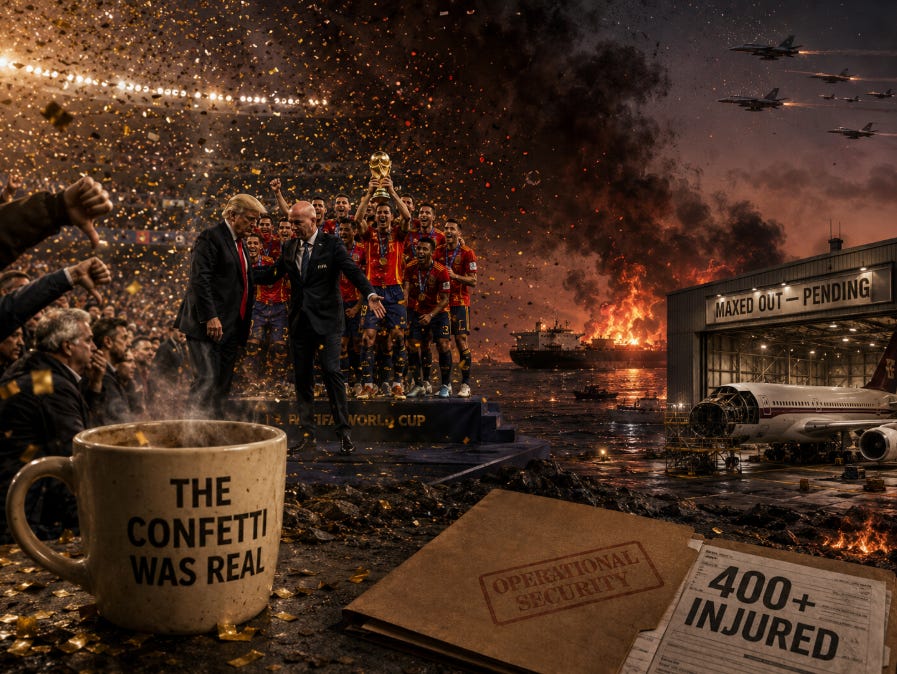
Video from the ceremony provided an additional detail. Infantino took special care to guide Trump toward his assigned position, pointing out the steps up, the steps down and the mark where he was meant to stand. Mexican president Claudia Sheinbaum and Canadian prime minister Mark Carney somehow crossed the same treacherous landscape without individual supervision. Infantino never grabbed Trump by the arm. He merely hovered with the focused vigilance of a man who had been told that the visiting dignitary must reach his mark without wandering into the trophy table.
He emerged from the festivities positively radiant. FIFA, Trump told reporters upon returning to Washington, had been “incredible.” There had never been anything like it. The tournament was four times greater than any previous World Cup and perhaps five times greater, according to the unidentified authorities who apparently brief the president on comparative event greatness.
“We congratulate Gianni Infantino,” Trump announced.
It had been, he continued, one of the greatest events of any kind ever held. People from all over the world had come to America and loved the country. They had apparently loved it most loudly when the president appeared on the stadium screens and again when he entered the trophy ceremony, although Trump did not dwell on the precise nature of the sound.
Asked whether he was disappointed that Argentina lost, Trump said both teams played well, Spain played better, Spain seemed to dominate and the match was nevertheless very close. It was a perfectly serviceable answer. Then someone mentioned the dead Americans, and the president’s evening shifted from football commentary to wartime casualty reporting with all the emotional grace of a malfunctioning elevator.
“We feel very badly,” Trump said.
The service members, he explained, were “great patriots” fighting to ensure that Iran could not obtain a nuclear weapon. Then came the count.
“It’s probably three as opposed to two.”
Probably three.
By Monday, two of those Americans had names. First Lieutenant Tyler James Feehan of Ewa Beach, Hawaii, was 25. Private Isabella Gonzales of Carrollton, Texas, was 19. Both were killed at Muwaffaq Salti Air Base in Jordan. A third service member died in northern Iraq during the controlled detonation of a downed Iranian drone.
“Probably three” was not a rounding error. It was a 25-year-old officer, a 19-year-old private and another American whose death Trump’s own military had already announced.
The president had spent considerably more time deciding whether this World Cup was four or five times greater than its predecessors than establishing how many Americans had died in the war he started.
Trump moved quickly from the casualties to victory.
Iran, he said, had been “very, very badly damaged.” It had lost almost everything militarily. The country still possessed some missiles, some drones and some manufacturing ability, but not much. The United States controlled the Strait of Hormuz. Iran “doesn’t control anything.”
Then he announced another round of American bombing.
“We hit them very hard again tonight,” Trump said, adding that the strikes had been carried out “in honor of” the dead troops.
Thus escalation became memorial tribute. Americans were killed, so more bombs fell in their honor, creating the conditions in which more Americans might eventually require honoring. Trump has always preferred a self-perpetuating business model.
Unfortunately for the victory speech, the Pentagon had been keeping a separate set of facts.
During the week before the fatal attack in Jordan, Iran had carried out three additional strikes against American forces there. Dozens of service members were injured, and several helicopters were damaged. Neither the attacks nor the casualties nor the aircraft damage was disclosed to the public.
Central Command subsequently announced retaliatory strikes against Iran but described them as a response to attacks on commercial shipping. The military did not mention that Iran had also been repeatedly striking American positions.
Officials were not merely withholding names while relatives were notified or concealing precise damage assessments during an active operation. They were managing the public explanation for why the United States was launching another round of attacks.
Military officials invoked operational security. Revealing too much, they argued, could help Iran assess the accuracy of its missiles and drones or improve its targeting of bases where thousands of Americans are stationed.
No responsible person expects the Pentagon to publish coordinates, vulnerabilities or real-time battlefield damage reports for Tehran’s convenience. Yet operational security does not require strategic infantilization of the American public. Acknowledging after the immediate danger has passed that an attack occurred is not the same thing as mailing Iran a targeting manual. Providing aggregate injury figures is not the same thing as identifying troop locations. Previous administrations somehow managed to report casualties from attacks by Iranian-backed militias without including a complimentary map and range card.
More than 400 American service members have been injured since the war began, according to Central Command, although the Pentagon has recently stopped updating the total. Seventeen have been killed. The last major Pentagon briefing on the war occurred in early May.
America is conducting a major regional war, losing troops, depleting expensive weapons and absorbing repeated attacks, but the public briefing schedule has apparently entered a protected bunker.
Trump claimed Iran had almost nothing left. Somehow, that nearly incapacitated enemy managed to strike American forces in Jordan four times in one week, wound dozens of troops, damage helicopters and kill two soldiers. It has also retained or rebuilt substantial missile capacity after months of assurances that its military power was being erased.
Perhaps that explains the information policy. “Iran has lost almost everything” sounds considerably less persuasive when accompanied by “here is the list of American bases Iran struck last week.”
By Monday morning, the United States had completed its ninth consecutive night of attacks. American missiles reportedly struck cities including Tabriz, Chabahar, Konarak, Bandar Mahshahr and Bandar Imam Khomeini. Iran claimed attacks on American military targets in Kuwait, Jordan and Syria, while Bahrain said hostile Iranian drones had targeted its air-navigation system, although flights continued normally.
A vessel in the Strait of Hormuz was burning after being struck by an unknown projectile. Its crew abandoned ship and was rescued by a tugboat while the vessel drifted, still on fire.
Trump says the United States controls the strait. Maritime insurers, tanker captains and the people fleeing burning ships may be working with a more demanding definition of control.
Then the Houthis announced a maritime embargo against Saudi Arabia.
Houthi-controlled territory overlooks the Bab al-Mandab Strait, the narrow passage connecting the Red Sea to the Gulf of Aden and the Arabian Sea. Roughly 15 percent of global maritime trade passes through that route. Saudi Arabia has been using its east-west pipeline to bypass the crisis in Hormuz. The Houthis are now threatening pressure at the other end of the peninsula.
One strategic waterway is constricted, another is threatened, a ship is burning and attacks are spreading across Jordan, Kuwait, Bahrain, Syria and Iraq.
Trump’s “little job” is becoming geographically ambitious.
He attempted to explain the change at the end of Sunday’s gaggle. Originally, he said, the United States had been performing a limited task to stop Iran from acquiring “a certain capability.” Now the administration was “ending it” by eliminating any chance that Iran could ever possess a nuclear missile.
In other words, the mission had expanded from disrupting an immediate capability to eradicating the future possibility of one. Trump insisted these were not the same mission.
On that point, he was correct.
He then said the United States had stopped Iran from “probably” accomplishing something after a week and a half, or perhaps two weeks, but not four weeks.
“I don’t want to have the word probably,” he said, before ending the exchange.
A president who had just described the American dead as “probably three” suddenly developed exacting standards for uncertainty when discussing whether his war had succeeded.
Iran, meanwhile, accused the United States of striking the unfinished Darkhovin Nuclear Power Plant. The International Atomic Energy Agency said the site had been in a very early stage of construction and contained no nuclear material when inspectors last visited. The agency again called for military restraint around nuclear-related facilities.
Destroying a facility that contains no nuclear material is difficult to present as the surgical elimination of an imminent weapon. It looks rather more like destroying infrastructure Iran might someday use, which places the war comfortably inside Trump’s newly expanded mission of eliminating future possibilities.
Anything can become a military target once “might someday” replaces “currently does.”
The economic consequences are also becoming harder to conceal.
The national average price of regular gasoline has returned to $4 a gallon, nearly a dollar above the $3.14 average a year ago. Oil briefly moved back below $90 a barrel after Iran acknowledged that diplomatic messages were still being exchanged through intermediaries.
Nine nights of bombing drove prices upward. Evidence that someone was still talking brought them down.
Even the oil market appears to recognize an exit strategy when it sees one.
Trump was asked what consequences China might face. “We’re going to see,” he replied, adding that the administration would speak with Chinese officials. The great geopolitical chess match thus advanced to its customary Trumpian stage: perhaps something will happen, involving people, at some time.
He had considerably more to say about Canada.
Trump confirmed that he had spoken with Mark Carney about wildfire smoke crossing the border. The conversation went well, he said, and the two men have a good relationship. Naturally, Trump followed this declaration of friendship by suggesting Canada might owe the United States damages or be subjected to tariffs.
Canada, he said, had to “stop these fires from coming in.”
Someone in Ottawa has neglected to close the northern smoke valve. Trump said American air had been “poisoned” and claimed businesses, car plants and other facilities had closed around Detroit. The United States might help Canada fight the fires, he added, but perhaps Canada should pay first.
This is the Reflex Presidency working its smaller rooms. The pattern that manufactures a fresh justification for a war that will not end is the same pattern that manufactures a trade grievance out of a climate disaster. Smoke becomes an invasion. A burning forest becomes an invoice. The possibility that worsening heat and drought might contribute to worsening wildfires remains diplomatically inadmissible, because carbon dioxide has yet to establish a trade deficit Trump can threaten. Iran gets bombs. Canada gets tariffs. Somewhere there is always a bill, and somewhere there is always a foreign hand to hand it to.
He also said he could not remember this happening before, except that he had seen it beginning four or five years ago. The fires were therefore both unprecedented and part of a multiyear pattern, a condition known in meteorology as talking until the next reporter asks something else.
The technique never changes size to fit the problem. It is the same reflex whether the failure is a war that will not end or a sky that will not clear.
And now, a brief visit to the schadenfreude department.
Trump’s beloved Qatari-donated Boeing 747 will soon be taken out of service to be “maxed out.”
A reporter pointed toward the aircraft and asked why the president was flying in a plane that lacked the full antimissile defenses of the older Air Force One models.
Trump replied that it had “a lot” of capability. It had so much capability, apparently, that it must be removed from service in about a month and sent away for additional capability.
The plane has been Trump’s airborne monument to decorative impatience. The existing presidential aircraft were too old, too stiff and insufficiently luxurious. Qatar supplied a 14-year-old flying palace, the administration rushed it through modifications, and Trump began using it even as he said the aircraft would eventually go to his presidential library.
Earlier this month, The New York Times reported that the jet lacked some of the sophisticated countermeasures installed in the older presidential planes, including full antimissile protections. The report prompted the White House to order a leak investigation. FBI agents hand-delivered grand-jury subpoenas to several Times reporters at their homes.
The administration treated the disclosure as a grave national-security breach.
Then Trump stood beside the airplane and confirmed it.
The reporters were subpoenaed for reporting that the plane still needed work. The president announced that the plane would be sent away to have that work performed.
No word yet on whether the FBI plans to hand-deliver a subpoena to the president, although agents may wish to wait until Infantino has guided him safely down the steps.
Trump said the upgrades would take about a month, a timetable the White House did not immediately clarify. Perhaps advanced antimissile countermeasures are now available through the same service that installs premium sound systems and undercarriage lighting.
The old Air Force One can withstand electromagnetic disruption, refuel in flight, function as a command center and defend against missiles. Trump’s preferred replacement has better upholstery and an appointment at the shop.
Even better, taxpayers may now finance sophisticated upgrades to an aircraft Trump hopes will eventually become part of his post-presidential collection.
Nothing says stewardship of public resources quite like asking the government to max out your future museum piece.
While the Trump administration spent the weekend bombing Iran, threatening Canada, intimidating journalists and performing victory beneath imported confetti, New York mayor Zohran Mamdani was asking whether international law applies when the accused is a close American ally.
Mamdani told The New York Times that his administration was in active discussions with the city’s law department about whether New York could arrest Israeli prime minister Benjamin Netanyahu if he visits for the United Nations General Assembly in September.
The International Criminal Court issued an arrest warrant for Netanyahu in 2024, alleging war crimes and crimes against humanity in Gaza, including starvation as a method of warfare, murder, persecution and other inhumane acts. Netanyahu has not been convicted. The warrant represents charges to be adjudicated, not a verdict.
Mamdani’s earlier campaign rhetoric was more categorical. As mayor, he is now being careful. He acknowledged that his authority remains unclear and said his administration would do whatever existing law permits, but would not invent powers it does not possess.
The practical obstacles are enormous. The United States is not a party to the ICC. Federal authority over diplomacy would almost certainly collide with any attempt by a city government to detain a visiting foreign leader attending United Nations proceedings. Netanyahu may also benefit from immunities connected with his official role and UN travel.
Mamdani may never obtain an arrest. He has already obtained a revealing response.
Trump’s UN ambassador, Mike Waltz, dismissed the inquiry as “pure political theater.” Marco Rubio has vowed to dismantle the ICC, accusing it of waging war against the United States through “so-called international law.” Trump imposed sanctions on the court soon after returning to office.
Perhaps Mamdani’s proposal is theater in the practical sense. It is nevertheless theater that illuminates the machinery backstage.
Washington invokes international law when it wishes to punish an enemy, dismisses international law when it constrains an ally and sanctions international lawyers when they become inconvenient. Rules are sacred when they authorize force, intolerable when they demand restraint and entirely optional when the defendant has the correct diplomatic seating assignment.
That question belongs beside the Iran war.
Trump says the United States must bomb because Iran cannot be allowed to possess a nuclear weapon. His administration attacks nuclear-related infrastructure that contained no nuclear material, conceals Iranian strikes on American bases, withholds casualty information and keeps broadening the objective. It treats an international court’s warrant against an allied leader as an act of hostility to be crushed.
Law, in this system, is a weapon whose legitimacy depends upon which direction it is pointed.
Trump spent Sunday borrowing Spain’s victory, approximating the American death toll and declaring Iran nearly destroyed even as it continued striking American positions. Behind the pageantry, the Pentagon concealed injuries, the White House pursued reporters, and Trump’s prized luxury jet prepared for a return to the shop. Gasoline reached $4 at home; abroad, a ship burned, a second strategic waterway came under threat and the bombing rolled into a ninth night.
The confetti was real. Almost everything beneath it was stage management.
Marz and I would also like to congratulate Spain on its World Cup victory, not least because, as satirist Andy Borowitz pointed out, Trump was rooting for Argentina, and any international result that disappoints him acquires a little extra sparkle. I was more conflicted about the bronze-medal match. My heritage is French, but I lived in England from the ages of three to eight, so my loyalties were divided. Congratulations to England as well, and my apologies to the French branch of the family tree, which I trust will recover with wine and dignity.
Sparkling prose, as always! Thank you! 😃
Thank you for covering the escalating war with Iran with clarity and detail.
Since the Korean War, it seems Republicans haven’t met a war they don’t embrace, fund without restraint, rationalize despite American military casualties and soaring civilian death tolls and massive destruction in the “enemy” target, and eventually lose.
Now we have to add the Trump factor - dominate or die - so an explosion in Pentagon spending and higher body counts are unlikely to deter further escalation.
At least Spain edited Trump out of the victory photo and thousands booed him when he entered the field. In his mind, he was undoubtedly the star, but it’s nice to know reality still has a voice.