


Good morning! Two days after American voters handed his party what The Economist calls the biggest wave election since Watergate, Donald Trump sat down at the Resolute Desk to take his first official action of the new political era. A red cap reading “VETO” rested beside him like a paperweight with opinions.
The pressing matter of state was the Oval Office itself. Trump signed a proclamation declaring it a national monument, along with the Cabinet Room, so that the space “won’t be able to be taken down, destroyed, touched, or anything else.” Nobody had proposed taking it down. Still, he warned of future vandals who might be “stupid people” bent on rebuilding it “in a slightly different shape,” and he pledged that if anyone starts knocking down walls, “you’ll call me wherever I may be and I will come back here.”
Picture it: a former president descending on Pennsylvania Avenue to defend the curvature of a room.
It’s an admirable commitment to preservation from the man who sent the excavators into the East Wing in October 2025. The wing that had housed generations of first ladies’ offices came down in a matter of days to clear ground for his ballroom, a project he had assured the public would sit near the existing building without touching it. On Thursday he boasted that the ballroom will be the finest in the world, with five underground stories of military facilities, and he complained that critics had sued over it. Apparently the rule against tearing down historic White House spaces to build something of a different shape applies to his successors, not to him.
The rooms he wants frozen in place are, of course, the ones he has spent two years lacquering in gold: gilded mirrors, gold eagles, cherubs shipped up from Mar-a-Lago. The proclamation doesn’t prevent a future president from redecorating, contains none of the congressional-approval requirement Trump described, and could itself become the subject of another president’s pen and another round of litigation. But the signature, he assured the room, deserved “a 10,” because “this space is a 10.”
Then a reporter asked about Pete Hegseth, and Trump got to talking about his wars.
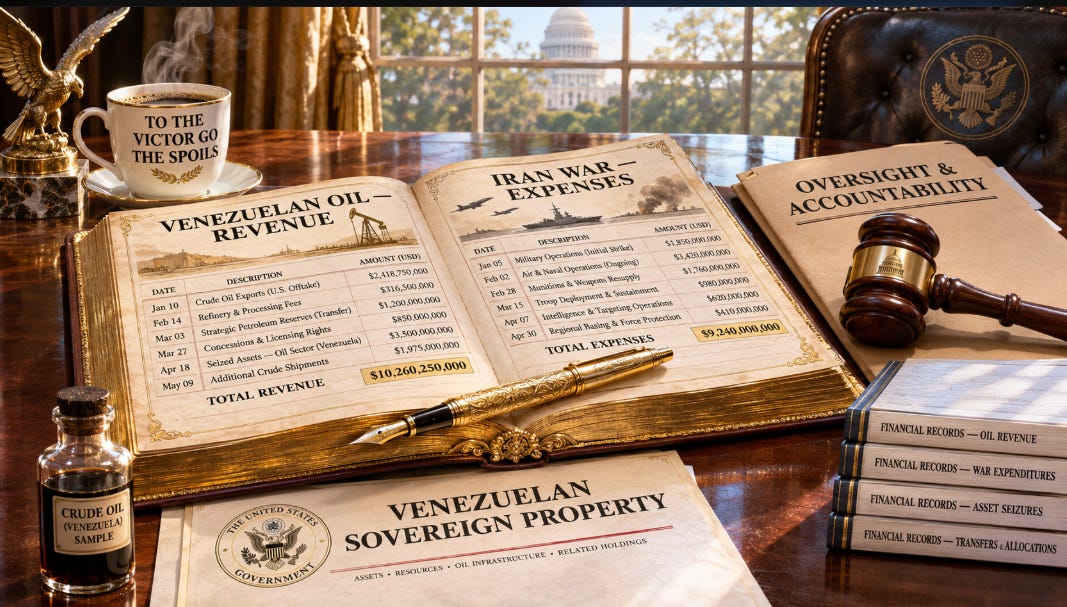
Within minutes, the man who had just sworn to protect a historic room from “stupid people” was explaining the economics of military intervention. A “lightweight congressman,” he complained, had criticized him for spending $25 billion on Iran. Trump had a ready answer: “We’ve taken much more money out of Venezuela than that, you know, if you add them up, because it’s basically two wars.”
Read that sentence again, slowly. A sitting American president, defending the cost of one war, volunteered the spoils of another as the offset. Venezuela, where US forces seized the head of state in January and Washington took control of the oil revenue, is presented as the revenue line. Iran, where he now describes the American presence as “virtually an occupation,” is the expense. The ledger balances, in his telling, because one country’s oil is paying for the bombing of another.
He didn’t stumble into this. For months, Trump has been treating Venezuelan oil as a return on his military adventures, although the numbers, and even which war he’s supposedly paid for, keep changing. Sometimes it’s twenty-five times the cost, sometimes twenty-eight, sometimes ten. On Thursday, he dispensed with the multiplier and simply stated the business model aloud, in the room he’d just declared a monument to American greatness.
So whose money is he spending?
Since Trump volunteered it, we should start with the arithmetic.
The Pentagon told Congress last month that the Iran war had cost $47.1 billion through mid-October, nearly double the $25 billion figure Trump keeps waving off. Meanwhile, the last widely documented estimate put Venezuelan oil sales at a little over $13 billion as of July, a figure Trump himself acknowledged. Those are different reporting periods, and the oil sales represent gross revenue, not American profit. But even allowing for additional sales, the administration has offered no accounting remotely substantiating Trump’s claims of a tenfold return. Ten times the Pentagon’s war-cost estimate would be $471 billion. As business models go, it’s less a cash cow than a cow somebody else owns, which has been producing considerably less milk than advertised.
That brings us to the more interesting problem: ownership.
Legally, according to the administration itself, none of that money is America’s. The executive order Trump signed in January defines the proceeds as the property of the Venezuelan government, held by the United States in a “custodial capacity,” with disbursements directed by the secretary of state on Venezuela’s behalf. Energy Secretary Chris Wright went further and said the funds sit in an account in the name of PdVSA, Venezuela’s national oil company, explicitly “not into the ownership of the U.S. Treasury.” The first $500 million took a detour through an account in Qatar, chosen, officials explained, so that Venezuela’s creditors couldn’t freeze it. Venezuela owes as much as $170 billion to bondholders and oil companies, and the administration has been careful to keep them from getting at it.
There is no evidence that Venezuelan oil revenues have actually paid for military operations in Iran. There are several possible explanations for Trump’s boast, none of which he has offered: commercial benefits counted as though they were government revenue, plain inflation of the numbers, or uses of the money his administration hasn’t disclosed. Whichever it is, treating Venezuelan sovereign property as an American war dividend raises questions that cannot be answered by another presidential boast.
What happens to the money once the oil is sold is considerably harder to establish. The first sales went to the commodity-trading giants Vitol and Trafigura. One of Vitol’s senior traders had contributed approximately $6 million to political committees supporting Trump. That doesn’t establish wrongdoing, but it makes transparency about who received the contracts and on what terms all the more important.
A State Department official told Congress in April that approximately $3 billion in payments had been authorized for Venezuelan public salaries, oil-industry supplies, and other “approved uses.” Who approved the individual payments, and who ultimately received them? Treasury Secretary Scott Bessent has repeatedly declined to provide a full accounting of the money received, the amounts disbursed, and the recipients.
Caracas even established a website to track the revenue. When the figures were examined in July, the site showed just one transaction: $300 million in March. For an arrangement involving billions of dollars in another country’s sovereign wealth, that’s a remarkably thin public record.
There’s an older word for this arrangement, one that predates sanctions regimes and custodial accounts. A ruling power takes control of a subject territory’s wealth, pays the local officials’ salaries at its own discretion, rewards favored merchants with the trade, and boasts that the proceeds can pay for wars elsewhere. Medieval Europe called it tribute. The lord collected, the vassal state’s government ran on his allowance, and the serfs who actually produced the wealth were told it was being held for their benefit.
Trump just has better branding: a Treasury account in someone else’s name.
For months, Democrats have been asking what’s in that account. In September, House Republicans blocked an attempt to subpoena the records [VERIFY: source]. The administration has resisted providing a full accounting.
On Tuesday, the shareholders voted.
Democrats took both chambers of Congress, flipping Senate seats in Texas and Kansas and gaining roughly 46 House seats. Exit polls and post-mortems pointed repeatedly to the same grievances: the war, the cost of living, and a president who seemed considerably more interested in his own ambitions than in either. Voters had been promised lower prices and no new wars, and they got a tariff crusade, a conflict with Iran, and diesel prices to match.
Trump’s response has run through the full spectrum of acceptance, from denial all the way to slightly different denial. On election night he declared that he hadn’t been on the ballot, and if he had been, Republicans would have won “IN A LANDSLIDE.” By Wednesday he was conceding he “knew” the war would cost his party. By Thursday he was demanding that Alaska take the votes cast for two minor candidates and hand them to the Republican incumbent, a procedure with no precedent in American law.
None of it changes the calendar. The new Congress takes office January 3. Until then, the enterprise operates under old management, with eight weeks remaining and a Republican Congress that still has constitutional powers to exercise if its members can summon the inclination to use them.
Thursday’s meeting suggests the management is considering how to use the time. Trump sat down with his national security team to discuss restarting major operations against Iran. Officials pointedly noted the new moon over the Middle East on November 9, and Central Command has been finishing preparations. Before the election, Trump had promised no major military action until after the vote and predicted a deal would follow it. The vote is over. In the Oval Office, he said he would “rather not destroy the rest of the country if possible, but maybe I’ll have to,” and assured reporters they would “know soon enough.”
This is where Pete Hegseth’s fate stops being a personnel story. Republicans, who spent months defending Trump’s war, have discovered in the space of 48 hours that it was all Hegseth’s fault. Thomas Massie will reintroduce his articles of impeachment on Monday. Thom Tillis is publicly listing Hegseth’s failures, from the fired generals to the war plans texted to a journalist. Massie has offered the president an exit: fire Hegseth now, while a Republican Senate can still confirm a replacement.
CNN reports the logic may run the other way. If Trump decides to resume strikes, a source says, he may need to keep Hegseth precisely because a Democratic Senate won’t confirm anyone else. The window that protects the war secretary is the same window that permits a wider war. Hegseth seems to understand this. His defiant video, all slow-motion swagger and culture-war greatest hits, isn’t really addressed to the House. It’s an audition for the next phase.
So the shareholders voted to replace the board, but the chief executive still occupies the corner office. And before the new directors arrive, he’s contemplating another hostile takeover.
Whether he proceeds may depend on what the people currently holding office decide their responsibilities are, and whether they’re prepared to exercise them.
The Economist, never a publication given to barricades, greeted Tuesday’s results with something close to exhilaration. Its cover argument was that the wave represented a victory for American democracy itself, proof that voters can still punish a party they’ve long supported. Its prescription fits in a sentence: “Voters have done their job. Politicians must now do theirs.”
Fair enough. But the editorial also urges both parties to reconsider the ugly mechanics of modern partisanship, then offers examples drawn entirely from Republican campaigns: gerrymandering, Elon Musk’s $150 million intervention in Texas, attacks on Muslims and transgender Americans, and an especially vicious campaign ad in Ohio. Having documented one party’s conduct, it distributes the responsibility for reform evenly between both. Shared responsibility for governing, however, does not require pretending that responsibility for the conduct being criticized is equally shared.
The editorial then frets that Democrats might overreach, that subpoenas and impeachments could crowd out the work of lowering prices and restoring health care. It’s a familiar worry, and it rests on a false choice.
The Venezuelan oil accounts aren’t a distraction from the cost of living. Neither is Trump’s Russian diesel arrangement, which senators from both parties contend violates the 2022 ban on Russian energy imports and which the administration promoted as a way to ease fuel prices. Nor is a war whose Pentagon-estimated cost runs nearly double the figure the president keeps citing, supposedly offset, in his telling, by another country’s oil.
Following the money is part of the affordability agenda. It just involves more bank statements than press conferences.
The first obligation falls on the people who still hold the gavels. For eight more weeks, Republicans run both chambers, and The Economist is right that voters have handed them a second chance. They can take it in concrete ways: a vote on Massie’s articles rather than another early recess, a war powers resolution before Trump orders another round of strikes rather than a debate over their legality afterward, and committee chairs of their own asking Scott Bessent the question he has dodged all year. Where is Venezuela’s money, and who has been paid out of it?
None of this requires courage on the scale of a profile in a history book. It requires showing up to work in the two months before they lose the keys.
How many will seize that opportunity rather than wait to see which way the wind blows from the Oval Office remains to be seen. They might consider The Economist’s other observation: once an old king’s power begins to drain, it can drain faster than anyone expects.
On January 3, Democrats inherit the gavels, along with two responsibilities Washington keeps trying to present as competing priorities: governing and investigating.
Robert Garcia, the incoming Oversight chair, marked the election results with a two-word statement: “Lawyer up.” His committee will want the Venezuelan account statements, the disbursement records, the KPMG contract and any audits it produced, and the names on the oil sales agreements. Other committees will want a full accounting of the Iran war and the legal basis for authorizing Russian diesel imports over the objections of lawmakers from both parties. None of this is political retribution. It concerns billions of dollars, the cost of a war, and the legality of executive decisions.
That is the distinction The Economist nearly makes but doesn’t quite carry through. Oversight isn’t an indulgence Congress must somehow fit around the serious business of governing. It is serious business. The power to investigate exists because Congress cannot write sound laws, appropriate public money responsibly, or restrain abuses of executive authority while remaining deliberately ignorant of how the government operates.
Congress has the authority to demand the records, examine the decisions, and establish what actually happened.
After all, how can Congress do its job if it won’t even find out what the administration has been doing?
Replacing his current chief of staff with Stephen Miller does not augur well, in addition to the ominous signals noted in today’s excellent update.
Hakeem Jeffries and Chuck Schumer weren’t up to this moment last night; with the evil duo of Trump and Miller now in charge of the vast powers of the presidency (thanks to the Trump Supreme Court), their unfitness to lead Congress is even more important.
We the People crawled over glass to be heard and will not back down!
Really interesting and well researched summary of what is really going on in Washington. I hope your knee is better today and Marz is not feeling too guilty.