


Good morning! It is Memorial Day, a federal holiday traditionally set aside for reflection on the human cost of war, which makes it a fitting occasion to note that the United States is currently fighting one, negotiating its way out of it, and taking a victory lap for battles that haven’t been won, all simultaneously, before breakfast.
Let’s begin with the information battlefield, because that’s where this war is most actively being lost. Al Jazeera’s Listening Post ran a tidy autopsy this week of how Donald Trump handles military reality when military reality declines to cooperate. The pattern, by now familiar: escalate the rhetoric, walk it back, repeat. Declare total victory. Call the journalist asking about total victory treasonous. Iran’s Foreign Ministry, demonstrating a fluency in both western pop culture and the specific architecture of this president’s ego, posted a clip from The Apprentice, young Trump receiving instruction from mentor Roy Cohn on the one true rule of winning: claim victory and never admit defeat, no matter what. Iran did not need to editorialize. The clip did the work.
The reality the clip was illustrating: three months into the US-Israeli war on Iran, the Strait of Hormuz remains effectively under Iranian control. A fragile ceasefire has been in place since April 8, punctuated by skirmishes. About 1,500 to 2,000 ships are trapped in the Persian Gulf. Gas nationally is averaging $4.51 a gallon, up 51 percent since the war began. Brent crude, even after falling sharply Monday on deal optimism, still sits roughly 30 percent above pre-war levels. The International Energy Agency has noted, helpfully, that even in the best-case scenario, mine-clearing operations alone will require several weeks of mobilization before shipping can resume, and a minimum of two to three months after that before export operations stabilize. “Prices are not going to drop quickly,” said the chief economist of High Frequency Economics, in the understatement of the holiday weekend.
So where does the deal stand? Depends entirely on who you ask, and when.
Saturday: Trump announces the two countries have “largely negotiated” a memorandum of understanding “pertaining to PEACE.” Sunday: Trump says the deal “isn’t even fully negotiated yet” and tells his negotiators “not to rush.” Monday morning: Rubio says a deal could materialize “maybe today.” Monday afternoon: Iran’s foreign ministry says “no one can make such a claim.” Monday evening: Trump posts that any deal will be “great and meaningful” or “there will be no deal,” without specifying which direction he’s leaning at that particular moment.
What appears to be on the table: a 60-day ceasefire extension, gradual reopening of the Strait, Iranian mine removal, a US easing of its naval blockade, phased sanctions relief and asset unfreezing, and a commitment to begin nuclear talks. What is emphatically not on the table, per Iran’s foreign ministry: nuclear details. What the US insists Iran has committed to: disposing of its highly enriched uranium stockpile. The Americans have a name for this: “no dust, no dollars.” Iran has a name for this too, which is “not what we agreed to.” Both sides are, in a meaningful sense, announcing different deals.
The GOP hawks are not pleased. Lindsey Graham warns that any deal in which Iran retains effective control over the Strait represents “a major shift in the balance of power” and “a nightmare for Israel.” Ted Cruz writes that an Iran “still run by Islamists” receiving sanctions relief while retaining enrichment capability would be “a disastrous mistake.” Trump’s response, characteristically, is to call them “Dumocrats, RINOS, and Fools.” This is the same Trump who in 2018 called the JCPOA “rotten” and withdrew from it. The deal currently under negotiation, several observers have noted, bears a passing resemblance to the JCPOA. Trump has promised it will be the “exact opposite,” without explaining how.
Underneath the ceasefire negotiations, a separate territorial crisis is quietly metastasizing. Iran last week published a map asserting regulatory control over Strait waters extending deep into UAE and Omani territory. Five Gulf states, Bahrain, Kuwait, Qatar, Saudi Arabia, and the UAE, jointly warned the IMO (International Maritime Organization) not to comply. The Institute for the Study of War assessed that Iran’s escalating territorial claims suggest Iranian officials believe they’ve already won. This is running in parallel to the peace talks, not instead of them, which gives you some sense of how durable any agreement is likely to be.
The Lebanon thread, meanwhile, has no resolution in sight. Israel continues striking Lebanese villages, over 3,100 killed since March, despite the nominal ceasefire. Hezbollah’s Naim Qassem welcomed a possible US-Iran deal this weekend, framed it as proof that “Iran has managed to humiliate America,” and called Lebanese citizens into the streets to topple their government for participating in US-brokered talks with Israel. Rubio condemned this as dragging Lebanon “back into chaos.” Netanyahu, whose statement on the emerging deal came 18 hours after Trump’s announcement, a silence Israeli analysts read as alarm, said Trump had reaffirmed Israel’s right to defend itself “on all fronts, including Lebanon.” How any of this resolves is unclear. What is clear is that the Lebanon war has its own logic, its own casualty count, and its own timeline, none of which are waiting on the Doha negotiations.
Closer to home, 5 miles from Disneyland, about 50,000 residents of Garden Grove, California spent their Memorial Day weekend evacuated from their homes while authorities attempted to prevent a chemical tank from exploding. The tank contains 6,000 to 7,000 gallons of methyl methacrylate, a highly flammable compound that had begun a self-reinforcing polymerization reaction. EPA administrator Lee Zeldin, a former Republican congressman with no prior environmental policy experience, chosen by Trump specifically for his enthusiasm for dismantling the agency he now runs, appeared on CNN Sunday to explain that the tank “will fail,” offering a spectrum of outcomes from “low-volume release” to cascading explosions. The discovery of a pressure-relieving crack Saturday night was cautiously welcomed by officials, though a Texas A&M chemical engineering professor noted that cooling on the tank’s surface does not preclude a runaway reaction occurring deep inside. Think of a soda can, said a Purdue engineer. Except the soda can is the size of a building and contains enough flammable material to level a neighborhood.
The facility’s operator is GKN Aerospace, a UK-based manufacturer backed by Melrose Industries, whose CEO received a £45.4 million bonus. Records show the Garden Grove facility was cited in 2018 by California’s Department of Industrial Relations specifically for improper cooling of volatile chemical tanks and failure to inspect active machinery. OSHA identified ten separate workplace safety violations the same year. The fine for all of this, collected in 2019: $2,898. The state agency responsible for enforcement, Cal/OSHA, currently operates with a 32 percent staff vacancy rate and conducts inspections by letter rather than site visit. More on the full regulatory accounting in a dedicated piece shortly.
That, in its own way, is also a Memorial Day story: not battlefield sacrifice, but the quieter civilian version, where ordinary people absorb the risk created by leaders, executives, regulators, and agencies that decided prevention was too expensive until evacuation became mandatory.
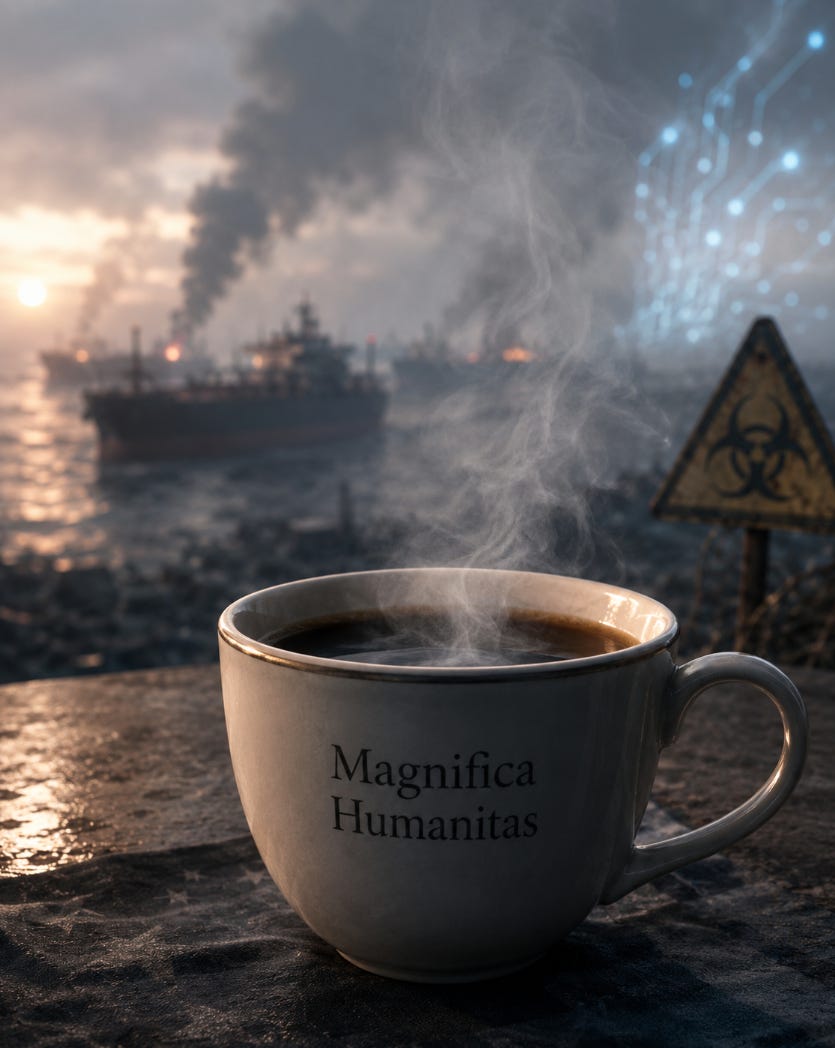
Finally, Pope Leo XIV chose this Memorial Day to release “Magnifica Humanitas,” a 42,300-word encyclical addressed to “all people of good will” on the subject of artificial intelligence and human dignity. He presented it alongside Christopher Olah, co-founder of Anthropic, in what the Vatican called a gesture of dialogue between the spiritual and technological worlds. Olah told the assembled cardinals, computer scientists, and diplomats that AI companies need “moral voices that the incentives cannot bend,” a sentence that rewards reading twice, given that it was spoken by a founder of an AI company, to the Pope, in Rome. Leo signed the document on May 15, the 135th anniversary of Rerum Novarum, Leo XIII’s 1891 encyclical written to protect workers from the Industrial Revolution. The parallel is not subtle.
On a day dedicated to remembering what humans sacrifice for one another, the leader of the world’s largest Christian denomination issued a reminder that the thing most worth protecting is the human role in human society, in work, in war, in the decisions that shape other people’s lives. Whether the tech industry will listen is, according to one ethics professor, doubtful. Whether it matters that someone said it anyway is a different question.
More this week as the Iran deal either materializes, collapses, or is announced three more times before Friday.
"AI companies need 'moral voices that the incentives cannot bend'..."
The US government and politicians also need "moral voices that the incentives cannot bend."
I'm not holding my breath, for either scenario. 😕
Reading that bit about the Garden Grove, CA situation, I was reminded of the first episode of The Newsroom (We Just Decided to) which covered the evolving disaster of the Deepwater Horizon blowout in the Gulf of Mexico. Also following instances of questionable safety measures, also exposing an understaffed and underfunded inspection regime, the lesson of pay now or pay much more later seems to be one that governments simply won't learn.