


It is July 3, the eve of America’s birthday, and for reasons known only to God, caffeine, motherhood, and whatever committee of raccoons currently governs my frontal lobe, I couldn’t sleep.
Maybe it was because I was enjoying time with my husband and couldn’t quite bring myself to go to bed. Maybe it was because once I finally did fall asleep, I managed about an hour and a half before my daughter woke me up needing help, as children are legally required to do the moment your body remembers it’s mortal. Maybe it was because once I got her settled again, my brain caught fire with ideas for B-roll to build up the video side of what Mom and I are doing, plus a mural I am now absolutely determined to paint on the living room wall through a campaign of charm, persistence, and only light domestic lobbying.
Bless my husband. I don’t know how he puts up with me and all my strange little visions. No husbands were harmed in the making of this mural plan. He supports my weirdness beautifully, even when his face says he would personally prefer the living room remain a room and not become a woodland folk-art chapel.
Or maybe I couldn’t sleep because I remembered the slab of myrtle wood I have been meaning to turn into shelving for the last six weeks. Or because I started thinking about the plants outside, the tomatoes, the chestnut tree, the little green lives depending on me to remember water exists. Or because, by quarter after four, I had stared at my husband with such devoted and unsettling intensity that my undying will apparently woke him from sleep, at which point I persuaded him to come outside to water and prune with me.
That’s how we ended up in the garden before the day had properly introduced itself. And that’s how I discovered the bindweed was back. Of course it was. Bindweed is the unpaid intern of the garden, wildly ambitious, impossible to supervise, and somehow in three departments before lunch. I respect the hustle, but I don’t appreciate the management style.
There I was, dirt under my nails, one glove missing, weeds at my feet, the tomatoes waiting, the chestnut tree needing checking, the kids somewhere between sleep and chaos, and my husband beside me in the early morning light, participating in the sacred rural man ritual of helping his wife pursue a weed-based vendetta before breakfast.
Inside, the dryer I had no recollection of starting had probably finished, which meant, naturally, that the laundry had entered the witness protection program. And my brain, loyal goblin that it is, had already left the meeting.
This is ADHD. Not the cute version where someone says, “Sorry, I’m so ADHD,” because they bought two planners and forgot one appointment. I mean the full municipal infrastructure problem.
The kind where your mind operates like a small town run by raccoons. Every department is understaffed, the filing system is mostly just a wing and a prayer, and the emergency siren goes off because someone remembered an email with a typo from 2019. Meanwhile, the Department of Fascinating Soil Facts has received unlimited federal funding. Which may be why, standing there with bindweed in my hand on the eve of America’s birthday, I found myself thinking about the republic.
This is not the first time my brain has done this to everyone. Everyone already had to enjoy the ride when, against all reasonable orders from management, my mind connected the garden to Donald Trump. We have done earthworms, invasive pests, bindweed, soil, decay, the underground republic, and a piece on blight will be coming soon, stay tuned.
So now, with apologies to those who came here hoping the tomatoes would remain politically neutral, we are going one layer deeper. This is not just a piece about ADHD. It is a piece about what my disorder taught me about the republic for which it stands, “one nation.”
That phrase gets repeated so often it can start to sound ceremonial, like something polished by habit until the meaning wears thin. But one nation has never meant one kind of person, mind, life, need, rhythm, voice, or one acceptable way to function. A nation is one because many different systems agree, however imperfectly, to keep belonging to the same whole.
That is also my brain. My mind is not a tidy kingdom with one calm ruler making reasonable decisions from a sunlit desk. My mind is a republic of competing departments, factions, emergency councils, public works projects, neglected archives, agricultural committees, emotional weather stations, and one wildly overfunded office dedicated to metaphor.
Some days, they cooperate beautifully. Some days, there is a government shutdown because someone moved the keys from the place I always leave the keys because if I don’t leave the keys there they may as well exist in an alternate reality.
I’ve known I have ADHD for a long time. Long enough that it is not a revelation, it’s more like property taxes, or that one drawer in the kitchen where batteries, thumbtacks, birthday candles, and moral decline go to live. It’s simply part of the landscape, and somehow, inside that landscape, I became a writer. A mother, a homeowner, and a person with a marriage, children, deadlines, tomatoes, a mortgage, a garden, and approximately seventeen systems designed to keep me from being defeated by laundry, which remains my oldest and most disrespectful enemy.
That’s the part I want people to understand. ADHD has made many ordinary things harder for me, it hasn’t made me less capable; it has made capability look stranger. For me, thinking isn’t a straight road. It’s a constitutional convention held in a forest during a thunderstorm. Everyone has notes, no one has the agenda, someone has discovered a mushroom, someone else has introduced an emergency resolution on the grocery budget, and a third delegate is making an impassioned case for researching Roman concrete “at once,” because apparently the survival of the household depends on it.
I start with one thought, trip over another, remember a bill, invent a sentence, lose my coffee, find my phone in the pantry, and somehow arrive at a useful conclusion forty minutes later with no clear record of the route. This is annoying when I’m trying to clean the kitchen, it is extremely useful when I’m trying to write.
Writing rewards the part of my brain that refuses to stay in one lane. It lets the associations run wild, then asks me to come back later with pruning shears. The same mind that can turn “switch the laundry” into an unsolved cold case can also connect policy, grief, soil, motherhood, democracy, and one emotionally suspicious earthworm before lunch.
This is not because ADHD is a superpower, please don’t put that on a mug, even though I would definitely buy it despite not agreeing with it. It’s because every brain has tradeoffs, and mine came with some defective wiring, some illegal fireworks, and a shockingly good metaphor department.
There are costs to this; real ones. There are days when everything technically gets done, the children are fed, the piece is written, the bills are paid, the tomatoes are watered, and still I feel as if I have survived a minor natural disaster no one else noticed. From the outside, it looks like functioning. From the inside, it feels like holding together a parade float with dental floss and maternal obligation.
ADHD isn’t simply distraction. It’s willful and deliberate self-governance. That is the realization I keep returning to. My mind isn’t empty, it’s actually rather crowded. Inside me are many states of being, and each of them believes it has a legitimate claim on the floor.
There is the writer, who wants to follow the sentence wherever it leads. The mother, who knows children need lunch, clean clothes, remembered appointments, gentleness, boundaries, and shoes that apparently fled the scene under suspicious circumstances. The wife, who loves her husband deeply and still sometimes loses the thread of a conversation while trying with all her heart to stay. The daughter, whose mother gave her language, politics, courage, and a tendency to notice when the world is being run by fools. The homeowner, who understands that mortgages, budgets, and repairs aren’t imaginary, and myrtle wood shelving doesn’t become shelving through intention alone. There is the gardener, who wants to know what the soil is doing. The artist, who believes the living room needs a mural and regards opposition as a temporary failure of imagination. The anxious historian, who keeps old warnings in the basement and occasionally comes upstairs ringing a bell. There is the exhausted body, begging for sleep. The bright, restless mind, asking whether we have considered starting a completely new project before breakfast.
All of those parts are mine. The goal is not to become one by becoming simple, the goal is to become one by learning how to hold complexity without letting it become civil war. That is the work of a republic, it’s also the work of living with ADHD.
Plato understood that the soul and the city reflected each other, which is a useful thing to remember when your own soul appears to be governed by raccoons with subcommittee authority. How we govern ourselves and how we govern one another belong to the same old human question: what do we do with all these competing hungers?
The answer, apparently, is not to hand the whole operation over to whichever appetite has the loudest microphone. This is also good advice for countries.
A republic, at its best, is an argument against rule by impulse. It admits that human beings are brilliant, selfish, frightened, generous, distractible, ambitious, easily flattered, and frequently one bad mood away from making a terrible decision. It doesn’t assume that people will always choose wisely on their own, it builds systems because goodwill alone isn’t enough.
That isn’t cynicism, it’s maturity. The American republic is often spoken of as an experiment, but we sometimes forget what experiments require. Observation, adjustment, humility, failure, return, the willingness to admit when the system is not producing the life it promised, the courage to repair what has been neglected, and the discipline to keep tending something that opportunists, weeds, grifters, and men with flag pins will absolutely retake the moment everyone gets tired.
A republic is not a machine that runs because someone said beautiful words in the eighteenth century. A republic is a practice. It needs systems, memory, accountability, restraint, repair, and shared purpose. It needs rules that keep the fastest climbers from strangling everything tender and needs citizens who understand that freedom is not the same thing as neglect.
That last part matters to me because I know, in my own life, what happens when freedom is misunderstood as the absence of structure. Without systems, I am not free; I am lost.
Without calendars, reminders, routines, baskets, notes, alarms, family rhythms, visible cues, and a certain amount of benevolent containment, my life becomes a scavenger hunt designed by someone who hates me.
Timers are infrastructure, calendars are load-bearing walls, laundry baskets in the right place are not evidence of domestic virtue, they are traps set for my future self, who can’t be trusted but can occasionally be guided with containers.
This is the part people misunderstand about ADHD, and perhaps about democracy too. Structure isn’t always the enemy of freedom, sometimes structure is the thing that makes freedom possible. A trellis is not a prison; because it helps the vine climb. A boundary is not cruelty; because it protects the garden from being swallowed. A system is not oppression when it allows complicated life to keep growing without collapsing under its own abundance.
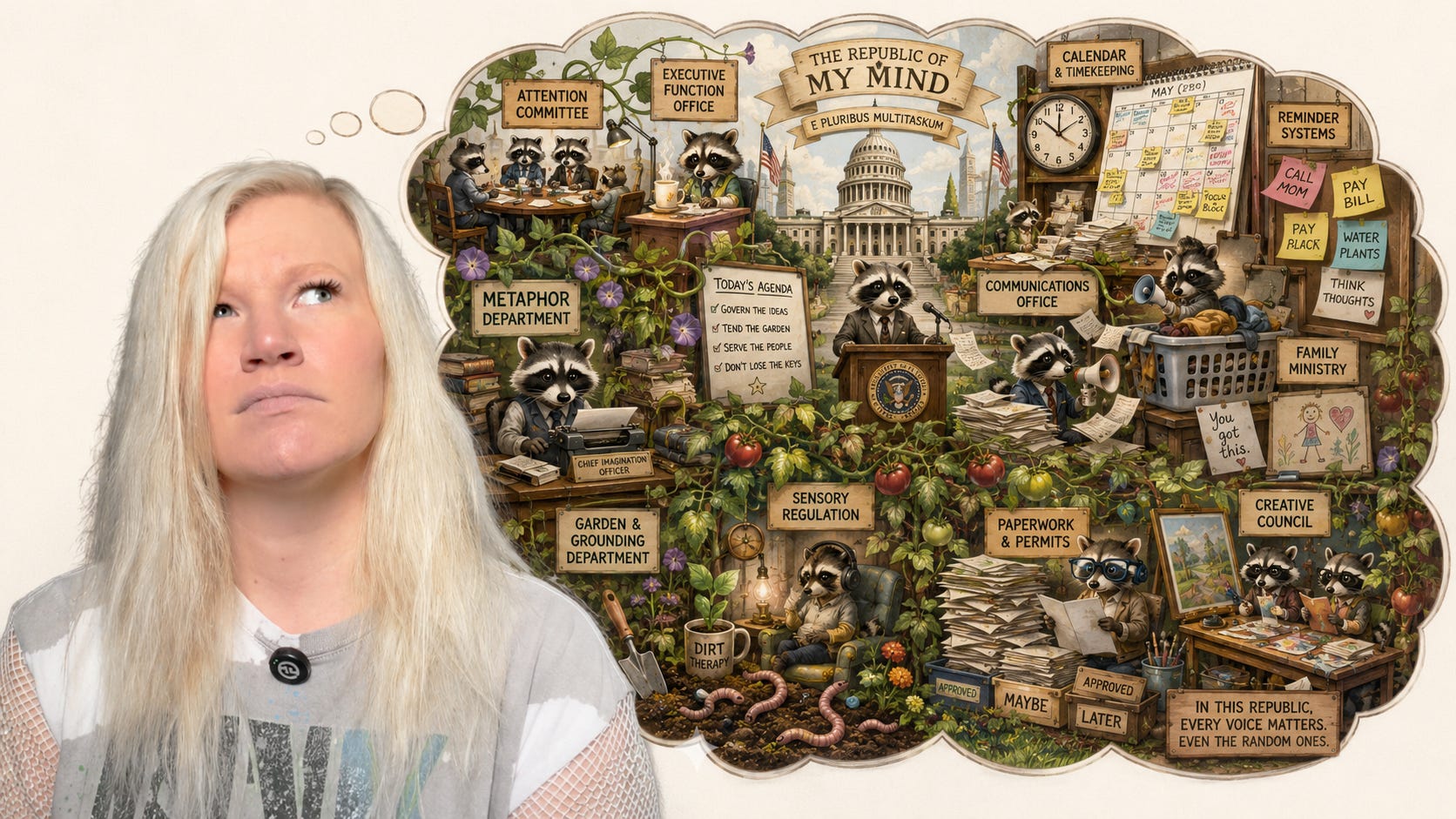
I don’t need systems because I lack love. I need them because I have too much life moving through me at once. That’s true inside a person, and it’s true inside a country. “One nation” is not the absence of difference. It’s the discipline of belonging despite difference, it’s many states, many histories, many needs, many wounds, many gifts, and many arguments, all trying to remain part of one body without being flattened into sameness or abandoned to chaos. Unity is not uniformity; it’s coordination, care, and a shared agreement that the loudest faction doesn’t get to burn down the whole house just because it’s having a feeling.
In my own internal republic, this means the part of me that wants to write until midnight has to negotiate with the part of me that has to mother at seven, the part that wants to paint the mural has to answer questions from the Office of Budgetary Reality and the Department of Spousal Facial Expressions, the part that sees the whole architecture of an essay in one bright flash has to cooperate with the part that needs to make dinner, the part that wants quiet has to live with the part that creates noise, and the part that loves my family beyond language has to learn how to show that love in the ordinary grammar of attention. That last one is the hardest.
My husband has had to live with the less charming parts of this, the dropped threads, the missed details, the way my attention can wander away from a conversation even when my love is standing right there trying to hand it a map. From the outside, I know it can look like indifference. From the inside, it’s more like trying to listen to one beloved radio station while every other station in the county breaks into the broadcast at once. Deadline alert, child noise alert, sudden urgent need to research wisteria alert, and domestic mural initiative alert. I’m not uninterested, I’m simply over-receiving. My brain lacks a bouncer, and everything gets in.
That’s exhausting for me, but I know it can be lonely for the people who love me. That’s the truth I don’t want to decorate too much. ADHD doesn’t only happen inside my head, it happens in a household, in a marriage, in the small gaps between what I meant and what someone else felt, and when love is present but attention is scattered, when I care deeply but fail visibly, when my inner republic is so busy putting out fires that someone I adore starts to wonder whether they have been forgotten. They have not been forgotten; but sometimes they’ve been waiting, which matters.
A humane system has to account for harm without turning every flaw into a moral indictment. That is true in a family, and it is true in a country. People need repair, accountability, patience, love with a memory, and grace with a calendar. My children, meanwhile, live almost entirely in the present, which is where I’m always trying to get.
They don’t care about my neurological profile when they need a snack. They require consistency, patience, clean socks, emotional regulation, and the ability to locate the shoes they personally removed during what appears to have been a fugitive operation.
They are beautiful, beloved, and administratively relentless, they’re also some of my best teachers. They remind me to look up and see the salamander under a log, a new tooth, a fairy garden, or a tiny hand covered in soil. They ask me questions about worms, which is, and I’m not trying to be dramatic, the proudest moment of my maternal journey.
Because you see, a child doesn’t say, “Mother, please optimize the household workflow.” A child says, “Look.” And sometimes, thank God, I do. That, too, is part of self-government. Not merely managing the chaos, but remembering what the management is for. A system that produces order without tenderness is not a life, a country that produces power without care is not a republic worth keeping, and a mind that becomes efficient but loses wonder has not been healed, it has only been made more convenient for someone else.
Mom taught me that, though I doubt she ever said it exactly that way. Mom gave me writing in more than one sense. First, I inherited some piece of it from her, the instinct for language, the habit of watching the world and needing to turn it over until the meaning reveals itself. Then she gave it to me again by bringing me into this work with her, by making room for my voice beside hers, and by trusting me with the strange, serious, ridiculous, but very necessary business of paying attention in public.
She also gave me politics early. Not party politics alone, although there was certainly enough of that to make childhood dinner conversations feel like a moderately well-informed subcommittee hearing. She gave me the deeper piece: the idea that power matters because people matter, that government is not some distant marble machine humming beyond ordinary life, but a set of choices that eventually finds its way into kitchens, hospitals, schools, forests, grocery bills, and the tired bodies of mothers trying to keep everything alive.
Because of her, I learned to see politics as stewardship and I learned that private life and public life are not separate gardens. What happens in the halls of power comes home. Power is never abstract to the people living under it and neither is disorder.
That may be why my brain sees connections everywhere. Not because I am trying to be clever, and not because every tomato is secretly a congressional hearing, although I reserve the right to make that case later if the tomatoes continue behaving suspiciously. I see connections because my mind has never separated the categories cleanly. The garden is the family, the family is the economy, the economy is the body, the body is the land, the land is politics, and politics is the argument over who gets protected, who gets used, who gets believed, who gets forgotten, and who is expected to keep functioning while the systems fail around them.
ADHD makes that kind of seeing chaotic. Writing makes it useful, motherhood makes it urgent, the republic makes it legible, and Mom, by giving me language and politics together, gave me a way to turn all that noise into meaning.
Still, the noise doesn’t stop. There will be mornings when I wake up too early because my brain has decided sleep is a bourgeois affectation. There will be days when I lose the thread, miss the detail, forget the laundry, overcommit to a mural, wander into the garden for one task and emerge three hours later with dirty knees, a political theory, and no idea where I put my gloves.
There will be moments when my husband needs my full attention and I have to fight my own ecosystem to give it. There will be moments when my children pull me back to earth by shouting “Look” with the authority of tiny CEO’s. There will be emails, dishes, appointments, deadlines, budgets, socks, tomato stakes, and weeds with imperial ambitions.
I will not conquer my brain. That would be a short and humiliating war, but I am learning to govern it. Not perfectly or quietly, of course. I govern it with timers, baskets, humor, apologies, notebooks, alarms, routines, grace, and the occasional desperate act of container-based strategy. I govern it with writing, with love, and by returning to the work after I drift, admitting when the raccoons have seized another department, and building systems that don’t require me to become someone else in order to live well.
This is the real experiment. Not becoming orderly in the way the world imagines order, but by becoming faithful in the way living things require. Faithful to the children, to the marriage, to the work, and to the small republic inside myself, unruly as it is, and to the larger one beyond my door, endangered as it is.
Because the truth is, I don’t believe one nation was ever supposed to mean one kind of person. I don’t believe a functioning republic requires the erasure of difference, or that a functioning life requires the erasure of complexity. I don’t believe my brain becomes worthy only when it becomes quiet. The point is not to silence every part of myself, the point is to bring them into relation.
The point is to build a life where the writer, mother, wife, daughter, gardener, homeowner, artist, researcher, and tired human body can all belong to the same whole without staging a coup every Tuesday.
The point is unity, freedom with structure, and love with systems. A republic, if we mean it, is not a finished object. It is a promise renewed through practice, so is a family, a mind, and a life with ADHD.
The bindweed will be back tomorrow. So will the dishes, the children’s shoes, the appointments, the noise, the tenderness, the tomatoes, the mortgage, the marriage, the republic, and the laundry, always the laundry, rising again like capitalism with fabric softener. And so will I. I will pull what I can, laugh where I can, build systems where I must, and probably lose the gloves, again, I only have 80 pairs, after all.
And somehow, the whole unruly nation of me will go on trying to grow.
Shanley, I love your writing, You throw a lot of things out there, take a circuitous and informative route to your destination, and then pull it together in such a way that it makes perfect sense. As the mother of a man with ADHD, I can knowingly say you handle it well.
Shanley, I am 74 years old and I have had ADHD all my life. Your descriptions of how my brain works hit home. I think I will allow myself more grace to not finish that long list of things I hope to accomplish today. Instead, I will go plant the rest of my tomato seedlings that have been waiting for me for a couple of weeks. They will catch up to their sisters that are already in. I am in California, which strangely enough is not over 100° today. Blessings to you and your family. Thank you for being such a gifted writer!