


On Floreana Island in the Galápagos, hope did not arrive with a motorcade, a slogan, or a podium. It arrived in crates carried by careful hands. It arrived as 158 juvenile giant tortoises, eight to thirteen years old, sturdy as old stones and somehow tender at the same time, their faces set in that permanent expression of patient judgment that makes you feel, briefly, as if you have been called into the principal’s office by the natural world itself.
These tortoises stepped onto volcanic ground their ancestors have not walked in nearly two centuries, not because nature forgot them, not because evolution moved on, but because humans removed them with the casual brutality of convenience. Sailors and whalers treated living beings as moving storage, as calories with legs, as a pantry that could not say no. And yet, in 2026, a line of park staff, scientists, and conservationists chose a different story, one made of patience rather than appetite, one measured in seasons rather than headlines.
The project is not a simple rewind button; it is more human than that, messier, more honest, and therefore more miraculous. Researchers found tortoises elsewhere in the archipelago carrying Floreana ancestry, then bred them carefully across years. They raised juveniles until they were strong enough to face the island, and they worked to clear invasive threats that would otherwise erase eggs and hatchlings before they had a chance to become history again. Restoration, in other words, is a long, stubborn love letter written in field notes, budgets, and blistered hands.
This is where I confess something, because it matters to the emotional geometry of the moment: when you watch humans bring something back, you realize how rarely we see repair up close. We see outrage, we see spectacle, we see the sharp dopamine spikes of conflict, but repair is quieter. Repair is incremental. Repair is the decision to keep going when there is no applause, and the Galápagos tortoises are a living rebuke to our addicted attention spans, a reminder that the future can still be built by people willing to work at the tempo of living systems.
Meanwhile, back in the United States, the opposite tempo is being celebrated: the fast tempo, the headline tempo, the tempo of “undo it, reverse it, roll it back.” This week the Trump administration’s EPA announced a sweeping deregulatory push aimed at undoing the 2009 greenhouse gas “endangerment finding,” the legal foundation that supports much of the federal government’s authority to regulate climate pollution under the Clean Air Act. In the language of the press release it is framed as liberation; in the language of physics it is denial. In the language of everyone who has watched the last decade of fires, floods, and heat records, it reads as a kind of bureaucratic amnesia performed with a flourish.
So yes, the giant cheeto energy is real. The urge to treat the planet like a reality show set is real, and the temptation to declare the smoke alarm an inconvenience and remove its batteries is real. If you have felt your hope thin out lately, if you have felt the air go shallow in your chest as the news cycle tilts toward extraction and away from protection, you are not imagining it. You are simply paying attention. And still, on Floreana, a different kind of attention is being practiced: attention as devotion, as caretaking, as a refusal to surrender to the easiest narrative.
Here is what makes the Floreana story more than a sweet animal headline, what makes it a counterspell: these tortoises are not only symbols, they are engineers of a living landscape. They spread seeds, they shape vegetation, they help rebuild the architecture of an island over time. The people who returned them were not merely “saving” a species in a sentimental sense; they were restoring a process, reopening an ecological job description that has been vacant for generations, inviting the island to remember how to be itself.
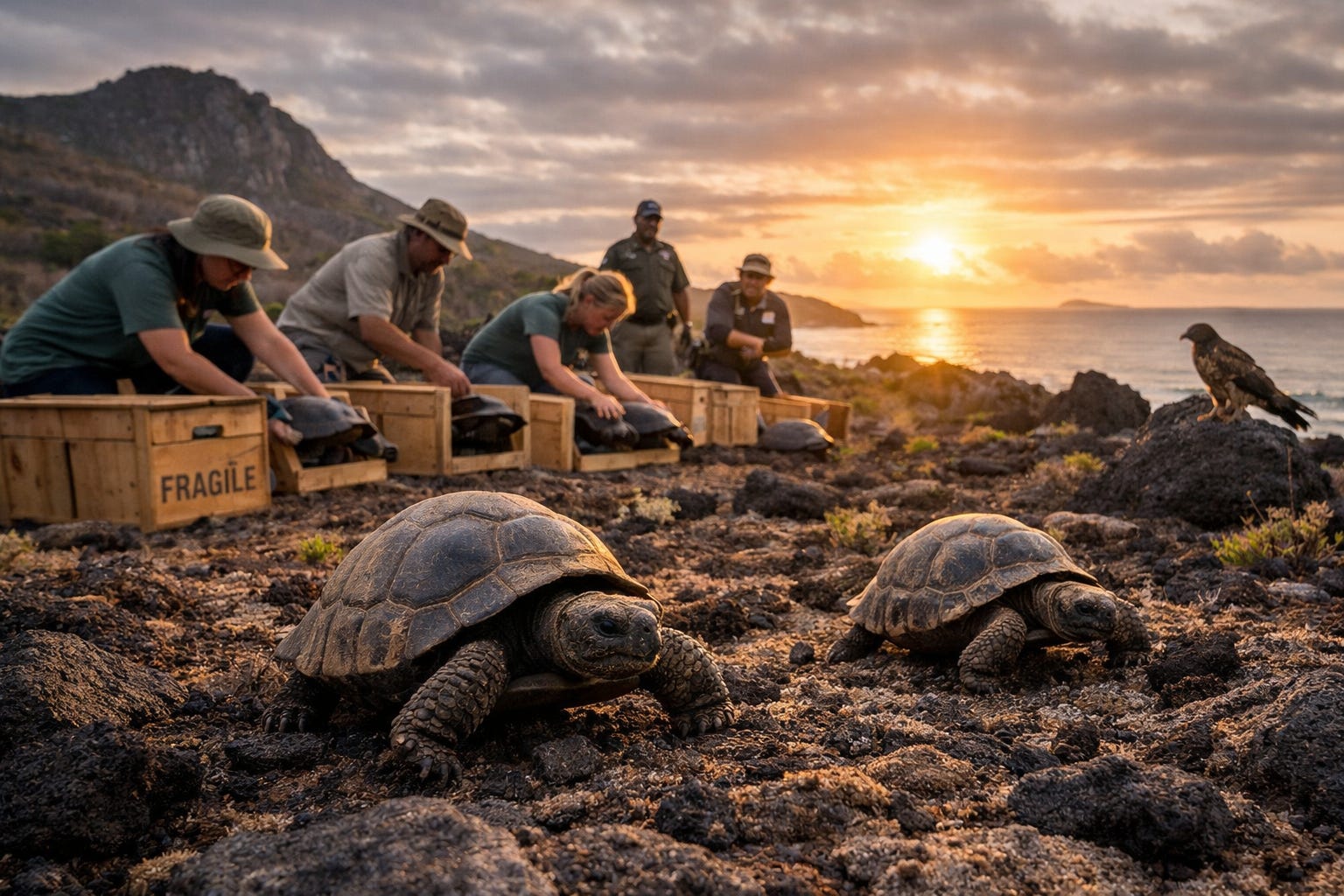
Also, and this matters because it is where the emotional punch lives, these juveniles are hybrids. They represent a lineage recovered imperfectly rather than resurrected perfectly, and that is the point. You do not need purity for repair to be real; you do not need a time machine. You need commitment. You need humility. You need enough people willing to do the unglamorous work long enough that the world can start to stitch itself back together. The release of 158 juveniles is one step within a broader plan to return hundreds more, and every step says, quietly and without drama: we broke this, so we will mend it.
If you place these two stories side by side, the contrast is almost unbearable. One story is a government attempting to unhook the legal wiring that allows the country to treat climate pollution as a public danger; the other is a coalition of humans treating a damaged ecosystem as a living responsibility. One story is loud, immediate, and eager for credit; the other is slow, distributed, and content to let the tortoises take the stage.
And yet, the tortoises are still walking. The island is still receiving them, and the people are still showing up with crates and clipboards and weathered hands. This is the piece I want to offer you, daringly hopeful and a little bit feral: power is not the only force operating on Earth. Cruelty is not the only human talent. Even when the loudest people in the room try to drag us backward, there are others, quieter, more stubborn, more alive to consequence, who keep pushing forward anyway.
Hope, if it is going to survive this era, may need to become more tortoise-like: less interested in speed, less interested in winning the day, more interested in winning the century. It may need to become the kind of hope that can tolerate setbacks without collapsing, the kind that can outlast a term, a news cycle, a tantrum, or a rollback. Ecosystems do not negotiate with press releases, the atmosphere does not care what we call a regulation, and the ocean will not pause because someone is tired of hearing about it.
So let the Trump administration posture and peel protections away as if the laws of chemistry can be bullied into submission. On Floreana, the rebellion continues with the gentlest possible weapon: a living animal placed back where it belongs, a being that does not shout, does not brag, and does not doomscroll. It simply moves forward, slowly, relentlessly, like a promise you can touch.
Inspiringly lovely, and happening......it's difficult to believe but it' s true, thanks for the lift-up, we all needed it.
Beautiful. Loved this! Thank you.