


Good morning! Before we get to the election returns, the political autopsies, or Donald Trump’s increasingly inventive explanations for what happened yesterday, I want to say thank you to my fellow Americans.
Thank you to everyone who voted, including those who reconsidered their previous loyalties and decided that enough was enough. Thank you to the election workers, public officials, and ordinary citizens who stood up for our democracy when it needed them. Americans weren’t only voting for themselves yesterday. People in Kyiv sheltering from Russian missiles were watching, as were families in Tehran living under the bombs of a war Congress never voted to authorize. So were farmers in Canada and factory workers in South Africa whose livelihoods have been upended by tariffs announced on a whim. Our fellow travelers on this planet have spent two years absorbing the consequences of American choices. Yesterday, we gave them reason to hope we haven’t forgotten them.
And what a statement Americans made. Democrats flipped seven Republican-held Senate seats, including in Texas, Kansas, and South Carolina, and took control of both houses of Congress. The New York Times estimates a roughly 13-point Democratic advantage in the national House vote, potentially the largest margin for either party in a congressional election in at least half a century. Americans have taken the first steps toward putting an end to this disaster. But an election cannot, by itself, undo the damage, restore our institutions, or repair our relationships with the world. That will take considerably more than one extraordinary Tuesday.
So let’s take a moment to feel it. We earned it.
But only a moment. An election is a beginning, not a finish line. Now the real work begins.
By any measure, this was a rout. Kansas will send a Democrat to the Senate for the first time since 1932. South Carolina handed Lindsey Graham’s old seat to a pediatrician. And in Texas, voters ousted both Ken Paxton and Greg Abbott in a single night, electing James Talarico to the Senate and making Gina Hinojosa the first Democratic governor since Ann Richards.
The rejection was broad as well as deep. According to Times Voter Trends, Democrats won roughly 70 percent of both Hispanic voters and voters under 30, two groups where Trump made his biggest gains just two years ago. Every age group shifted left, including voters over 65. So did white voters without a college degree, a core of the coalition that put Trump back in the White House.
Now consider the man at the center of it all. For two months, Donald Trump traveled the country asking voters to treat this election as a vote on him. “So I’m asking you to pretend that I’m on the ballot,” he told the Republican convention in Dallas. In Oklahoma he added, “Pretend I’m running please, because I’m on the ballot.” In Mobile he asked the crowd to close their eyes and imagine it. The night before the election, he told Sean Hannity, “If our people vote, we win in a landslide.”
Voters took him at his word. Then, as the results came in, the president discovered he hadn’t been on the ballot after all. “I wasn’t on the Ballot and if I was, we would have won IN A LANDSLIDE!” he posted. By morning he was telling Fox News, “I don’t view it as a hit on me. We’ve had the greatest two years in the history of the presidency in terms of the economy.”
Voters disagree. In the NBC exit poll, only 38 percent approved of his performance, the lowest Election Day rating for a sitting president in nearly two decades. Forty-three percent said they voted to oppose him, against 16 percent who voted to support him. Roughly three-quarters described the economy as being in bad shape, and about two-thirds said Trump’s policies had made it worse. On Election Day itself, new federal data showed that average gasoline prices over Trump’s second term had surpassed even Biden’s presidential-term average, reaching the highest nominal average for any administration. That’s a strange way to mark the greatest two years in history.
Having ruled himself out as the cause, the president spent election night looking for one. He blamed Fox News for putting Democrats on the air. He accused Greg Abbott of turning RINO. He blamed the candidates themselves, as though someone else had handpicked Ken Paxton. As Simon Marks of LBC observed, it’s hard to blame a terrible candidate when you’re the one who chose him. Anthony Scaramucci, who knows the man better than most, summed it up: the president asked Americans to treat the midterms as if he were on the ballot, and Americans said okay.
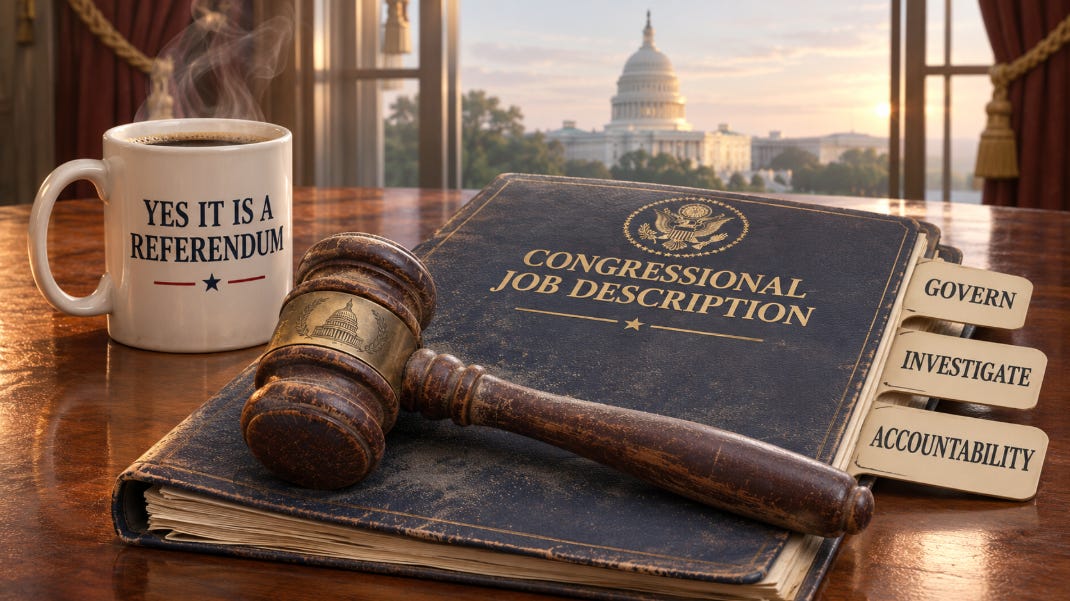
A referendum on a president, however, is not a blank check for his opponents. The AP Voter Poll found that about 7 in 10 voters, including roughly 4 in 10 Republicans, believe Congress hasn’t done enough to check the presidency. That’s not a love letter to the Democratic Party. It’s a job description.
Every rout needs a little comic relief, and the richest man in the world was kind enough to supply it.
Elon Musk, who promised last year that he would spend “a lot less” on politics, became the largest disclosed donor in modern American history instead. By mid-October he had given more than $445 million to federal political committees, more than double the roughly $177 million George Soros gave in 2022, when Soros was crowned the cycle’s biggest donor. Analysts at CNBC put his total election spending this year at no less than $474 million.
Texas was his biggest bet. Musk poured about $224 million into races there, including $158 million routed through the Senate Republicans’ main super PAC to the group backing Ken Paxton, and another $5 million to Greg Abbott. Both lost. Across the country, his own America PAC spent about $87 million on 44 federal races. As of Wednesday morning, its candidates had lost 29, won 3, and 12 were still uncalled. Ninety-three cents of every dollar it spent went to candidates who lost.
To be fair to the billionaire, he wasn’t facing a penniless opponent. James Talarico raised a record-breaking $146 million, much of it from small-dollar contributors. According to his campaign, 97 percent of contributions were $100 or less. Ordinary people supplied much of the money that allowed him to compete with the billionaire-funded political machine. In his victory speech, Talarico said his campaign had taken on “goliaths,” including “the richest man in the world,” and won.
Musk’s response came in two installments, moments apart. First: “Data centers in space looking pretty appealing right now.” Then: “Guess my election-interfering space lasers didn’t work this time.”
Elon Musk spent nearly half a billion dollars trying to influence American democracy. When the voters declined to cooperate, he started looking for off-world real estate.
Musk hasn’t lost his fortune, his government contracts, or his ability to finance future political campaigns. But come January, he will face a Congress with both the authority and the stated intention to examine how he exercised government power. His leadership of DOGE, his companies’ federal contracts, and the extraordinary access his operatives received to Americans’ personal information could all become subjects of congressional investigation.
Yesterday’s vote rang well beyond our borders. In Paris, Libération called it “une vague bleue,” a blue wave. London’s Daily Mail went with “historic blue tsunami.” The Times of India settled for “midterm blues for Trump.” Analysts from France 24 to Australia’s ABC to Britain’s LBC reached the same verdict American voters did: this was a judgment on Donald Trump and his policies.
The reactions ranged from celebration to cautious optimism to the sort of reassurance that tells you exactly what a government hopes won’t change. Spain’s Pedro Sánchez, facing his own snap election later this month, said Americans had voted against policies that impoverish people and protect elite privilege, and predicted Spain would follow. South Africa’s Cyril Ramaphosa, whose government is locked in trade tensions with Washington, said the results could usher in “a new era in world relations.” Norwegian Prime Minister Jonas Gahr Støre called it a powerful signal that American voters want a change of course.
In Kyiv, the Kyiv Independent greeted the result as a potential boost for Ukraine, though Ukraine also lost one of its staunchest Republican allies when Rep. Brian Fitzpatrick was defeated. Moscow’s reaction was revealing in its own way. Russian newspapers acknowledged the scale of Trump’s defeat, while the state-run Rossiyskaya Gazeta suggested that a frustrated president might direct his anger toward Europe. Kremlin spokesman Dmitry Peskov emphasized that Trump remains president and expressed hope that his diplomatic initiatives would continue. Deputy Foreign Minister Sergei Ryabkov was less enthusiastic about the incoming Democrats, whose approach to Russia he characterized as deeply negative. Kyiv is looking for change. Moscow is emphasizing continuity. Both understand that control of Congress matters.
European leaders offered a useful reminder that yesterday’s election, however extraordinary, cannot instantly repair two years of damaged relationships. European Parliament Vice President Christel Schaldemose welcomed the possibility of stronger support for Ukraine and renewed cooperation, but insisted Europe must continue building its own independence. Trust, once squandered, is not restored by a single election.
Trump still occupies the White House, commands the military, and possesses considerable power to affect lives far beyond our borders. The new Congress can constrain that power, but it cannot simply wish away the damage already done.
And Trump didn’t spend the last two years acting alone. What about the powerful people and institutions that helped him along the way?
Simon Marks of Britain’s LBC pursued much the same question in his overnight coverage. In his view, the constitutional checks Americans were taught to trust largely failed over the last two years, and it took an election to do what institutions would not.
Start with Congress. Republicans controlled both chambers, with the authority to investigate, issue subpoenas, and demand answers. They exercised those powers selectively, while largely declining to challenge a president who was rapidly expanding executive authority. The branch of government charged with checking presidential power had become remarkably reluctant to use it.
Then widen the lens. Marks pointed to tech titans like Mark Zuckerberg and Jeff Bezos, who courted the administration rather than keeping their distance, and to media owners he accused of bending their newsrooms to fit. He was particularly scathing about CBS News under its new owners, the Ellisons. Universities and law firms faced similar pressure and responded in very different ways. Columbia cut a deal; Harvard went to court. Several major law firms signed agreements with the White House, while others fought executive orders aimed at them and won in court. Accommodation is not the same as corruption, and resistance deserves credit. The point is to follow the evidence, not to paint every institution with the same brush.
Wall Street offered a revealing glimpse of what might be at stake. Shares of companies associated with AI data centers fell in early trading as investors contemplated a Democratic Congress and new governors who might insist on greater scrutiny of projects that consume enormous amounts of electricity and water. In Texas, Gina Hinojosa’s victory raised the prospect that communities might finally have more say over developments affecting their utility bills, water supplies, and public infrastructure. Investors were weighing the possibility of tougher permitting, environmental rules, and requirements that developers shoulder more of their own costs.
This is something we’ve been examining throughout our Lords and Serfs series. A rising stock market is not necessarily evidence of rising prosperity for working people. A corporation can report record earnings while its customers struggle to pay their bills. A data center can generate enormous wealth for investors while neighboring households worry about the cost of expanding the electrical grid. What looks like a booming economy from a corporate boardroom can look considerably less impressive from the kitchen table.
And if asking corporations to pay their own costs is enough to frighten investors, perhaps we should be asking who has been paying those costs until now.
The incoming Congress will have opportunities to examine government contracts, regulatory decisions, political influence, and the conduct of officials who were supposed to protect the public interest. Those investigations must be grounded in evidence, not conducted as exercises in partisan revenge. But neither should they be abandoned because someone worries that congressional scrutiny might unsettle the markets.
Some Democrats, and plenty of commentators, warn that the new majority will squander its moment if it spends the next two years on investigations instead of lowering prices. Rahm Emanuel told the Washington Post’s David Ignatius that a knock-down fight over impeachment would be a loser for Democrats, while ethics reform, a minimum-wage increase, or health care would be winners. Joe Hockey, Australia’s former ambassador to Washington, cautioned that a narrative dominated by corruption could crowd out the cost of living. Analysts on France 24 reminded viewers that swing voters who moved this year can move right back.
Those concerns deserve a serious answer, not a dismissal. Americans are struggling with health care, housing, groceries, fuel, and utility bills, and they expect the people they just elected to do something about it. Democrats say they have a plan. Hakeem Jeffries has promised early votes to restore the Affordable Care Act subsidies that lapsed in January, reverse nearly $1 trillion in Medicaid cuts, roll back Trump’s tariffs, and force votes to end the war in Iran. He established working groups on health care, housing, groceries, energy costs, and caregiving months ago. That agenda has to be an immediate priority, and Democrats must show voters what progress they can deliver, even with a president who retains the power to veto their legislation.
Nobody is asking voters to choose, and voters didn’t ask Congress to. In the AP Voter Poll, roughly half of voters called government corruption crucial to their vote, a slightly larger share than those who said the same about the cost of living. They want lower prices and honest government, and they don’t see a contradiction.
Neither should Congress.Corruption is an economic issue. Government favoritism determines who receives public money, who escapes scrutiny, and who ultimately pays the bill. Investigating those decisions is how we find out where the money went and how to keep it from going there again. Even Emanuel’s own list of winning issues includes ethics reform. And surely investigating how existing safeguards failed is one way to design better ones. Rep. Jason Crow put it simply: Democrats cannot dodge their obligation to investigate corruption and overreach.
History has already run this experiment. In 2007, a new Democratic Congress passed the first federal minimum-wage increase in a decade. President Bush signed it on May 25 as part of a supplemental appropriations bill funding the Iraq war. Meanwhile, congressional committees were investigating wartime contracts, reconstruction spending, and the conduct of government officials and private contractors. Congress managed to raise wages, fund the government, and investigate the executive branch at the same time. That’s not a contradiction. It’s part of the job.
The line between oversight and political theater is real, and it’s drawn by how investigations are run. Disciplined oversight follows evidence, uses fair procedures, publishes what it finds, and turns its findings into reforms. Theater starts with the verdict and works backward. Democrats should commit to the first, and that includes being willing to follow the evidence wherever it leads, even when it leads somewhere uncomfortable.
Impeachment is a separate question. Rep. Joe Courtney told Australia’s ABC that opening with an impeachment resolution would be counterproductive. He’s right about the sequence. Investigate first. Let the facts decide what comes next.
Barack Obama struck much the same note in his response to the election. He thanked the candidates who stepped forward, the voters who supported them, and the election workers and volunteers of both parties who made the process possible. Americans, he said, want leaders who bring people together and offer practical solutions to their problems. But he also reminded Democrats that Trump has another two years in office. The task now is to “roll up our sleeves,” make changes wherever possible, “prevent further damage,” and prepare for the future.
That sounds very much like a call to govern and to exercise oversight, not to choose between them. But there is another test awaiting the incoming Democratic majority, and it may prove considerably more uncomfortable than investigating Donald Trump: whether Democrats are prepared to follow the money when it leads toward the people who helped finance their own victories.
Democrats did not win this election on small checks alone. Federal law bars corporations from contributing directly to federal candidates out of their treasuries, but that hasn’t kept corporate money out of politics. It flows through corporate-sponsored PACs funded by eligible individuals, contributions from executives and their families, wealthy donors, and outside groups that can spend without limit independently of candidates. Democrats benefit from all these channels. Their financial backers include figures from Wall Street, Silicon Valley, and many of the same industries now waiting to see how much scrutiny the new majority is actually willing to apply.
Voters have noticed. The AP Voter Poll found that a substantial share of Americans don’t believe either party would be better at fighting corruption. Democrats held a modest advantage on that question, but they haven’t earned the public’s unconditional trust. They’ve won a probationary period.
Reid Hoffman, the tech billionaire and Democratic megadonor, wrote after the election that it’s now on Democrats to fight for an economy that serves every American, “not just the already rich and powerful.” He’s right. And the test of whether Democrats mean it won’t be found in their speeches. It will be found in their subpoenas.
When a committee follows the money behind a government contract, a regulatory favor, or a data center deal and finds a company whose executives or PAC also supported Democratic candidates, what happens next? Does the investigation continue, or does it quietly lose momentum? A Congress that examines only its opponents’ patrons isn’t conducting oversight. It’s settling scores.
None of this assumes that a political contribution establishes corruption. But the lords of this economy have always understood something the rest of us sometimes forget: they don’t need to own a party, so long as they keep friends in both. The new majority can demonstrate that friendship doesn’t buy immunity. Or it can demonstrate, once again, that it does.
Not every community joined the national shift. Here in Coos County, the latest unofficial election-night returns had Republican David Brock Smith leading Jeff Merkley by nearly 17 percentage points. That’s somewhat closer than Trump’s roughly 20-point margin here in 2024, although Christine Drazan carried the county by nearly 25 points over Tina Kotek. The results remain unofficial, and comparing a Senate race with a presidential one isn’t a precise measure of partisan swing. But the message is clear enough: the conversations this country needs to have aren’t finished, and some of the most important ones are happening in places like ours.
Donald Trump is still president. He still commands the military and holds the veto, and Republicans will control Congress until January 3. But the voters have already spoken, and their message wasn’t addressed exclusively to the Democrats who won. It was also directed at the Republicans who have spent nearly two years treating congressional oversight as an inconvenience to be avoided. They still hold the gavels. They still control federal spending, can demand answers, investigate abuses of power, and refuse to rubber-stamp the president’s decisions. The election didn’t suspend their constitutional obligations for the next two months. Quite the opposite. Americans have just demonstrated that elected officials are accountable to the people, not to the president. The current Republican majority might consider acting accordingly. January 3 is when control of Congress changes hands. It isn’t when congressional responsibility begins.
Here’s what I’ll be watching. Will the first House votes on health care and tariffs come quickly, as promised? Will the war powers resolutions on Iran keep coming until the war ends? And when the committees start following the money, will they follow it all the way, including to the doors of their own donors?
So thank you again, to every voter, every poll worker and every neighbor who refused to look away.
Now the real work begins right after Marz and I treat ourselves to a spa day.
Superb and very wise summary and recommendations
My Dear Mr. President:
RE: Mid-term Results
It could never be your fault, could it?
Nothing ever is.
Regards,