


Good morning! When I viewed Trump’s schedule for Saturday, I have to confess that my mind went immediately toward images of him receiving a necromantic IV cocktail of peptides, electrolytes, vitamins, stimulants, and whatever they’re currently extracting from the fresher zombies.
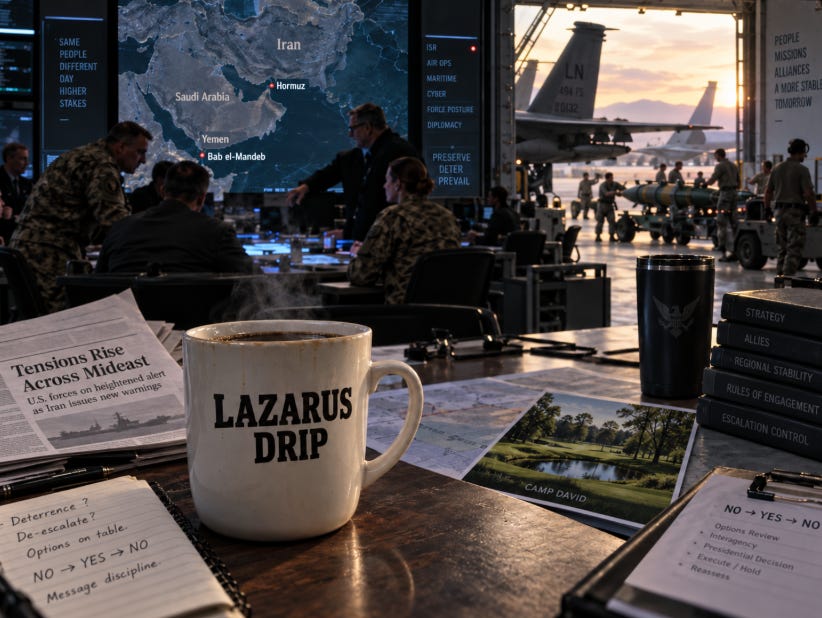
His public schedule contained exactly one substantive entry: “Executive Time,” Camp David, closed press. He was supposed to remain there until Sunday but returned to Washington Saturday evening, a day early. The White House has not publicly explained why. We do know that golfers Bryson DeChambeau and Gary Player were among the people who spent time with him there, because photographs are wonderfully indiscreet things. What we still do not have is a public list of the officials who participated in whatever national-security discussions took place behind those gates.
CNN national-security analyst Alex Plitsas said he was told the Camp David meeting had been convened to “deliberate and review Yemen strike options.” The White House has not confirmed that account, so it should remain attributed to Plitsas rather than engraved onto one of Washington’s increasingly plentiful slabs of granite. But it fits what was happening elsewhere in the government. The New York Times now reports that the United States came extraordinarily close to launching another bombing campaign against Yemen’s Houthis this weekend.
According to the Times, Trump met with advisers Wednesday and told them he did not favor striking the Houthis. Saudi Crown Prince Mohammed bin Salman called him Thursday and again pressed for American military help. After that conversation, Trump reversed course and instructed the Pentagon to prepare airstrikes. By Sunday he had reversed course again and decided against them, at least for now. Commanders literally had approved target lists, American personnel were loading bombs onto the warplanes selected for the operation, and the first wave of attacks was reportedly close to beginning when Trump flipped again.
Changing one’s mind about military action is not inherently evidence of poor judgment; there are occasions when the wisest presidential decision is the one not made simply because preparations have reached the point where everyone else is expecting it. Presidents are supposed to keep asking questions until the moment there are no more questions available to ask.
When the sequence is no, yes, load the bombs, no, knowing something about the deliberative process becomes important.
Who was in the room? What changed Trump’s mind after the Saudi call? What was presented at Camp David? What did military commanders say about the risk of Houthi retaliation against American forces? What was the assessment of American interceptor inventories after seven months of war with Iran? What did CENTCOM say about the possibility of simultaneously defending American bases, keeping Hormuz functioning and reopening a fight around Bab el-Mandeb?
We don’t know, but we know who the golfers were. Quite an information hierarchy for the history books: Marine One foursome, available. War council, please check back later.
The problem facing the administration is genuinely difficult. Saudi Arabia is being attacked by the Houthis and has repeatedly sought American military assistance. The United States, meanwhile, has a separate understanding with the Houthis under which they have agreed not to attack American vessels so long as Washington does not resume bombing them. A senior Houthi official reaffirmed that arrangement to the Associated Press this weekend while simultaneously warning other countries against joining Saudi Arabia’s fight.
So attack the Houthis and Washington risks blowing up the separate ceasefire that currently keeps American ships out of their crosshairs. Don’t attack them and the United States risks further alienating Saudi Arabia precisely when American operations against Iran depend upon Saudi bases, Saudi airspace and Saudi cooperation.
And this isn’t merely the Middle East supplying another ancient riddle for Washington to solve. Several pieces of this particular puzzle were laid down by the administration itself. Trump backed the Saudi strike that helped reignite the Houthi confrontation. His administration separately negotiated a ceasefire protecting American vessels from Houthi attack. His war with Iran has strained the very interceptor stocks Saudi Arabia now needs. And Riyadh has already demonstrated that when it dislikes Washington’s Iran strategy, it can simply close the door on American bases and airspace.
Which leaves the president with a wonderfully inconvenient piece of policy origami: protect the Saudi ally and endanger the American ceasefire; protect the American ceasefire and aggravate the Saudi ally whose cooperation you need for the Iran war.
There is just something uniquely Trumpian about this quagmire.
Former CIA officer Marc Polymeropoulos, discussing the situation with Sam Stein over the weekend, took a strong position that failing to assist Saudi Arabia risks telling Gulf allies that American security assurances cannot be relied upon. Stein then asked the question on the other side: what are the cascading consequences if Washington does intervene when American munitions are already strained and another major energy chokepoint could be dragged into the war?
Current and former American diplomats and commanders interviewed by the Times questioned whether another limited bombing campaign would accomplish much, anyway. The United States bombed Houthi targets for more than 50 days last year and struck more than 1,000 targets. The Houthis survived it, kept firing and have since rebuilt much of their capability. The same officials warned that renewed fighting could threaten Bab el-Mandeb while Hormuz remains unstable. This is the discussion we should be having because there is no tidy option here.
Iran, meanwhile, is issuing its own warnings. An Islamic Revolutionary Guard Corps spokesman says another American attack would produce changes in the “geography” of the war, different weapons and targets Iran has not previously struck. Iranian legislators have also submitted legislation seeking withdrawal from the Nuclear Non-Proliferation Treaty. Those are Iranian threats and political moves, but, they are nevertheless part of the threat environment American planners have to consider.
This is where my concern stops being theoretical. The Americans who will pay first for a miscalculation are not sitting at Camp David. They’re sitting at Prince Sultan Air Base. Camp Buehring. Camp Arifjan. Naval Support Activity Bahrain. Al Udeid. And the other American installations scattered across a region in which Iran has already demonstrated that those bases are not invulnerable.
The Pentagon inspector general released the first comprehensive official accounting of Operation Epic Fury last week. Iranian attacks damaged or destroyed hundreds of buildings and other structures at American bases in eight countries. The report documents major equipment losses and what the inspector general calls strategic munitions shortfalls and defense-industrial bottlenecks. AP reports that as many as 30 MQ-9 Reaper drones were lost, seven KC-135 tankers were damaged or destroyed and 18 American service members died during the period examined, 11 of them killed in action, the rest in incidents the report classifies as non-hostile, including a KC-135 collision that killed six and a helicopter crash into the Arabian Sea.
Then CBS News obtained photographs from service members showing what some of that damage actually looks like: wrecked buildings, vehicles and equipment at American positions in Saudi Arabia and Kuwait, including damage at Prince Sultan Air Base and Camps Buehring and Arifjan. One service member told CBS, “We’re not defending these bases. We’re just watching them get destroyed.”
The Pentagon has disputed broader suggestions that American forces lack the weapons necessary to conduct their missions, and military defenses have successfully intercepted enormous numbers of Iranian missiles and drones.
There is no longer much room to pretend the force-protection question is hypothetical. Hundreds of structures have been hit. Aircraft have been destroyed. Americans have been killed. Strategic munitions inventories are under strain.
When Washington considers adding another enemy to the list of forces capable of shooting back at Americans, the question “How well are our troops protected?” ought to be somewhere very near the top of the briefing book.
This is where I am going to wander farther into territory I ordinarily avoid for the excellent reason that my medical training consists largely of knowing where I keep the ibuprofen.
But actual physicians and mental-health professionals have been arguing for years that Trump’s publicly observable behavior raises concerns serious enough that they believe silence would be irresponsible. Psychiatrist Bandy Lee has been among the most persistent. She argues that determining whether someone meets a particular psychiatric diagnosis is different from assessing whether observable behavior presents a potential danger, and that in extreme circumstances professionals can have a duty to warn.
Lee goes considerably further and describes what she considers a “presidential psychiatric emergency” and believes Trump is dangerously impaired. Those are her professional conclusions. Absent Trump’s full medical records, something the White House has refused to provide members of Congress, we cannot confirm her conclusions, nor can I write that Trump has dementia.
It does leave us with something I think journalism is obligated to examine: what happens when serious questions about presidential decision-making are being raised at precisely the moment that presidential decisions can put thousands of Americans in immediate danger?
Consider only what is publicly observable. While Washington was deciding whether to add Yemen to the weekend’s military itinerary, Trump announced that his planned 250-foot triumphal arch, barely a mile from the Pentagon, is being upgraded from monument to heavily armed Fort Versailles.
At the “strong request” of the United States military, he says, the arch will become a “top grade Military Complex,” complete with large numbers of drones, snipers stationed on the roof and plaza, and enough sniper ammunition to ensure the gift shop never gets lonely. The Pentagon, asked by the Associated Press to explain this newly discovered defense requirement, had no information to offer beyond Trump’s post.
Perhaps the threat assessment is still coming. Maybe NORAD has identified an urgent strategic gap and generations of Pentagon planners somehow overlooked the tactical possibilities of ornamental neoclassicism with overwatch.
For now, Trump’s explanation begins and ends with the hardware: drones, snipers, ammunition. Missing are such fussy military details as what the threat is, what mission this solves, how it plugs into Washington’s existing layered defenses, and precisely how fleets of drones are supposed to operate beside some of the most restricted and congested airspace in America.
Not a diagnosis, simply another piece of observable presidential reasoning available for the public record.
So are Trump’s words about Iran. On Sunday, while discussing his choices in the war, Trump publicly framed one of the possibilities as the question, “When do I blow the entire nation up?” He also mentioned economic pressure and negotiating an agreement, and he has indicated that he remains open to diplomacy with Tehran. The larger context therefore matters; this was not an announcement that he had ordered Iran destroyed. But presidents know, or should know, that their words are listened to by adversaries, allies and American troops who may be the first targets of retaliation.
That brings me back to Camp David.
We don’t need to know what was happening in Trump’s brain Saturday afternoon, or if he was on some sort of Lazarus drip; just what was happening in the room.
The War Powers Resolution says the president shall consult Congress “in every possible instance” before introducing American forces into hostilities or circumstances in which imminent involvement in hostilities is clearly indicated, and it requires continuing consultation thereafter. Congressional Research Service describes the statute as a structure intended to ensure that the judgment of both elected branches participates in decisions about armed conflict.
A Congress exercising that oversight can demand the basic facts surrounding decisions that put American forces at risk: who attended the Camp David meeting, which military options and intelligence were presented, how CENTCOM assessed the danger of renewed Houthi attacks, whether commanders believe existing bases and missile defenses are adequately protected, what alternatives to direct strikes were considered, and under what legal authority the operation would proceed.
Congress can ask what changed between Wednesday’s no, Thursday’s yes and Sunday’s no and when lawmakers were brought into that process. It is called oversight.
American troops deserve for them to be asked somewhere other than after-action reports.
One of the most troubling things in the material we’ve been reading over the past several days is how many enormous decisions are converging at once.
Iran. Hormuz. Saudi Arabia. The Houthis. Bab el-Mandeb. Depleted interceptors. Damaged bases. Global fuel supplies. Russia and Ukraine. A president considering whether to expand one war while trying to end another and simultaneously talking about blowing up an entire country.
That would be a formidable decision-making environment for any president.
Which is why this should be an essay about whether the institutions surrounding any president are doing enough to verify, challenge and oversee decisions whose consequences are measured in American lives.
Bandy Lee and dozens of her colleagues believes there is a medical emergency. This layperson tends to agree.
The Pentagon inspector general, meanwhile, says Iranian missiles and drones have already damaged or destroyed hundreds of structures at American bases. An American service member tells CBS that troops at his installation feel as though they are watching the bases be destroyed. Saudi Arabia is asking Washington to enter another fight. The Houthis are promising not to attack Americans unless Americans attack them. And, according to the Times, we came close enough this weekend that bombs were being loaded onto aircraft before the decision changed.
Whatever anyone thinks about how this war began or how it should end, one fact ought to cut through the noise: Americans in uniform are already bearing its consequences. They are flying the missions, standing the watches, sleeping within range of missiles and drones, and living with decisions made thousands of miles away.
Congress has a role here that cannot be performed by press release, television hit or campaign speech. The Constitution gave it powers over war precisely so that sending Americans into danger would not become the decision of one person operating without sustained public accountability.
Call Congress today and demand they fulfill their responsibilities to our troops and the country.
Men and women wearing the uniform are fighting for us, we damn well better fight for them.
Whether a ‘cell’ in any jail for the Criminally Insane or Rikers , the crumbling mess sums this ‘crazy like a fox’. Pure intent, cunning, and based on lifelong manipulation as in the Art of the Steal… be no longer fooled.
There are too many who will still vote for him.
Remember their names, choice is yours….
Maybe Americans should start considering whether depleting our military arsenals, the destroying of military bases and equipments etc, possibly inviting, say Saudi Arabia, or even someone like Eric Prince, to start overtaking our country? We have measles epidemics, we have foods being contaminated, we have a financial/housing crisis etc, etc. Just wondering… third world countries are constantly being overtaken by power hungry morons and we are dealing with possibly the sickest one in Washington DC right now