

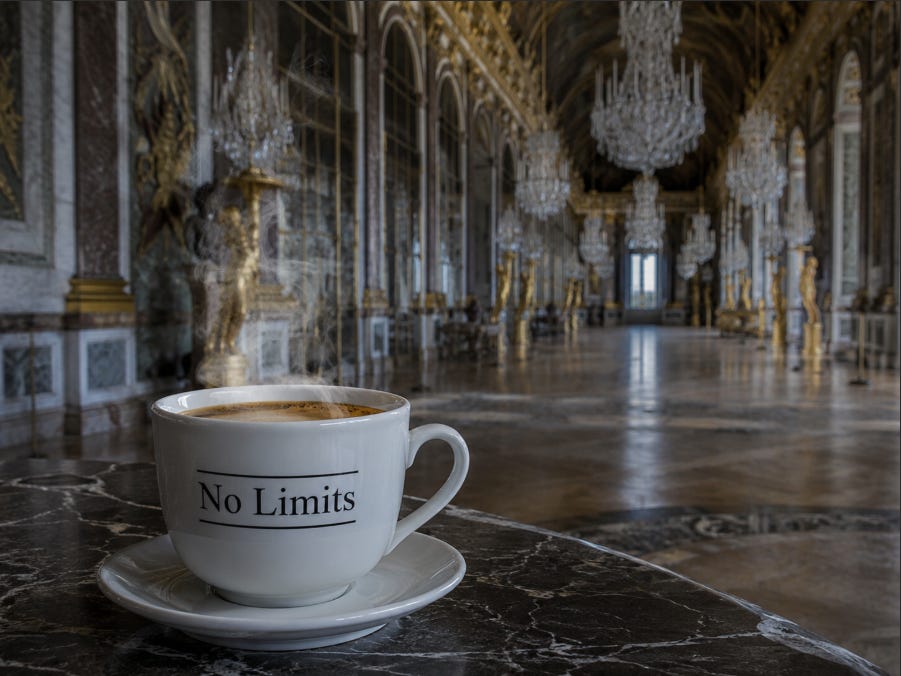
Good morning! This week the President of the United States sat down with Axios and described his own power in the language of conquest. Asked what he had learned about the limits on that power after fifteen weeks of war with Iran, he answered that there were none. “No limits,” he said. “None.” He said he had defeated Iran “totally militarily.” Asked elsewhere about Israel’s resistance to the agreement, he insisted that Prime Minister Netanyahu would have “no choice” and that he, Trump, “called the shots.” A forthcoming book reportedly describes him embracing a document that ranked his global reach above Genghis Khan, Stalin, and Hitler, because apparently the normal presidential hobbies were unavailable; that detail rests on the authors’ account and on the oddity of the document itself, and should be held lightly. The posture, however, needs no embellishment. He has measured his standing all week by who submits to him.
It is worth taking the claim seriously enough to test it. Because in the same forty-eight hours that the President declared his command over Israel total, Israel was demonstrating the opposite in real time, on the one front capable of unraveling everything he had just signed.
Israel struck more than eighty targets across southern Lebanon overnight, by its own military’s count. At least eighteen people were killed, according to Lebanon’s Ministry of Public Health. Four Israeli soldiers died, including a lieutenant colonel. Israel’s National Security Minister, Itamar Ben-Gvir, said that all of Lebanon must burn. The Prime Minister, the President says has no choice announced that Israeli forces would remain in Lebanon “as long as necessary,” a direct refusal of the deal’s central demand. And we know the defiance is not news to Washington, because three weeks ago, in reporting sourced to two U.S. officials, the President called Netanyahu “crazy” in an expletive-laden phone call and accused him of ingratitude. The man who says Israel obeys him has been privately raging that it won’t.
That is the first tier of the answer, and it is the loudest. But it is not the only one. Iran is not obeying either. The technical talks that were meant to begin sealing this deal, in Bürgenstock, Switzerland, with Qatari and Pakistani mediators involved, did not happen. The Swiss Foreign Ministry confirmed they were postponed, with no new date set. Vice President Vance, dispatched to lead them, had staff and aircraft waiting on the tarmac at Joint Base Andrews before the trip was called off. The White House blamed logistics, that reliable drawer where failed diplomacy goes to hide. The likelier reading, voiced from Tehran, is patience rather than logistics: Iranian officials are in no rush, because they remember the last American promise. The 2015 nuclear deal, the JCPOA, which this President abandoned in his first term, is a live memory there, and the new Supreme Leader, Mojtaba Khamenei, granted his permission for this agreement only conditionally, saying he held a different view but would allow it if Iran’s rights were safeguarded. A nation that has read this book before is in no hurry to reach the chapter where the United States walks away.
There is a second tier, quieter still, that answers to no one’s rhetoric at all: the market. Americans are paying roughly four dollars a gallon at the pump, up from $2.98 when the war began, according to AAA, an extra four hundred and sixty dollars per household, by Brown University’s tracker. Moody’s Analytics estimates the war has cost the American economy at least a hundred and thirty-two billion dollars. The Strait of Hormuz has reopened, and the President will call that a victory, because the bar has now been lowered to “temporarily restoring the thing we helped break.” What he is less likely to mention is that the passage is free only for sixty days, with Iran itself absorbing the costs in the interim: a toll booth with the meter switched off and a timer running. The crude that spiked to a hundred and twenty dollars a barrel in March has fallen back to around eighty. He will cite the fall, naturally, as gravity has always been willing to work for free. The honest number is the start: eighty is not victory. It is the war’s premium, still being charged.
So this is the shape of “no limits”: a man who commands a market that ignores him, a Supreme Leader who consents only conditionally, and an ally who answers his orders by setting a country on fire. The power he describes in the language of Genghis Khan cannot reopen a strait without a clock on it, cannot start a negotiation his counterpart will actually attend, cannot stop his closest partner from doing the one thing that detonates his own deal.
On Wednesday, he flew to France and signed it again, at the Palace of Versailles, the room where, more than a century ago, the powers of Europe signed a peace so punitive and so brittle that it is remembered now mostly as the overture to the next war. He chose the room.
By Friday afternoon, the symbolism had stopped waiting for history to supply it. A few hours after Lebanon’s health ministry counted the morning’s eighteen dead, a ceasefire took effect, brokered, a senior U.S. official said, by Washington and Qatar, working with Israel and Iran respectively. That is its own quiet admission of who has leverage over Hezbollah, and it is not the man who says Israel has no choice. This is, by my count, at least the fifth time since April that Israel and Hezbollah have agreed to stop. Each one has been called a ceasefire. Each one has held until it didn’t.
Read the terms and the word frays in your hand. Israeli troops, an Israeli source said, will remain in the southern Lebanon buffer zone. The occupation is not lifted; it is normalized. Israel reserves the right to strike if Hezbollah moves. Washington’s framing, relayed to Tehran, was not that both sides would cease, but that Israel had “agreed to let it be,” and the rest was up to Hezbollah. Iran’s foreign minister was already accusing Israel of wanting permanent war. Lebanon’s president was already condemning the strikes. A peace announced over occupied ground, hours after the dead were counted, with every capital narrating a different version of what had just been agreed.
This is what “no limits” purchased: a war declared won and quietly unwinnable, a strait reopened on a meter, a ceasefire that is mostly a sentence each government reads differently. Power measured by who submits, in a week when no one quite did.
I want to leave the war here, because the war is not finally where I want this column to live, and I suspect it is not where yours wants to either. But before I turn to the thing I actually came to write about, I want to name why the two are the same thing.
The Strait of Hormuz buckled global shipping because a single chokepoint could do it. The sulfur that moves through it is a key ingredient in fertilizer, and the chief economist of the U.N.’s Food and Agriculture Organization warned this month that disruptions there would push food prices and hunger upward well beyond the region. One waterway hiccups and the price of growing food rises on three continents. The grocery shelf in Kalispell and the grocery shelf in Coos Bay are downstream of a strait most Americans could not find on a map.
That is not a war story that wandered into a sustainability column. That is the sustainability story, told in the register of consequence. A food system concentrated enough that one strait can move its prices is brittle in precisely the way a politics concentrated enough that one man narrates the world’s submission is brittle. Both have traded resilience for the appearance of control, and both present the bill to the people who never got a vote. The chaos of this week is an argument for building something steadier, which is where I’m trying to focus what remains of my energy.
And now I am going to step away from the wreckage for a little while. It is Juneteenth, the coast is cloudy, and Marz is waiting to take me for a romp. Some freedoms are solemn. Some arrive on four paws and insist you come outside.
There are only two ways to end this adventure: diplomacy or going all in with a land invasion and a war of conquest. The blowback on a land invasion I can only imagine, but if there is anybody competent left in Hegseth's puzzle palace, they have probably gamed it out. Diplomacy is hard, takes time, and Trump's collection of non-diplomats seem poorly suited to the task. Maybe they should contract it out to Obama's team, who have a track record of success. Yeah, as if.
It is amazing to me, and I am a simple person, that renewables for energy are not more focused on, that wind and solar projects, as well as other forward future holistic energies that I am not aware of, aren't being broadcast more loudly and broadly...the eggs are all in one basket (Hormuz) and it is NOT sustainable for anyone anywhere in the world. China is way out front on this! This has got to stop! Hopefully in November and then in 2028 we can reach something closer to REASON. It will get darker before the dawn, as they say, BUT THE DAWN IS COMING!!!! I think Marz, who sounds very reasonable, should run for President! And then maybe my sweet girl, Sydney, could be his VP.