


Good morning! For more than half a century, psychiatrists have observed the Goldwater Rule, which bars them from diagnosing public figures they haven’t personally examined. The rule was born of embarrassment: in 1964, a magazine polled psychiatrists on Barry Goldwater’s sanity and published the results. The American Psychiatric Association reaffirmed the principle in 2017, clarifying that it also prohibited professional judgments about publicly observed behavior.
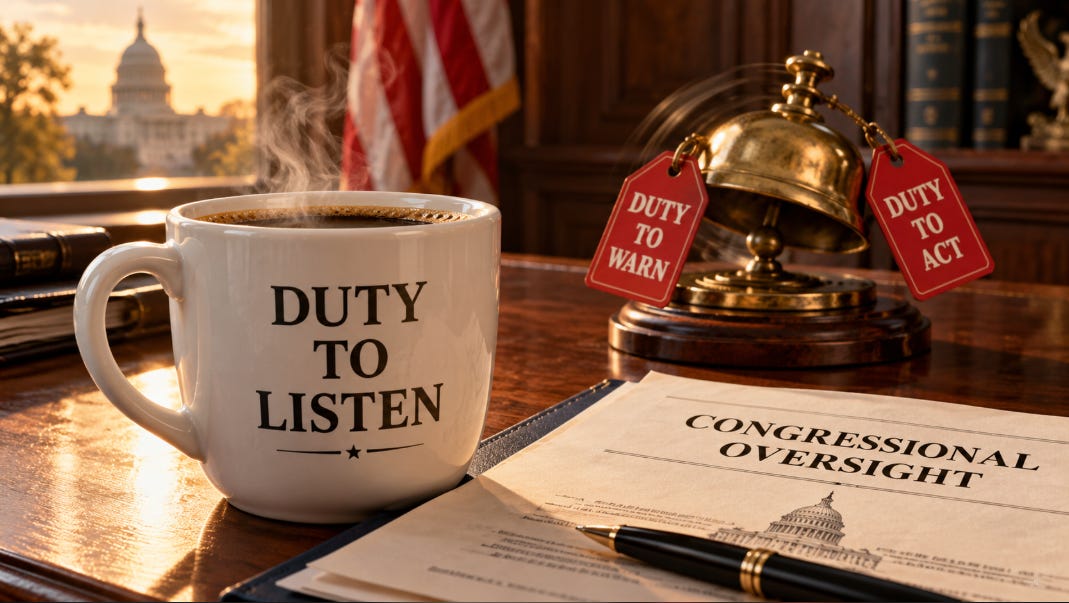
Some clinicians argue that silence carries its own ethical cost. They point to Tarasoff, the 1976 California ruling establishing that therapists have a duty to take reasonable steps to protect a foreseeable victim when a patient poses a serious danger of violence. That duty arises from a therapeutic relationship, and the APA rejects extending it to public assessments of a president the psychiatrist hasn’t examined. But these clinicians aren’t claiming a legal obligation. They’re making a moral argument: when the potential danger runs through the nuclear chain of command, professional discretion has limits.
It’s an unresolved dispute, and a public warning is a reason to investigate, not proof that the warning is correct. But this week’s events offer plenty to scrutinize without settling a single medical question.
On Thursday, Trump canceled his planned Saturday rally in Kansas. The Republican National Committee subsequently called off Sunday’s Iowa appearance, explaining that Republicans were “in a strong position” in both states. The polling told a different story: both Senate races were exceptionally close.
So when Trump stepped off Air Force One, Reuters reporter Jacob Bogage asked a reasonable question: did skipping Kansas have anything to do with being sick of traveling? Trump seized on the word “sick,” called Bogage sick instead, and demanded to know whom he worked for. Bogage identified himself as a Reuters reporter and explained, almost touchingly politely, “We just want to make sure you’re doing well.” Trump proceeded to call him out of shape and disgusting, and told him he looked like hell. The fitness advice came from an 80-year-old president visibly drenched in sweat.
Later that evening, the White House’s official Rapid Response account posted screenshots of Bogage’s snack-review videos under the caption “Sloppy!” Trump’s tarmac outburst was improvised, but the follow-up was a staff decision, made on government time.
On Friday morning, the rallies were back on. A White House official announced back-to-back stops in Kansas and Iowa on Sunday, explaining that the schedule had merely been rearranged to make room for tele-rallies. Asked about the cancellation on Thursday, Trump had insisted he didn’t “feel I have to go to Kansas.” By Friday, apparently, he did.
For perspective: in the final 72 hours of the 2018 midterms, Trump held seven rallies in seven states. This year’s closing stretch has featured a cancellation, a tantrum, and a reversal, all inside 24 hours. One senior Republican told CNN, on hearing the trips were off, “Thank God, he hasn’t moved the needle anywhere.” That official now gets to watch him go anyway.
Trump, for his part, has spent the fall assuring audiences he’s “working like a dog.”
No one needs a diagnosis to read that.
Trump has a simple theory of the midterms. “Every place that I’ve gone to, we’re up,” he told reporters earlier this month, naming Texas and Alaska for good measure. Whether he meant Republicans were leading or merely gaining ground wasn’t entirely clear. The polling, however, offers a considerably less triumphant picture.
Kansas is the obvious place to start, since it’s where this week’s drama began. Kansas hasn’t elected a Democratic senator since 1932. Today, two independent surveys, from CNN and Emerson College, have Democrat Adam Hamilton, a Methodist pastor, leading Republican incumbent Roger Marshall 49 to 45. Neither margin establishes a clear leader, but the RealClearPolling average also shows a close contest. Cook Political Report moved the race to toss-up in early October, and Sabato’s Crystal Ball followed a week later, as national Republicans mounted a rescue operation in a state Trump carried by 16 points.
The rescue has not been cheap. The Senate Leadership Fund redirected money from North Carolina and has spent at least $11 million defending Marshall. Total advertising expenditures by both sides have now exceeded $84.5 million, making this the most expensive election in Kansas history. The previous record was $49.1 million, set when Marshall first won his seat in 2020.
And the problem extends beyond Marshall. Emerson’s latest poll finds Trump’s approval in Kansas underwater, 45 to 51. Among independent voters, Hamilton leads Marshall 59 to 25. Republicans are spending extraordinary sums to defend a Senate seat in a state that hasn’t elected a Democrat to the chamber in 94 years.
Asked about Trump canceling his appearance, Marshall managed two rounds of “I’m not sure” before suggesting the president probably had better places to spend his time because Marshall was doing so well. Kansas Republican Party chairwoman Danedri Herbert was less sanguine. She says she warned the RNC months ago to take the race seriously. “People laughed in my face,” she told CNN. “Who’s laughing now?”
Iowa, the other state on Sunday’s restored itinerary, offers little more comfort. The PollCheck average has Democrat Josh Turek at 46 percent and Republican Ashley Hinson at 45.5, effectively tied for the seat Joni Ernst is vacating. Iowa hasn’t elected a Democratic senator since 2008. Trump carried the state by 13 points two years ago. Yet Republicans are fighting to hold the seat, and the president’s planned appearance was canceled and restored within a day.
South Carolina tells a different story: a party divided against itself. Sen. Darline Graham, appointed after her brother Lindsey’s death in July, faces Democrat Annie Andrews in a contest that recent polls place anywhere from a tie to a four-point Graham advantage. Trump has now rallied for Graham twice in nine days. His latest appearance was in Rock Hill, home turf of Ralph Norman, the congressman Graham defeated in a bitter Republican runoff. Norman says he’ll vote for Graham to honor his pledge to support the nominee, but refuses to campaign with her. His family isn’t following his lead; his son says he’s leaning toward voting for Andrews. Asked about Trump returning to Norman’s territory to campaign for Graham, Norman reportedly laughed. When a Republican president has to make repeated visits to South Carolina while local Republicans remain divided over their own nominee, the picture is considerably more complicated than “up everywhere.”
Texas is genuinely murky, which is itself the story. A new CNN poll has Democrat James Talarico leading Republican Ken Paxton by six points, while a Quantus Insights survey released Friday puts Paxton ahead by one. The RealClearPolling average places Talarico ahead by less than two points. There is no clear leader. Trump could point to Republican Gov. Greg Abbott, who leads his own race by a few points, but the Senate contest is the one attracting national attention. “Too close to call” is a strange way to describe Republican fortunes in a state the party has dominated in statewide elections for three decades.
Alaska presents another difficulty for Trump’s claim. PollCheck’s average, which estimates the final round under Alaska’s ranked-choice voting system, puts former Rep. Mary Peltola ahead of Republican Sen. Dan Sullivan, 51.1 to 48.3. RealClearPolling’s separate average also places Peltola ahead, although by a narrower margin. Neither establishes the election’s outcome, but neither supports Trump’s assertion that Sullivan is leading. This is a state Trump carried by 13 points.
Five states, five different problems: a costly rescue operation in Kansas, a coin flip in Iowa, intra-party feuding in South Carolina, an unsettled Senate contest in Texas, and a Democratic polling advantage in Alaska. Some individual Republican candidates are ahead, but the sweeping gains Trump describes are nowhere evident in these numbers. Instead, his party is spending money, time, and presidential attention defending ground it once expected to hold comfortably.
Instead of a wave, it’s more of a bailing operation.
Every few months, a fresh outburst brings renewed calls to “invoke the 25th Amendment.” Section 4 of the amendment allows the vice president, together with a majority of the Cabinet, to declare the president unable to discharge his duties. The vice president then becomes acting president. The amendment lets Congress designate some other body to replace the Cabinet in that role, but it has never done so; a House Democratic bill to create such a commission has no path in the current Congress. If the president disputes the finding, Congress decides, and keeping him sidelined takes two-thirds of both chambers.
In practice, then, the process begins with JD Vance and Trump’s own Cabinet, officials who owe their positions to the man they would have to declare unfit. Even if Congress created an independent commission, Vance would still have to agree. Section 4 has never been invoked.
Serious presidential misconduct is a separate matter, addressed through impeachment, which Congress controls. The 25th Amendment concerns incapacity. And under the system currently in place, the first decision belongs to the president’s own vice president and Cabinet.
The clinicians debating their duty to warn have done what their consciences allow: they’ve raised an alarm, at some professional risk, and asked the rest of us to take it seriously. Jacob Bogage did his job too. He asked a fair question, politely, and was rewarded with a public mauling and a White House meme. Neither a psychiatrist’s warning nor a reporter’s question can remove anyone from office, and neither should. Warnings and questions are where accountability starts, not where it ends.
The formal remedies sit elsewhere. The 25th Amendment rests first with a vice president politically bound to this president and a Cabinet whose members generally serve at his pleasure. How they would respond to a genuine incapacity is something no one outside that room can know. Impeachment rests with Congress, and so do subpoenas, hearings, budgets, and every other tool of oversight a president would prefer to go unused.
That’s what makes Tuesday matter. Voters won’t be deciding whether Donald Trump stays in office. They’ll be deciding who sits in the institution charged with watching him, and how vigorously that institution exercises the oversight powers it already possesses.
Psychiatrists can argue about when to sound the alarm, but voters decide who’s obliged to listen.
Alas, the gap between when the voters decide and when something can actually be done is a chasm of potential disaster for us all
I worry that, when push comes to shove, republicans vote for republicans, no matter what. i have been a democrat my adult life but have voted for republicans, even republican presidents when i thought that they were the better candidate. i have never met a republican who can make the same claim. they march to the polls regardless of the importance of the election, the weather, or whether they think their person will win or not. once there, they tend to pull the lever on all republican candidates as they have been so brainwashed over the years. i suspect that a lot of people with a microphone or a clipboard or e-mail in front of their face will express their displeasure, but ultimately will vote for the republican candidate. this is why the republicans fight so hard against any efforts to get out the democratic vote. if the democrats would ever turn out in serious numbers, the country would change rapidly. i recently learned that Paxton is suing the state because "there have been too many early votes by people of color"... if that does not tell all, i don't know what does... i recently had a conversation with some farmers in MT. they were furious with trump and all his policies. when i asked if they were going to vote republican, they answered as if i had asked if they were going to stop breathing. they each went thru some song and dance about how they nor anyone in their family had ever voted for a democrat... not sure what you do with a population like that... i guess they deserve what they get and should stop bitching... we get fooled by the polls as people can say what they want., but behind the curtain, they are "team players", like fans of the NY Giants or Philadelphia eagles, "their team right or wrong..." knowing what we know about some of these candidates, it is so hard to imagine why anyone would vote for them, but people do. i love the polling numbers but sadly am not optimistic about what will really happen on Tuesday