


Every so often the news produces a story so spiritually perfect that it feels less reported than divinely dropped from a glowing question-mark block. Nintendo, the company that built a multibillion-dollar empire on a plumber sprinting through hostile terrain hoovering up gold coins like he’s being audited by God, is now reportedly suing the U.S. government because it wants its tariff money back. With interest. Which is honestly the most Nintendo sentence ever written, because Mario has never in his life collected one coin casually. That man grabs money like he owes something to a very patient loan shark.
To clear up the internet sludge immediately, this is not about Nintendo giving refunds to customers. This is not about some child in Ohio demanding compensation because Yoshi’s Crafted World made him feel weird, and this is not about a Joy-Con drifting into the Pacific Ocean. This is Nintendo of America reportedly seeking refunds on tariffs the Supreme Court said were unlawfully imposed under the International Emergency Economic Powers Act, which sounds less like legislation than the title of a direct-to-streaming action movie for divorced dads. The company wants the duties returned, plus interest, which is the corporate equivalent of Mario planting both gloved fists on a table and saying, in a voice so calm it becomes menacing, I would like every coin restored to the vault. And truly, who among us does not respect that level of emotional clarity.
The factual spine here is simple, even if the legal architecture is one of those cursed American contraptions with twelve brass levers and a smoking boiler. In February, the Supreme Court ruled that IEEPA does not authorize the president to impose tariffs. That was the big one. The Court basically looked at this whole setup and said, no, sorry, this item is not unlocked. You cannot just rummage around in the statutory attic, find a wrench, and declare it a crown. Then the Court of International Trade clarified that importers are entitled to the benefit of that ruling, which in practical terms meant hundreds of thousands of companies collectively pivoted from quiet suffering to the much more satisfying activity of demanding their money back. Nintendo, being a company with both substantial import exposure and an almost theological relationship to coins, was not going to sit this one out and clap politely from the sidelines.
And why should it. Nintendo had already spent months dealing with tariff fallout around the Switch 2 and related products, which is the kind of phrase that sounds dry until you remember it translates to “a giant consumer-electronics company had to price its next blockbuster console while the federal government was randomly adding lava pits to the map.” The company delayed U.S. preorder timing while it assessed the situation, then later raised prices on some accessories. So, when the courts essentially announced that the whole tariff regime at issue here should not have existed under that legal authority in the first place, Nintendo did what any large corporation would do after being forced to play a level designed by a drunk raccoon. It lawyered up and went looking for the hidden room where the money went.
The beauty of this story is that Nintendo is almost too on-the-nose as a plaintiff. It would already be funny if this were Whirlpool or Caterpillar or a company that makes industrial hose fittings. But Nintendo, Nintendo, the House of Mario, the Vatican of cheerful coin acquisition. The Louvre of brightly colored economic extraction. This is the company whose most famous employee has spent forty years ricocheting through castles, sewers, deserts, ghost houses, galaxies, and whatever the hell Rainbow Road is, all while vacuuming up currency at a rate that should have triggered an SEC inquiry years ago. If any corporation was destined to wake up one morning and say, with papal gravity, we do not appreciate this unauthorized interference with our coin flow, it was always going to be Nintendo.
You can practically storyboard the whole thing as a game. Mario bursts into Washington, soaked from some humiliating water level everybody hated, and discovers the federal government has installed an unannounced fee every time he touches a coin. Luigi immediately starts trembling because Luigi’s entire life is one long panic attack with overalls. Peach asks whether this means the kingdom budget is delayed again. Toad, cursed to be both earnest and useless, explains that Customs is working on a refund mechanism and asks everyone to remain patient. Wario, naturally, thinks the government did great and wants to know whether there’s any way to make the tariffs nastier and more confusing. Bowser is standing off to the side in total disbelief because for once he did not kidnap anybody, set anything on fire, or create a giant airborne murder clown car, yet somehow the human government still found a way to produce the dumbest castle in the franchise.
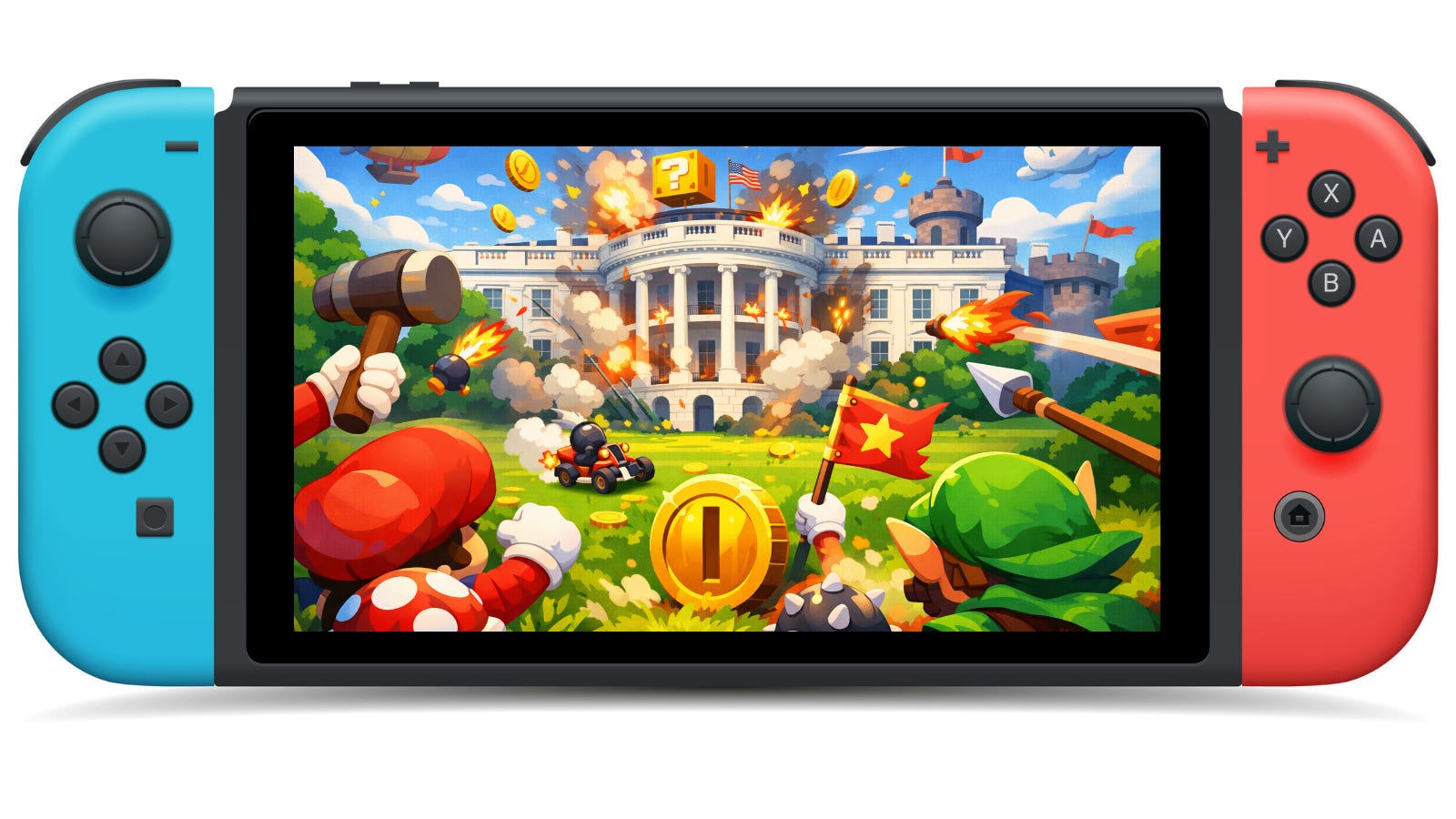
And yes, the administrative details somehow make this even funnier, because they are exactly the kind of details that take a ridiculous story and frost it like a cake. Customs has said the possible refunds affect more than 330,000 importers, more than 53 million entries, and around $166 billion in tariffs, as noted in Mary’s recent piece about this. That is not a manageable bureaucratic task. That is the amount of work a cursed wizard would assign after you mistakenly agreed to “one small favor.” The agency has also said, in essence, that its systems are not built to unwind all this neatly, which is the kind of sentence that should make every American stare into the middle distance for a moment. Oh, your systems were perfectly capable of collecting mountains of money on the way in, but on the way out they suddenly become a Victorian fainting lady with delicate nerves. Incredible, sensational, five stars, no notes.
There is also something gorgeously humiliating about the government’s position here. It is like watching someone snatch everybody’s coats at a party and then, once caught, explain that returning them immediately is actually quite difficult because the coat room software is old. Customs has said it is building a new process and that many importers are not fully set up to receive electronic refunds yet, which means the fate of a huge constitutional tariff unwinding effort now partly depends on whether corporate finance departments filled out the right forms. Somewhere, millions of Americans are wondering how the world’s largest economy keeps finding new ways to sound like a suburban Pilates studio dealing with a glitchy payment app.
The online discourse around all this has predictably become stupid, so it is worth keeping one point clean. This does not mean every tariff in America has evaporated in a puff of mushroom dust. The rulings concern tariffs imposed under IEEPA, the emergency-powers theory at issue in the case. So no, Nintendo has not personally slain the concept of tariffs with the Master Sword. That said, for the tariffs covered here, the central idea is still pretty devastating. Companies paid money under a legal theory the Supreme Court said did not authorize those tariffs. Now those companies want the money back. Nintendo included. Because of course Nintendo included. This is basically a coin repossession story wearing a constitutional-law wig.
And I do think we should pause to appreciate how rare it is for a corporation to look this much like its own IP. Usually companies are boring. Usually they make couplers or cloud software or things with names like Applied Infrastructure Global Holdings. Nintendo, by contrast, sounds like it should resolve every dispute by jumping on it three times. So there is something almost moving about seeing the company’s real-world posture align so perfectly with its cultural brand. It was taxed on imported goods, the courts said that specific tariff authority did not hold, and now it wants restitution. Of course it does. Mario did not spend decades risking blunt-force head trauma against sentient bricks just so some emergency-powers tariff experiment could siphon off the proceeds.
The funniest possible summary is still the most accurate one. Nintendo is not doing a customer-service pity party. It is not conducting a whimsical consumer rebate event. It is doing what any giant corporation does when the courts imply that the government grabbed money it should not have grabbed. It is walking up to the cashier window, tapping the desk, and asking why America thought it could levy a surprise tax on the Mushroom Kingdom’s coin economy without eventually getting a fireball to the face.
So yes, Mario is upset. Luigi is on the verge of collapse. Peach is tired. Toad is reading a customs bulletin nobody asked for. Wario is trying to monetize the panic. Bowser, stunningly, comes off like the adult in the room. And Nintendo, after years of training the public to understand that coins matter, has reached the only conclusion its mythology permits: if somebody took the coins, you hit the block until they come out.
Didn't most corporations pass at least some of the tariffs on to the consumers in the form of price hikes? It would be nice if we got a tariff rebate for the increased burden we all bore. Actually, I'm wondering where all the funds from the tariffs went. The whole Trump tariff fiasco smells funny to me.
What a beautiful mind you have