


Good morning! On Monday, the Trump Justice Department announced the creation of something called the “Anti-Weaponization Fund,” a $1.776 billion pool of taxpayer money, the date is not subtle, to compensate people Donald Trump has decided were mistreated by the previous administration. The fund resolves a lawsuit Trump filed against the IRS over the leak of his tax returns. The lawsuit he filed against an agency he controls. The agency whose decisions are, as the presiding judge noted with some delicacy, “subject to his direction.” He sued himself, and the settlement is $1.7 billion of your money administered by a commission appointed by his own Attorney General.
When asked about it at a healthcare event Monday afternoon, Trump said he “knows very little about it” and “wasn’t involved in the whole creation of it.” This is either the most plausible thing he has ever said about his own Justice Department, or the least. A five-member committee of “very talented, very highly respected people” appointed by Todd Blanche, who serves at the president’s pleasure, will decide who gets paid. The DOJ assures us there are no partisan requirements. Anyone who believes they’ve been unfairly persecuted may apply. Letitia James, whose office was subjected to a federal investigation widely regarded as retaliatory, is presumably already reviewing the paperwork. James Comey, who had federal agents show up at his door over a book, may want to consult a lawyer about his eligibility. The January 6th rioters who beat police officers with flagpoles are, at least in theory, equally welcome to apply. Trump, when asked if he or his family would be seeking compensation, said it would all be up to the committee. The committee he controls and knows very little about.
Jamie Raskin called it “a racket.” Donald Sherman of Citizens for Responsibility and Ethics in Washington called it “one of the single most corrupt acts in American history.” The Justice Department, for its part, compared it to an Obama-era fund that compensated Native American farmers who had experienced documented racial discrimination by their government. The comparison did not survive contact with a straight face.
Also this week, because scandal requires company, the Office of Government Ethics released Trump’s financial disclosures for the first quarter of 2026: 3,642 stock transactions totaling somewhere between $220 million and $750 million. That’s roughly forty trades a day, every business day, for ninety days, in companies that have a funny habit of receiving good news from the White House shortly after shares are purchased on the president’s behalf.
Nvidia stock was bought on January 6th. Days later, the administration backed a deal allowing the company to sell chips to China, with Nvidia’s CEO joining the presidential delegation to Beijing. Oracle stock was purchased on January 12th. Days later, the company finalized a deal brokered by the US government for partial ownership of TikTok. Boeing stock was accumulated across February and March. This week, Trump announced from Beijing that he had secured a deal for Boeing to sell up to 750 planes to China, the largest order in the company’s history. DoorDash stock was purchased roughly a dozen times between January and March. In April, a DoorDash delivery arrived at the Oval Office in what the White House appeared to believe looked spontaneous. “Doordash is doing a good job,” the president noted, for the record.
The White House position is that all of this is managed by third-party financial institutions with no involvement from the president or his family. Eric Trump has said the holdings are exclusively in broad market indexes. The filings show 3,642 individual trades. One of these things is not like the other.
Presidents are, by law, exempt from the conflict-of-interest statutes that govern every other member of the executive branch. This was a conscious legislative decision, the logic being that a president must be free to act on anything that crosses their desk without the paralysis of recusal. The assumption baked into that exemption, honored by every president from Carter through Obama, was that the occupant of the office would behave as though the rules applied anyway. Some assumptions age better than others.
Also on Monday, Trump announced via Truth Social that he had been asked by the Emir of Qatar, the Crown Prince of Saudi Arabia, and the President of the UAE to hold off on a military strike against Iran that had been scheduled for Tuesday. He named them. Full names, full titles. He said he had instructed Pete Hegseth, the Chairman of the Joint Chiefs, and the United States Military not to proceed, but warned that he had directed them to be prepared for a “full, large scale assault of Iran, on a moment’s notice.” He signed the post: “Thank you for your attention to this matter. President DONALD J. TRUMP.”
Several Gulf officials said they were not aware of any imminent planned attack, which is worth sitting with. The President of the United States announced, in writing, with full names attached, that three specific heads of state personally intervened to prevent a major military operation. Those three heads of state, or officials speaking on their behalf, said they didn’t know what he was talking about. This leaves a narrow range of interpretations, none of them reassuring.
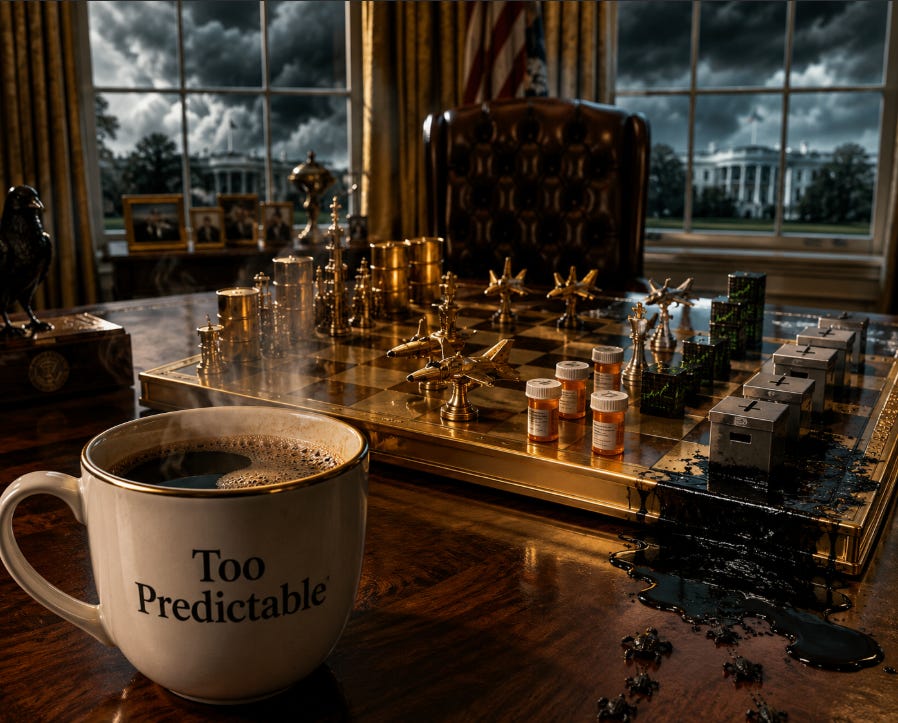
What we do know is this: when Trump launched the war alongside Israel on February 28th, he said it would be over in four to five weeks. It is now in its third month. The ceasefire announced in April has not held. Iran’s nuclear stockpile, the stated justification for the entire enterprise, has not been touched. During the ceasefire, Iran dug out scores of bombed ballistic missile sites, moved mobile missile launchers, and, possibly with Russian assistance, studied the flight patterns of American aircraft. The New York Times reported Monday that the US has a “more hardened, resilient adversary” than it did eleven weeks ago. A recently downed F-15E, and a damaged F-35 suggest that American air tactics had become, in the understated language of a US military official, “too predictable.”
Brent crude is trading around $110 a barrel, the Strait of Hormuz remains a pressure point, and negotiations have stalled on the specific demand, dismantlement of Iran’s nuclear program, that Iran has consistently refused. Trump has rejected multiple Iranian proposals. The one that might produce a deal is the one he can’t accept and remain credible.
Into this landscape arrives the Truth Social post announcing a strike that wasn’t and a pause that might be forever, or possibly just a little while. The three leaders Trump credited with talking him down, Qatar, Saudi Arabia, UAE, happen to be the same three whose sovereign wealth funds are managed by Jared Kushner, the president’s son-in-law, who is simultaneously serving as a “volunteer” envoy on Middle East policy. This detail keeps appearing in different contexts. At some point a pattern becomes a thesis.
Ed Gallrein, the Trump-backed candidate running in Kentucky’s Republican primary against Thomas Massie, offered the most clarifying analysis of Trump’s Iran strategy available. Asked about the war’s effect on gas prices, Gallrein told a local NBC affiliate that Trump was “playing five-dimensional chess.” By the following day, speaking with Mark Levin, the game had expanded to nine-dimensional chess. The escalation between interviews is its own editorial comment. When you cannot explain the strategy, you add dimensions until the question disappears. It is, in this sense, indistinguishable from theology.
Speaking of Gallrein: Pete Hegseth flew to Kentucky on Monday to campaign for him, making the Defense Secretary possibly the first cabinet member in modern history to use a Purple Heart ceremony at Fort Campbell as the opening act for a partisan primary rally. His office noted that he was attending “in his personal capacity” and that no taxpayer dollars were used, which is the kind of thing you say when you know how something looks.
Gallrein is running against Thomas Massie, who voted against Trump’s Big Beautiful Bill, opposed the Iran war, and co-sponsored the release of the Epstein files alongside Democrat Ro Khanna. Trump has called him “the worst Republican Congressman in History.” Hegseth’s visit is the military prestige play in a campaign designed to punish a Republican who voted his conscience.
Gallrein’s pitch to voters is straightforward: the most important things about him are classified, the president has seen his file, and that should be enough. He has skipped every debate. His endorsements are redacted. His campaign slogan might as well be trust the process, except the process is a leather binder on the Resolute desk that you’re not cleared to read. He calls civilians “sheep” and special operators “sheepdogs,” which is a memorable worldview for someone seeking elected office in a constitutional democracy where civilians are, technically, in charge of the sheepdogs.
Ken Klippenstein, reporting for his Substack, found one episode from Gallrein’s post-military career that exists in full public record: he was fired from his job as a Safety and Security Specialist at a nuclear facility in 2013 and filed a whistleblower complaint that was dismissed because he reported his concerns to the wrong person. The man whose entire campaign is built on mastery of the classified world could not navigate the whistleblower complaint process at the Department of Energy. He has not mentioned this on the campaign trail. The sheep vote today.
In December 2025, at a Cabinet meeting, Donald Trump called affordability “a con job by the Democrats” and said the word “doesn’t mean anything to anybody” and that rising costs were a “fake narrative.” He repeated the sentiment in Michigan in January, in what was described as a speech intended to demonstrate his concern for ordinary Americans’ struggles. Yesterday, he hosted a healthcare affordability event at the White House.
The event featured Robert F. Kennedy Jr., Dr. Mehmet Oz, and the co-founder of Airbnb, who demonstrated the new TrumpRX.gov website by explaining that comparing drug prices was now as easy as comparing hotels or baseball tickets. American healthcare is being redesigned by the people who taught us that a $97 room becomes $284 after cleaning fees and vibes. The president called it “the biggest thing to happen to healthcare” and “truly the hottest thing in medicine.” Dr. Oz called it “the fastest site of its kind I’ve ever seen.” Mark Cuban was there too, and Trump noted graciously that Cuban had endorsed Kamala Harris in 2024, adding: “He made a mistake. It was a big mistake.” Cuban did not disagree.
Not everything this week fits the sardonic register, and this item doesn’t try. Videos verified by the New York Times show oil coating the shores of Shidvar Island, a protected wildlife sanctuary in the Persian Gulf that researchers have called the Maldives of Iran. The footage, emerging now because Iran’s internet blackout has only recently begun to ease, was shot in early April, more than a month ago. It shows birds, turtles and crabs trapped in mounds of tar. The oil spill is believed to have originated from strikes on the Lavan refinery, hit hours after the ceasefire took hold in April.
Thousands of turtle hatchlings should be emerging from Shidvar’s beaches this week. The sand is covered in oil.
Iman Ebrahimi, an Iranian conservationist who monitored Shidvar’s bird populations for four years, put it this way: “Once oil enters the Gulf, it does not remain inside the logic of war. It moves into beaches, nests, feathers, turtle hatchlings, fish nurseries and the bodies of animals that belong to the whole region.”
The internet blackout that kept this invisible for a month is also keeping invisible whatever else has happened in eleven weeks of intensive bombing that we have not yet seen. Shidvar is what becomes visible when the blackout eases. The rest is still dark.
A federal jury in Oakland took less than two hours on Monday to find Sam Altman, Greg Brockman, and OpenAI not liable for Elon Musk’s claims that they stole a charity and unjustly enriched themselves. The judge said she was prepared to dismiss on the spot. Musk’s lawyer, casting about for historical precedent, invoked the Battle of Bunker Hill.
The British won that one, BTW.
Musk will appeal. The case, his attorneys said, had proved a point regardless of the verdict. The jury, which had listened to three weeks of testimony and reviewed hundreds of pieces of evidence, apparently felt otherwise. OpenAI now has a clear path to a public offering at roughly a trillion-dollar valuation.
Musk, the richest man in the world, lost a two-hour jury trial and compared it to a Revolutionary War battle that the side he was implicitly claiming to represent actually lost. Some weeks write themselves.
A final note: it is election day in Oregon. Marz and I cast our ballot early, as is our habit, and we urge every Oregon reader to get theirs in before the polls close at 8PM tonight. Whatever dimension of chess is allegedly being played in Washington, the most direct line between citizens and consequences remains the one that runs through your ballot. Use it.
That’s the roundup for Tuesday, May 19th. The bar remains: no nuclear exchange. See you tomorrow.
Everyone must vote this primary. Everyone must vote!!
How to Claw Back what Trump Just Stole
https://therickwilson.substack.com/p/den-of-thieves?r=108sd&utm_campaign=post&utm_medium=email