


Good morning! It’s Sunday, and if the news cycle feels like it ran a marathon overnight and then decided to do wind sprints for fun, well... We’re going to take this one step at a time, because frankly, that’s all any of us have in the tank today.
Gunfire near the Washington Hilton ballroom interrupted last night’s White House Correspondents’ Dinner, the annual black-tie ritual where journalists, politicians, and assorted power brokers gather to pretend they like each other. Here’s what we know, stripped of spin. A 31-year-old suspect from Torrance, California, identified in multiple reports as Cole Allen, allegedly charged a security checkpoint armed with multiple weapons, including a handgun, shotgun, and knives, before being confronted and taken down by law enforcement. A Secret Service agent was shot at close range but saved by a bulletproof vest and is expected to recover. The suspect is in custody, facing federal charges, and investigators are now reconstructing his movements, which reportedly included travel from Los Angeles to Chicago and then Washington in the days leading up to the incident.
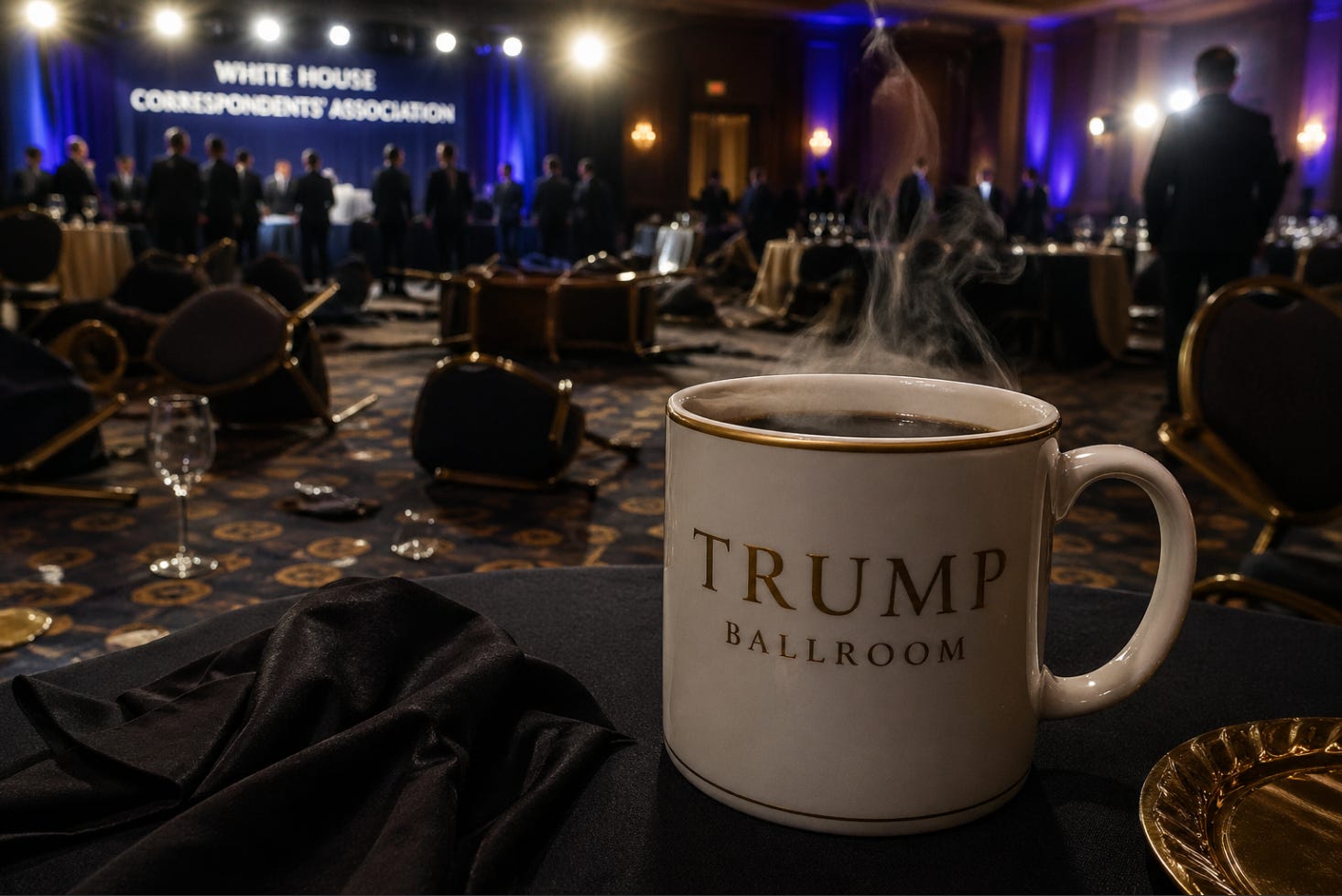
It was chaotic, frightening, and very real. Witnesses described people diving under tables, agents rushing in with guns drawn, and a room full of powerful people suddenly reduced to the same basic human instinct: get low and stay alive.
Within minutes, the second act began. Trump’s press conference started as a sober update on a dangerous situation and, with the inevitability of gravity, transformed into a promotional seminar for Donald J. Trump: Martyr, Unifier, Ballroom Developer.
He opened by praising the Secret Service and law enforcement, describing how the suspect charged a checkpoint and was taken down quickly. He confirmed the agent had been shot but saved by his vest and was in good spirits. So far, fair enough, a serious incident met with a competent response.
Then came the pivot so fast it should have had its own Secret Service detail. Trump declared the Washington Hilton “not a particularly secure building” and immediately used the attack to justify his long-desired White House ballroom, describing it as larger, more secure, drone-proof, and fitted with bulletproof glass. When democracy is shaken by gunfire, the real lesson, apparently, is that what this republic needs is better event space.
He leaned hard into the “beautiful unity” theme, insisting the room was filled with Republicans, Democrats, independents, conservatives, liberals, and progressives, “those words are interchangeable perhaps, but maybe they’re not,” which is the sort of sentence that enters the room wearing a tuxedo and leaves in a shopping cart.
He did call for Americans to resolve differences peacefully, “We have to resolve our differences,” which was the correct message. But then he wrapped it in the usual Trumpian mythology: “This is not the first time in the past couple of years that our republic has been attacked by a would-be assassin,” he said, invoking Butler, Pennsylvania, and Palm Beach, Florida, as earlier chapters in the saga of The Man Too Successful Not To Be Attacked.
When asked why this keeps happening to him, Trump went full marble-statue-in-his-own-mind: “I’ve studied assassinations,” he said, before explaining that “the people that make the biggest impact” are the ones targeted. “I hate to say I’m honored by that, but I’ve done a lot,” he added, which is a sentence that should be sealed in a glass case labeled break only in case of unbearable narcissism.
He promised the Correspondents’ Dinner would be rescheduled within 30 days and made “bigger and better and even nicer,” because true resilience is turning a near-disaster into a venue relaunch.
Just in case the messaging wasn’t clear enough, FBI Director Kash Patel chimed in to explain that law enforcement performed heroically because Trump inspires them “24/7, 365.” Then, adding a level of devotion usually reserved for boy bands, cult leaders, and possibly certain Peloton instructors, that officers respond the way they do because “they know that you have their back.”
Patel’s performance also deserves its own tiny velvet kneeler. The FBI director has been under growing scrutiny over allegations of excessive drinking, absences, job insecurity, and misuse of FBI resources, allegations he denies and is suing over, so his tribute to Trump landed less like a law-enforcement briefing and more like a man auditioning to keep his parking space. AP reports Patel filed a $250 million defamation suit against The Atlantic over claims involving excessive drinking and management concerns, while House Democrats have also probed his use of the FBI jet.
So when Patel thanked Trump for his “leadership” and said officers performed heroically because the president inspires them “24/7, 365,” the subtext practically came with subtitles: please do not fire me during sweeps week. Just in case anyone thought the bulletproof vest deserved top billing.
Beneath the spectacle, and this is where things actually matter, there is a very real and uncomfortable question emerging this morning: How did this happen?
While officials are praising the speed and effectiveness of the response, and by all accounts agents acted quickly once the suspect bolted, Simon Marks made the sharper point on LBC: the question is not only whether law enforcement reacted well, but why the suspect was able to get that far in the first place. Security screening appears to have been concentrated at the ballroom entrance, not the hotel perimeter. People could reportedly enter the Washington Hilton without being screened, as long as they weren’t heading directly into the dinner itself.
Marks noted that this is not how presidential security at that hotel usually works. In his experience, magnetometers are normally placed outside in the driveway, meaning guests are screened before they enter the building at all. He even pointed to a recent Trump event at the same Hilton where the street was sealed and magnetometers were outside despite only about 15 protesters nearby.
The agents may have responded heroically once the suspect charged the checkpoint. But if someone carrying multiple weapons, and possibly assembling a weapon inside the hotel perimeter, could enter the building before encountering serious screening, then the “heroic response” story has to sit beside a much uglier question: why was the first real line of defense so far inside the building?
It matters because it may explain how a suspect carrying multiple weapons was able to get as far as he did before triggering a response, and because, at previous presidential events at the same venue, magnetometers were reportedly placed outside the building, screening people before they entered at all. The difference between “heroic response” and “preventable breach” is not academic, it’s the entire story.
This is also where the noise starts to creep in. Social media, doing what it does best, immediately filled the vacuum with speculation, including claims that the event was staged. There’s no evidence of that so far. What we have is a real suspect, real weapons, a real injury, and a real investigation. Conspiracy theories thrive in moments like this, especially when the facts are still coming together. But here’s the thing: the attack does not need to be staged to be exploited.
Trump’s approval numbers are in rough shape, particularly on the economy, and his instinct to turn a moment of national shock into a narrative about his own greatness, resilience, and architectural ambitions is not new. It’s reflex, pure muscle memory, the political equivalent of breathing.
In real time, we saw how quickly that messaging ecosystem snapped into place, from influencers pushing the ballroom angle to allies framing the moment as proof of Trump’s strength. The choreography was… efficient.
Then there was the small but very human detail that cut through all of it: in the scramble to evacuate, Trump reportedly stumbled forward, going belly-first onto the stage as agents rushed him out. The kind of thing that reminds you that beneath all the mythology, this is still a group of people reacting to danger in real time, without a script.
So where does that leave us this morning? A suspect in custody with a growing profile and a lot of unanswered questions, and a president who, within minutes, managed to alchemize the entire episode into unity theater, personal mythology, and a sales pitch for a bulletproof ballroom.
His instinct to monetize the emotional oxygen in a room remains undefeated.
Marz and I will keep following the investigation as more details come in, especially around how the suspect gained access and what failures, if any, allowed this to happen. Because that’s the part that actually matters.
For now, take a breath, refill your coffee, and we’ll tackle the rest of this mess together.
Absence of magnetometers; no security checkpoint until nearing the entrance to the ballroom; an event that Trump has declined to attend in the past (So why was he there? He hates the press.)
What else might one do to facilitate a bit of drama to upstage the correspondents and their mentalist?
I can't help myself! It was a planned staging to elicit sympathies for trump and acceptance of the need for a ballroom, not that he would ever invite any journalist who disagreed with him if one is built. Those combat-ready troops with their weapons pounced upon that stage to escort the felon off and played their parts well. However, this turns out, I am outraged at the number of journalists who attended even though they've been berated time and time again by the felon. They have no backbone and the entire event should be cancelled during this administration and until the journalists are willing to write bravely and truthfully about this corrupt administration. Rant over!