


Good morning! The news cycle has decided to sprint today, and unfortunately the people currently making decisions about war appear to be doing roughly the same thing, only without a map.
Let’s start with the administration’s messaging, which this week has achieved the rare feat of being both crystal clear and completely incomprehensible. If you were trying to assemble a perfect snapshot of the administration’s communication strategy on the war with Iran, you could hardly do better than the trifecta we got over the past few days: Defense Secretary Pete Hegseth, President Trump, and press secretary Karoline Leavitt each stepping forward to explain why everything is going spectacularly well.
Hegseth kicked things off at the Pentagon with what can only be described as the “shock and awe: director’s commentary.” The United States and Israel, he said, are about to achieve “complete control of Iranian airspace,” meaning American aircraft will soon be flying over the country day and night delivering what he cheerfully described as “death and destruction from the sky.”
With that air dominance secured, Hegseth explained, the United States would shift to dropping hundreds of precision bombs, 500-, 1,000-, and 2,000-pound munitions, from what he described as a “nearly unlimited stockpile.” The campaign, he promised, is not slowing down.
“The throttle’s going up,” he said.
The secretary also emphasized that fairness was never part of the plan.
“This was never meant to be a fair fight,” Hegseth said. “We are punching them while they’re down, which is exactly how it should be.”
Points for honesty, I suppose. Pentagon briefings usually involve careful language about restraint and proportionality. Hegseth skipped the euphemisms and went straight to kicking the other guy while he’s on the floor, with what he assured everyone is essentially an unlimited supply of bombs.
The whole presentation sounded like a professional wrestling promo: lots of swagger, lots of talk about domination, and very little sense that anyone was describing decisions that involve real people dying.
From there the message moved to the White House, where Trump offered his own strategic assessment during a roundtable event. Someone, he said, asked him to rate the war on a scale of ten.
“I said about a 15.”
There we have it: war reduced to a Yelp review.
Trump then reassured the audience that Iran’s leadership is rapidly disappearing. “Everybody that wants to be a leader, they end up dead,” he said, before pivoting seamlessly into domestic policy and explaining that he had personally solved America’s looming AI energy crisis by telling tech companies to build their own power plants. This, he noted several times, was “sort of my idea.”
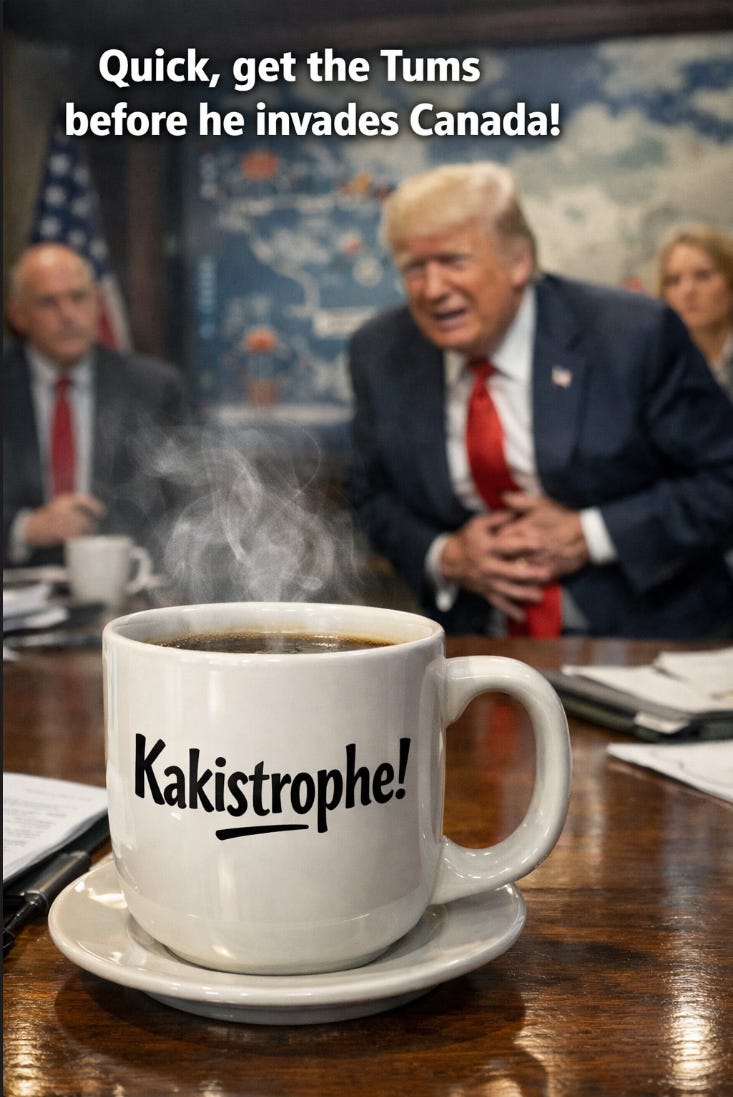
Press secretary Karoline Leavitt stepped in to clarify the reasoning behind launching the war. According to Leavitt, the decision ultimately came down to presidential intuition.
“The president had a feeling… based on fact that Iran was going to strike the United States.”
Reporters naturally asked what specific imminent threat prompted the attack. Leavitt rejected the premise of the question and reiterated that the president’s feeling, again, a feeling “based on fact,” justified the decision.
That explanation is not far off from how the president himself described it. Sitting in the Oval Office this week, Trump said the strike was largely driven by “gut instinct” that Iran might attack first. As the New York Times has reported, the administration’s decision-making process often revolves around a small circle of advisers executing the president’s instincts rather than a traditional national security review weighing multiple options.
For me it invoked Dickens. In A Christmas Carol, when Scrooge encounters Marley’s ghost, he wonders whether the apparition might simply be digestive trouble, perhaps “an undigested bit of beef, a blot of mustard, a crumb of cheese, a fragment of an underdone potato.” More gravy than grave.
In Dickens’ story, the indigestion produces a ghost.
In ours, apparently, it produces a war.
Across the Atlantic, the reaction has been… let’s say less than enthusiastic.
British broadcaster James O’Brien captured the view from abroad in a blistering monologue this week. Listening to the shifting explanations coming out of Washington, he said he found himself almost nostalgic for the Iraq era, not because it was better, but because it at least came with a single, testable lie.
Weapons of mass destruction were false, yes. But they were specific. Eventually, you could prove them wrong.
Now, O’Brien noted, the rationale for war appears to change by the hour. Regime change. Preventing terrorism. A mysterious assassination plot. Nuclear weapons that may or may not exist. A presidential “feeling.”
“If you’ve got half a dozen and counting conflicting claims about why a war is being undertaken,” he said, “then you can never be accused of failing or succeeding.”
That, he suggested, may actually be the point.
“The thing that confuses you most is always the point… the confusion is the point.”
If no one can agree on what success is supposed to look like, victory can always be declared later, and disproving it becomes almost impossible.
Halfway across the world, Ukraine is continuing to do what it has done repeatedly over the past three years: invent the future of warfare in real time while the rest of the planet tries to catch up.
According to reporting in the Financial Times, the Pentagon and at least one Gulf government are now exploring the purchase of Ukrainian-built interceptor drones, the small, fast, inexpensive machines Kyiv has developed to shoot down Russia’s Iranian-made Shahed attack drones.
The interest is not academic. Since the United States and Israel launched their strikes on Iran, waves of those same Shahed drones have been fired across the Middle East. And while the drones themselves cost roughly $30,000, the missiles typically used to shoot them down, like the PAC-3 interceptors in the Patriot system, cost more than $13 million apiece.
That’s the military equivalent of swatting a mosquito with a Ferrari.
Ukraine, which has endured years of Russian drone barrages, solved the problem the way countries at war often do: by improvising.
Instead of burning through expensive missiles, Ukrainian engineers began producing small interceptor drones that cost only a few thousand dollars each. Some are bullet-shaped quadcopters designed to smash directly into incoming drones. Others are fixed-wing interceptors guided by computer vision or remote pilots. They fly faster than the Shaheds and simply ram them out of the sky.
The result is a radically different approach to air defense, one based on cheap, mass-produced countermeasures rather than multimillion-dollar missiles.
There are now dozens of Ukrainian companies building these systems, many of them start-ups that emerged during the war. Among them are the Merops interceptor, developed with backing from former Google CEO Eric Schmidt, and the “Sting” quadcopter built by the Ukrainian firm Wild Hornets.
One Ukrainian official described the surge of foreign interest bluntly: Ukraine’s expertise in countering Shahed drones is now “the most advanced in the world.”
There is, of course, a certain irony here. For months Washington has slow-walked weapons shipments and debated the limits of military support to Kyiv. Now the Pentagon is reportedly looking to buy Ukrainian technology to defend its own forces and allies from the very drones Russia first deployed against Ukrainian cities.
Ukraine, for its part, is open to cooperation, with one important caveat. Any export of those interceptor systems, President Volodymyr Zelensky said this week, cannot come at the expense of Ukraine’s own defenses. A polite way of saying: yes, we’ll help. But we’re still the ones being bombed.
Back here in Washington, confusion appears to extend even into the classified briefings.
Senator Mark Warner of Virginia, the top Democrat on the Senate Intelligence Committee and one of the eight lawmakers who receive the government’s most sensitive national security briefings, says the administration has not outlined any clear plan for what happens after the bombing campaign.
“I have never had, from any of the briefings, any description of what phase two would be,” Warner said.
That’s not a small detail. The so-called “Gang of Eight” is normally the first place where detailed war planning gets shared. In this case, Warner says lawmakers are still guessing what the endgame is supposed to be.
Even some Republicans are privately uneasy. One member of Congress warned that if the United States simply bombs Iran and then leaves, “there is no telling what could happen over the course of the summer,” raising the specter of a regional retaliation spiral.
Warner added that American intelligence agencies have studied for years what might happen if Iran’s leadership collapses. The conclusion, he said bluntly, was not reassuring.
“It could be worse.”
The war is already producing consequences well beyond the battlefield. Iranian missiles and drones have struck targets across the region, including Gulf infrastructure. Qatar’s state-run energy giant, QatarEnergy, has now declared force majeure after Iranian drone attacks hit major facilities at Ras Laffan Industrial City and Mesaieed, forcing a halt to liquefied natural gas production.
That’s not a minor disruption. Qatar sits atop the North Field, its share of the largest natural gas reservoir on Earth, containing roughly ten percent of the world’s known gas reserves. The country supplies LNG to energy companies and utilities across Europe and Asia. When production stops there, the ripple effects travel quickly.
Shipping through the Strait of Hormuz, the narrow corridor through which roughly one-fifth of the world’s oil moves, is slowing as the conflict intensifies. That brings us to the part where geopolitics meets your morning commute.
The average price of gasoline in the United States has now climbed to about $3.25 a gallon, the highest level in nearly a year and up more than twenty cents in just the past week. Traders call it the “Hormuz risk premium.” When war threatens the flow of oil through the Persian Gulf, markets react instantly, pushing crude prices higher. Those increases move through refineries and distribution networks until eventually they show up on the giant glowing sign at the gas station down the street. In other words, a war thousands of miles away is already making itself known in places like Oregon, Ohio, and everywhere in between.
Congress is at least attempting to reassert a little constitutional gravity. After the Senate voted down a measure that would have required the president to seek authorization before continuing the war, the House is now preparing its own vote on a war powers resolution. The outcome is expected to be close.
Representative Gregory Meeks, the top Democrat on the House Foreign Affairs Committee, summarized the issue bluntly: if the president believes war with Iran is in the national interest, he should come to Congress and make that case. Under the Constitution, the power to declare war belongs to Congress, not to presidential indigestion.
At moments like this it can feel as though events are moving faster than citizens can respond. Wars begin on instinct, strategies appear to be improvised in real time, and the people constitutionally responsible for authorizing war are left trying to catch up after the fact. But history is very clear about one thing: public pressure still matters.
Congress has the power to act. Lawmakers can demand answers, insist on a coherent strategy, and reassert the constitutional authority that was supposed to prevent exactly this kind of drift into open-ended conflict. None of that happens, however, unless the public makes it impossible to ignore.
In an earlier essay we introduced a word to describe what happens when elected officials shrug their shoulders while chaos unfolds around them: kakistrophic, the predictable disasters that occur when governance collapses into incompetence and abdication. We used it to describe the tariff refund debacle Congress created by refusing to confront Trump’s tariff policy.
Allowing a war to expand under the same shrug of indifference would be equally kakistrophic, only this time the consequences won’t show up on a tax form. They’ll show up in lives lost, economies shaken, and a world made far more dangerous.
So yes, keep calling. Keep organizing. Take to the streets. Disrupt business as usual where you can, peacefully but visibly. Remind the people elected to represent you that their job is not to rubber-stamp wars launched on gut instinct, but to debate them, restrain them, and end them when necessary.
Marz and I, as always, will be holding everyone in our thoughts during our nightly moonbeam vigils.
It would be interesting and instructive to know more about the position of the military in Trump's War. Inasmuch as it looks like we are doing Israel's bidding in this conflict and the strategic fog surrounding U.S. involvement - is the military leadership supine? Is Caine just a lapdog who does anything his Fox News boss tells him to do? Does he concur with the fiction that we have a limitless store of advanced weapons? Does military leadership collude with the Christian Nationalist gibberish being promulgated by the rapture crowd?
You left out the bit where SecDeath Kegseth complained that the media's questions about our fallen soldiers was just "trying to make President Trump look bad"
This soulless lack of empathy was exceeded only by president bone spurs calling soldiers buried at Arlington "suckers and losers"