


Good morning! It seems increasingly likely Trump’s war of choice may end with a semantic argument over whether the United States paid Iran to conclude a war Washington expected Iran to lose.
That is increasingly the uncomfortable question lurking beneath the diplomacy around the Strait of Hormuz. Five months after Donald Trump went to war promising something much closer to capitulation than compromise, “a little excursion”, Tehran is no longer merely talking about surviving. It is naming its price.
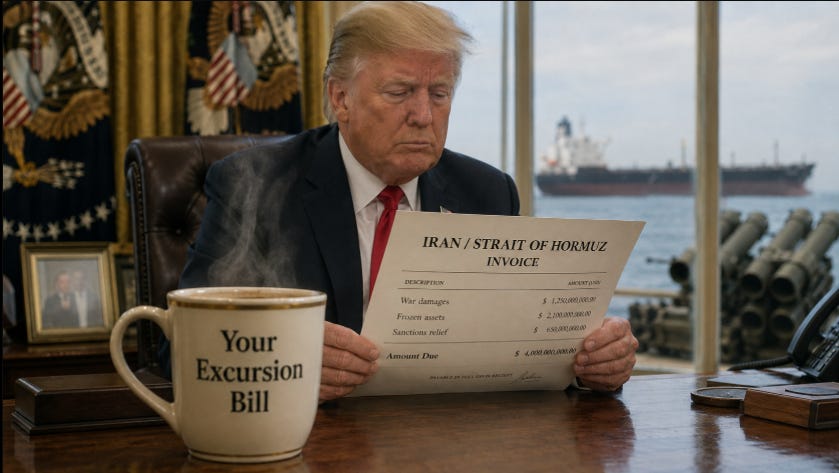
Iran’s Supreme National Security Council has laid out six conditions for reopening Hormuz: an end to threats against Iran, a permanent halt to military action against Iran and its regional allies, withdrawal of US forces participating in the blockade, compensation for damage inflicted during the war, sanctions relief and the release of frozen Iranian assets.
The compensation demand deserves to be pulled out of the list and examined under bright lights. Restitution. Reparations, if one is feeling politically adventurous.
Abas Aslani, a senior researcher at Iran’s Center for Middle East Strategic Studies, described the logic to Al Jazeera with admirable clarity: Tehran is effectively presenting Washington with an “invoice.” The purpose is not merely to recover what Iran says it lost, but to make future attacks expensive enough that an American president thinks twice before trying the same thing again.
This is where the eventual choice of nouns becomes almost as important as the amount of money involved. Washington will not want to announce that it is paying “reparations” to a government it spent months insisting was on the verge of defeat. “Release of frozen assets” sounds much nicer. A “claims settlement mechanism” is practically soothing. “Reconstruction assistance” could probably get its own logo.
Money is stubbornly fungible, and Iran’s political objective is obvious enough: if it can tie reopening one of the world’s most important shipping routes to some form of financial redress, Tehran gets to tell its own population and the region that the United States bombed Iran, failed to force surrender, and then had to put something on the table to make the crisis go away.
Iran, meanwhile, is making sure nobody gets ahead of themselves and calls this a negotiation. Foreign Minister Abbas Araghchi says there are currently no direct talks with the United States, only messages passing through intermediaries, with “efforts underway to create grounds for negotiations.”
Rather less triumphant than the sort of “they want a deal” messaging coming out of Washington.
Aaron David Miller, the former US Middle East negotiator, put the stakes much more starkly in an interview two days ago, and he is hardly alone among foreign-policy observers outside Washington in reaching for the language of strategic defeat.
“The United States is on the verge of really suffering a significant, would I call it a strategic defeat? Maybe,” Miller said. The danger, in his telling, is that Washington may ultimately have to “acquiesce in Iran’s leverage and control, if not its sovereignty, over who or what gets through the Strait of Hormuz.”
That is an extraordinary place to arrive after beginning a war on the assumption that overwhelming American military superiority would force Tehran to bend.
Miller’s broader framework has aged remarkably well over forty-eight hours. Iran cannot match the United States or Israel “missile for missile,” he noted. Instead, “what they’ve done is escalate horizontally,” identifying the Gulf states and the Strait of Hormuz as weak points and turning them into sources of leverage.
Tehran appears to believe time is on its side. “They are prepared to suffer a degree of pain,” Miller said. “I think their pain threshold is much higher than the Trump administration’s.”
The United States retains overwhelming destructive power, but Iran does not need to match it weapon for weapon, only to make the costs of using that power intolerable elsewhere: threaten Gulf energy infrastructure, constrain navigation through Hormuz, increase pressure on global oil markets and make America’s regional partners increasingly desperate for Washington not to start another round. Pain threshold may be the most important asymmetry in the war now.
Miller’s assessment was blunt: if Trump follows through on threats against Iranian infrastructure, “the Iranians would respond in kind,” and “I don’t think we’ve seen yet the kind of damage they could do to Gulf oil facilities.”
That brings us to the increasingly awkward question of what exactly remains available when the president decides it is time for another round of maximum pressure.
The United States has been burning through weapons at a rate that “maximum” increasingly describes rather well.
The New York Times reports that the Iran campaign has depleted critical American stockpiles, pulled weapons and military assets out of Europe and Asia, and created concerns inside the military and intelligence communities about the resulting erosion of US firepower elsewhere.
According to people briefed on the inventory cited by the Times, the United States has used more than 1,500 Patriot interceptors during the Iran war, while the remaining US inventory stands at fewer than 1,700. Replacing those used missiles could take more than two years, even with accelerated production.
Patriots sitting in the Middle East are Patriots not sitting somewhere else. The Times reports that Indo-Pacific Command became an important source of munitions for the Iran campaign, with Tomahawks and other long-range weapons transferred from stocks intended for a potential conflict with China. Advanced interceptors have been moved from South Korea and elsewhere in Asia, while high-end naval assets and surveillance capabilities have also shifted toward the Middle East.
Russia and China, one imagines, have located pencils.
Both governments are closely tracking American inventories and replenishment rates. Analysts quoted by the Times warn that the longer the Iran war continues, the larger and more visible the resulting window of vulnerability becomes.
The strategic problem is that adversaries are obtaining real-world data about consumption rates, manufacturing bottlenecks, redeployment patterns and the difficulty Washington faces sustaining simultaneous high-end contingencies.
The United States is conducting a demonstration of its war-fighting capacity. Unfortunately, it is also demonstrating the refill time.
Now we land, inevitably, on Pete Hegseth.
Hegseth built his Pentagon persona on one word: lethality. “Maximum lethality,” to be precise, the rebrand that came with ending DEI programs, restoring “warrior ethos,” and a physical-standards push built around testosterone testing and toughness as doctrine.
So it is worth sitting with what happened, according to two people familiar with the exchange who spoke to the Washington Post, when a major accountability test of the war arrived.
Confronted by Trump at Camp David over why he had allegedly been misled about severe munitions shortages, the secretary of maximum lethality reportedly did not own it.
He pointed to his deputy.
Stephen Feinberg, according to the Post’s sources as summarized by Newsweek, was blamed both for the shortages themselves and for failing to keep Trump adequately informed.
White House press secretary Karoline Leavitt, who says she was present at Camp David, called the account “100% fake news” and insisted that it “literally never happened.” The Pentagon likewise says Hegseth misled nobody and did not blame Feinberg. Trump has publicly declared that the United States possesses “massive amounts” of munitions and has praised Hegseth’s leadership.
Maybe the reported exchange did not happen, but a Pentagon built around masculine bravado facing a major accountability moment of the war, and immediately generating sourced reporting that its leader tried to hand responsibility to a subordinate, is the kind of detail that requires no embellishment.
Mr. Maximum Lethality has spent months selling toughness, testosterone and accountability. When the ammunition cupboard became the subject, the reported response was less warrior ethos than: ask my deputy.
Republican senators are beginning to criticize Hegseth publicly. Thom Tillis says the defense secretary has lost his confidence. Susan Collins has called the removal of senior military leaders deeply troubling. Other Republicans are warning that patience with an unresolved war is running thin.
On Sunday Benjamin Netanyahu supplied another complication. The Israeli prime minister has now explicitly rejected the 15-point Gaza plan backed by Trump’s Board of Peace, despite Trump having announced the arrangement last month as a major breakthrough.
The plan envisioned Hamas surrendering its weapons in stages while Israel gradually withdrew from territory it still occupies in Gaza. Netanyahu’s answer is effectively to reverse the sequencing: no Israeli withdrawal until Hamas is already disarmed.
“I want to be clear here, Israel is ruling out the 15-point plan,” Netanyahu said, according to the Israeli government’s account reported by the New York Times.
It is a rare and very public rejection by one of Washington’s closest partners of an agreement the American president had already placed in his diplomatic trophy cabinet.
Al Jazeera’s latest reporting says Hamas, for its part, maintains that it remains committed to the roadmap agreed with mediators in Cairo and wants the United States and other guarantors to pressure Netanyahu to adhere to it.
Former Israeli diplomat Alon Pinkas told Al Jazeera that Netanyahu appears to believe defying Trump is “risk free,” arguing that the Israeli prime minister needs a “forever war” as elections approach.
There is an uncomfortable symmetry developing.
On Iran, Trump has repeatedly presented deals or imminent deals as evidence that American pressure is succeeding, only for the underlying disputes to reappear.
On Gaza, he announced another breakthrough, only for Netanyahu to publicly reject the framework days later.
I’m not suggesting Iran and Israel are equivalent actors or that the negotiations are interchangeable. The common thread is Trump’s increasingly visible difficulty converting presidential declarations into durable behavior by the people supposedly being pressured.
Which returns us to the Guardian’s rather merciless description of the Iran war as Trump’s own Groundhog Day.
By its count, Trump has cycled through the same threat-and-retreat maneuver seven times since the war began: announce devastating consequences, suggest Iran has hours or days to capitulate, pull back as negotiations appear, declare progress, discover that the fundamental dispute remains unresolved, and begin again.
Andrew Neil offered an alternative count, joking that Trump has now brought peace to the Iran war eight times and wondering what more a man must do to earn the Nobel Peace Prize.
It is an excellent joke because the rhythm is now recognizable.
The underlying pattern is considerably less funny. Every turn through the cycle burns more actual missiles and reveals a little more about American political and military constraints. Iran learns where Washington hesitates. Russia and China gain additional data about US readiness and replenishment. Gulf states acquire another reason to hedge against being dragged into the next escalation. And now Netanyahu has demonstrated that even one of Trump’s closest regional partners believes there may be little immediate price for rejecting one of his signature agreements.
Groundhog Day traditionally ends when the protagonist learns something.
Washington may want to get on that, because Iran is attaching an invoice to the next morning.
Pete Hegseth is a deeply insecure human being. His insecurity is displayed in all of his "macho" statements and actions. Freud called this a reaction formation. Hegseth is all puffed up, fearful of the shame of being seen as weak. This underlies his crude approach to everything, including all of his firing of top military offiers who just happen to be women, Black, and transgender.
It has often been claimed by MAGAns that Trump is playing multidimensional chess. In this case,it appears Iran is playing chess while Trump is playing Slap Jack.