


Good morning! Before we get to the smoke over Tehran, the evacuation orders, the B-2 flyovers and the chest-thumping at the Pentagon, let’s begin with something far more consequential:
Congress votes this week. The House is expected to take up a War Powers resolution as early as Thursday. The Senate is moving on its own version. These aren’t symbolic “sense of the chamber” gestures. They are direct tests of whether Article I of the Constitution still functions when a president decides to unleash what his defense secretary calls “the most lethal, most complex aerial operation in history.”
That vote matters, not just domestically but internationally, because right now, let’s be honest, we do not look like a reliable ally. Reliable allies consult before launching wars that could engulf entire regions. Reliable allies don’t send mixed signals, “limited mission” from the Pentagon, “big wave coming” from the White House, “depart immediately” from the State Department, while embassies close and civilians scramble for commercial flights out of fourteen countries.
Reliable allies don’t sneer at “so-called international institutions” while expecting everyone else to absorb the aftershocks. If you’re sitting in London, Berlin, Ottawa, Canberra, or frankly anywhere within missile range of the Strait of Hormuz, you’re watching an American administration that appears to have launched sustained major combat operations without congressional authorization, without a clearly articulated endgame, and without the courtesy of predictable guardrails.
Instead of strength, all we are demonstrating is volatility. Volatility is not a comforting trait in a superpower. Which is why this week’s votes matter. Congress has an opportunity, maybe its last clean one for a while, to signal to the world that Americans do not casually endorse unilateral war-making. That there is still a branch of government that believes the Constitution is more than a decorative pamphlet handed out on field trips to D.C.
Former U.S. Attorney Harry Litman cut through the fog with refreshing clarity. Strip away the speeches and the slogans, he argues, and this is simple: sustained war requires congressional authorization. The 2001 AUMF does not stretch to Iran. Article II does not grant presidents a blank check for multi-week offensive campaigns whose “nature, scope, and duration” look indistinguishable from war. The United Nations framework does not provide cover for regime decapitation absent self-defense or Security Council authorization. In other words: this is not a gray area. It is a power struggle.
Even conservative legal scholar Jack Goldsmith concedes the action would be legally suspect under the executive branch’s own historical standards. His shrug, that legality has been overtaken by political muscle, is less a defense than a diagnosis. If Congress doesn’t assert itself now, then the war clause becomes ornamental. A parchment relic.
Pete Hegseth took to the podium and assured us this is “not Iraq,” always a comforting sentence in the way “this will be quick” is comforting right before something is not quick. He declared, “We didn’t start this war, but under President Trump, we are finishing it,” described Iran as having been “gifted death,” and boasted that America is operating with “maximum authorities.”
He went further: “No stupid rules of engagement. No nation-building quagmire. No politically correct wars.”
One pundit remarked the performance felt less like a Pentagon briefing and more like an SNL cold open. It was hard to disagree. The delivery was half sermon, half campaign rally, complete with lines like, “We are not defenders anymore. We are warriors trained to kill the enemy and break their will.”
Rules of engagement, for those keeping score at home, are not political correctness. They are how law meets the trigger. They are how allies know you won’t drag them into an escalatory spiral because someone confused swagger for strategy.
When the Defense Secretary mocks restraint and boasts of “maximum authorities,” allies hear something else: unpredictability.
Which brings us to James O’Brien over at LBC, who looked at this unfolding spectacle and reached instinctively for two words: “Iraq and Trump.” That, he said, was the entirety of his prep for the show. “Those who do not learn from history are condemned forever to repeat it,” he began, before asking the question that seems to hover over every European capital right now: how can anyone contemplate another Middle Eastern war without remembering Iraq?
O’Brien didn’t mince words. “I never thought I’d say Donald Trump makes George W. Bush look like Einstein,” he said, not because Bush was wise, but because in 2003 there was at least the public acknowledgment that you were supposed to have a plan. “They at least pretended to have a plan,” he noted. “The idea expressed now by the White House… that plans aren’t our job. Aftermath is not our job.”
And then the line that should make any policymaker uncomfortable:
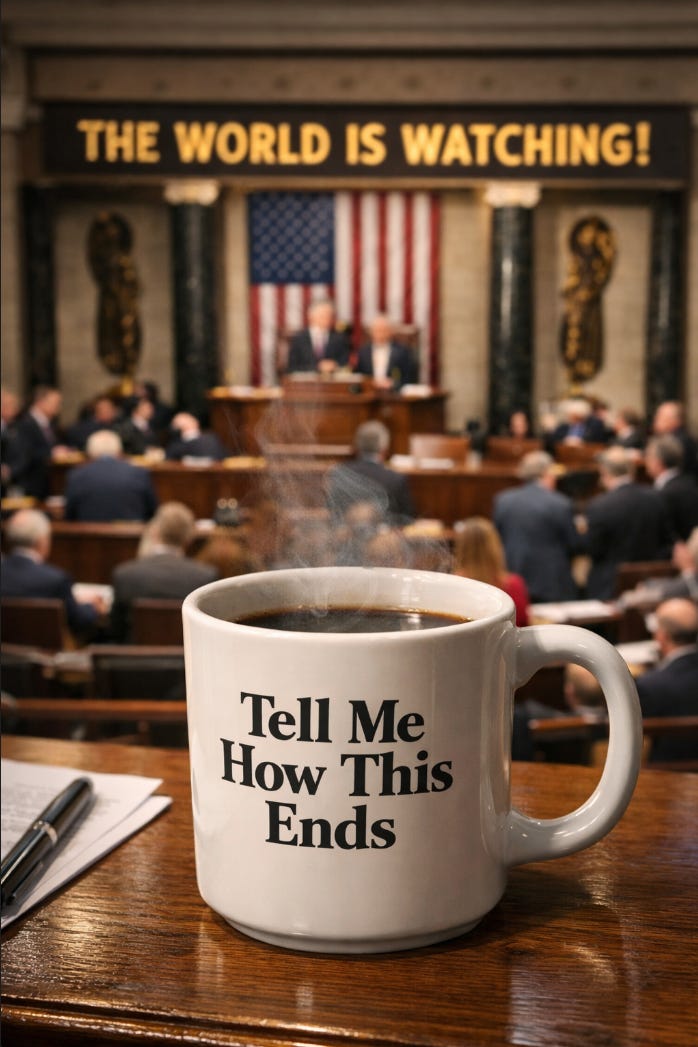
“Tell me how this ends.”
He repeated it. “Tell me how this ends.” Not rhetorically. Not theatrically. As a genuine strategic inquiry.
Because that’s the question that has no clear answer in Washington right now.
O’Brien also zeroed in on the legality issue that Harry Litman has been dissecting here at home. Referring to the British Prime Minister’s insistence that any action must have “a lawful basis and a viable, thought-through plan,” O’Brien asked, “How can that be controversial? How can it be controversial?” He looked at parts of the British press demanding lockstep support for Washington and marveled aloud that some commentators appear to believe “you do not need a lawful basis or a viable thought-through plan to go to war.”
From across the Atlantic, that’s what this looks like: a superpower brushing past legality, shrugging at aftermath, and daring everyone else to keep up.
So when Hegseth waves away “stupid rules of engagement” and promises to fight “without hesitation,” it’s not just domestic theater. It reverberates abroad because coalition warfare depends on predictability. It depends on shared constraints and on knowing that the country with the largest military in the world is also the one most bound by law.
When those signals fray, trust frays with them. In 2003, allies were told there was intelligence, a coalition, and a reconstruction plan. Today, we’re told this is “not Iraq,” that we “fight to win,” and that timelines are elastic because the Commander-in-Chief has “all the latitude in the world.”
And so O’Brien’s question hangs there, unanswered: Tell me how this ends. No one at the Pentagon did.
U.S. embassies are evacuating. Americans are told to depart immediately from fourteen Middle Eastern countries. Six U.S. service members are dead. Three American F-15s went down in a friendly fire incident. Senior administration officials reportedly told congressional staff that intelligence did not indicate Iran was preparing an imminent strike against the United States, even as public rhetoric leans heavily on urgency.
Limited missions do not usually involve hundreds of aircraft, thousands of targets, carrier strike groups, additional forces flowing into theater, and open-ended authority to “scale the fight.”
Congress does not merely face a political moment this week. It faces a constitutional obligation. The power to declare war was placed in Article I precisely to prevent this: the concentration of war-making authority in a single pair of hands, the acceleration of escalation without deliberation, the normalization of “maximum authorities” as a substitute for authorization.
That duty is not theoretical. Congress has a duty to protect America’s standing in the world, because alliances depend not only on strength, but on credibility and restraint. It is a duty to protect American service members from being committed to open-ended combat without lawful authorization. It is a duty to protect civilian lives across the region from escalation spirals fueled by ambiguity and bravado. And it is a duty to ensure that the United States does not stumble, self-assured and unrestrained, into the widening kind of regional war that future historians might describe in far darker terms.
If you believe the Constitution still matters, then now is the moment to behave like it does. Call your representatives. Call your senators. Flood their offices with emails. Demand that they assert their authority.
If you are able to be in Washington, show up, peacefully, lawfully, visibly. Fill the hallways. Let them hear you. Let them see that war is not an abstract headline but a decision with human cost and historical consequence.
This isn’t about partisanship; it’s about precedent. If unilateral war-making becomes routine, it will not matter which party holds the White House next. The erosion will already be complete.
The world is watching, not just to see how Iran responds, but to see whether the United States still governs itself by law.
Citizens have a voice, seize this moment!
What will we say when another nation decides that it would like the resources of another? As a nation we are shameful in this moment 💔...
It's a world turned upside down. As Congress considers the War Powers resolution, let us hope it is with dual intent. Voting for the procedure and voting against the current wars and even those in the future. Our future depends on the intent they present to the people and the rest of the world. It is a fragile time !