


Good morning! David Hearn stopped by the Lincoln Memorial Reflecting Pool and touched a piece of peeling paint to see how it felt. He was arrested for vandalism.
Trump has demolished the East Wing, erected cage-fight octagons on the South Lawn, and ruined the Ellipse. If anyone has vandalized the public inheritance, it is him.
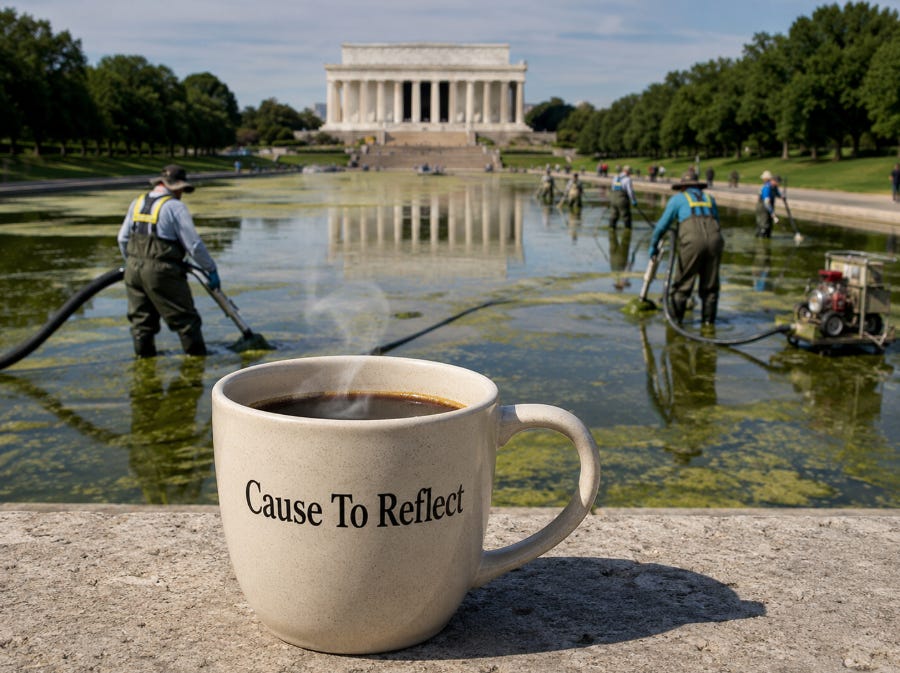
The pool had recently been renovated, painted blue on presidential instruction for the coming 250th anniversary festivities, and then promptly became a visible argument against the people who had touched it last. Algae bloomed. Paint peeled. The national mirror looked like a municipal maintenance complaint with a security perimeter. Trump inspected the damage, declared himself amazed, “WOW, who would do such a thing?” and the machinery moved. Five people were reportedly arrested. Five more were reportedly cited. Jeanine Pirro went on Fox to promise prosecution. The pool, degraded by the administration’s own pageant work, was transformed into a crime scene.
Hearn’s mistake was not that he damaged the spectacle. His mistake was noticing that the spectacle was already damaged.
That is today’s move. The folly comes with a second cost. First, the administration manufactures or mismanages the failure. Then ordinary people, allies, institutions, shippers, inspectors, cities, and bystanders are conscripted to absorb the consequences and supply the alibi. Paint peels, and the citizen becomes the vandal. The strait is destabilized, and the shipper becomes the test case. The ceasefire is written around actors who are not party to it. Lebanon becomes the escrow account for everyone else’s war. The money is unfrozen, perhaps, but only if it passes through a toll booth stocked with American soybeans.
The day’s operating principle is simple: make the mess, assign the bill.
JD Vance emerged from Switzerland on Monday morning to announce that the United States and Iran had made “a lot of good progress.” This was the same negotiation that, the day before, had produced reports of Iranian fury, a refusal to participate in the opening photo opportunity, a threatened walkout, Trump threats about bombing Iran and keeping negotiators from making it home, and enough shuttle diplomacy by Qatar and Pakistan to make the Bürgenstock resort look less like a peace summit than a very expensive group-therapy intake.
Vance’s answer was that none of this mattered very much. The Iranians, he said, had not walked out. They had threatened to walk out, or perhaps social media had threatened to walk out on their behalf, which in the current diplomacy apparently counts as a recognized procedural category. The talks continued past 1 a.m. The technical teams remained. There had been, in his phrase, “a little bit of threatening” and “a little bit of whining,” but the process survived.
This is how empires in decline learn to speak HR.
The vice president laid out four accomplishments. First, a mechanism to keep the Strait of Hormuz open. Second, a mechanism for regional deconfliction, especially around Lebanon. Third, an Iranian agreement to invite IAEA inspectors back into the country. Fourth, a structure for technical negotiations over the next 60 days. The final deal, Vance said, is the house. What they built in Switzerland was the foundation.
It is a useful metaphor, provided one remembers that foundations are what people point to when there is not yet a house.
Still, the Vance remarks were not nothing. If Iran has indeed agreed to invite IAEA inspectors back in, that matters. If the technical teams remain in Switzerland, that matters. If Qatar and Pakistan have wrestled the parties into a roadmap for a final deal, that matters. Process is not peace, but in a region where public threats can derail private talks before lunch, process is at least the room not catching fire.
The problem is that every mechanism Vance described also functions as a confession. A mechanism to keep Hormuz open means Hormuz is not reliably open. A mechanism to deconflict Lebanon means Lebanon is already inside the deal, whether Israel, Hezbollah, or Lebanon itself consented to being turned into the tripwire. A mechanism to invite inspectors back means inspectors are not yet back. Vance said his team tried calling nuclear inspectors at 2 a.m. and discovered, to the surprise of no one outside a vice-presidential press gaggle, that not many people answer their phones at 2 a.m.
So the major milestone briefly went to voicemail.
The Strait of Hormuz remains the clearest expression of the toll-booth logic. Trump has said there will be no tolls during the 60-day ceasefire period and no tolls afterward “unless they are imposed by and for the United States of America,” should the deal not be completed, “for services rendered as the guardian angel” to the countries of the Middle East, for “past, present, and future reimbursement of costs.”
This is the sentence you write when you believe international law is a franchise agreement and the Persian Gulf is an under-monetized parking facility.
The branding is doing more work than the waterway. U.S. officials say the strait is open; Iran says it has asserted control; the shipping analysts watching the traffic see vessels moving, hesitating, and going dark by turns. Secretary Chris Wright leaned on transit counts to suggest normalization, but 55 ships is not 138 ships, and a vessel can pass through a strait and still prove it is not open in the only sense commerce cares about: predictably, insurably, without becoming a geopolitical scratch-off ticket. Access to a chokepoint remains leverage even after the president declares the chokepoint open on television.
Then there is Jared Kushner’s contribution, because no Middle East file is complete until a member of the Trump family has located a revenue stream. Vance said that if Iranian frozen assets are ever unfrozen, the money could be routed through a process approved by the United States and Qatar to buy American soy, corn, and wheat for the Iranian people. He called it a “classic Trump deal”: the money would “go to make American farmers richer and to feed the Iranian people.”
There is an argument for ring-fencing unfrozen assets so they cannot be diverted to militias or weapons programs. There is an argument for humanitarian purchase mechanisms. But the way Vance sold it was pure toll booth: the funds can move, perhaps, if they first pay tribute to the domestic political coalition. Iran gets food. Iowa gets a cut. Jared gets a mechanism.
It was almost elegant in its shamelessness.
The backlash is instructive because it does not fit neatly into partisan buckets. Susan Rice called the deal egregious and argued that too many concessions had been granted up front. John Cornyn gestured toward the sanctions-evasion problem from the other side. Hawks, Democrats, pro-Israel voices, and Iran skeptics can disagree about almost everything and still smell the same thing here: the administration appears to have paid in advance for compliance that has not yet arrived.
That does not mean the deal is doomed. It means the deal is expensive before anyone knows what it bought.
The Iran talks are back on track in the way a car is back on track after skidding across the median and being waved forward by two very tired police officers. It is better than the ditch. It is not yet transportation.
At home, the same governing style is being performed in smaller, uglier rooms.
The Reflecting Pool is the cartoon version because the facts are too gaudy to improve: a renovated pool, an algae bloom, an arrest.There is a kind of genius in choosing a reflecting pool as the site of the parable. The whole purpose of the thing is to show the country an image of itself. This week it reflected algae, peeling paint, state insecurity, and the federalization of embarrassment.
The pool did what it was built to do. Naturally, someone had to be charged.
The same pattern is visible in Memphis, though without the comic lighting. Nine months after Trump sent an anti-crime taskforce into the city, observers attempting to monitor the operation say they have been tailed, surveilled, intimidated, and in at least one case falsely arrested, according to allegations in an ACLU lawsuit. The point of observers is to watch power. The point of this kind of power is to make watching feel like obstruction.
That is the domestic toll booth. The government acts. The public asks what the government is doing. The public becomes the problem the government was supposedly sent to solve.
Chicago supplies the campaign version. After another violent weekend, Trump again floated military intervention and demanded to know why Illinois Governor JB Pritzker had not welcomed deployment. The city’s grief becomes raw material for a federal spectacle. The dead are not yet buried before they are turned into an argument for troops the state did not request.
Pool, Memphis, Chicago: three scales of the same move. Rename failure as sabotage. Rename scrutiny as interference. Rename local tragedy as an invitation for federal force. Punish the people who notice. Threaten the people who refuse to applaud.
The operation does not require a coherent policy. It requires a camera, an enemy, and a surface on which to project authority. A pool will do. A city will do. A protester will do. A bystander touching paint will do.
Not all toll booths are built after the accident. Some are installed before the road opens.
The AI industry is spending heavily in the 2026 midterms, with AI-focused super PACs reportedly raising roughly $100 million and spending about $44 million so far. Nearly half of that spending has converged on a single Manhattan race: the Democratic primary in New York’s 12th congressional district, where Assemblymember Alex Bores, a tech worker turned politician, has become the unlikely center of an industry fight over the first generation of AI legislation.
This is the quiet version of the same architecture. Not conscription after failure, but capture before consent. The lords arrive early, buy the zoning board, and then explain that the castle was inevitable.
The point is not that every AI company is sinister or every tech-backed candidate is a puppet. The point is that an industry whose social consequences are still being discovered is already spending like a sovereign power to shape the rules that will govern it. The public is still trying to understand the machine. The machine’s owners are already funding the referees.
Prediction markets offer a related preview. Public health advocates warn that resources are failing to keep pace with the rapid growth of online gambling just as Trump endorses the nationwide surge of prediction markets. The old gambling problem was whether people could afford to lose money on games. The new one is whether politics, crisis, war, weather, elections, and public life itself can be converted into a tradable addiction layer before anyone has built a serious public-health response.
This is what technofeudalism looks like when it wears a lanyard. First the platform creates the terrain. Then the platform monetizes the behavior. Then the platform funds the politics that will decide whether the behavior was ever a problem.
By the time the public arrives, the terms of service are already binding.
Elsewhere, entire eras are wobbling offstage.
Keir Starmer has announced he will resign as Labour leader while remaining caretaker prime minister until the party chooses a successor. Less than two years after Labour’s landslide, the great restoration of managerial competence has ended in the usual British manner: a leadership process, a polling collapse, and everyone pretending the next person will discover a lever the last person somehow missed.
Trump, naturally, claimed the scalp before it had fully hit the floor, tying Starmer’s fall to immigration and energy and shouting “OPEN NORTH SEA OIL!” because no foreign political crisis is complete until he has converted it into a fossil-fuel bumper sticker.
The British story is its own machine, and it deserves more care than a roundup can give it. But as a mood marker, it matters. The technocratic center promised stability. It got less than two years before the floor opened.
Alan Greenspan is dead at 100. Greenspan was not merely a former Federal Reserve chair. He was the high priest of a vanished faith: the belief that markets could be made neutral, that risk could be priced, that wise men with interest-rate tools and obscure syntax could keep the system rational if only politicians stayed out of the way. Then the system produced the mortgage crisis, the crash, the bailouts, the rage, and the politics that followed.
The timing is almost indecent. The patron saint of market neutrality exits the morning the toll-booth presidency drops the pretense. No invisible hand today. Just a hand out.
Greenspan deserves a fuller reckoning than this morning’s roundup can give him. For now, mark the timing.
So return to Hearn. The pool was never just an anecdote, but the Trump domestic model.
That is the whole operation in miniature.
The banner says power. The paint says otherwise. The citizen reaches out a hand.
And then the state arrives to defend the illusion.
My fervent hope is that a kindly attorney, devoted to seeing justice done, takes the cases of those arrested for touching the water or just being near the reflecting pool, and sues this regime to high heaven. I think 1.8 billion is a fair ask.
And a bunch of regular citizens are about to get bankrupted by the "justice" system because King Fool needs others to blame for his latest destruction.