


The most revealing thing about Donald Trump’s prime-time address on the economy wasn’t any particular lie, though there were plenty to choose from. It was the fact that it happened at all, carried live, uninterrupted, and largely unfiltered by the same legacy media institutions that already know, in advance, exactly what kind of performance he delivers when handed a microphone and a teleprompter.
There wasn’t any new information. Trump repeats these claims daily at gaggles, rallies, signing ceremonies, and anywhere else a camera wanders into range. Inflation stopped, prices are plunging, wages are soaring, and of course, the border is sealed. Oh, and crime has vanished, tariffs are a miracle cure that somehow pay for tax cuts, cash handouts, and a $1,776 “warrior dividend” Congress hasn’t authorized. Drug prices have been slashed by 400, 500, even 600 percent, a mathematical achievement that would require pharmacies to start Venmo-ing customers at the counter. The only that changed when he moved from the Oval Office to prime time was the lighting.
The networks rolled the tape anyway, as if the sheer act of presidential posture transforms falsehood into information. There was no advance transcript requirement, no conditional airing, no editorial threshold beyond “well, he is the president.” The result was an hour of economic fantasy delivered at a near-shouting cadence, while viewers were asked, once again, to wait patiently for the fact checks to arrive after the damage was done.
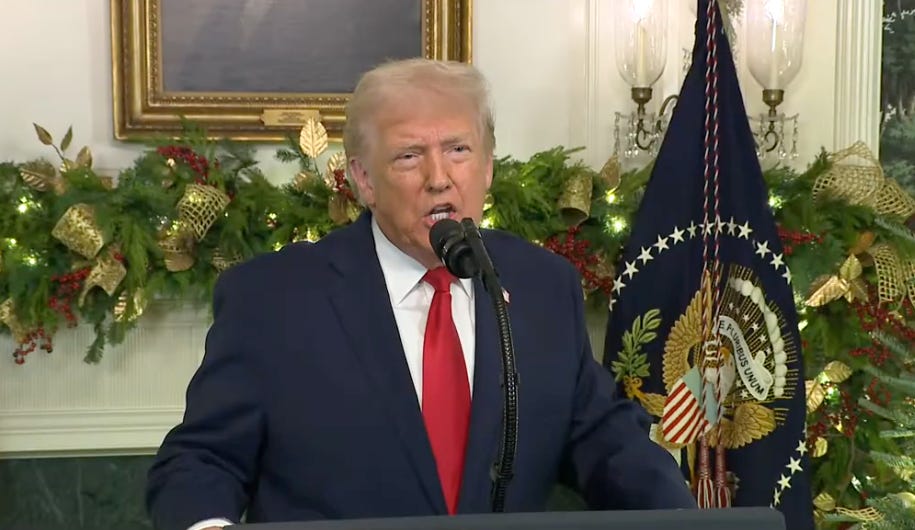
Trump’s speech followed a familiar arc: the country was “dead” before he returned to office; now it’s the “hottest country anywhere in the world.” He blamed his predecessor for inflation that was supposedly the worst in history (it wasn’t), then declared inflation “stopped” even as prices remain elevated and unemployment has recently ticked up. He claimed gas prices had fallen below $2 a gallon in many states (they haven’t), that grocery costs are collapsing (they aren’t), and that mortgage costs are rapidly dropping thanks to his leadership (the data says otherwise).
He also leaned hard into a favorite ideological trope, boasting that “100 percent” of all jobs created since he took office are private-sector jobs, as though government employment were an economic disease rather than the backbone of schools, hospitals, infrastructure, emergency services, and public health. The claim itself doesn’t hold up to scrutiny; government employment fluctuates monthly, and absolute statements like that rarely survive contact with reality, but the message was clear enough. In Trump’s America, the state exists to police borders, punish enemies, and funnel benefits to the deserving, not to employ teachers or staff emergency rooms.
Perhaps the most surreal moment came when Trump assured viewers that checks for every service member were “already on the way,” funded by tariff revenues that legally belong to Congress and may yet be clawed back by the courts. It was a campaign promise masquerading as policy, delivered as fait accompli, with no mechanism, authorization, or timeline beyond Trump’s own confidence. Confidence, as ever, was doing the heavy lifting.
What makes this corrosive isn’t simply that Trump lies. That’s a settled fact. It’s that legacy media continues to pretend that live broadcasting of those lies is a neutral act, that airing them uninterrupted is offset by a fact-check posted later, quietly, after the audience has already absorbed the emotional impression: certainty, dominance, inevitability.
Here’s the part too often left unsaid: this surrender isn’t just about tradition or timidity, it’s about profit. Trump’s lies drive ratings, engagement, outrage, and repeat coverage. They’re good television. The incentives reward spectacle, not verification. In sacrificing journalistic judgment for audience capture, legacy media has steadily eroded the very standards it claims to defend, confusing access with obligation and exposure with accountability.
There is no constitutional requirement to air a presidential address live. There is no journalistic obligation to provide uninterrupted airtime for claims that editors already know are false, misleading, or mathematically impossible. Requiring advance transcripts, delaying broadcasts pending basic verification, or airing speeches with real-time context wouldn’t be censorship; it would be journalism.
Trump understands this ecosystem perfectly. He doesn’t go to prime time to inform; he goes to overwhelm. He floods the zone with numbers, absolutes, and superlatives, betting, correctly, that the spectacle will outrun the correction. By the time reporters note that inflation isn’t “stopped,” gas isn’t $1.99, and drug prices can’t be cut by more than 100 percent, the impression has already landed. Loud, certain and almost presidential.
Sure, the speech told us something about Trump. But it told us even more about the media ecosystem still enabling him, lowering its standards, mistaking access for obligation, and confusing live coverage with accountability. At some point, “we had to air it” stops being an explanation and starts sounding like an excuse.
Once again, Mary thanks for a succinct, clear overview. I have reached a point where I refuse to listen or watch the lying demagoguery that has become the news.
I simply never watch his television appearances they are a waste of my time.