


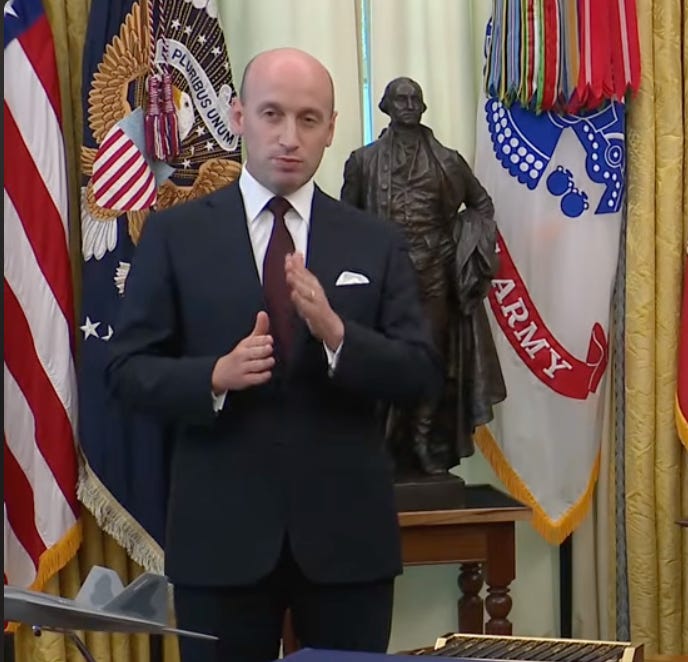
At a White House press event today, Stephen Miller explained that the Fourteenth Amendment was adopted solely to guarantee citizenship to the children of formerly enslaved people. It “had no other meaning and purpose outside of that,” he said, adding that this was “not something that’s even seriously contested by anybody.”
That “nobody” excludes Barbara, the Honduran asylum seeker whose pseudonym gives Trump v. Barbara its name; Sarah, the infant daughter of a Taiwanese student-visa holder; and the Supreme Court itself. Miller announced a constitutional theory the Court had just buried and complimented it on its health.
The Citizenship Clause says that all persons born or naturalized in the United States, and subject to its jurisdiction, are citizens.
Repudiating Dred Scott and securing citizenship for formerly enslaved people was a central purpose of the Fourteenth Amendment. Historical impetus is not textual limitation.
Arguments like Miller’s conduct a peculiar kind of originalist séance. They summon the authors of an old law, identify the crisis immediately before them, and declare that crisis the limit of everything their words can ever mean. Historical figures cease to be fallible legislators responding to the problems of their time and become prophets whose unexpressed intentions govern circumstances they never imagined.
The Reconstruction framers were not omniscient, and their authority does not come from being omniscient. It comes from the language that was debated, ratified, and placed in the Constitution. They could have limited citizenship to the children of former slaves. Instead, they wrote “all persons.” A constitutional provision adopted in response to one injustice is not a single-use coupon, nor does the framers’ inability to imagine Stephen Miller’s “baby mills” silently amend the words they chose.
In United States v. Wong Kim Ark, the Supreme Court held in 1898 that the Amendment constitutionalized the longstanding common-law rule of citizenship by birth. With narrow exceptions, most notably the children of diplomats and those born during hostile occupation, a person born on American soil is subject to American law and therefore a citizen.
The Trump administration tried to reopen that question, arguing that children whose parents were unlawfully or temporarily present were not fully subject to US jurisdiction. On June 30, the Supreme Court answered in Trump v. Barbara. The administration lost the case 6–3: five justices rejected its position on constitutional grounds, while Justice Kavanaugh supplied a sixth vote on statutory grounds. The majority held that temporary visitors and undocumented immigrants remain subject to American law while here, and their US-born children are citizens.
The Court observed that the restrictionist theory had commanded only the dissent in Wong Kim Ark and “is not the law.” That is almost certainly the “very unfortunate decision” Trump complained about today.
There are originalists who hold Miller’s position. Several justices substantially agreed with it. Which is precisely why his insistence that nobody seriously contests him is so brazen. The dispute was real, fully litigated, and decided against the administration. Miller’s version of consensus means everyone except the people who won.
His response to that defeat was revealing. Hours after the decision, Miller appeared on Jesse Watters’s Fox News program and warned that a tourist arriving late in pregnancy could soon become “the mother of a lifetime American citizen.”
Watters asked the obvious question: “Are we banning foreign pregnant women?”
Miller did not say no. He replied that the government must reconsider whom it admits even temporarily and said there were many things it would now have to examine more closely. When Jesse Watters gives you an opportunity to reassure the public that you are not contemplating a pregnancy ban and you decline it, the omission is doing rather a lot of prenatal labor.
Subtlety being unavailable at the drafting office, on the day of the decision, Representative Andy Ogles of Tennessee introduced H.R. 9562, which he named the “Anchors Away Act.”
The bill would attempt to narrow statutory birthright citizenship to children with at least one parent who is a citizen, permanent resident, or lawful member of the armed forces. It would also make any pregnant nonimmigrant inadmissible if she is not married to a US citizen, with an exception for legitimate medical treatment related to childbirth.
Ogles’s press release describes the provision as targeting certain pregnant travelers whose primary purpose is securing citizenship. The actual bill is less coy. Pregnancy plus the wrong immigration and marital status is enough.
Miller’s Fox appearance was not one stray extremist riff escaping into the television studio. The pregnancy-ban idea had already been translated into legislation. Today’s executive orders are another prong of the same project.
The first order, titled “Continuing to Protect the Meaning and Value of American Citizenship,” purports to identify additional categories outside the birthright-citizenship rule. It reaches beyond traditional exceptions to include broadly defined “alien enemies,” multiple classes of foreign-government employees, and children whose parents participated in commercial arrangements intended to secure citizenship, including some surrogacy arrangements.
Miller has a gift for taking a narrow exception, feeding it ominous nouns, and waiting for it to block the doorway.
The second order, “Ending Birth Tourism,” invokes §215(a) of the Immigration and Nationality Act. It directs officials to deny or revoke visas, prevent entry, remove participants, impose permanent bars, and pursue people or organizations that facilitate the prohibited travel.
The machinery did not appear from nowhere. Since January 2020, a State Department rule has instructed consular officers to deny B visas when they have reason to believe the applicant’s primary purpose is giving birth in the United States to obtain citizenship for the child. The regulation creates a rebuttable presumption: if an officer believes an applicant will give birth during her stay, she must satisfy that officer that citizenship is not her principal objective.
Today’s order expands that approach beyond consular visa adjudication to entry, revocation, removal, permanent exclusion, and alleged facilitators.
The two orders perform different legal functions. The citizenship order stretches the exceptions, while the visa order prevents people from reaching the rule. Together they pursue through immigration administration what the Court refused to permit as a direct presidential redefinition of citizenship.
A failed constitutional rewrite is broken into routine-looking acts of classification, visa adjudication, fraud prevention, and national-security enforcement. By the time the pieces are reassembled, the administration hopes the result will resemble ordinary housekeeping rather than an end run around a Supreme Court decision. Its a form of laundered legitimacy.
The enforcement problem, however, exposes what the antiseptic language conceals. Pregnancy is not a status stamped in a passport, and reproductive intent is not visible in a customs declaration. How will an officer decide that a traveler is pregnant, that she might give birth during her stay, and that citizenship is her real motive?
Officials can ask questions, examine itineraries and medical records, or infer from appearance and circumstance. A traveler can conceal a pregnancy; an officer can mistake someone for being pregnant; early pregnancy may not be visible at all. Anything more definitive moves quickly toward medical testing.
A policy that makes pregnancy a basis for exclusion must either create a system for determining pregnancy or grant officials broad discretion to guess. Neither is a minor administrative detail. The inevitable pool of suspicion extends beyond proven birth-tourism operators to women whom border personnel believe might be pregnant.
“Cracking down on birth tourism” shades into reproductive surveillance. Once admission depends on what the government believes is happening inside a woman’s body, and what it imagines she intends to do with that body, the border officer has acquired an obstetrics portfolio.
The political sales pitch is an updated version of the old “anchor baby” canard: the fiction that an immigrant gives birth in America and is immediately rewarded with legal status for the entire family. In reality, a citizen child cannot petition for a parent until age 21, and a petition begins an immigration process; it does not retroactively erase violations or automatically produce lawful status.
“Anchor baby” has become impolite in respectable company, so the same story now arrives in business attire. The immigrant family becomes an organized fraud ring. Citizenship becomes a commodity being purchased. A possible petition two decades in the future becomes a “permanent foothold.” The citizen child becomes something improperly manufactured.
Miller described the practice today as trying to “mint an American citizen.” The metaphor does the work. A child is no longer a person to whom the Constitution applies but counterfeit currency produced by scheming foreigners.
Visa fraud is real. Businesses that coach clients to lie to consular officers can be investigated and prosecuted. The government may regulate admission and require visitors to tell the truth about why they are coming. None of that establishes that the citizenship of a baby born here is itself fraudulent. The adult may deceive a consular officer, but the newborn does not thereby falsify the Fourteenth Amendment.
That distinction is what Miller’s rhetoric is designed to dissolve. First the parent is transformed into a fraudster, an enemy, or an operator. Then the parent’s alleged wrongdoing is transferred to the child. Finally, the child’s constitutional citizenship is treated as the proceeds of a crime.
The administration supplies the ominous nouns; the agencies supply the procedural verbs; and somewhere between “deny,” “revoke,” “classify,” and “enforce,” a constitutional guarantee is made to look like a loophole being closed. It is a laundering operation.
The old slur has not disappeared; Ogles built his bill’s title around it, but Miller’s official vocabulary gives the same story a blazer and a security clearance. The new version comes with an executive order, a statutory citation, a proposed pregnancy ban, and Stephen Miller solemnly assuring us that nobody disagrees.
Same canard. Better stationery.
A note on vocabulary
Readers of our Roy Cohn piece will recognize the pattern. “Communist” has had a busy summer, Ted Cruz alone has called Zohran Mamdani a “full-on communist,” part of a “toxic, toxic stew” of communism, and warned of a “communist takeover of the Democrat Party,” while other Republicans have gone as far as invoking the Communist Control Act to try to strip Mamdani’s citizenship outright. Now “anchor baby” is having its own revival, laundered into “birth tourism” and “minting citizens.” Neither word is new. Neither is being deployed because it’s persuasive on the merits, both arrive pre-loaded with decades of fear, which is precisely why no one bothers explaining what they mean anymore. Be watching for what comes next.
Gruppenführer Stephen Miller’s odious rhetoric does not give the Supreme Court power to rewrite the Fourteenth Amendment. The Court can interpret the Citizenship Clause and reconsider precedent, but it cannot delete or amend the Constitution.
In its June 30 ruling, the Court reaffirmed birthright citizenship, so any new executive action attempting to evade that holding can be blocked as unconstitutional
Once again, the white patriarchy shits on the women.