

Good morning! This essay arrives courtesy of the usual Trumpian clown car of corruption, cruelty, chaos, and chest-thumping nonsense, with a special guest appearance by the global oil market reminding everyone that reality remains stubbornly unimpressed by a Truth Social post.
Alas, Trump made public appearances yesterday, and in the first one he did what he does best: turn a press gaggle into a slurry of ego, menace, and improvisational fiction. He babbled about Iran, insisted a deal was basically around the corner, treated geopolitics like a real estate closing, and kept returning to the idea that he alone was holding back catastrophe by sheer force of masculine will. “Iran wants to make a deal and we’re dealing very nicely with them,” he said, before boasting that “they’re willing to do things today that they weren’t willing to do two months ago.” Later, he declared, “we’re very close to making a deal,” as if war, sanctions, and regional instability were just the paperwork phase before closing day.
He claimed Iran had already agreed not to have nuclear weapons, suggested the blockade was crushing them into submission, and talked as if regime change had somehow already yielded a fresh batch of more “reasonable” leaders. At one point he said, “They have no navy. They have no air force. They have no anything. They have no leaders,” before pivoting to praising “their new leaders” as “more intelligent and more moderate.”
The most revolting moment came when he was asked about Epstein-related hearings and the survivors. Trump, in classic fashion, pretended to be open to public hearings and then immediately pivoted to undermining the women involved, saying he’d heard that the “victims or whatever” had refused to go under oath. There it was, naked and ugly: that familiar Trump trick of performing concern for about four seconds before sliding into suspicion, dismissal, and contempt for the people whose pain might prove inconvenient to him. Survivors are obstacles, props, or threats, depending on the needs of the moment.
He also continued his fight with the Pope, insisting the Pope “has to understand Iran,” falsely reframing moral criticism as support for Iranian nuclear weapons, and repeatedly bringing up the Pope’s brother being “MAGA all the way,” because apparently Catholic doctrine is now to be adjudicated by lawn signs in a sibling’s living room. It was petty, surreal, and deeply on brand: every ethical disagreement must be flattened into personal grievance and partisan trivia.
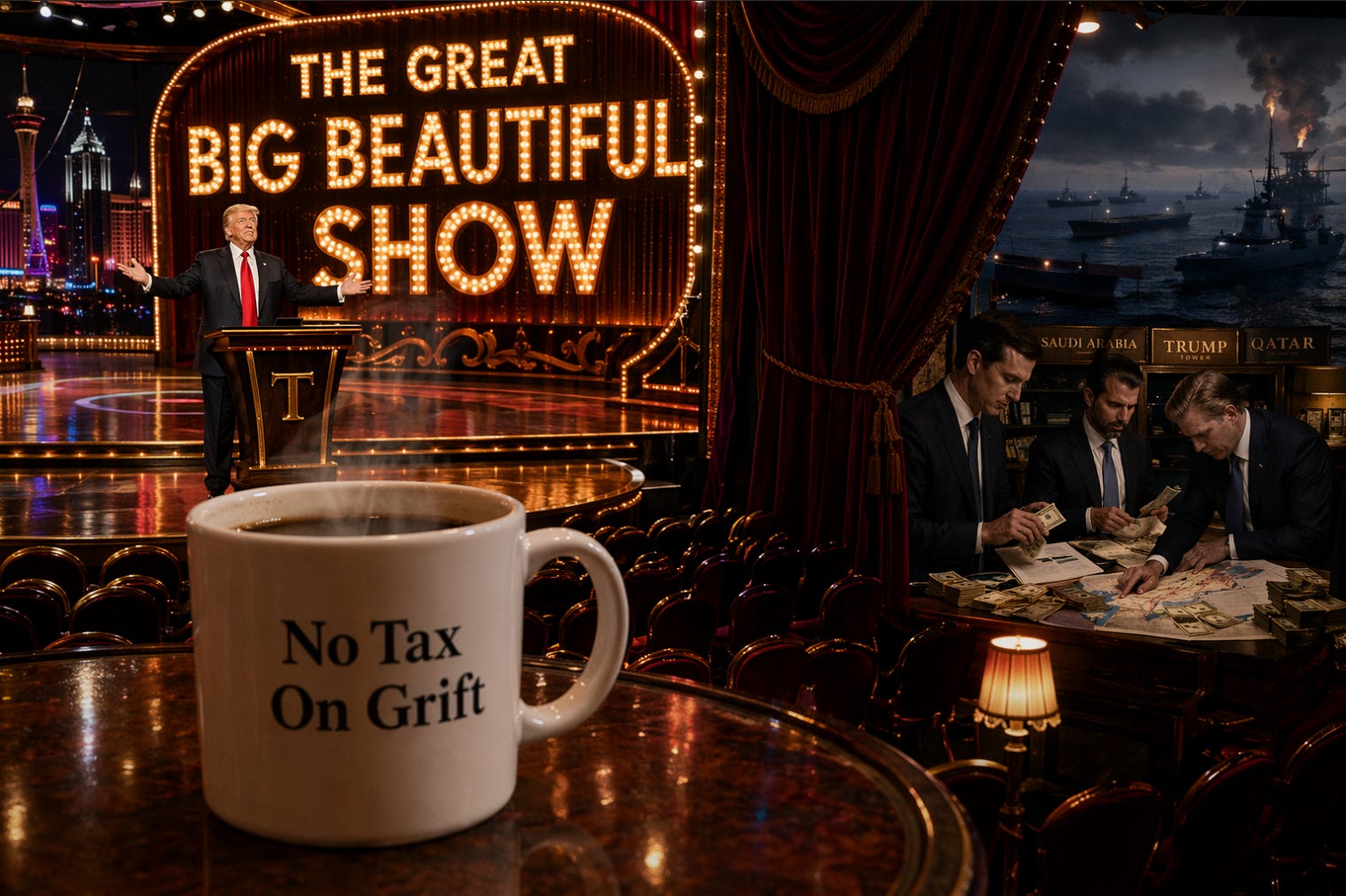
Then came the Las Vegas event, which on paper was presented as a triumphant policy appearance but in practice read like a made-for-camera infomercial for Trump’s own mythology. The meeting opens with patriotic pageantry, then rolls straight into a carefully staged testimonial economy where every worker, every family, every retiree, every tipped employee is supposedly discovering surprise piles of money thanks to Trump’s boundless genius. He retold the now-sacred origin story of “no tax on tips,” in which a waitress floated the idea and he, like some orange Moses descending from the mount with a cocktail napkin, instantly recognized it as the most brilliant thing ever spoken in the English language.
From there it was one long televangelist miracle hour. Tax refunds were the biggest ever. Seniors, of which he is “not a senior,” were thrilled. Overtime workers were ecstatic. Bartenders were nearly in tears. People were apparently crying, rejoicing, and whispering “God bless the IRS,” which sounds like something generated by a malfunctioning campaign chatbot programmed by a man who has never voluntarily stood in line at a DMV. Trump bragged that everyone was suddenly discovering these miraculous windfalls, as though the Treasury had become Santa Claus and the sleigh was pulling into Nevada because a casino waitress once spoke to him during dinner.
Trump cannot simply deliver a tax pitch without stirring the grievance stew, so he used the occasion to attack Democrats, rant about open borders, throw in the usual obsession with trans athletes, and dream aloud about “four more years” just to make his enemies mad. Even at what was supposed to be an economic event, the deeper fuel remained the same: resentment, macho posturing, and the constant need to turn governance into a personality cult. He even ended by polling the room on which of his three favorite tax slogans they liked best, like a washed-up game show host auditioning campaign merch.
Behind all that theater sat a much more embarrassing reality. By some accounts, it was a small room with space for maybe 100 to 120 people, not even full, and Trump still showed up 90 minutes late to bask in the canned adoration. The event was meant to evoke mass enthusiasm, but the atmosphere sounds more like a regional insurance awards luncheon with presidential walk-on music and worse ethics. It was less rally than community theater authoritarianism: a cramped set, a patient audience, handpicked praise, and one old narcissist pretending history had stopped to watch him workshop slogans.
In the Middle East, reality was once again busy humiliating the simple-minded triumphalism of Trumpworld. First came the Financial Times reporting that oil tumbled after Iran pledged to open the Strait of Hormuz during the Lebanon truce. Brent crude dropped roughly 10 percent on the news, markets exhaled, and for a hot minute the headlines looked like one of those moments when cable anchors start talking about “stabilization” while everyone else frantically looks for the fine print. And there was plenty of fine print. Iran said the strait was open for commercial shipping, yes, but vessels still needed permissions, the Revolutionary Guards remained involved, analysts warned any reopening would be slow and partial, insurance remained a headache, and the U.S. naval blockade of Iranian ports was still in force. Peace had not so much broken out as filed some paperwork.
The New York Times confirms that this contradiction was not a mirage. Iran said the strait was “completely open,” Trump thanked them for it, and then Trump separately insisted the U.S. blockade would remain “in full force and effect” until a peace deal was complete. So the message from Trump, as usual, was that he had simultaneously restored normal commercial passage and preserved maximum coercive dominance, basically the international-relations equivalent of saying the store is open, the doors are locked, and customers should be grateful for the convenience. The Times also noted that around 900 ships had been stranded in the Gulf during the conflict and that real shipping recovery would likely take weeks, not days, even if the immediate panic eased. The markets may have heard “de-escalation,” but the shipping world was still hearing “maybe don’t move the tanker yet.”
Energy analyst Matt Randolph’s warning was doing the hard, unglamorous work of dragging the conversation back down to the level of actual material consequences. While the chest-thumpers were celebrating tanker traffic and oil headlines like it was halftime at the Super Bowl of empire, Randolph pointed out that what matters to ordinary people is not the macho fantasy of energy dominance but what happens to diesel, jet fuel, gasoline, freight, fertilizer, and food prices. He argued that increased flows and export dynamics around refined products can keep diesel tight and expensive, which then ripples outward through transportation, goods, and groceries. The same people cheering the spectacle today may curse their grocery receipts a few months from now, having somehow once again applauded the mechanism of their own impoverishment.
No Trump-era morning would be complete without a reminder that corruption is not a side effect of the administration but one of its core design principles, and PBS gave us a pair of reports that help explain the larger architecture of the rot. The first laid out how Jared Kushner, Don Jr., and Eric Trump are expanding private business ventures while remaining attached, formally or informally, to the machinery of political power. Kushner, in particular, is operating as a “volunteer” foreign-policy adviser while running Affinity Partners, a multibillion-dollar investment firm whose assets are overwhelmingly tied to non-U.S. investors, particularly in Saudi Arabia, the United Arab Emirates, and Qatar. PBS notes that Affinity Partners reported “more than $6.1 billion in assets” and that “about 99% of those assets belong to non-U.S. investors,” with most of the money tied to those Gulf states.
So there he is, negotiating sensitive matters in the Middle East while the same region finances his private investment empire. As Maureen Farrell put it, “he’s out there negotiating peace deals with governments” while also “investing their funds and getting big fees from these governments,” which raises the obvious question: “who is he working for?” But relax, everyone: technically he’s a volunteer. Apparently, if you just remove the payroll paperwork, a conflict of interest becomes a charitable donation instead of an ethics problem. PBS points out that “as a government volunteer and not an employee, Kushner is exempt from the usual financial disclosure laws,” which is one hell of a loophole for a man casually drifting between diplomacy and private capital.
PBS also detailed how Don Jr. and Eric have moved aggressively into business sectors that stand to benefit from federal policy, deregulation, procurement, and geopolitical upheaval, drones, crypto, fusion power, speculative tech plays, all the sexy little corners where political proximity can be converted into wealth with unusual speed. One example involved drone firms that may compete for Pentagon contracts and sell systems in Gulf states threatened by Iranian attacks. Another involved Trump Media’s fusion deal, a multibillion-dollar exercise in speculative hype orbiting the family brand. The whole structure screams the quiet part out loud: this is not a family trying to avoid the appearance of influence peddling. This is a family that looked at the presidency and saw a venture accelerator. Forbes estimated Eric and Don Jr. were worth perhaps $40 to $50 million each before the 2024 election; about a year later, those estimates had ballooned to roughly $400 million for Eric and $300 million for Don Jr. Funny how that happens when access to executive power becomes the most lucrative product line in the catalog.
And then there is Project 2025, which PBS neatly helped expose for what it always was: not some random think-tank fever dream Trump had never heard of, but a staffing guide, governing blueprint, and wish list for dismantling what remains of modern democratic restraint. Russell Vought, one of its principal architects, now runs the Office of Management and Budget. Other contributors, including Peter Navarro, Brendan Carr, and Tom Homan, have landed in positions where they can directly implement the policies they wrote. Trump spent the campaign pretending he did not know what Project 2025 was, calling parts of it “seriously extreme.” Now its authors are sitting inside the government with pens in hand and badge access. Amazing how often the man who “knows nothing” ends up surrounded by exactly the people advancing exactly the policies he supposedly never heard of.
PBS notes that analysis from the Center for Progressive Reform found the administration had already initiated or completed 53 percent of Project 2025’s domestic agenda by February, 283 of 532 recommended actions. Sounds like a hostile takeover with citations. The report also tied Project 2025’s language on Iran and military expansion to the administration’s current budget posture and regional belligerence, showing again that this was never just about culture-war cruelty at home. It was also a roadmap for a more militarized, more centralized, more openly punitive state. On LGBTQ issues, on reproductive rights, on agency power, on the budget, on war, the document did not disappear. It moved into the executive branch and unpacked its bags.
Somehow, against all odds, that was just yesterday.
My uncle, my late father’s younger brother, is nearing the end of his time here, and Marz and I will be on the road over the next few days to say our goodbyes and be with family. Like my father before him, he has made it to the remarkable age of 94, and there is something profound in that symmetry. I will still be keeping one eye on the chaos, because apparently the world never takes a day off from being absurd, but my posting may be a bit sporadic over the weekend. Peace be upon you all.
As usual, an inspiring piece--with a thinking head and a feeling heart.
What I wonder, as I watch the Trumps and their a/and immoral friends pile up huge heaps of dirty money, is whether the majority of our population has had their souls removed and no longer cares about right and wrong; possibly, even, no longer even understands that there is difference between right and wrong.
I especially focus on the stock market... This has always been, since it's inception in the early 1800's, a place where the playing field is permanently tilted. ...now it's not only tilted, it's so completely turned upside down that only people with total insider information can ever hope to hit the daily winning number. It's fixed slot machine, a roulette wheel with a bribed dealer spinning it... Trump and his filthy family play the numbers KNOWING exactly what the number is going to be... When anybody else "makes money" (whatever that means) it's not by any knowledge of trade or business, it' because they're watching what the sleaze-balls in charge do and bet with them...
I hope your uncle's death is relatively painless...
So sorry Mary about your uncle! Prayers for him and the family. Thank you so for all you and Shanley do to help us thru! 🙏🏼🙏🏼🙏🏼