

Good morning! Watching a theory of power get stress-tested in real time is nerve-wracking, and I confess, entertaining.
The theory is Donald Trump’s conviction that the United States is so economically indispensable that everyone else will eventually do what he wants. Threaten access to the American market, the dollar system, or both; apply enough pressure; announce repeatedly that the other side has no cards; wait for surrender.
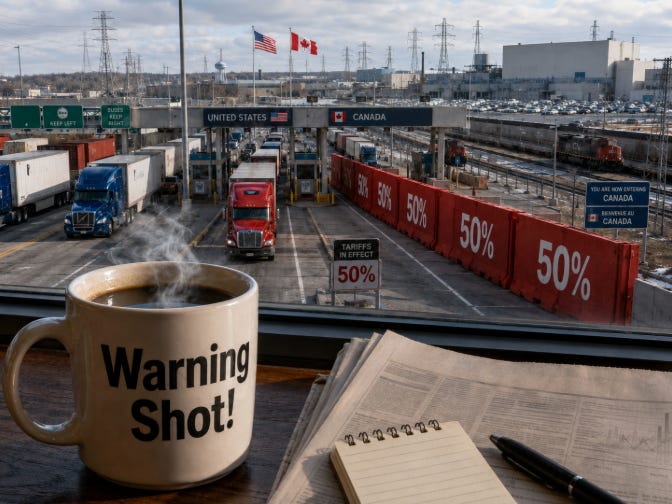
Canada read the script and tore it up.
Trade talks collapsed over the weekend, 50 percent U.S. tariffs landed on roughly $20 billion worth of Canadian goods, and Prime Minister Mark Carney announced dollar-for-dollar retaliation beginning September 8. Ontario Premier Doug Ford, meanwhile, dispensed with the diplomatic niceties entirely.
Trump can, Ford said, “kiss my ass.”
I am not in the habit of cheering Doug Ford, but credit where it is due.
Trump responded by calling him “Flunky Ford,” describing Ford and Carney as clowns and, because apparently the president of the United States cannot conduct a trade dispute without eventually dragging somebody’s dead relative into it, saying Ford was the less charismatic and intelligent version of his late brother Rob.
Ford called Trump a dictator and the “king of bankruptcies,” then compared him to the school bully who steals your lunch money, your toque and eventually your running shoes.
There is something of a WWE smackdown quality developing here, as Ontario Liberal leader John Fraser observed, but there is also an important asymmetry. Trump has spent months threatening Canada’s sovereignty, calling it the 51st state and its prime minister a governor. Ford is responding to a degradation of the relationship that came from Washington.
It is remarkable that Trump keeps turning people I would ordinarily have very little interest in defending into Captain Canada.
Justin Wolfers, the University of Michigan economist, offered perhaps the funniest description of how we arrived here. The United States and Canada already have a trade agreement negotiated by Trump.
The first Trump administration declared NAFTA terrible, replaced it with the USMCA, CUSMA, as Canada prefers, celebrated the new agreement as magnificent, and the second Trump administration has now arrived demanding to know what idiot agreed to all this free trade.
“President Trump negotiating against President Trump,” Wolfers called it, with Mark Carney and the Canadians standing somewhere in the middle.
For a while, Washington had found an almost perfect arrangement for accommodating the president’s preferred relationship with reality. Trump could bellow about enormous tariffs on Canada while an asterisk quietly exempted most goods covered by the existing trade agreement. As Wolfers put it, “this is not a bloke who reads the footnotes.”
Perhaps the most concise description of this administration I have heard in months. Trump governs in 72-point type. America lives in the footnotes.
The footnotes are disappearing now, and Canada and the United States did not merely trade with one another for decades; they built economies around one another. Auto plants, parts suppliers, electricity markets, steel, agriculture and energy networks span a border businesses were encouraged to regard as stable.
Wolfers uses the example of a Canadian auto-parts manufacturer deciding where to build its next plant. When NAFTA and then USMCA represented durable commitments, building near Michigan to plug directly into American manufacturing made perfect sense. With a president who changes the rules whenever the mood strikes, putting that factory near a port and integrating instead with European supply chains begins to look rather more sensible.
That may be the larger damage here. Tariffs are visible. Uncertainty is harder to photograph, and national resentment does not appear anywhere on a customs schedule.
Canadians are already checking labels in grocery stores and avoiding some American products. That behavior is unlikely to be reversed by Trump and Carney eventually emerging from a meeting with another piece of paper. As Wolfers put it, “You can’t unring some bells.”
In trying to make Canada bend the knee, Trump has instead manufactured Canadian nationalism.
This morning Canada put numbers behind the resistance.
Ottawa announced retaliatory tariffs of up to 50 percent on roughly 700 American products beginning September 8. The list runs from aluminum foil to dishwashers to fish, but it was built with precision: many of the targeted goods mirror categories hit by the U.S., particularly clothing, forestry products and tools, and the total value is deliberately about $20 billion, the same amount of Canadian trade caught by Trump’s latest tariffs.
Two details stand out. First, Carney was nowhere to be seen. He left the announcement to cabinet ministers and kept no public events on his own schedule even as he acknowledged retaliation “will raise costs and reduce choice for Canadians.”
Ford supplies the theater. Carney, it turns out, prefers the paperwork.
Second, Canada deliberately chose not to escalate everywhere it could have.
Trump threatened Monday to double the auto tariff to 50 percent, a rate that would likely doom Canadian plants exporting upward of 90 percent of what they build. Canada instead held its retaliatory auto tariff at 25 percent and preserved the tariff-free allowance that lets Canadian-built cars continue crossing the border.
Wolfers had invoked economist Joan Robinson’s old analogy: if another country throws rocks into its harbor and makes trade more difficult, does it improve your position to retaliate by throwing rocks into your own?
Ottawa’s answer appears to be: some rocks, yes. Just not enough to close the harbor.
None of this happens on equal terms. Canada’s economy is about one-twelfth the size of America’s, and economists have compared its retaliatory tariff capacity to a pea shooter in a gun battle. Provincial unity is thinner than Ford’s rhetoric might suggest as well. Ford favors aggressive retaliation; Alberta Premier Danielle Smith, whose province depends heavily on oil exports that Trump has so far excluded, urges restraint.
The pea-shooter comparison is fair as far as it goes.
Tariff-for-tariff firepower is not the only leverage available. Ontario supplies electricity to Michigan, Minnesota and New York. Canadian officials have discussed critical minerals and targeted measures aimed at maximizing political pressure on the American side. Businesses can redirect investment. Consumers can buy elsewhere.
Trump’s assumption is that Canadian dependence on the United States gives Washington leverage over Ottawa.
Canada’s answer is increasingly: your greater power does not make you immune from our leverage.
North American integration works in both directions.
Canada cannot out-tariff the United States. It can make coercion more expensive.
With the U.S. midterms approaching, the political question is how much pain Trump is prepared to impose on Americans in order to do it.
France 24 neatly paired this fight with Washington’s new economic campaign against Iran. In both cases, the administration is betting that American economic weight can force another government to accept terms it has so far refused.
Which brings us, unfortunately, to Scott Bessent.
A small victory lap, if you’ll indulge me. Saturday, I published a piece arguing that Bessent’s Treasury interventions were band-aids on a structural wound, and that his own career, spectacular working under someone else’s institutional umbrella, considerably rockier running his own, was a preview of exactly the kind of confidence problem he’s now facing at Treasury.
Monday, the Financial Times editorial board published its own piece making essentially the same argument, opening with the same hook: Bessent as the young Soros trader who profited from betting against a government defending an unsustainable position in 1992, now sitting on the other side of that exact table.
I’ll take the confirmation.
The FT adds a few useful details. Bessent describes himself as America’s “top bond salesman,” has now attached an actual number to “fiscal consolidation,” a deficit target of 3 percent of GDP, roughly half the current level, and continues trying to reassure foreign holders of Treasury debt.
Asked yesterday about the much-discussed buyback operation, however, Bessent acknowledged Treasury “hasn’t bought a single bond yet.” The next operation is scheduled for September 9.
The top bond salesman is, for the moment, still mainly selling confidence.
His Iran briefing offered an even cleaner window into the limits of the administration’s leverage theory.
Bessent called the new sanctions campaign “economic D-Day,” promising to “tighten the noose,” pursue “zero leakage” and “collapse every last option” available to Iran.
Then a reporter asked the obvious question. D-Day was not a warning. The Allies did not offer Germany a deadline and a cure period. If this is really economic D-Day, why not impose all the threatened secondary sanctions immediately?
Bessent answered:
“Why would I want to blow up the global financial system?”
There it was.
Treasury, he explained, needs a “cure period,” a “warning shot” and an opportunity for governments and companies to change their behavior first.
Which rather destroys the D-Day analogy on contact, but more importantly, it exposes the actual constraint. American financial leverage is enormously powerful because so much of the world relies on the dollar system. That also means Washington cannot wield it without regard for the stability of the system that makes the weapon powerful in the first place.
Possessing leverage is not the same as having unlimited freedom to use it, and China is the practical test.
Bessent said “no one is above the reach of U.S. sanctions.” Asked specifically about major Chinese banks helping convert Iranian oil into usable revenue, however, Treasury suddenly preferred “quiet diplomacy.”
“We know who they are. They know who they are.”
By Tuesday, the Wall Street Journal had filled in the missing footnote.
China buys more than 80 percent of Iran’s oil exports, yet the new “zero leakage” campaign avoided major Chinese banks and firms. A former Treasury official told the paper the campaign had been structured to give China room to adjust quietly without forcing Washington to target those banks directly.
The reason is not hard to find. China demonstrated during last year’s tariff confrontation that it can retaliate, including through rare-earth restrictions that hurt American manufacturers. One Council on Foreign Relations fellow described Chinese retaliation as “a real threat now.”
So “no one is above the reach of U.S. sanctions” turns out to contain an asterisk too.
Iran, unsurprisingly, has noticed the shift. An IRGC spokesman called the economic campaign a “tacit admission” that military pressure failed to achieve Washington’s objectives. That is plainly Iran’s preferred interpretation, but Sina Toossi of the Center for International Policy similarly described the sanctions as an attempt to accomplish what “military force has so far failed to achieve.”
Wolfers supplied the appropriately absurd summary: “starting a trade war to solve a war war.”
That is enough Iran for today.
Canada is offering the more compelling demonstration of the same governing instinct: when pressure fails, increase the pressure and announce that the next escalation will finally reveal the overwhelming leverage everyone was supposed to recognize the first time.
Bessent even supplied a useful glimpse of how that grammar travels from adversary to ally.
Asked whether Trump still wants Canada to become an American state, Bessent did not repeat Trump’s formulation, but neither did he disavow the premise. Instead, he attacked Carney, describing him as “anti-American, anti-Trump,” questioning whose interests he was serving and insisting Canada had been offered “quite a good deal” and “chose to reject it.”
Treasury is not equating Canada with Iran, but the grammar is recognizable: Washington defines its preferred outcome as reasonable, resistance becomes misconduct, and the consequences that follow become something the other side chose.
Disagreement with Donald Trump quietly becomes “anti-American.”
That is a revealing way to discuss an allied democracy refusing terms it regards as incompatible with its own interests and sovereignty.
After all of that, the president held a back-to-school event and naturally began by talking about the ballroom, noting that Xi Jinping is coming soon, recalling China’s Great Hall and announcing that America will now have a “great Hall” too.
Welcome to Washington, Mr. President. Please admire the ballroom. Scott Bessent would also like a quiet word about your banks.
Somewhere in the middle, Trump also said his administration is “requesting, even telling people” to break childhood vaccinations into smaller doses, adding “we think” this affects autism rates, a claim offered with no evidence, and not one I’d bury inside the usual daily pile of presidential improv.
Then he took the children outside to admire the construction.
The event began with the ballroom and ended with the ballroom.
Stay in character.
But I keep coming back to Canada, because underneath all of today’s noise is a serious change in the way one of America’s closest allies is thinking about the United States.
Trump believes interdependence gives America leverage.
Canada is beginning to treat that same interdependence as a vulnerability, to identify where dependence runs in the opposite direction and, as of this morning, to price the answer out to the dollar.
There is a larger institutional problem hiding inside that shift. NATO’s collective-defense machinery was built around the assumption that the threat to an ally would come from outside the alliance. Its famous Article 5 addresses armed attack; even its newer thinking about economic coercion largely imagines Russia or China doing the coercing. There is no ready-made mechanism for the scenario Canada is confronting now: the alliance’s most powerful member using economic pressure against another member while openly questioning its sovereignty.
That gap may explain Carney’s language of strategic autonomy. Canada is not waiting for an alliance mechanism that does not exist. It is building leverage of its own.
The tariff is today’s cost. The possibility that allies begin redesigning their economies around the assumption that America itself is the risk is tomorrow’s.
The rest of the world has started testing Washington's assumed leverage, and this morning, it sent an invoice.
Carney exposed Trump to the entire world…
A Bully with no diplomatic abilities…
And someone whose word is worthless…
In the meantime…
Trump and his cronies are filling their pockets at the taxpayers expense…
The Lies, The Greed, The Corruption…
Morally, Ethically, Politically Bankrupt…
And he’s sending the country down the same Rathole…
Tell me he doesn’t work for Russia…
Maybe this will awaken the Republican sycophants to reality…
Thanks for writing this...
A beautiful, deep, wide analysis of where everyone stands in the current moment--and in which direction things are headed... What an accomplishment it would be, a true sea change, if Carney could truly switch partners in this great economic dance-- Our great loss of course--and all because of one man's demented egotistical vanity!
All this yelling back a forth is really no higher on the list of evolution than elementary-school shoving and pushing in the playground. It's entertaining for about 1 second, then you shake your head in disgust and disbelief and wonder how the entire school managed to change hands from adult supervision to Lord of Flies brute anarchy..
Trump wants a cage match (where he watches, but, of course, would never risk getting in the cage)-- How did this big, whinging baby get to be the President of our country? "I wont do anything till I get my tariffs!. Wah, Wah, Wah!!"
It's sad beyond words to think he was the choice of millions of voters; you can only assume they're all ignorant enough to become willing victims of Trump's big con... Can our government--our very country itself ever come back from this looming dead end?