


Good morning! Welcome to another rousing episode of Are We Still Calling This Governance? It is hump day, which means the Trump kakistocracy has had only half a week to saw through the load-bearing beams of civilization, and yet here we are, already checking the structural integrity of the Strait of Hormuz, the dollar system, and the historic Oval Office table.
We begin, naturally, with fitness. Trump’s youth fitness proclamation started as a wholesome Oval Office event about bringing back the Presidential Fitness Test and quickly became what happens when a pep rally, a golf podcast, a war briefing, and a Fox News comment section are left unattended in a blender. The children summoned to witness it had no idea they were about to become a live studio audience for something that wasn’t quite a ceremony and wasn’t quite a press conference and wasn’t quite a rally, but had the flavor of all three.
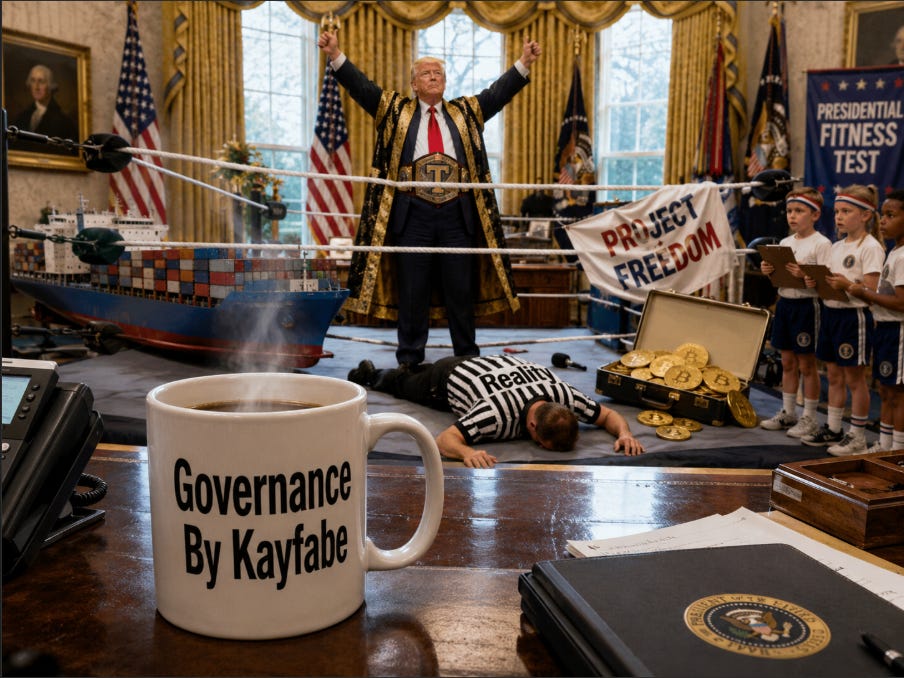
The most instructive exchanges came when Trump turned to the kids themselves: asking what sports they played, telling a young powerlifter he would “never compete against women,” launching into a trans-athlete rant apparently for the benefit of a child who had expressed no interest in competing against anyone other than himself, asking the boy if he could “take me in a fight,” and then claiming he could do fifty push-ups on the historic Oval Office table if only decorum allowed. Gary Player, who is ninety years old and shot a 70, stood there being insufficiently excited about it.
So yes, the official event was about fitness. The actual event was something else, a performance for an audience that had agreed, or been asked, to treat it as real. We’ll have a word for that in a moment.
And that brings us to the word of the day: kayfabe.
I had not previously heard the term, because I am not a wrestling fan, but James O’Brien over at LBC may have handed us the Rosetta Stone of Trumpism. In professional wrestling, kayfabe is the shared fiction in which everyone performs as if the staged drama is real: the heroes, the villains, the grudges, the betrayals, the threats, the triumphs. The audience both knows and agrees not to know. The point is not truth; but the performance of truth.
Once you see Trump through that lens, the day’s chaos becomes less random and more legible, which is its own kind of terrifying. The strongman routine is kayfabe. The victory declarations are kayfabe. “Perfect deals” are kayfabe. The wall, the stolen election, the “only I can fix it” routine, the imaginary business genius, the fake martyrdom, the fake toughness, the fake populism wrapped around actual elite looting, all kayfabe.
The difference is that in wrestling, the table is rigged to break. In Trump’s world, the table is the global economy, and the children are standing right there watching him climb the ropes.
Which brings us, unfortunately, to Iran. The latest reporting suggests that Trump may once again be on the verge of a deal with Tehran, although “on the verge” is doing a lot of work here, possibly more work than Project Freedom did before being quietly escorted offstage.
The Financial Times reports that oil prices tumbled Wednesday on hopes that the United States and Iran could be close to an agreement to end the conflict. Trump said the war would end and the Strait of Hormuz would be “open to all” if Iran “agrees to give what has been agreed to,” while also warning that if Tehran does not agree, “the bombing starts,” at “a much higher level and intensity than it was before.”
So we have peace talks, market optimism, and a presidential threat to resume bombing all in the same breath. Diplomacy, but make it hostage-note adjacent.
The reported U.S. framework, according to the FT, involves Iran accepting a moratorium on nuclear enrichment while the United States releases frozen Iranian funds and lifts sanctions. Both sides would also end restrictions on transit through the Strait of Hormuz. Oil prices reacted immediately: Brent crude fell as much as 11 percent below $98 a barrel before climbing back above $100 after Trump’s post, while European stocks rallied and government bonds recovered on hopes that the inflation shock from the Iran war might ease.
The New York Times live updates added more of the real-world cost behind the market story. Trump’s decision to pause the U.S. Navy effort to guide stranded ships through the Strait came after requests from countries including Pakistan and Saudi Arabia, with Pakistan mediating between Washington and Tehran. The NYT also reported that more than 1,600 ships remained stranded in dangerous conditions in the Strait of Hormuz, with roughly 20,000 seafarers aboard, while gasoline prices in the United States had jumped to a national average of $4.54 a gallon and diesel to $5.67.
So while Trump performs “great progress,” actual human beings are sitting on giant metal boxes in a militarized bottleneck, waiting to find out whether the most powerful man in the world is negotiating peace, threatening war, or just workshopping a new nickname for a failed naval operation.
About that operation. Project Freedom, Trump’s grand plan to escort commercial ships through the Strait of Hormuz, lasted roughly as long as a Trump infrastructure week. According to the FT, Washington paused the mission after Trump cited “Great Progress” in talks with Tehran. The same reporting notes that the suspension came after the operation had barely begun and as shipping groups struggled to assess risk amid sudden policy changes.
The British, as always, cut through the fog with admirable economy. Andrew Neil looked at Trump’s claim that he was on the brink of a “complete and final agreement” with Iran and said he would be leaving to colonize Mars tomorrow, and he was not sure which scenario was more likely. His verdict on the whole spectacle: “It’s a shambles. It’s all over the place. No one has a clue what’s really happening.”
When someone suggested that perhaps Trump was practicing strategic ambiguity, Neil was even more direct. “They’re not playing 4D chess,” he said. “They couldn’t play 1D chess.”
That may be the most generous, accurate thing anyone has said about this administration all week.
The Times Middle East correspondent Samer Al-Atrush gave a deeper diagnosis: Trump and his allies appear to have gone into the war believing they could launch attacks, kill enough Iranian leadership in the opening days, and trigger regime collapse. That did not happen. Since then, he said, the war has been “rudderless,” with Trump trying a new pressure tactic every week or two to break the stalemate, especially Iran’s hold over the Strait of Hormuz.
Project Freedom, in that reading, was not strategic brilliance. It was the latest object hurled at the wall. And according to Al-Atrush, it clearly flopped. Within hours, there were exchanges of fire, ships hit or ablaze, Iranian attacks, and shipping companies with no clarity about how the United States intended to guarantee safe passage. No rational shipping company was going to interpret that as an invitation to resume normal traffic. Trump announced he had opened the Strait. Reality filed a dissent.
James O’Brien and his maritime caller Ash took the analysis even further. O’Brien framed the whole thing as kayfabe: the Strait is open except it is closed; the ceasefire exists except they are still firing; the war is over except a deal is supposedly imminent; America has a safe passage lane except commercial shipping still is not flowing normally.
Ash, who actually knows what he is talking about on maritime matters, argued that Operation Freedom looked less like a genuine humanitarian rescue for stranded seafarers and more like a test. Send U.S.-flagged vessels and destroyers through the safest available route, see how much Iranian capability remains, gather intelligence, then dress it up as a humanitarian mission. What came back was not “mission accomplished.” It was drone attacks, missile attacks, fast boats, damaged vessels, and the conclusion that Iran’s ability to deny or disrupt access had not been sufficiently reduced.
That is the key point. Trump can play the wrestler. Rubio can issue threats. Pete Hegseth can talk about “kamikaze dolphins,” because apparently the Pentagon briefing room is now being written by rejected Bond villains. But shipping companies, insurers, Gulf states, China, Pakistan, Iran, and the people trapped aboard those vessels still have to live in the real world.
The real world is not buying the pay-per-view package. Regional reporting from Al Jazeera adds another important corrective to the White House victory narrative. While Washington appears to be floating a one-page memorandum to end the war and set up more detailed nuclear negotiations, Iranian officials are describing something narrower and more conditional. They say they have received the U.S. response to Iran’s 14-point proposal through Islamabad, are reviewing it, and will send their reply back through Pakistan. But they insist that the immediate talks are focused “exclusively and solely” on the Strait of Hormuz and lifting the blockade.
That is not the same thing as a sweeping grand bargain. According to the Al Jazeera reporting, Iran is describing a three-phase process. First, a 30-day discussion over Hormuz, the blockade, and new rules for the Strait. If that succeeds, then Iran says it may move to a second phase involving its nuclear program. A third phase would involve regional security talks with neighboring countries, not the United States.
While Trump is selling “complete and final agreement,” Iran is talking about step one of a narrow, phased negotiation over the chokepoint it now claims it will not allow to return to the prewar status quo. Tehran is also rejecting claims that it is ready to sign a one-page memorandum covering its nuclear program and regional policies, calling those reports fabricated.
Trump is performing leverage; and Iran appears to be negotiating from it. This is where the kayfabe gets dangerous. In the ring, the crowd can cheer when the babyface staggers backward and pretends it was a tactical retreat. In geopolitics, that retreat shows up as gas prices, shipping paralysis, stranded crews, aviation disruption, bond-market stress, and allies trying to build an off-ramp before the main character decides the script needs more explosions.
If this all ends in a deal, good. Truly. Nobody sane should root against de-escalation just because the man taking credit for it is also the one who helped set the fire. But let us be clear about what the likely “victory” looks like: Trump may claw his way back toward some weaker, messier, less effective version of the 2015 Iran nuclear deal, the one Barack Obama helped negotiate and Trump tore up because it had Obama’s fingerprints on it, and then declare it the greatest diplomatic achievement in the history of oxygen.
The old deal took years. This one is apparently supposed to be solved in 48 hours by a real estate clique, a Truth Social post, and the diplomatic equivalent of “double promise.”
Which brings us from foreign-policy kayfabe to financial kayfabe. If Trump’s Iran policy is kayfabe with missiles, his crypto empire is kayfabe with a wallet-connect button.
Max at UNFTR, reporting for the MeidasTouch Network, walked through the latest trouble inside the Trump family’s crypto bazaar, World Liberty Financial. The pitch, naturally, was freedom from elites, financial innovation, and a bold new frontier where the little guy could finally participate in the future of money. What buyers appear to have gotten instead was the usual Trump production: a tanking token, a missing mass-market app, insiders allegedly using self-minted assets as collateral, and now one of their own crypto whale partners suing them for fraud.
World Liberty Financial, or WLFI, is the Trump family’s decentralized finance play. It launched during the 2024 campaign, and on paper it offered governance tokens and a Trump-branded stablecoin called USD1. The Trump family initially controlled up to 86 percent of the company’s equity, and the project raised more than $550 million through token sales. Trump’s own financial disclosure reportedly listed at least $57 million worth of tokens by June 2025.
The real concern is not just that this is another tacky Trump side hustle with digital gold leaf. It is that World Liberty sits at the intersection of Trump’s private enrichment and public power. Stablecoins are essentially dollar IOUs on the blockchain, often backed by cash or short-term Treasuries. When private issuers create stablecoins, they keep the interest earned on those reserves. That means if a politically favored Trump-branded stablecoin becomes part of the official or semi-official digital dollar ecosystem, Trump is not just selling a token. He is trying to insert himself into the plumbing of money itself.
This is the grift version of monetary policy. The Fed used to earn that spread and return profits to the public system. Under the private stablecoin fantasy, the spread flows to private issuers. If the issuer is tied to the president’s family while that same president is gutting regulators, blessing crypto legislation, and promoting private stablecoins over a public digital dollar, we are no longer talking about innovation. We are talking about a private tollbooth on the dollar, installed by the guy who also controls the traffic lights.
Because this is a Trump family operation, the rot appears to come with the usual garnish of incompetence. According to the reporting, WLFI tokens opened around 45 cents and have since fallen more than 80 percent, recently hovering around 7 cents. Governance has produced little of substance. There is no meaningful mass-market banking revolution, no user-friendly freedom from “woke” banks, no evidence that ordinary Americans have gained some magical new financial tool. What the project did produce was a set of tokens, a stablecoin, and a series of insider-friendly deals that look a lot like centralized extraction.
Enter Justin Sun, the Chinese crypto billionaire famous for, among other things, buying a $6 million banana duct-taped to a wall and then eating it, because the universe has apparently outsourced symbolism to performance artists. Sun reportedly bought tens of millions of dollars’ worth of World Liberty tokens and became a major investor in Trump’s separate memecoin. Under Biden, the SEC sued him. Under Trump, the case was paused and then settled.
Then, when Sun should have been able to sell some of his World Liberty tokens, the company froze certain accounts, including his, citing vague misconduct. Sun responded by calling himself World Liberty’s first and largest victim and warning others not to become exit liquidity for the Trump machine. His lawsuit alleges that World Liberty built secret tools into the system to freeze accounts and potentially wipe his tokens, and that the company tried to pressure him into putting hundreds of millions more into USD1.
It is hard to know whom to root for here, but the lesson is clear: even the people who paid for front-row seats to the Trump crypto show are discovering that the match may be fixed against them too.
That is the domestic version of the same doctrine. Sell the spectacle. Monetize the believers. Declare victory before the thing works. When it collapses, blame the refs, the media, the regulators, the enemies, the traitors, the audience, the deep state, the weak hands, the paper hands, the fake news, the old deal, the new deal, the dog that ate the blockchain.
It is all kayfabe until the bill comes due.
Meanwhile, back in reality for the masses, a pediatrician-recommended nighttime ER visit for our ill 8 month old grandson resulted in a bill of over $6000 - for little more than a check for Covid, RSV and pneumonia and thoughts and prayers his symptoms would not worsen. Insurance covered some but not all - millions of those without insurance or with scam insurance would be devastated by such a bill. Guess who couldn’t care less? Trump and everyone who enables and supports him. As you say, the bill comes due no matter what Trumpworld theatrics and fakery project.
As the Trump blather and bullshit becomes ever more disconnected and destructive--AND, if possible, even MORE corrupt--you have to wonder how much more blood can be squeezed out of the pitiful stone of American finance...
I think Trump and his twisted spawn--AND his pet gangster cabinet--are playing with oil futures the way a kid plays with a yo-yo... I believe the the goal of these phony "negotiations" with Iran are less about stopping a war than manipulating the price of crude oil. Every time some bullshit announcement is made about the "don't-call-it-a-war" with Iran, somebody makes tens of millions of dollars on the future price of oil.
What a supreme, unmatched son-of-a-bitch this man is--He shouldn't be allowed in the same room with anybody under the age of 18. ...Time to call him by his true comic-book-reality-show-name- BRENT CRUDE!!