


Good morning! The news today begins, as so much of it now does, with Donald Trump announcing something that sounds like it wandered out of a classic naval battle movie and into a presidential press gaggle by mistake.
I’m going to do a deeper dive into this address separately, because It definitely deserves it. But it’s worth pausing here to note one simple, stubborn fact: every navy on the planet mothballed its battleship fleet for a reason.
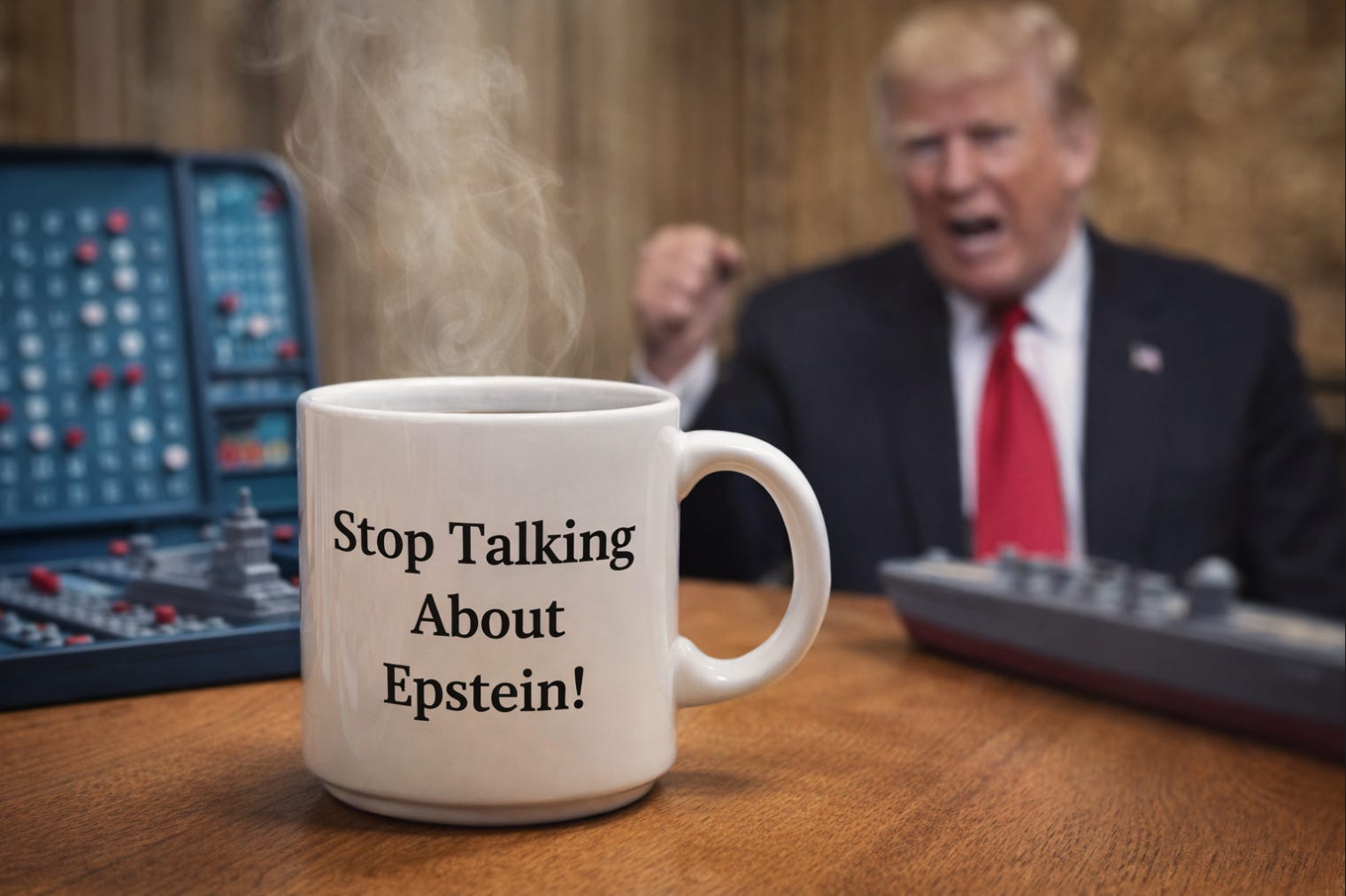
Standing at Mar-a-Lago, visibly irritated that reporters were asking him questions about Jeffrey Epstein instead of applauding on cue, Donald Trump declared that he would personally oversee the development of a new “Trump Class” of U.S. Navy battleships, the centerpiece of what he grandly called a “Golden Fleet” bigger, stronger, more powerful than ever. The implication was unmistakable: the past can be resurrected, scale equals strength, and if we just build enough steel monsters bearing his name, reality will stop asking uncomfortable questions. The entire address was basically an incantation.
Trump wasn’t talking about modern naval warfare, about logistics, missile saturation, cyber vulnerabilities, drones, submarines, or deterrence. He wasn’t talking about Congress, shipyards, or even the Navy as an institution. He was talking about possession: about command, spectacle, and legacy. About a golden fleet that exists largely in his head, gleaming, obedient, and named after himself, sailing away from the present and everything it contains.
Inconveniently for Trump, the present intervened in the ghost of Epstein. Trump snapped at reporters, insisting the story was finished. He accused the media of deflecting from Republican “success.” He complained that instead of marveling at his imaginary armada, they were asking him questions about a man he insists everyone knew, everyone met, and everyone should now stop talking about. The timing, as it turns out, was exquisite. We are now in the drip-drip phase of the Epstein disclosures, the stage where nothing explodes all at once, but the truth leaks steadily enough to erode the denials.
Three days after the Justice Department released an initial tranche of Epstein-related documents that somehow managed to spotlight Bill Clinton while containing few references to Trump, a second, much larger batch quietly appeared on Monday. This one included wide-ranging mentions of Trump: a subpoena sent to Mar-a-Lago in 2021 seeking records tied to the prosecution of Ghislaine Maxwell; internal notes from a federal prosecutor stating that Trump flew on Epstein’s private jet far more often than previously reported; and documentation of at least eight flights between 1993 and 1996, including one involving Trump, Epstein, and a 20-year-old woman. Several of those flights included Maxwell and fell within the period prosecutors were examining in her sex-trafficking case.
The files also show that the FBI collected multiple tips concerning Trump’s involvement with Epstein and parties at their respective properties in the early 2000s. The documents do not indicate whether those tips were ever investigated or corroborated. What they do show is that the entire set of files was publicly available for only a few hours before being taken down from the Justice Department’s website around 8 p.m. The Washington Post managed to download them before they disappeared. Neither DOJ nor the White House has explained why the documents were posted and then removed.
As always, the disclaimers remain carefully in place. Being named in investigatory files does not establish criminal wrongdoing. Trump has not been charged in connection with Epstein’s crimes. The system asks us, once again, to accept that a man can appear repeatedly in federal records tied to one of the most notorious trafficking operations in modern history, and that this fact should not trouble us too much.
Trump, meanwhile, has chosen a different strategy: sympathy for Bill Clinton. At that same Mar-a-Lago event, he complained about photographs of Clinton with Epstein being released, warning that images of people who “innocently met” Epstein years ago could unfairly tarnish reputations. It was a remarkable pivot from a man who has spent years demanding investigations into everyone but himself.
This is Trump’s version of confession. Not denial exactly, repetition. He keeps circling the same terrain: power, secrecy, grievance, nostalgia. He doesn’t refute the record so much as try to drown it out with spectacle, as if a sufficiently shiny battleship will make subpoenas evaporate.
The courts, predictably, are helping. This week, Trump-appointed Judge Aileen Cannon agreed to lift her year-long block on the release of Special Counsel Jack Smith’s final report on Trump’s handling of classified documents, those he stored at Mar-a-Lago, setting a tentative date of February 24. But she also made clear that her timeline could easily give way to new legal challenges from Trump or his co-defendants, effectively inviting further delay. The door may open, she suggested, unless Trump decides it shouldn’t.
This is the same judge who previously dismissed the classified-documents case outright after ruling Smith was unconstitutionally appointed. The Justice Department appealed, then dropped the appeal once Trump returned to power. Smith testified to Congress last week but remains bound by grand jury secrecy rules. Evidence and conclusions exist, and the public, once again, waits.
Secretary of Defense Pete Hegseth is now actively reshaping the military’s Chaplain Corps, eliminating the Army’s Spiritual Fitness Guide and reframing chaplains not as confidential caregivers for service members, but as explicitly religious authorities. In a video filmed in front of a Christmas tree, because symbolism matters, Hegseth complained that chaplains have been treated too much like emotional support providers and not enough like ministers. Caring for troops, he argued, has displaced faith.
Army combat veteran Chris Goldsmith, founder of Veterans Fighting Fascism, described what this means in practice. For many service members, chaplains are the only safe place to seek help without triggering mental health records that could threaten careers or security clearances. Turning chaplains into ideological enforcers doesn’t strengthen the force, it closes one of the few doors people trust. Goldsmith recalled encountering Christian nationalist proselytizing in a war zone, where combat was framed as a crusade and trust disintegrated. When he later needed help for severe PTSD, that path was no longer available to him.
Rather than expanding faith, it feels more like excluding those who don’t conform. It aligns seamlessly with JD Vance declaring to cheering crowds that Americans no longer need to apologize for being white, and with a broader MAGA worldview that treats grievance as governance and identity as destiny.
The economic fallout of this worldview, meanwhile, continues to land where it always does: on communities that don’t get to imagine golden fleets. In Lexington, Nebraska, Tyson Foods is shutting down the beef plant that has sustained the town for decades. Three thousand two hundred workers will lose their jobs in a town of roughly 11,000. Economists estimate total losses could reach 7,000 once spinoff effects hit, restaurants, shops, schools, everything that exists because paychecks circulate. Tyson workers alone are expected to lose about $241 million a year in wages and benefits.
Lexington is the place politicians love to reference abstractly. Immigrants built lives there, families bought homes, and their kids went to college. The American Dream, was stubbornly intact. Now, church basements fill with folding chairs and quiet fear, and parents are forced to rethink tuition. Tyson explains it all with a phrase so bloodless it almost feels intentional: “right-sizing.”
I couldn’t read this without thinking of what happened in my own county a few years ago, when a profitable paper mill employing roughly 1,200 people was shuttered because corporate leadership decided the real business wasn’t manufacturing anymore; it was financial engineering. A different industry, but the same logic and the same outcome. When the boardroom pivots, towns become expendable.
And just in case the universe felt we were missing the metaphor, Yellowstone supplied one. This weekend, Black Diamond Pool went kablooey. Park webcams captured mud and boiling water blasting dozens of feet into the air. The U.S. Geological Survey cheerfully dubbed it a “morning kabloeey,” noting that similar eruptions have been building for weeks. Pressure accumulates, heat rises, and everything looks stable until it isn’t.
Which brings us, quietly, to the end. Last night, Marz and I held our moonbeam vigil again, standing still and imagining peace rising with the torchlight and scattering itself across the planet. No spectacle, just intention, offered into a world that feels increasingly loud and brittle. It felt like the right counterweight to a week full of eruptions, political, institutional, geological.
It’s the holidays. If the next few roundups are a bit shorter than usual, I hope you’ll understand, rest is not retreat. That said, the rest of that golden fleet speech absolutely deserves its own post, because some fantasies are too revealing to leave unexamined.
Until then: stay warm, stay skeptical, and take whatever small, peaceful moments you can find. We’ll be back in the morning, if not sooner.
Maybe, just maybe, the cracks that are appearing in maga and the renewed strength of the people to fight back is our small but appreciated holiday gift. America is a patchwork and most of those people have hearts of empathy and some, kindness. We will prevail.
You are informative and inspiring. I trust what you write and am grateful for it.