


Good morning. Welcome to the post-Christmas hangover of an administration that appears to be running on rage posts, grievance, and vibes. If you’re looking for the through-line today, it’s this: the Epstein files are haunting the White House, and everything else feels like noise generated in response. Loud, dangerous, fully armed noise.
Trump spent Christmas Day doing what emotionally regulated presidents traditionally do on holidays: launching airstrikes overseas, threatening allies, and angrily litigating his innocence on social media. In between announcing U.S. military strikes in northwest Nigeria, Trump took to Truth Social to insist, once again and at great length, that he was the only person who ever truly dropped Jeffrey Epstein “long before it became fashionable.” He dismissed calls for transparency as a “Radical Left Witch Hunt,” angrily naming no one and everyone at once. It was the kind of post people write when something they swear doesn’t matter is clearly living rent-free in their head.
This wasn’t a casual aside, it came amid renewed scrutiny of the administration’s handling of the Epstein files, fresh document releases, congressional pressure, court involvement, and public demands that are not, inconveniently, going away. One new tranche included a claim, not a finding of wrongdoing, but a claim, that Trump appeared on a flight with Epstein and a 20-year-old woman in the 1990s. Another revealed emails between Ghislaine Maxwell and a mysterious correspondent signing as “A,” cheerfully noting he was at “Balmoral Summer Camp for the Royal Family.” The web keeps expanding, and Trump keeps shouting.
While all of that was simmering, the United States dropped bombs. Trump announced that U.S. forces had launched “powerful and deadly” strikes against ISIS targets in northwest Nigeria, framing the operation as divine retribution for what he repeatedly describes as the slaughter of Christians. “MERRY CHRISTMAS,” he added helpfully, “including the dead Terrorists.” Nigeria later confirmed the strikes were coordinated, intelligence-driven, and approved by President Bola Tinubu after direct calls between Nigeria’s foreign minister and Secretary of State Marco Rubio.
What’s notable isn’t just that Trump announced this on Truth Social, it’s that he announced it first. Major events are now breaking on his personal platform before any formal White House or agency statement. The effect is predictable. His emotional framing becomes the baseline reality, not the sober language of AFRICOM, State, or DOJ lawyers who might otherwise contextualize or constrain it.
He’s scooping his own administration. Truth Social posts aren’t vetted. They are grievance-forward, absolutist, and personal. By leading with them, Trump locks in a narrative that institutions are then forced to clean up after. Nigeria can confirm intelligence-sharing. AFRICOM can issue careful statements. Courts can intervene. But the public record already contains the rage version, time-stamped and viral.
That rage framing matters. Nigerian officials themselves have pushed back, warning that violence affects Muslims and Christians alike and that sectarian escalation feeds extremist propaganda. Experts have questioned whether the targeted region even contained a clearly established ISIS cell, noting instead a complex mix of bandit networks and overlapping militant groups. In other words: a coordinated strike wrapped in rhetoric that actively undermines its stated goals. Legal on paper, unhinged in presentation.
All of this is unfolding alongside a deliberate expansion of bureaucratic cruelty at home, most starkly in plans to scale up warehouse-style detention facilities for migrants. These are industrial spaces repurposed for mass confinement, designed around throughput, capacity, and control. Human beings reduced to units in a logistics chain. The language surrounding the plan is telling: efficiency, scalability, optimization. What’s missing is any serious reckoning with the moral cost of treating migration as a warehousing problem rather than a human reality to be governed.
This reflects a worldview in which suffering is administratively neutral as long as it’s properly processed. The warehouse plan doesn’t just expand detention it normalizes it, embedding cruelty into infrastructure so it becomes harder to see, harder to challenge, and easier to scale. Once harm is routine, it no longer requires outrage to sustain it. It just requires paperwork.
in what may be the most on-brand development yet, it turns out some of the newly released Epstein documents weren’t actually redacted, just badly censored. Readers quickly discovered that supposedly blacked-out passages could be revealed with basic highlighting or image tools, exposing allegations of six-figure payments to young women, years-long financial arrangements, and a shell game involving hidden property assets. None of this involved victim identities. Some of it didn’t even involve people. Apparently, even Santa Fe property taxes are now a national security risk.
You could chalk this up to kakistocratic incompetence, but there’s another possibility. In institutions where direct defiance is punished and whistleblowing is career suicide, resistance often takes quieter forms. Soft resistance shows up as procedural friction: following orders exactly, but in ways that undermine intent rather than advance it. Documents are released, but redacted just poorly enough to be reversible. Compliance is literal, not protective. Errors flow in only one direction, toward disclosure. Maybe there are still a few angels left in the bureaucracy.
Largely unnoticed amid the churn, the administration has also begun weaponizing visa policy, threatening or pulling visas for European journalists, researchers, and officials who criticize U.S. actions or pry too closely into uncomfortable terrain. Immigration law, like so many systems now, is less about rules or reciprocity than leverage. Access becomes control, and dissent becomes disqualification. It’s a small move on paper, but a revealing one.
This is the connective tissue between the warehouse plan, the fake redactions, the visa retaliation against European critics, and even the fixation on Epstein. Sure it’s chaos, but it’s also a governing style that treats institutions as obstacles, people as problems, and process as something to be bypassed rather than respected.
When that style is coupled with visible impulse, rage posting, and the announcement of lethal force via social media, the concern stops being abstract. It becomes structural. Authority isn’t just slipping from institutions into impulse, it’s being redirected there, because impulse is easier to control than accountability.
Just ask Imran Ahmed. A federal judge had to step in this week to block the Trump administration from detaining or deporting the British CEO of the Center for Countering Digital Hate, a lawful U.S. resident, married to an American, with an American child, whose apparent crime was pushing back against online extremism and repeatedly annoying Elon Musk. Ahmed is one of several Europeans caught up in what’s being described as a “visa dispute,” though that phrasing badly understates the reality. State Department officials have been blunt: challenge American tech platforms, and you may find yourself “unwelcome on American soil.”
Europe has noticed. So has the judiciary. Free-speech absolutism, it turns out, applies selectively, loudly defended for billionaires and platforms, aggressively denied to critics, regulators, and researchers. Allies are treated like adversaries, norms like inconveniences, reciprocity like weakness. The transatlantic alliance isn’t cracking over a single policy fight. It’s cracking because Washington is no longer pretending to operate in good faith.
Trump’s foreign-policy imagination has meanwhile wandered north, where Louisiana Gov. Jeff Landry has been dispatched as a “special envoy” to Greenland, a place Trump, for some reason, believes falls under the Monroe Doctrine and can be wooed with Cajun food. Danish social scientist Steven N. Højlund, PhD, who studies Greenland and Arctic politics, has been blunt about what this represents. Talking about U.S. “control” of Greenland, he notes, is “not normal diplomacy,” but a direct provocation that ignores both Danish sovereignty and Greenlanders themselves, who have home rule, their own parliament, and a legal right to self-determination.
Højlund has also warned that this kind of rhetoric isn’t accidental. “In international politics, contesting territory often starts by contesting legitimacy,” he explains. Undermine another country’s claim loudly enough, long enough, and you create room for pressure later, even if the legal reality hasn’t changed. Invoking the Monroe Doctrine, he argues, is part of that strategy, selectively revived to frame Greenland as an American sphere of influence despite the U.S. having repeatedly recognized Danish sovereignty in treaties and alliances.
Crucially, Højlund is skeptical that the effort could even succeed. Presidential terms are short, Greenlandic public opinion can’t be flipped by a visiting envoy, and antagonizing Denmark risks weakening NATO, an alliance “far more valuable to the United States than Greenland alone.” Still, he stresses that improbability does not equal harmlessness. Undermining legitimacy, even clumsily, destabilizes alliances and invites escalation. History has seen this movie. It does not end with a charming travelogue.
If anyone doubts this fixation is being taken seriously abroad, Canada has answered, not with rhetoric, but policy. Ottawa announced plans to open new consulates in Greenland and Anchorage, Alaska, explicitly to strengthen Canada’s Arctic presence, with Foreign Minister Anita Anand calling the Arctic Canada’s top foreign-policy priority.
The timing isn’t subtle. Prime Minister Mark Carney has pledged to boost Canada’s military and security footprint in a region already contested by Russia and China, and now, unpredictably, by the United States. Trump’s musings about acquiring Greenland rattled Denmark and Greenland. Canada is responding by reinforcing sovereignty, diplomacy, and alliance coordination before impulse has room to harden into policy.
Anand has pressed Nordic counterparts, spoken directly with NATO Secretary-General Mark Rutte, and pushed for concrete action in a region no longer theoretical. Defense spending will rise to 2 percent of GDP this year, with plans to reach 5 percent by 2035, a quiet rebuke to Trump’s habit of demanding allied spending while destabilizing the alliances that give it meaning.
Allies don’t issue dramatic press releases. They open consulates, reposition forces, and shore up relationships around Washington rather than through it. Canada’s move isn’t anti-American, it’s preemptive stability in response to an administration that treats Arctic sovereignty like a branding opportunity.
At home, the cultural vandalism continues. A Christmas Eve jazz concert at the Kennedy Center, a 20-year tradition, was canceled after Trump’s name was bolted onto the façade of a congressionally protected JFK memorial. Artists are walking away rather than legitimize the capture. Hamilton pulled. Issa Rae canceled. The message is quiet but unmistakable: some institutions would rather go dark than be Trumped.
And then, like a beam of light cutting through the wreckage, there’s the story that shouldn’t exist in this ecosystem, but does. Graham Walker, a Louisiana factory owner, sold his company for $1.7 billion and gave $240 million of it to his employees. No stock options, or IPO fairy dust. Just a decision that loyalty mattered, that people mattered, that walking into your hometown grocery store without shame mattered. In an America defined by extraction, it landed like a rebuke, because it proves cruelty is a choice.
Which brings us back to the center of gravity: Epstein. For all the noise, the military strikes, the threats, the visas, the warehouses, the redactions, the annexation fantasies, the Epstein files remain unmoved. Subpoenas don’t get bored. Courts don’t forget. Trump can rage-post on Christmas, announce bombs on holidays, and relitigate his innocence into the void, but none of it dissolves the paper trail. If anything, the fixation gives the game away. People who are unburdened do not behave like this.
This is why this moment feels dangerous. Not because one scandal exists, but because pressure plus impulse plus power is an unstable mix. A president who cannot regulate his emotions is increasingly attempting to regulate the world instead, loudly, personally, and sometimes violently. Unlike the first administration, there are fewer adults in the room. The strain is visible.
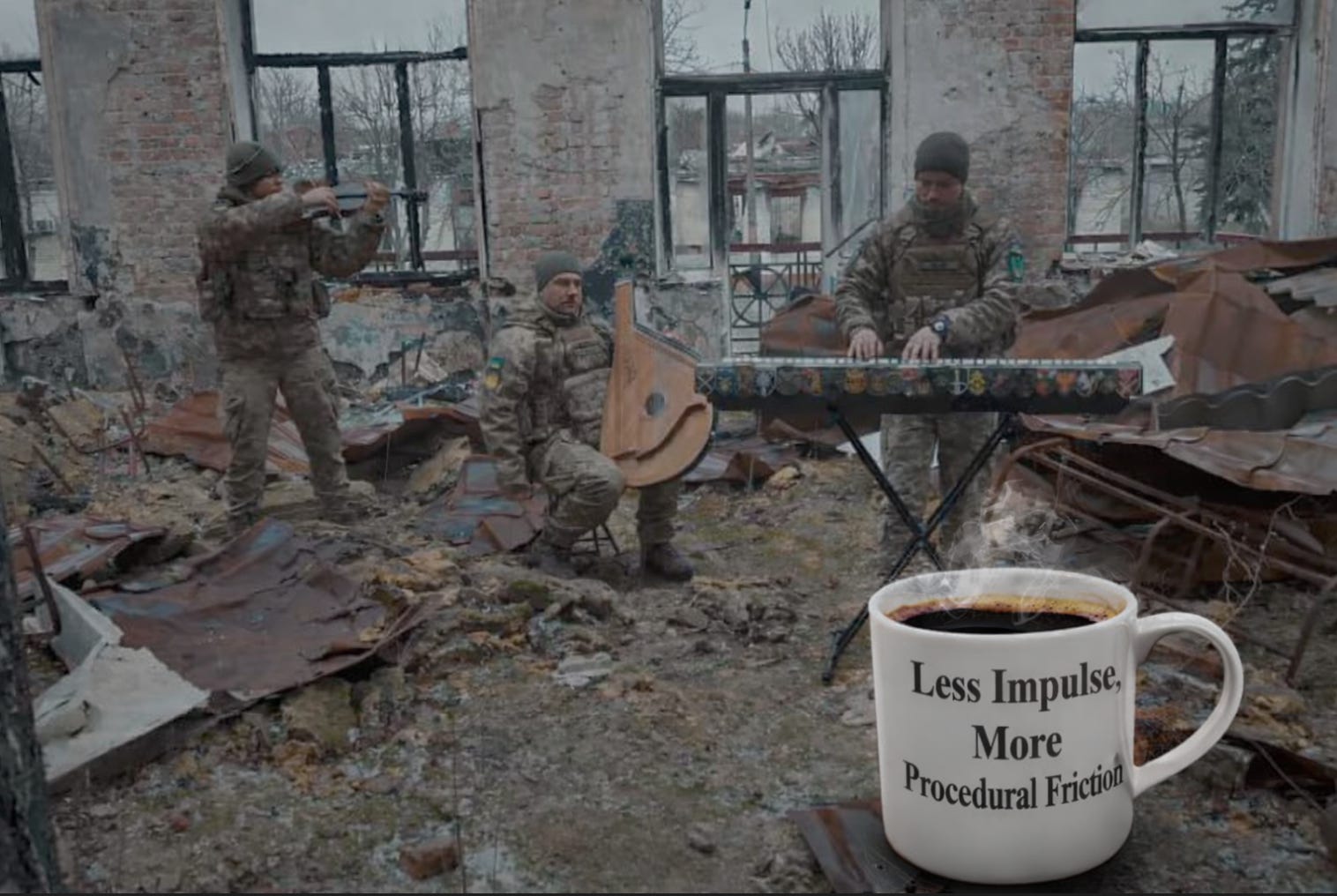
After all the noise, the rage posts, the threats, the redactions, the warehouses, the annexation fantasies, Marz and I stepped outside and held our moonbeam vigil. We listened to the Ukrainian Cultural Force play Carol of the Bells, filmed amid the rubble of a bombed-out building near the front lines. Three musicians in combat gear, a violin, a keyboard, a bandura, standing where homes once stood, playing their hearts out. No spectacle, or posturing. Just beauty, defiance, and remembrance in the middle of destruction.
I cried, not from despair, but from recognition. That piece, born in Ukraine and played under fire, carried more truth than any press release or rage post ever could. Culture refusing to die. Humanity asserting itself where it’s supposed to be erased. A reminder that even as institutions falter and leaders unravel, people still choose meaning, dignity, and creation.
I don’t know if our moonbeam reached them. But I hope it did, if only as a whisper across the distance, letting them know their music mattered, that it was seen, and that it carried its own kind of power. In a moment when authority feels untethered from restraint, that kind of grounded courage is its own form of resistance.
Trump and his regime are guilty of crimes of moral turpitude, acts considered inherently base, vile, or depraved, shocking public conscience, often involving fraud, theft, or violence, like murder, robbery, child abuse, or serious fraud.
Our collective American reputation and identity is being so blemished and stained that we the people, must mount an aggressive, continuous, and strident campaign to assert the madness of one protagonist and his sycophantic extremists do not represent the values and principles of our nation.
The returning 119th Congress faces fateful challenges as the Trump regime continues to melt down into unfettered lawlessness, criminal contempt, naked and unabashed corruption, and delusional derangement.
Any continued GOP loyalty will only appear grotesques and insulting to our enduring American sensibilities. We must demand the re-establishment of moral primacy as a bedrock of our culture and punish moral turpitude as an unacceptable, evil crime against our common good and the values of our civil order.
Slava Ukraini!!