


Our daughter continues to spend nearly every waking moment with her dad. If he is on the tractor, she is on the tractor. If he is in the woods, she is in the woods. Wherever he goes, she follows, his tiny and profoundly committed sidekick, presumably making certain he does not attempt any unauthorized land improvement without consulting middle management.
The strawberries are booming. The tomatoes recently had a nasty encounter with the deer, who apparently interpreted our garden as a farm-to-table restaurant with unusually slow service. We built a fence, the tomatoes are recovering, and the deer have been forced to resume the ancient and unreasonable hardship of eating everything else on the property.
The rest of the land grows more beautiful by the day. Our fairy garden plans are enormous, naturally. They began as a few whimsical ideas and have developed into something closer to a municipal infrastructure proposal for very small magical people. Every day, though, the plans look a little more possible. The paths are beginning to appear. The trees are finding their places. What once existed only in my head is slowly making its way into the world.
Ezra, my mister boy, has a third tooth coming through. His newest fascination, aside from his siblings and the dog, is sitting in his highchair, throwing objects onto the floor, and watching them fall with the intense concentration of a tiny Isaac Newton.
He drops the spoon, he studies the spoon, someone returns the spoon, he drops it again. Science requires replication, you see. It is miraculous to watch a person discover gravity, particularly when you are the person crawling beneath the highchair to retrieve the experimental materials.
We learn more about this place every day now that we can truly call it home. We are learning where the sunlight stays longest, where the water settles, which plants thrive, which plants sulk, and which creatures considered the property theirs long before a piece of paper announced that it belonged to us.
And my husband, oh, where do I begin? He is so full of love, care and patience. He sits beside me through every strange new thing I become convinced must be done immediately. The other day, it was building a succulent rock garden. Then came my fascination with plant terrariums.
I found several old mason jars in the attic and began envisioning an indoor forest contained inside them. My husband did not share this vision, so, he did what any wonderful and reasonably self-protective man would do. He bought me an actual plant terrarium, then promptly hid the mason jars before I could establish a sprawling glass ecosystem across every available surface in the house.
I have not quite persuaded him about the mural yet, but I am still gently picking away at his resistance. Love is patient, after all, and so is a woman who has already selected the wall.
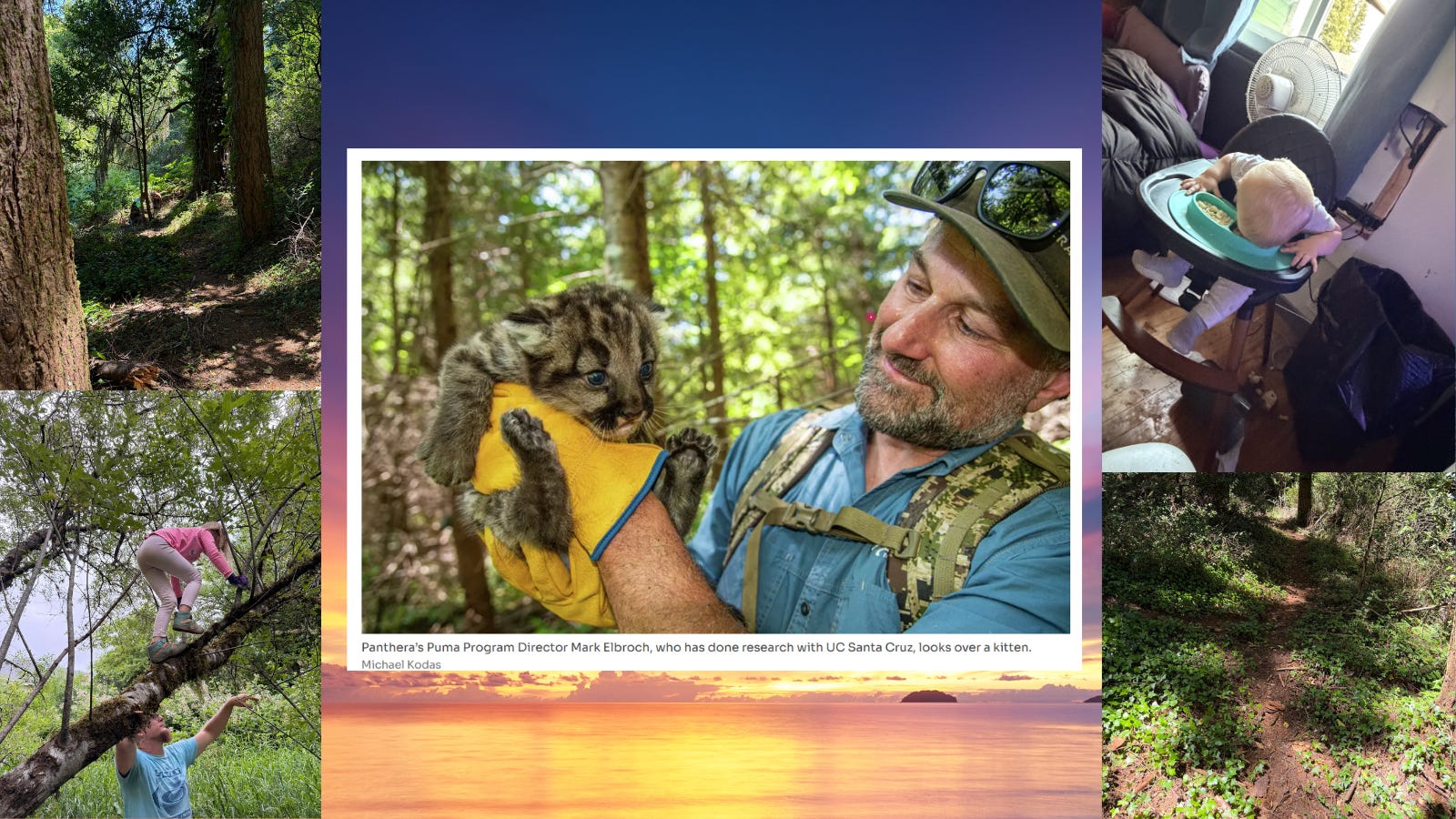
This season of our lives feels like one long lesson in making room. Room for roots, room for children, room for wild ideas, room for creatures whose paths existed before ours did. That’s why a story from California’s Santa Cruz Mountains found me this week.
Highway 17 winds through mountain lion territory, carrying more than 60,000 vehicles a day through a landscape that animals must cross to find food, territory and mates. At Laurel Curve, the road became an especially deadly barrier. Researchers using wildlife cameras, roadkill records and tracking data from collared mountain lions found that roughly half of the wildlife collisions recorded along the highway were occurring near that one curve.
We built the road, divided the habitat, and created the danger, then, eventually, we built a tunnel. The wildlife underpass beneath Laurel Curve was completed in late 2022, connecting protected habitat on either side of the highway. It was not an act of grand human heroism. It was something quieter and, in some ways, more meaningful. It was an admission. The road could not continue to belong only to us.
During the first year of monitoring, cameras recorded 934 animal crossings through the tunnel. Black-tailed deer used it most often, but bobcats, gray foxes, opossums, skunks and mountain lions also found their way beneath the highway. The latest reporting indicates that roughly 1,000 animals now use the crossing each year, including at least four mountain lions.
The tunnel alone was not enough. Animals still needed to be guided toward it, so conservationists added fencing along the highway. The fence did not simply tell the animals where they could not go. It led them toward a place where they could safely continue. Since that additional fencing was installed, no mountain lions have been killed at Laurel Curve. There is something deeply hopeful about that.
Not because the tunnel solves everything. It does not. Roads continue to fragment mountain lion habitat throughout California, separating populations and limiting the genetic diversity they need to survive. John Morgan, a researcher with the UC Santa Cruz mountain lion project, described the crossing as a success story while cautioning that it is “not the whole picture.”
Hope doesn’t require us to pretend the whole picture has been repaired. It asks whether we are willing to repair the part directly in front of us.
The mountain lions don’t know about the years of research, the fundraising, the protected acreage, the transportation agencies or the meetings required to build the crossing. They don’t know that humans studied the paths of animals we couldn’t see, then poured concrete beneath a highway so those paths wouldn’t end in blood.
They only know that where there was once noise, light and danger, there is now a dark and quiet passage through. That may be one of the most honest forms of hope humanity can offer. We aren’t innocent in this story, we’re the creatures who built the obstacle; but we are also capable of recognizing what we’ve done, changing the design and leaving a way through.
We can build roads and still remember that other lives have somewhere to go. We can plant tomatoes and protect them without pretending the deer are trespassers in a world they inhabited first.
We can make homes without treating the land beneath them as empty. We can build fences that do more than exclude. Sometimes, with enough thought, a fence can guide a living thing away from danger and toward an opening.
Here at home, our daughter trails behind her father through the woods. Ezra drops his spoon and watches the laws of the universe reveal themselves. The strawberries spread, the tomatoes recover, my terrarium waits to become a tiny world, and the mural remains under active spousal negotiation.
All around us, life is searching for somewhere to grow, somewhere to wander, and some safe way to reach the other side. This week, humanity built a passage; and for today, that’s enough to make me hopeful.
You are a wonderful writer, and what a beautiful essay you have gifted us. It felt calming, in a sense, for these crazy times. I enjoyed it so very much.
Lovely reflections. Thank you for sharing. I agree with Joyce...a calming space away from the crazy we're living through.