


What was supposed to be a routine budget hearing turned into five hours of something far more revealing: a sustained demonstration that the United States Secretary of Defense will not answer basic questions about a war he is asking the country to fund, defend, and fight. Also, he’s the biggest gutless wonder to ever cosplay as a wartime tough guy.
Nearly every member of the House Armed Services Committee, Democrat and Republican alike, began in the same place: praise for the troops who have done their job as they always do. They executed all these missions in Iran and Venezuela with skill, discipline, and courage under extraordinarily dangerous conditions. Which made what followed even more jarring. While the soldiers showed courage, the Secretary of Defense, also, Maximum Lethality Man is, it turns out, Maximum Flinchy when cornered.
Rep. Ro Khanna asked what this war costs the American people, not in abstract terms, but in dollars: gas prices, food prices, taxpayer burden.
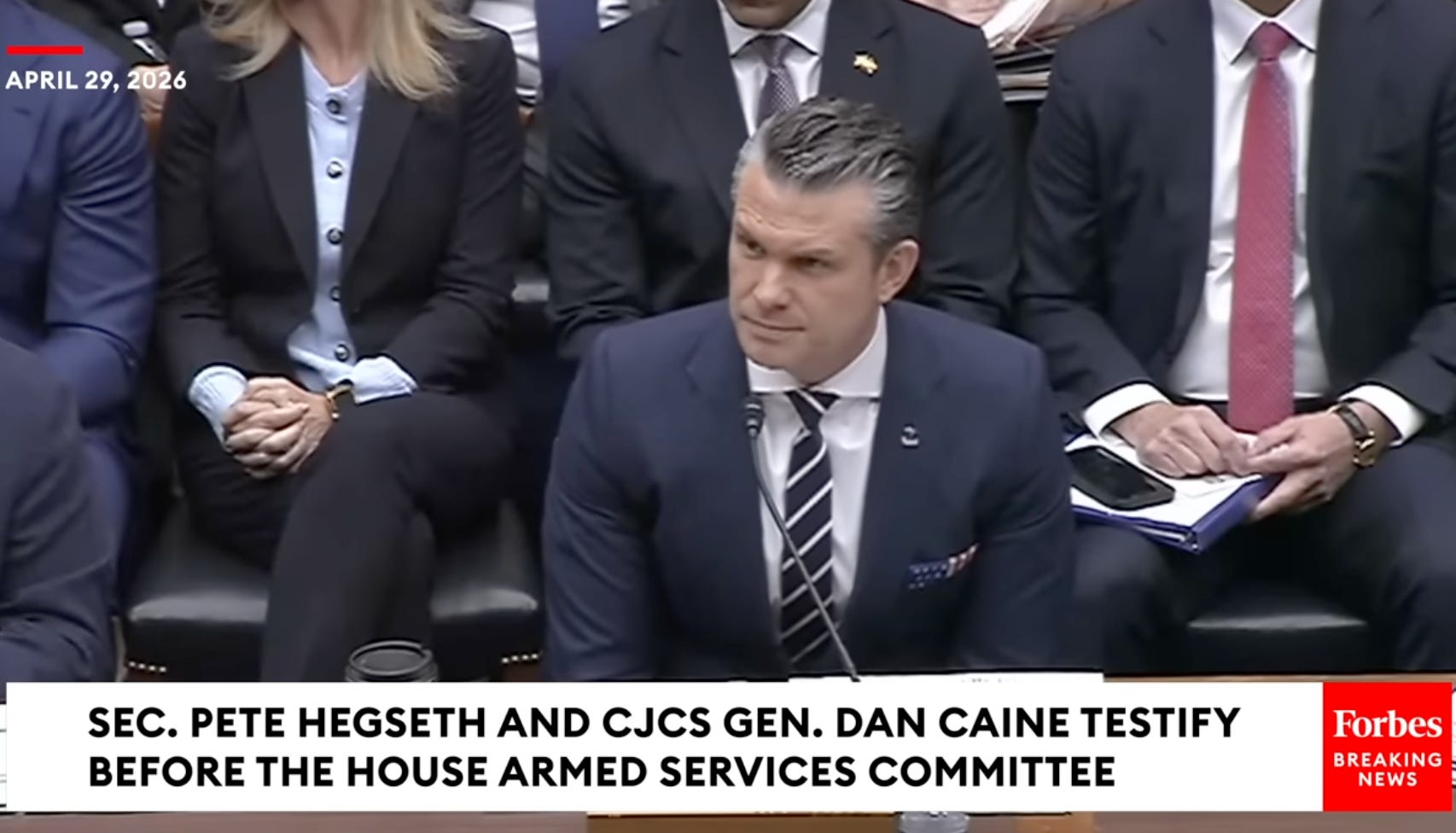
Hegseth’s response? “I would simply ask you what the cost is of an Iranian nuclear bomb.”
Then he accused Khanna of playing games: “You’re playing gotcha questions about domestic things.”
Khanna immediately called out the dodge: “You’re saying it’s a gotcha question to ask what it’s going to be in terms of the increased cost?”
Hegseth kept pushing the same rhetorical escape hatch: “What would you pay to ensure Iran doesn’t get a nuclear bomb?”
But Khanna didn’t let him float away into hypotheticals. He dragged him back to the actual burden on Americans: “Will you acknowledge that there is an economic cost to the American people for doing what you believe is necessary?”
Hegseth still would not answer. Instead, he veered into talking points: “We have an incredible economic team…” And then quickly pivoted to blaming “the previous administration” for inflation.
So even when Khanna narrowed the question to the bare minimum, will you acknowledge there is a cost? Hegseth refused to give the American people even that much.
Then came the indictment: “You don’t even know what the average American is paying,” Khanna told him. “You don’t know what we paid in terms of the missiles that hit the Iranian school. You don’t know what we’re paying in terms of gas. You don’t know what we’re paying in terms of food.”
It’s a commonplace rhetorical trick: replace a measurable question with a hypothetical existential threat. Shift the ground so the original question disappears.
Khanna didn’t let it disappear; he kept asking for numbers, and Hegseth never gave them.
Rep. Jason Crow asked about who is actually advising the Secretary of Defense. Crow focused on Timothy Parlatore, Hegseth’s former private attorney and a lawyer with ties to Trump’s political orbit.
He started simply: “Timothy Parlatore served as your private attorney. Correct?”
Hegseth answered: “Correct.”
Crow continued: “And Mr. Parlatore also served as private attorney for President Trump’s campaign. Correct?”
Hegseth suddenly got foggy: “I’m not privy to every professional position that he’s held.”
Crow supplied the answer: “Well, I’ll help you out. He did.”
Then Crow moved to Parlatore’s current role: “And you appointed Mr. Parlatore as your senior adviser. Correct?”
Hegseth tried to blur the arrangement: “He does reserve duty on behalf of the Navy. His title is senior adviser.”
Crow pressed: “You gave him that title. Correct?”
Hegseth would not answer directly, but conceded: “I would count him as very much an adviser of mine.”
Crow kept going. Does he travel with you? Does he sit in meetings with you? Does he advise you?
After dodging with praise, “long-term friend,” “great patriot,” Hegseth eventually admitted: “Yes, of course.”
And: “He sits in some meetings on occasion.”
Then Crow got to the heart of it: Parlatore did not go through the White House personnel process. He did not go through Senate confirmation. Hegseth had directly commissioned him into the Naval Reserve, which gave him a path into the Pentagon without those normal civilian vetting channels.
At one point, he appeared not to know whether a man sitting in his meetings had a security clearance. Did Parlatore have a security clearance when he became a senior adviser?
Hegseth: “I’d have to check.”
Does he represent foreign governments or foreign persons through his private law practice?
Hegseth: “I don’t know.”
Does he represent senior officers currently under consideration for promotion by Hegseth’s office?
Hegseth did not answer directly. Instead, he insisted: “The only person that makes determinations about senior officers is me.”
Crow kept pressing because that wasn’t the question. The question was whether Parlatore had clients whose careers could be affected by decisions made by the very office he was advising.
Hegseth’s response was an accusation: “You’re playing a gotcha game like you do on TV and everywhere else.”
That was the tell. Crow wasn’t asking trivia. He was asking whether a politically connected private attorney, Hegseth’s own former lawyer, had access to sensitive Pentagon meetings while maintaining outside clients, possibly including foreign clients or officers whose promotions could come before Hegseth.
And the Secretary of Defense’s answer, over and over, was some version of:
“I don’t know.” “He’s a great patriot.” “This is a gotcha game.”
Rep. John Garamendi began by separating the troops from the decision-makers: “Their professionalism and selfless service are not in question… What is in question is the purposes and the strategic direction of this war.”
Then he laid out the cost in stark terms: “Thirteen Americans have been killed in action, hundreds wounded, and thousands of civilians killed, including more than a hundred school children.” He called the war what he believed it to be: “A geopolitical calamity… a strategic blunder resulting in worldwide economic crisis.” Then he asked the question every citizen is asking: “We know what we have lost, but what have we gained?”
He didn’t stop there. Garamendi pointed out that the Iranian regime remains intact, its ballistic missile and drone capabilities are still in place, and its ability to rebuild its military industry has not been meaningfully degraded. He noted that Iran’s coordination with China, Russia, and North Korea continues, and in some respects has been strengthened by the conflict, and that its capacity to disrupt global energy markets, particularly through the Strait of Hormuz, remains a central lever of power.
Then he delivered the indictment: “You have been lying to the American public about this war from day one… While the military has executed this war with tactical success, the strategy has been an astounding incompetence.”
Finally, he brought it back to the reality Americans feel: “This war of choice is a political and economic disaster at every level.”
Hegseth’s response? “Who are you cheering for here? Who are you pulling for?”
Rep. Adam Smith dismantled the intellectual justification, noting Hegseth has repeatedly framed this war as “realism.”
Smith calmly walked through what that “realism” actually looks like:
A full-scale war in the Middle East, launched without allies, while alienating those allies, sidelining diplomacy, and pretending that tactical victories will somehow magically transform into strategic success.
At one point, Smith reached for a line from The Princess Bride:
Realism. “You keep using that word. I do not think it means what you think it means.”
It was funny. It was also devastating.
Rep. Pat Ryan brought in some reality. Referring to the March 1 Iranian drone strike on Port Shuaiba in Kuwait, that resulted in six dead American soldiers, Ryan read from survivor accounts describing a base with effectively no meaningful drone defense, no countermeasures, no overhead protection, nothing resembling what soldiers had even twenty years ago.
Hegseth had previously described the attack as something that “squeaked through fortified defenses.”
Ryan asked the obvious question: Are these soldiers lying? Hegseth didn’t answer directly. He spoke in foggy generalities using language like “maximum defensive posture” and “the larger picture” and “classified,” language that sounds serious but says nothing.
Ryan’s response cut through everything: “The soldiers told the truth. They are braver than you are.”
This was no longer about policy; it was about character.
Rep. Seth Moulton asked about ownership. “Did you advise the president that we should attack Iran?”
“In this position, in the cabinet,” Hegseth sidestepped, ”we never talk about what we would advise the president to do or not.”
Moulton pressed the obvious point: “Are you afraid to take ownership of this? Do you think it was a good idea or not?”
Hegseth pivoted back to the familiar abstraction: “Imagine what the world would look like right now if Iran had a nuclear weapon.”
Then Moulton asked the question Hegseth clearly wanted to answer in slogan form: “How is this war going? Do you think we’re winning militarily on the battlefield?”
Hegseth replied: “It’s been an astounding military success.”
Moulton sharpened it: “But are we winning the war?”
Hegseth: “Absolutely.”
So Moulton walked through the reality: the Strait of Hormuz is disrupted, global consequences are unfolding, and the conflict is expanding. When Hegseth tried to frame the U.S. blockade as proof of control, Moulton distilled the absurdity perfectly: “So they blockaded us and then we blockaded their blockade?”
Eventually, the gap between rhetoric and reality becomes impossible to ignore.
By the end of the hearing, Hegseth’s approach was both visible and predictable. He uses the same set of moves over and over: replacing facts with existential hypotheticals, turning oversight into accusations of disloyalty, hiding behind vague military-sounding language, attacking the questioner instead of answering the question, and refusing to take ownership of any decision. These techniques all serve the same purpose: avoiding owning up to your mistakes.
You can call it incompetence; there’s certainly plenty of that to go around, or you can call it partisanship. But neither quite captures what happened here. The defining feature of this hearing wasn’t confusion or ideology. It was pure, unadulterated cowardice.
The Secretary of Defense is not a pundit or a campaign surrogate. Nor is he there to win arguments on cable news.
I’ve watched some of the worst of the worst: Pam Bondi, Kash Patel, Kristi Noem, and Karoline Leavitt’s daily assault on democracy. But this was something else entirely. Hegseth is responsible for sending Americans into harm’s way, managing the most powerful military on Earth, and answering to Congress, the constitutional body that authorizes and funds that power. He is also asking for another $200 billion, on top of a war already estimated at $25 billion, while refusing or proving unable to answer basic questions about costs.
The soldiers in that drone strike didn’t hide behind talking points and rhetorical tricks. They described what happened. Told the truth about their conditions and took responsibility for what they saw.
The Secretary of Defense, sitting under oath, was too gutless to do the same.
Excellent. Every point a direct hit.
Hegseth gives new meaning to the word weasel. I am also reminded of the expression-“you can’t crush a cockroach in the sand”